On a cold November night in 2026, nothing will appear different in the sky. The moon will still hang in its familiar place. The constellations will trace their ancient shapes. Airplanes will blink their way across the darkness. And yet, somewhere far beyond what any backyard telescope can see, a small, aging machine will quietly cross a boundary no human artifact has ever reached before: one light-day from Earth.
The Day We Measure Distance in Light
The phrase “one light-day” sounds like science fiction, but it’s a very real, very dizzying unit of distance. Light — the fastest thing we know of — takes about eight minutes to travel from the Sun to Earth, just over a second to bounce off the Moon and return, and a full year to cross a light-year. A light-day is the distance light races through space in just 24 hours.
By November 2026, NASA’s Voyager 1 spacecraft will have traveled so far that the space between it and us will be measured not in millions or billions of kilometers, but in the distance light covers in a day. It will be the first time in history an object made by human hands reaches that kind of remove — a full day’s sprint of light away from home.
There will be no fireworks to mark the moment. No photograph will snap into focus on a screen at NASA showing Earth as a pale speck. The crossing will be a quiet mathematical line, drawn in the imaginations and spreadsheets of engineers who’ve been tracking Voyager 1 for nearly half a century. But for anyone paying attention, it will feel like a sudden intake of breath — the realization that humanity has already learned to throw messages this far into the dark.
The Elder Traveling Alone
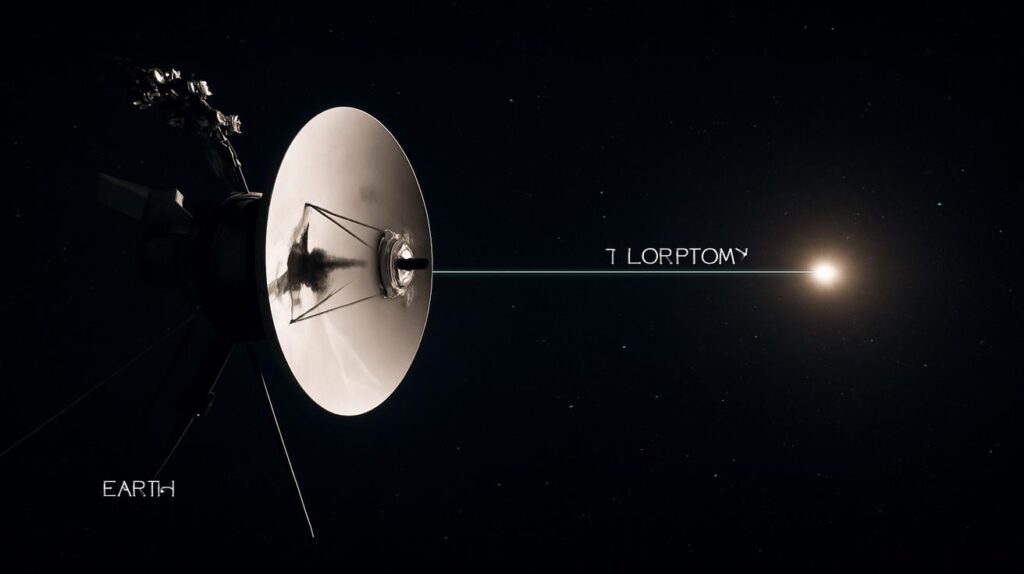
Voyager 1 was never supposed to live this long. When it launched on September 5, 1977, Jimmy Carter was in the White House and the first Star Wars movie was still a fresh shock to audiences. The spacecraft was about the size of a small car, its golden dish antenna shining like a mechanical sunflower, with a long boom of instruments reaching out as if to taste the solar wind.
Engineers designed it for a four-year tour of the outer planets. Four years. Long enough to swing past Jupiter and Saturn, grab as many close-up portraits and measurements as possible, and then drift silently into the dark. They added a few extras that had nothing to do with gas giants or magnetic fields: a golden phonograph record, for example, carrying music, greetings, and sounds of Earth — a time capsule more than a scientific instrument.
But Voyager, it turned out, was stubbornly, magnificently overbuilt. Systems had backups, and the backups had backups. Software could be reprogrammed across billions of kilometers. Ingenious engineers on the ground found ways to coax more life from dwindling power. The craft that was intended to last a handful of years has now measured its existence in decades, still whispering faintly to the Deep Space Network antennas that strain their ears toward the stars.
Outside, the spacecraft is sunburned and scarred by radiation, its once-shiny surfaces dulled by the constant drizzle of high-energy particles. Temperatures hover near absolute zero. Inside, a tiny nuclear heart — a radioisotope thermoelectric generator — continues to provide a trickle of power, just enough to keep a few instruments warm and working. If Voyager 1 were a person, it would be a centenarian, wrapped in thick blankets and still telling stories in a voice so soft you have to lean in to hear it.
The Longest Conversation
If you sent a command to Voyager 1 today, you would need patience. By 2026, that command — a simple “turn a few degrees” or “send your latest measurements” — will ride a radio beam across the void for more than 22 hours before it reaches the spacecraft. Then the spacecraft will respond, its own whispering signal taking another 22 hours or so to get back. A conversation that once took hours will, by then, take nearly two days for a single question and answer.
It’s like talking to a loved one across time instead of distance. By the time Voyager “hears” from Earth, our message is nearly a day old. By the time we hear back, its reply belongs to yesterday from Voyager’s point of view. There is no real-time control, no quick corrections. Just trust, planning, and the quiet hope that the little craft still understands what we’re asking of it.
And yet, despite the distance, the connection remains astonishingly precise. From subtle changes in Voyager’s carrier signal, scientists can detect minuscule shifts in speed, even tiny wobbles caused by thruster firings or the faint push of sunlight. A spacecraft more than a light-day away is still part of an ongoing dialogue between our planet and the outer dark.
What Does “One Light-Day” Look Like?
It’s hard to feel a number this big. Even astronomers reach for comparisons. We talk about “astronomical units” — the distance from Earth to the Sun — or light-minutes and light-years. But a light-day sits in a strange middle ground: too large to picture easily, too small to be truly cosmic. It’s like trying to imagine the size of an ocean when you’ve only ever held a glass of water.
Yet, we can try. Light streaks through space at about 300,000 kilometers per second, or about 186,000 miles a second. Multiply that by the number of seconds in a day and you get a figure so large it loses texture — tens of billions of kilometers, or more than 16 billion miles. Voyager 1, once a gleaming sculpture in a cleanroom, has already traveled so far that the Sun itself has been reduced to just another bright star from its perspective.
To give a little scale, imagine this: if Earth and the Sun were comfortably sitting at opposite ends of a modest living room, Voyager 1 by late 2026 would be somewhere beyond the city limits — a lonely traveler long past the porch light, trudging off into countryside without roads.
Yet this traveler carries a memory of home. The Golden Record bolted to its side holds greetings in dozens of languages, whale song, thunder, laughter, Bach and Chuck Berry, a mother kissing her baby. Encoded images show trees and mountains, chemical formulas, and human bodies. It is a love letter to the universe, written by a civilization that wasn’t yet sure anyone would ever read it.
A Milestone in Quiet Numbers
In the years leading up to November 2026, the people who track Voyager will watch the numbers inch upward: 19 billion kilometers, 20 billion, and more. The exact moment when the spacecraft slips across the threshold of one light-day will depend on how you define and calculate the distance — whether you use round-trip time for radio signals, or a straight-line calculation of where spacecraft and Earth are at a specific moment. But the essence remains the same: a human-made object will be a full day of light-travel away.
It’s a milestone that invites comparison, and a small, simple table can put this into perspective:
| Distance Measure | Approx. Light Travel Time | Typical Example |
|---|---|---|
| Earth–Moon | ~1.3 seconds | Radio to Apollo astronauts |
| Earth–Sun | ~8 minutes | Sunlight reaching Earth |
| Earth–Mars (average) | 4–20 minutes | Signals to Mars rovers |
| One light-day | 24 hours | Voyager 1 in 2026 |
| One light-year | 365 days | Distance to nearby stars |
Seeing it laid out this way, you can feel how far Voyager has gone — perched in a territory between the familiar solar system distances of minutes and the stellar gulfs of years. It is an ambassador lingering on the threshold.
Beyond the Bubble of Our Sun
Voyager 1 has already made other firsts. In 2012, it crossed the boundary that scientists call the heliopause — the point where the influence of our Sun’s solar wind gives way to the more mysterious pressure of the interstellar medium. Before that moment, almost everything we knew about the space between stars came from studying it at a distance, through telescopes. With Voyager 1, we stuck a thermometer and a wind sock directly into that environment and started taking readings.
Out there, the solar wind thins and finally breaks. The magnetic field lines twist into new shapes. High-energy particles, born in the shockwaves of distant supernovae, crisscross the spacecraft’s path. Space, which might sound empty, reveals itself as a subtle, restless ocean of charged particles and fields. Voyager 1 drifts through all of this like a weather station set afloat on a sea we’ve barely charted.
As it approaches the one-light-day mark, it continues to send back clues about this frontier region. The data is sparse — a trickle instead of a flood — but every bit of it reshapes our understanding of what lies beyond the Sun’s protective bubble. Tiny fluctuations in plasma density, sudden spikes in high-energy particles, the way the magnetic field bends and hums: each of these tells us how our solar system sits within the much larger fabric of our home galaxy.
The Poetry of Departure
There is something quietly poetic about Voyager’s long journey. It left Earth in an era of analog dials and paper star charts, carrying a record that demands a needle and a turntable. Yet it has outlived many of the technologies that launched it. The main computers on board have less processing power than a modern digital watch. The cassette-like tape recorders used to store data are, by now, relics of a forgotten age.
And still, the little craft goes on. Engineers back home have had to remember — or relearn — how to talk to a machine built in the 1970s, coaxing it to try new tricks with old hardware. There’s a strange tenderness in the way they describe it: as if Voyager were an elderly relative, stubborn but lovable, who surprises you now and then with a sharp memory or an unexpected joke.
Reaching a light-day feels like a line in a story that humans have been writing since we first looked up and wondered what was out there. For most of our history, the stars were unreachable lights. Then they became objects of study. With Voyager, we flung a small piece of ourselves into their direction, not expecting to ever hear from it this long. That we still do is a source of quiet wonder.
What This Means for Us Back Home
On Earth, life goes on almost entirely unaware of this approaching milestone. Kids go to school. People glance at their phones. City lights drown out the stars. And yet, whether we’re looking up or not, Voyager’s journey subtly changes how we understand our place in the universe.
Distances that once seemed abstract now have a companion: a real object, with a name and a story, marking them off. A light-day is no longer just a number pulled from equations, but a path an actual spacecraft has traveled. That matters in the same way early voyages across oceans mattered. Before ships crossed them, maps showed seas full of monsters and empty spaces. Afterward, even if most people never saw those waters, they knew they could be crossed.
Voyager tells us that the space between stars is not simply blank. It has weather and structure. It can be entered, studied, eventually crossed. For the next generations of spacecraft — robotic probes, maybe one day crewed starships built by distant descendants of our current civilization — Voyager is a kind of first footprint in the sand just beyond the edge of the known beach.
There is also something humbling in the way the universe answers — or doesn’t answer — our presence. No one waves back at Voyager. No alien civilization has yet found its Golden Record and called to say they loved the music. The silence is vast. And still we send our explorers out, not because we expect an answer, but because reaching out is what we do.
The Fading of a Distant Signal
Voyager’s story will not go on forever, at least not in any way we can hear. Its nuclear power source is slowly weakening. To keep critical systems going, engineers have already turned off many instruments. One day — likely sometime in the 2030s — it won’t have enough power to heat or operate its transmitters. The last signal will fade into the background hiss of the galaxy.
After that, Voyager 1 will continue moving, but in silence. It will drift for billions of years among the stars, passing eventually within a few light-years of other suns, a cold artifact tracing a long, slow arc through the Milky Way. Long after Earth’s continents have shifted into unfamiliar shapes, long after the languages on the Golden Record have transformed or vanished, this little craft will still be out there. In that sense, November 2026 is not just a milestone — it’s a chapter heading in a story that far outlives us.
One day in that distant future, perhaps some other intelligence will notice a strange, symmetrical object coasting through their neighborhood. They may find, bolted to its side, a metal cover etched with diagrams and a record inscribed with sounds from a vanished world. They’ll learn that, once, on the inner edge of a spiral galaxy, there was a planet where oceans breathed clouds into the sky, forests stitched carbon into wood, and a curious species built machines that reached for the dark.
Looking Up in November 2026
When November 2026 arrives, there may not be many public celebrations. NASA might issue a press release. A few science shows will mention it. Somewhere, a handful of people who have dedicated their careers to tending this distant explorer will mark the moment in quiet phone calls and emails.
If you happen to remember, though, it’s worth stepping outside on a clear night that month. Let your eyes adjust. Find the faint slice of the Milky Way if you can, that misty river of unresolved starlight. Somewhere out there, too small and faint to see, Voyager 1 will be coasting along, more than a light-day from the planet that launched it.
You might imagine what it’s like from Voyager’s point of view. The Sun, no longer a blazing presence, is simply one bright point among many. The planets are invisible without instruments, their orbits reduced to invisible geometry. In every direction, there is more space, more darkness, more scattered stars. No up, no down, just an unending field of cold brilliance.
And yet, in the memory of its circuits and on the grooves of its record, Voyager carries a different view: blue skies, rolling waves, the rustle of wind in leaves, the crackle of a campfire, the hush of a human voice saying hello. It is as if Earth has leaned forward into the cosmos and whispered, “This is who we are, in case anyone is listening.”
So when we say that in November 2026, NASA’s Voyager spacecraft will make history as the first object to reach a light-day from Earth, we’re not just marking a distance. We’re acknowledging that, quietly and steadily, our world has begun to touch the wider universe in a tangible way. A small machine, crafted by human hands, now lives out there in the realm of days of light, carrying a fragile cargo of sounds and images that say: we were here. We wondered. We cared enough to send something of ourselves into the dark.
Frequently Asked Questions
What does “one light-day” actually mean?
A light-day is the distance light travels in 24 hours, moving at about 300,000 kilometers per second. It’s roughly tens of billions of kilometers, far beyond the orbit of any planet, but still much smaller than a light-year, which measures the distance to nearby stars.
Why is Voyager 1 the first object to reach a light-day from Earth?
Voyager 1 is currently the most distant human-made object. Other spacecraft, like Voyager 2, Pioneer 10 and 11, and New Horizons, are also moving outward, but Voyager 1 had a particularly fast trajectory and gravitational boosts from Jupiter and Saturn that flung it outward at a record pace.
Will we still be in contact with Voyager 1 by 2026?
Yes. By November 2026, Voyager 1 is expected to still be able to send data, though only a few instruments will remain active. Communication will be slow — nearly a full day for signals to travel each way — but the Deep Space Network should still be listening.
Can Voyager 1 ever reach another star?
Voyager 1 is heading generally toward the constellation Ophiuchus, but it won’t closely approach any particular star for tens of thousands of years. It doesn’t have the speed to “arrive” at another star system in any practical human timescale, but it will continue drifting through interstellar space indefinitely.
What is on the Golden Record, and why was it included?
The Golden Record is a phonograph record attached to both Voyager spacecraft. It contains sounds of Earth (thunder, animals, human speech), music from many cultures and eras, images encoded as analog signals, and greetings in dozens of languages. It was included as a symbolic message to any potential extraterrestrial finders, a kind of time capsule of life on Earth in the late 20th century.
Will Voyager 1 always be the most distant human-made object?
Not necessarily. Future missions specifically designed for high-speed interstellar travel could eventually overtake it. But for many decades to come, Voyager 1 is likely to remain our most distant ambassador, the first to turn the abstract idea of a light-day into the story of a real journey.