The first time I realized that “fresh air” could actually feel heavy, it was mid-July, in a small upstairs bedroom with white curtains and swollen wooden window frames. The sky was turning the color of wet steel, the kind that seems to soak into your bones. I slid the window open to “air things out,” certain I was doing the right, healthy, vaguely adult thing. Within an hour, the room smelled less like laundry and more like a damp basement. The sheets felt cool, then clammy. The walls seemed to sweat. I’d done something that felt right and yet somehow made everything worse.
When Fresh Air Isn’t Actually Fresh Relief
There’s a strange little betrayal in the moment you realize that opening a window—our most instinctive move for comfort—can quietly sabotage the very comfort you’re trying to create. We grow up with the idea that windows are the cure for stuffy rooms, stale air, and restless sleep. Parents tell us, “Crack a window, it’ll do you good.” Teachers swing open classroom windows between lessons. We trust the outside to fix the inside.
But air isn’t just “good” or “bad.” It’s not a moral character; it’s a mixture, a moving, shape-shifting soup of temperature and moisture. And when we invite it inside at the wrong time, we’re not just letting in a breeze—we’re letting in its entire personality. On some days, that personality is gentle, drying, and gracious. On others, it’s clingy, damp, and unwilling to leave.
To understand why your open window might be quietly raising the humidity in your home, it helps to step back from the glass and think less like a person who wants to “feel better,” and more like the air itself. What does it carry? Where does it want to go? What happens when it meets surfaces cooler or warmer than itself? Hidden in those questions is the reason that some windows are comfort’s allies—and others are conspirators in mold, must, and sticky skin.
The Secret Life of Moisture in the Air
Humidity is an invisible guest that never arrives alone. It rides along in air as water vapor—tiny molecules, unseen but intensely felt. Stand in a summer forest after a thunderstorm, and you can almost taste it. The air feels full, thick, as though it’s having a hard time holding itself together. Stand on a crisp autumn morning, and the air feels lean, nearly weightless. Same sky, different story.
Indoor air is its own small world, but it’s never sealed off completely. Doors open, windows crack, clothes dry, pasta boils, showers steam. Each of these little daily rituals drips more moisture into the invisible reservoir of your home. Some of that moisture clings to surfaces, hiding in fabrics and carpets, waiting. Some of it keeps circling, bouncing off walls and windows, searching for a place to settle.
When you open a window, you’re essentially connecting two worlds: the microclimate inside your room and the larger one outside. And the balance between them depends on two big, quiet forces: temperature and moisture content. We feel this as “humid” or “dry,” but there are more precise ideas at play—like relative humidity and something called dew point. You don’t need to remember the equations; your skin, your nose, and your walls will tell you what they mean.
Why Cool Air Can Be Sneakily Damp
Here’s the trick: cool air often feels refreshing, but it can be hiding a great deal of moisture. Think of a foggy evening in late summer or a drizzly spring morning. The air feels cool against your face, but your jeans stay damp forever. The reason is simple: the cooler the air, the less total water vapor it can hold before that vapor begins turning into liquid. Once the air reaches that threshold, it’s saturated—100% relative humidity.
Now picture letting that cool, very humid air into a slightly warmer house. It slips over your floorboards, curls up under your bed, flows past your furniture. Inside, it warms up just a little—and warm air can hold more moisture. So, as it adjusts to your indoor temperature, its relative humidity can actually drop slightly, but the total moisture in your house just went up. The air feels milder, but your room is now storing more water vapor than before.
Later, when that air brushes up against cooler surfaces—like a windowpane, an exterior wall, a mirror, or a shaded corner—it can’t keep all that moisture in vapor form. Some of it condenses into tiny droplets, leaving behind a clammy signature: misted glass, darkened grout, that faint sweet smell of damp cardboard in a closet you don’t open often enough.
Opening Windows at the Wrong Time: The Everyday Traps
There’s no villain here. No “bad window” or cursed rainstorm. Just timing. We often open windows at exactly the moments when the outside air is most loaded with moisture, even if it doesn’t feel like it. And certain habits make it worse.
1. The After-the-Shower Instinct
You’ve just taken a long, hot shower. The mirror is clouded, the ceiling beads with moisture, and the bathroom feels like a miniature rainforest. Your reflex? Open the window wide. Let the steam out. It seems sensible.
But if it’s a muggy summer morning, or a fog-laced evening, the air outside might be nearly as moist—or more so—than the steam you’re trying to banish. The room feels cooler and the mirror slowly clears, but that doesn’t mean you’ve reduced the total moisture indoors. Often, you’ve just traded thick, steamy air for slightly cooler, wetter air. Your walls and ceiling, already warmed from the shower, are eager surfaces for that moisture to cling to. Over time, the corners of the bathroom darken, caulk lines begin to spot, and the paint softens, long before you notice why.
2. Nighttime “Freshening” on Summer Evenings
There’s a special romance in sleeping with the window open. The sound of crickets. A distant train. The smell of wet soil after a day that threatened rain. You slide the window up, feeling the night air trickle in, and it feels gentle against your skin. You sigh, convinced the room will be drier and more pleasant by morning.
But in many climates, nighttime is when humidity surges. As the air cools, it edges closer to saturation. Dew collects on grass and car hoods. That same process is at work with the air now drifting into your bedroom. It is cool, yes—but it’s heavily laden with moisture, enough to fog your windows or subtly dampen your sheets before dawn.
By the time you wake, the room can feel not “aired out” but faintly swampy. Pillows have absorbed a little more moisture. The wardrobe, especially if it hugs an exterior wall, has become just a bit more inviting to mold. None of it is dramatic. It’s a slow, persistent borrowing from your indoor dryness that adds up over weeks and months.
3. Rain-Adjacent Air
Then there’s the siren song of storm air. Just before or after a rain, the world outside feels electric and alive. Colors deepen. Leaves glisten. The air smells like soil and stone and the green breath of plants. It’s intoxicating. Opening a window then feels almost ceremonial—like you’re letting the weather itself walk into your life.
The catch: before and after rain, the air is often near saturation. It’s holding nearly as much water vapor as it can. Slide the window open, and you may lower the temperature inside slightly—but you’re also inviting in a vast amount of moisture. That romantic, rain-soaked breeze is the atmospheric equivalent of wiping your counters with a damp sponge instead of a dry cloth. It feels satisfying in the moment, but it doesn’t leave things truly dry.
How to Sense the “Right” and “Wrong” Times
Luckily, you don’t need a meteorology degree to learn when a window will help you or quietly undermine you. You already own some of the best instruments: your skin, your breath, your nose, and your patience.
Still, it can help to have a few small anchors—simple cues you can return to. Think of them less as rules, and more as gentle prompts, like a friend murmuring, “Maybe wait an hour,” or “Now’s a good moment.”
| Outside Situation | What Usually Happens Indoors | Window Move |
|---|---|---|
| Cool, dry, breezy morning | Indoor humidity likely higher than outdoors | Open wide for a while |
| Hot, sticky afternoon | Outdoor air holds a lot of moisture | Keep mostly closed; use shades or AC |
| Fog, drizzle, or just after rain | Air outside near saturation | Limit opening; use short, targeted vents |
| Cold, clear winter day | Outdoor air very dry once warmed | Brief “shock” airing is powerful |
| Still, muggy night | Little air movement; moisture just drifts in and settles | Close windows; rely on fans/dehumidifiers |
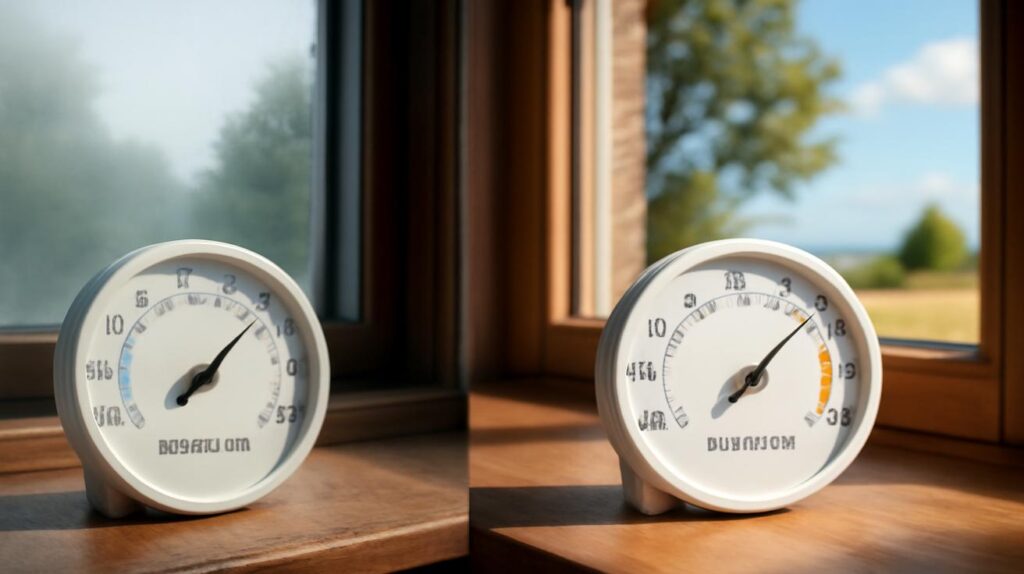
A small humidity meter (a hygrometer) can be as revealing as a mirror. Set one by a window, and another in a deeper part of the room. Watch what happens when you open the window at different times of day. Sometimes, within minutes, you’ll see the indoor humidity creep up instead of down. It’s strangely satisfying to catch the invisible in numbers—and it quickly rewires your instincts about when “fresh air” is truly fresh for your home.
The Quiet Battle Playing Out on Your Walls and Windows
When you get the timing wrong, the consequences don’t arrive like a thunderclap. They arrive as a slow, creeping patina. The edge of a window frame softens. A closet near an exterior wall smells a little like old books. Shoes pushed to the back feel cool and vaguely damp when you pull them out. None of it feels like a crisis, until it suddenly does.
Every time overly moist outdoor air slips in and lingers, it hunts for cooler surfaces where it can finally rest as liquid. That’s where mold finds its foothold—on the paint film of a north-facing wall, in the dust along a baseboard, on the backing material of a cheap wardrobe pressed tightly against stone or brick.
On winter mornings, you might notice droplets marching down the inside of your windows. It’s easy to blame “cold glass” alone, but that condensation is also a diary of yesterday’s choices: how long you boiled pasta, whether you dried laundry inside, when you cracked the window in the kitchen or bathroom, how often you let the house truly air out on a clear, cold day when the outside air was dry and bracing.
Humidity is patient. It doesn’t need a single dramatic mistake; it just needs a routine. A nightly habit of sleeping with the window open in a damp valley. A weekend pattern of throwing open every window after rain “to enjoy the smell.” A lifetime assumption that cooler air always means drier air. The house remembers, even when you don’t.
Learning to Work With the Weather, Not Against It
Still, there’s something deeply human about wanting the outdoors to breathe through your rooms. We’re not meant to live sealed away behind glass and filters. The trick is not to stop opening windows, but to start opening them more like a conversation than a reflex.
On a crisp, pale winter morning, for example, the air outside is often astonishingly dry. Open windows wide for just five or ten minutes—what some people call “shock airing”—and you exchange a surprising amount of heavy, moisture-laden indoor air for that cold, dry brightness. Close the windows, let the heating recover, and you’ve done more for your indoor humidity than hours of timidly cracked openings on a damp day.
In spring and autumn, watch for those in-between days: cool but not wet, breezy rather than still. Early mornings, just after sunrise, often bring air with lower humidity than the thick, late-night version. Throwing open windows then turns the entire house into a slow, gentle lung, inhaling what it actually needs.
Even in thick summer, there are windows of grace—short periods after a dry front has moved through, or during a windy spell when the air is less saturated. That’s when you can fling open your home to the world without inviting in a swamp. The more you pay attention, the more you notice these weather “moods,” and the less your window habits are ruled by simple temperature comfort alone.
Small Rituals That Help
There’s a certain pleasure in turning humidity management into a kind of daily ritual, rather than a chore. You might start the day by stepping outside for just a moment and feeling the air on your face: Is it heavy? Is it crisp? Does your breath linger in front of you, or vanish instantly?
Maybe you glance at your hygrometer the way you check the time. You learn that on days when the outdoor humidity is much lower than indoors, ten minutes of open windows feels like a deep exhale for the walls themselves. On days when it’s the opposite, you reach instead for small, precise actions: run the exhaust fan while you shower, close the bathroom door, let the fan run for fifteen minutes, then only briefly crack the window if the outside doesn’t feel like a wet towel.
Drying clothes indoors becomes a more mindful choice: If the air outside is bone-dry and bright, maybe the clothesline or balcony is the better option. If you must dry inside, perhaps that’s the night you keep windows closed and let a dehumidifier and a fan shoulder the work instead of inviting in more moisture.
None of these rituals are dramatic. But over weeks, they change the way your home feels. Fabrics stay fresher. Rooms smell less like “indoors” and more like neutral, quiet space. The glass on winter mornings is clearer. And opening the window stops being a gamble, becoming instead a kind of informed kindness to your walls, your lungs, and your sleep.
In the End, It’s About Listening
Opening a window will always be one of the simplest gestures we make: a hand on a latch, a soft scrape, a little rush of sound and smell and sky. It’s a way of saying, “Come in,” to the wider world. But like any invitation, the timing matters.
The wrong moment—when the air outside is heavy with hidden water—turns that invitation into a slow, quiet burden on your space. Humidity sneaks in, tucks itself into the corners, and lingers in the seams between plaster and paint. The room might still feel cooler, more pleasant on your skin, but the house itself is doing the slow work of storing moisture it never needed.
The right moment, though—clear, dry, just a little brisk—turns the same gesture into something almost magical. You feel the house sigh, the air sharpen, the soft invisible weight on your walls ease. The world outside doesn’t just visit; it helps. And little by little, you learn that comfort isn’t only about what feels good in an instant, but what lets your home breathe well over seasons and years.
In that sense, the art of opening windows is the art of paying attention—of noticing not just temperature, but texture; not just breeze, but burden. Once you start listening, you’ll never look at that simple pane of glass the same way again.
FAQ
Does opening windows always increase indoor humidity?
No. Opening windows can lower or raise indoor humidity depending on the outside air. If the outdoor air is drier than indoors (once it’s warmed to room temperature), opening windows helps dry the house. If it’s more humid, especially during muggy or foggy weather, it often makes indoor humidity worse.
Is it better to open windows at night in summer to reduce humidity?
Not usually. At night, especially in humid climates, outdoor air often reaches very high relative humidity as it cools. It may feel cooler but still carry a lot of moisture. This can raise indoor humidity and make bedding and walls feel clammy by morning.
Why do my windows get condensation even when I don’t boil water or shower much?
Everyday activities like breathing, cooking small meals, and drying clothes add moisture. If you also open windows at humid times, the total moisture indoors builds up. Cold window glass then becomes the first place that extra moisture condenses.
What is the best time of day to open windows to reduce humidity?
Often late morning to early afternoon on cool, dry, or breezy days works best. In winter, short, wide openings during clear, cold spells can dramatically reduce humidity. Always consider both temperature and how “heavy” or “light” the air feels, not just how cool it is.
Are exhaust fans better than opening a window?
For specific moisture sources—like showers and cooking—yes, exhaust fans are usually more effective. They directly remove moist indoor air without necessarily pulling in equally moist outdoor air. Windows are best used strategically when outdoor air is clearly drier than what’s inside.