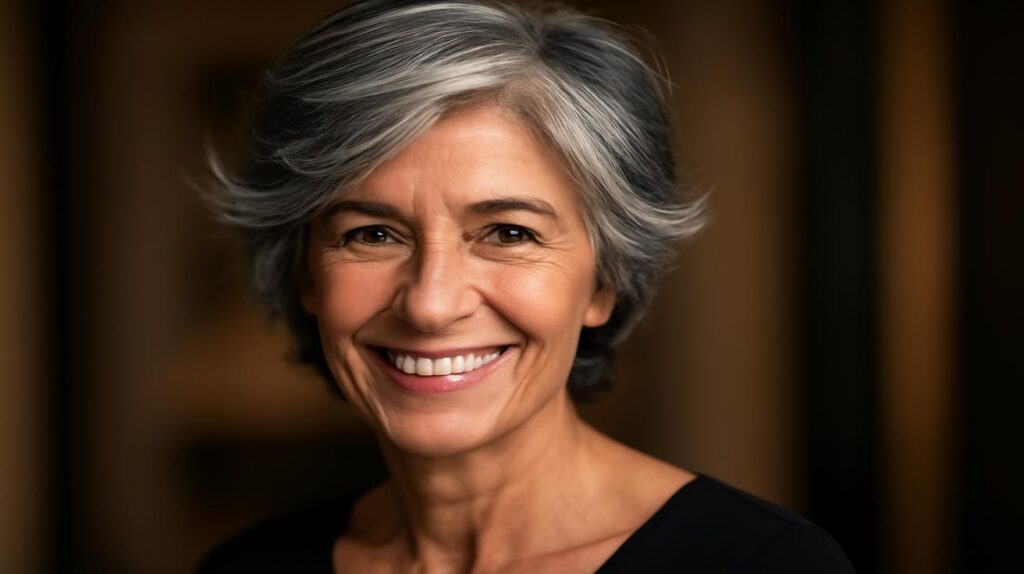
The first thing I notice when she walks into the salon isn’t her age. It’s the light. It follows her, catches on every silver strand that threads through her dark hair, until her head looks like someone dipped it in morning sun. She sits in my chair with that familiar mix of shyness and defiance I’ve seen so often in women over 60 who are finally ready to let their dye grow out. She folds her hands, takes a breath, and says the line I hear every week: “I think it’s time I go natural. But I don’t want to look… old.”
The moment you stop hiding and start highlighting
Most women don’t decide to embrace their salt-and-pepper hair in a single, triumphant moment. It happens in slow-motion: the roots that keep coming back faster, the calendar alarms for color touch-ups that begin to feel ridiculous, the towel stains, the tiredness of chasing a shade that never quite looks like real hair. Somewhere between another box of at-home dye and another expensive salon appointment, the thought appears: What if I just stopped?
That’s usually when they find me, or someone like me—a hairdresser who actually loves grey. Who sees it not as “giving up” but as an upgrade. When a client crosses the invisible line into her sixties, something shifts. There is less patience for pretending. More hunger for ease. More desire to feel like herself instead of an airbrushed version of who she was at forty-two.
Salt-and-pepper hair—those scattered strands of white threaded through charcoal, chestnut, or black—is one of the most beautiful textures nature gives us. It has depth, movement, natural highlights that no foil can reproduce. But it also has quirks: it can frizz, stick up, or fall flat in all the wrong places. The key is choosing cuts that work with that texture, not against it.
In my chair, I don’t start by asking, “How do you want to look?” I ask, “How do you want to live?” Because the perfect cut for your salt-and-pepper hair at 60+ isn’t just about your face shape—it’s about your morning routine, your energy, your style, your patience for styling tools, and how you want to feel when you catch yourself in a shop window on a Tuesday afternoon.
The soft layered bob: effortless movement for everyday elegance
Let me tell you about Marianne. Seventy-one, former science teacher, sharp humor, eyes the color of rain-soaked slate. She had shoulder-length dyed brown hair when she first came in, with about two inches of stark white regrowth at the roots. “I hate this in-between stage,” she said, tipping her head forward like she was ashamed of it. “But I also sort of… love it?”
What she loved, of course, was the glow. Salt-and-pepper hair frames the face like light. The trick is to shape that light.
For women who want elegance without fuss, I often suggest a soft layered bob. Not the stiff, helmet bob of magazine cartoons, but a living, breathing version: chin or collarbone length, gentle layers, soft edges, and enough movement to keep the silver from looking blocky.
We cut Marianne’s hair to just above her shoulders, added long layers that swayed when she turned her head, and created a subtle angle so the front grazed her collarbone while the back lifted slightly for shape. As more of her silver grew through, the layered bob gave it a stage. Each grey strand caught the light and danced.
For salt-and-pepper hair, a bob should do three things:
- Lift the face slightly—especially around the jawline and cheekbones.
- Break up any harsh contrast between white roots and darker lengths.
- Add movement so the color variation looks intentional, not patchy.
I like to leave the ends a little textured, not blunt. Blunt ends can sometimes make grey hair look heavy or wig-like. A softly shattered hemline, on the other hand, invites light in. Your hair moves with you; it doesn’t sit on you.
Who it’s perfect for
If you have fine to medium hair that tends to fall limp when long, or a natural wave that gets lost past the shoulders, a layered bob is your best friend. It’s low maintenance but never boring, and it can air-dry beautifully with the right product: a pea-sized amount of lightweight cream and a bit of scrunching is often enough.
The modern pixie: bold, free, and astonishingly feminine
There is always that one moment when a woman touches her hair, looks in the mirror, and whispers, “What if we cut it short? Like… really short?” The words hang between us like snowflakes, delicate and dangerous. Because a pixie cut is not just a style; it’s a declaration.
On salt-and-pepper hair, a well-cut pixie is pure magic. The mix of silver and darker strands adds dimension and texture that keeps it from ever looking flat or severe. Each tiny layer becomes a brushstroke of color. The sparkle is built in.
One of my clients, Ana, came to me at sixty-four with shoulder-length dyed black hair and a heart full of rebellion. “I’m done,” she said. “I’m done with dye, and I’m done with hiding. I want my grey. I want my scalp to feel the wind.” So we went there. A modern pixie, cropped close at the nape, soft at the top, longer through the fringe so she could push it to the side or let it fall artfully across her forehead.
When we finished, she ran her fingers through it and started to laugh—this deep, surprised laugh that had tears tucked into the edges. “I look like… me. But lighter.”
That’s what the right pixie does: it lifts weight off your face, your neck, your morning routine, your self-consciousness about thinning hair or scattered patches of grey. It makes the salt-and-pepper blend look deliberate, like you sat in a studio while someone painted it strand by strand.
Why a pixie loves salt-and-pepper
- Short hair emphasizes texture; salt-and-pepper has built-in texture.
- Grey hair tends to be drier and more stubborn. In a pixie, that “stubbornness” becomes structure and volume.
- It flatters glasses, statement earrings, bold lipsticks, and laughter lines.
To keep a pixie looking modern—and not like a schoolboy cut from 1962—I always soften the hairline around the ears, avoid hard, straight lines across the forehead, and leave just enough length on top to play with. Think “air and movement” rather than “helmet and discipline.”
Longer layers with face-framing softness: for those who can’t bear to go short
Not every woman over 60 wants to chop it all off, and she shouldn’t have to. There is something deeply romantic about longer salt-and-pepper hair that falls past the shoulders, especially when it moves like water instead of hanging like a curtain.
Grey hair can absolutely be worn long; it just needs the right architecture. The biggest mistake I see is one-length, heavy hair that pulls the face down and emphasizes every line. The trick is to carve softness back in.
When Ingrid, sixty-eight, came in with hair halfway down her back, she clutched it like a security blanket. “Don’t make me look like a different person,” she begged. “Just a less tired version.” Her salt-and-pepper was stunning—silver at the crown, deep steel at the nape, and streaks of white framing her temples like moonlight. But the sheer length was dragging it all down.
We kept the overall length, trimming it to just below the shoulders, then added long, sweeping layers that started around her cheekbones and descended like a gentle waterfall. Around her face, I carved soft, curved pieces that followed the line of her jaw and drew attention upward, toward her cheekbones and eyes.
Why long layered cuts flatter natural grey
- The layers break up blocks of color so the salt-and-pepper looks dynamic, not patchy.
- Face-framing pieces create a natural “soft focus” effect around the features.
- Long layers keep length but remove heaviness, so hair gains bounce rather than slump.
Long grey hair loves a bit of polish—nothing intense, just a quick blow-dry with a round brush at the roots or a loose twist while it dries to encourage gentle waves. A light oil (used sparingly, just at the ends) will reflect light and keep the silver from looking dull. And if your hair is very straight, ask your hairdresser for “invisible layers” that give movement without obvious steps or choppiness.
The textured shag and soft “lived-in” cuts: when you want character over perfection
Not everyone wants smooth, neat hair. Some women want their hair to mirror their stories—wild, textural, slightly unruly in the best way. For them, I love a soft, modern shag on salt-and-pepper hair.
Forget the harsh, choppy shags of the seventies. Today’s version is all about feathered edges, longer layers, and gentle disconnection that gives you volume at the crown and softness around the face. On grey hair, it looks like starlight sprinkled through motion.
Think of the shag as the “artist’s haircut” for women over 60: easy, expressive, never boring. It works especially well if your hair has a natural wave or curl. The mix of lengths encourages your salt-and-pepper shades to mingle in unexpected ways; no two days will look exactly the same, and that’s the joy of it.
How a shag flatters salt-and-pepper hair
- Shorter layers on top emphasize volume, which many women miss as hair thins with age.
- Longer, wispy pieces around the face soften the transition from dark to light hair.
- The overall “lived-in” look makes regrowth part of the style, not a phase to hide.
For clients who crave low-maintenance styling, I usually pair a shag cut with air-drying and a salt spray or curl cream. Scrunch, let it dry, shake it out. The magic is in not overworking it. The more you let the hair express its natural pattern, the more the salt-and-pepper shimmer shines through.
Bangs, fringes, and face-framing magic: the smallest change, the biggest impact
If chopping your length or radically changing your shape feels like too much, bangs can be the gentlest revolution. A fringe—whether full, wispy, side-swept, or curtain style—can completely transform how your salt-and-pepper hair interacts with your face. It’s like adding a soft-focus filter in real life.
Grey hair at the hairline often appears first and is usually the brightest. Using that natural brightness in a fringe creates a halo around the eyes. Side-swept bangs with streaks of silver can draw attention to your cheekbones; airy, longer curtain bangs can soften a high forehead and blend beautifully into face-framing layers.
However, bangs on grey hair require care in the cut. Heavy, blocky bangs can look severe or highlight cowlicks and frizz. I prefer to “chip” into the fringe with small, deliberate snips to create feathered edges. This keeps the hairline soft and allows the different shades of grey to mingle rather than form a hard bar across the forehead.
When clients worry that bangs will make styling harder, I explain a simple truth: bangs are only high-maintenance if they’re cut to defy your natural growth pattern. When your fringe follows your cowlicks instead of fighting them, it wants to fall into place. A quick finger-comb in the morning, maybe a touch of smoothing cream, and it usually behaves.
Small adjustments, big difference
Sometimes we don’t even change the overall length or layers—we just introduce a soft, side-swept fringe and slightly brighten a few strands around the face with subtle, cool-toned highlights. The result? The salt-and-pepper suddenly looks like a deliberate, dimensional color choice instead of a transition you’re “stuck in.”
A hairdresser’s cheatsheet: choosing your perfect cut after 60
After decades behind the chair, I’ve noticed the same questions surfacing again and again. To make it easier, here’s a simple overview I walk many of my over-60 clients through when we talk about their salt-and-pepper hair.
| If you want… | Best cut style | Why it works for salt-and-pepper |
|---|---|---|
| Low-maintenance elegance | Soft layered bob (chin to shoulder length) | Adds movement, breaks up regrowth lines, and naturally frames the face. |
| A bold, freeing change | Modern pixie with softness on top | Enhances texture, makes grey sparkle, and lightens your whole look. |
| Keeping your length | Long layers with face-framing pieces | Keeps hair romantic while preventing it from dragging the face down. |
| Texture and personality | Soft, modern shag or “lived-in” cut | Embraces natural wave and curl, turns varied tones into a feature. |
| Subtle refresh, not a full change | Side-swept or curtain bangs plus gentle reshaping | Draws focus to eyes and cheekbones, softens lines without losing length. |
Beyond style, there are a few universal tricks I share with every client embracing her natural grey:
- Ask for “soft” everything: soft edges, soft layers, soft graduation. Grey hair can already read as more high-contrast, so you want the cut to counterbalance that with fluidity.
- Beware of harsh, dark ends: if the lower lengths are still artificially dark, a few subtle, cool-toned highlights or a gentle blending technique at the salon can make the transition look intentional.
- Consider your neckline and posture: a cut that grazes the collarbone can feel lighter if you tend to curl forward; a pixie can beautifully reveal a graceful neck and shoulders.
- Plan for grow-out: the most beautiful salt-and-pepper cuts look good not just on day one, but four weeks later. Ask your stylist how the shape will age between appointments.
Most importantly: bring photos of haircuts you love, but also photos of yourself when you’ve felt most like you. Your salt-and-pepper hair is not a costume; it’s a return. The perfect cut doesn’t turn you into another person. It lets the person you’ve become walk into the light, fully visible.
FAQs about enhancing natural salt-and-pepper hair after 60
Is salt-and-pepper hair actually flattering after 60?
Yes—often more flattering than flat, artificial color. Salt-and-pepper hair reflects light, adds natural dimension, and can soften features when paired with the right cut. The key is shape and texture: styles with movement and softness tend to be most flattering.
How do I know if I should go short or keep my hair long?
Think about your lifestyle and your hair’s behavior. If your hair is fine, limp, or thinning, shorter cuts like bobs or pixies usually create more volume and energy. If your hair is thick, wavy, or you love the feeling of length, keep it longer but add layers and face-framing softness to avoid heaviness.
Will a pixie cut make me look older?
A well-cut, modern pixie usually does the opposite. It exposes your neck and cheekbones, lifts your features, and turns salt-and-pepper texture into an asset. The secret is softness—avoid severe, ultra-short cuts with hard lines. Ask for a little extra length on top and around the fringe.
Can I wear bangs with salt-and-pepper hair?
Absolutely. Bangs can be incredibly flattering with grey, especially when your hairline is naturally lighter. Side-swept or soft curtain bangs are often easiest to maintain and blend beautifully with salt-and-pepper tones. Just make sure they’re cut to work with your natural growth pattern.
How do I keep my salt-and-pepper hair from looking dull or yellow?
Use a gentle, violet or blue-tinted shampoo once a week to neutralize yellow tones, and avoid very high heat when styling. A lightweight leave-in conditioner or serum can add shine without weighing hair down. Regular trims also keep the ends fresh, which helps the whole head look brighter.
How often should I get my hair cut once I embrace my natural grey?
For short cuts like pixies and bobs, every 4–6 weeks keeps the shape intentional. For longer layered cuts, every 8–10 weeks is usually enough. The goal is to maintain the structure that makes your salt-and-pepper hair look lively, not overgrown.
What should I tell my hairdresser if I want a flattering salt-and-pepper cut?
Tell them you want a cut that:
- Embraces your natural color and texture.
- Softens your features and adds movement.
- Is easy to style with your current energy and routine.
Bring a couple of photos of salt-and-pepper cuts you like, along with a photo of yourself on a day you felt especially confident. A good hairdresser will translate that feeling into a shape that works with your face, hair, and life right now.