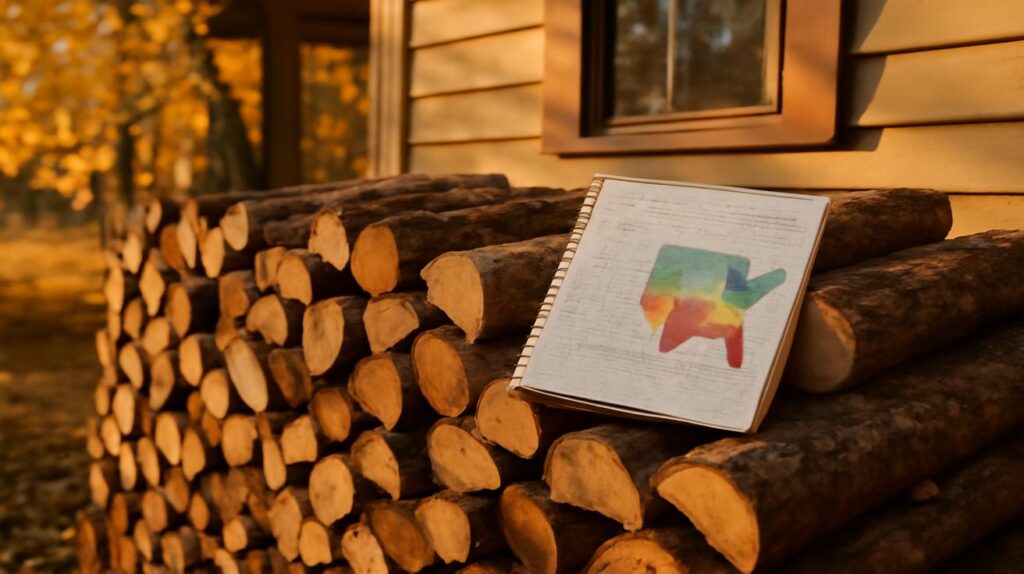
The first cold snap always arrives on a Tuesday, doesn’t it? One minute you’re pretending that an extra sweater counts as heating, the next you’re standing by the woodpile in the thin light of late afternoon, wondering—really wondering—if you’ve stacked enough firewood to see you through to spring. The air smells of damp leaves and chimney smoke from some neighbor who clearly planned better than you. A few logs sit in the basket by the stove, suddenly looking far too few. It’s in that moment—when your breath hangs in the air and your fingers ache—that firewood stops being a rustic aesthetic and becomes something more primal: a simple question of “Do I have enough warmth for the winter?”
Learning to Read Your Winter Like a Map
Most of us start the heating season with a guess. A rough, gestured, “Eh, three cords should do it,” based on a friend’s advice, last year’s half-remembered burn, or the height of the woodpile against the shed wall. But winter isn’t guessed at; it’s counted—slowly, log by log, night by night.
Imagine you’re standing in your living room in late October. The first proper fire is crackling in the stove, the flames licking at a well-split piece of oak. You’re not just warming your house; you’re beginning a slow experiment in numbers. How many logs does it take to keep the room comfortable for the evening? How long before the stove cools? How many times do you find yourself lifting the lid or opening the door to nudge another piece into the coals?
This is the first trick to avoiding the dreaded January shortage: treat early winter as your data-gathering season. You’re not just burning wood—you’re “reading” your house, your stove, and your climate, the way a tracker reads the marks in snow.
For two or three weeks at the beginning of the heating season, pay attention. Maybe even jot a note on a pad by the kindling basket:
- Outdoor temperature (roughly—“mild,” “cold,” “really cold” is fine).
- Number of hours the fire is going.
- How many armloads, baskets, or logs you go through in a day.
After a dozen days, patterns emerge. You’ll see that “mild” days barely tap the stack, while biting cold snaps cause a visible dent. This isn’t abstract math—it’s the daily rhythm of your winter life turning into information you can use.
The Quiet Math of a Cord: Turning Wood into Warmth
Somewhere along your path into wood-burning life, you probably encountered the mysterious unit everyone bandies around: the cord. It sounds solid, authoritative—like something you should already understand. But the reality on the ground is messier: loose stacks, toppled heaps, odd lengths, drifts of bark. The trick is learning how this tangle of wood translates into actual months of heat.
A full cord is a neat, tightly stacked pile that measures 4 feet high, 4 feet deep, and 8 feet long. That’s 128 cubic feet of wood and the air spaces between. In practice, most people buy or stack something slightly more chaotic: face cords, half cords, or “a truckload,” which can mean nearly anything. The goal is not to become a human tape measure, but to get close enough that your winter doesn’t end in a scramble to find overpriced “emergency” wood in mid-January.
One simple way to think about it is this: on an average cold day—fire lit in late afternoon, going through the evening—you might burn somewhere between 1/8 and 1/4 of a cubic meter of wood (roughly 0.03–0.07 cords). Multiply that by the number of days you expect to run the stove as a primary or major heat source, and the edges of your winter begin to take shape.
To make it easier to grasp on a phone screen, here’s a compact picture of what typical usage can look like for different homes and climates. These are rough, real-world style estimates—not lab perfection—assuming reasonably seasoned hardwood, an efficient stove, and wood as your main heat source.
| Home & Climate | Season Length | Typical Use | Approx. Cord Need |
|---|---|---|---|
| Small, well-insulated home in mild climate | 3–4 months, light use | Evening & weekend fires | 1–1.5 cords |
| Mid-size home, moderate climate | 4–5 months, regular use | Daily fires, nights only | 2–3 cords |
| Larger home, colder climate | 5–6 months, heavy use | Fire most of the day | 3–5 cords |
| Poorly insulated home, very cold climate | 6+ months, intense use | Primary heat, nearly 24/7 | 5–7+ cords |
Those numbers are a starting point. The real precision comes from blending them with the early-season “tracking” you did around your own stove. If you see that a week of truly cold weather uses half a face cord, you can sketch out how many such weeks you expect based on your usual winter.
Matching Wood to Home and Climate: Not All Logs Burn Alike
On a still winter night, different kinds of wood speak in different tongues. Ash burns with a clear, clean flame and a steady heat; oak glows deep and long, an overnight companion. Softwoods like pine and spruce leap into bright fire quickly, then vanish just as fast, leaving only a thin bed of coals. If you’ve ever woken at 3 a.m. to find the stove cold and the house suddenly sharp with the bite of frozen air, you already know this difference in your bones.
Planning your wood for the season isn’t only about how much; it’s about what kind. The right mix can stretch your pile weeks further, especially when tuned to your local climate and home.
For Mild and Coastal Climates
If your winters lean more toward damp and chilly than brutally cold, you may never need to run the stove flat-out. In these places, softer woods or mixed hardwood/softwood loads make sense. They light quickly, warm a cool house fast after a day away, and you’re not depending on them to keep a biting -15°C night at bay.
Here, you might think in terms of flexibility: some dense hardwood for the coldest weeks, some softwood or lighter hardwood for shoulder seasons and quick evening comfort. You’ll use fewer cords overall, but you’ll likely cycle through different wood types as the season deepens.
For Deep-Winter and Snow Country
In a valley where the sun skims low and the snow squeaks under boots, your priorities shift. Overnight heat becomes non-negotiable. Here, the fire is less a luxury and more a quiet agreement between you and the landscape: you keep the wood dry; it keeps your pipes from freezing.
Dense hardwoods—oak, beech, hickory, maple, ash—are the backbone of your plan. They carry you through the longest, darkest stretches. You’ll want enough of this “premium” wood to cover your coldest 8–10 weeks, when temperatures drop hard and stay there. For milder spells inside that same winter, you can mix in lighter hardwoods or softwoods to keep from burning your best wood when it’s not strictly needed.
For Drafty Houses and Old Farmsteads
Some homes leak heat like tales leak from an old storyteller: steadily, relentlessly, like it can’t be helped. If you live in a beautiful but drafty place, the temptation is to assume you simply need “a lot” of wood. There’s truth to that—but there’s also strategy.
First, accept that your baseline might be higher than your neighbor’s snug, modern cottage. But then get clever: tighten up even small drafts with weatherstripping and door snakes, close off unused rooms, hang heavy curtains. Every little bit you keep from escaping makes each log work harder for you.
Then, match your wood: heavier hardwoods for the coldest winds, medium-density wood for milder days. The better you stabilise indoor temperature, the fewer times you’ll find yourself opening the stove door out of impatience rather than need. Fewer, larger loads of dense wood burned hot and clean usually beat constant fiddling with small, damp pieces.
Seasoning, Stacking, and the Illusion of Plenty
There’s a special kind of false security in a gigantic but poorly seasoned woodpile. It looks heroic, like a fortress of future warmth towering along the fence—but if much of that wood is green or wet, it might as well be sculpted out of ice. It will hiss, smolder, blacken your chimney, and leave you wondering why you’re burning so much and staying so lukewarm.
Part of calculating “how much” is being honest about “how good.” A smaller pile of properly seasoned wood can out-perform a mountain of spongy, unready logs. Firewood that’s been split and stacked for at least 6–12 months for softwoods and 12–24 months for many hardwoods, kept off the ground and covered on top but open on the sides, burns hotter and more efficiently.
Picture your ideal stack: rows of splits, ends facing south or west to catch wind and sun, raised on pallets or rails. The bark has gone from shiny to matte. When you clack two pieces together, they ring with a hollow, drum-like sound, not a dull thud. You pick one up and it feels lighter than you expected, like it’s mostly promise and stored sunlight now.
Seasoned wood means you’ll use fewer logs to achieve the same warmth. It also means your early-winter usage tracking will be more accurate. If you do your measurements on half-seasoned, wet wood, then switch to properly dry pieces midwinter, your estimates will be off and your rhythm with the fire disrupted.
Simple Test for Moisture
If you want to move beyond guesswork, a small, inexpensive moisture meter can be a quiet revelation. Split a log, push the probes into the freshly exposed inner wood, and check the numbers. Under 20% moisture is the sweet spot. Over that, you’re burning water along with wood.
Knowing which part of your pile is truly ready lets you plan: burn the driest first, leave the borderline stacks for shoulder season or next year, and never count unseasoned wood in your mental “Do I have enough?” tally. It might be there physically, but it’s not really there energetically—not yet.
Day-by-Day Tuning: Avoiding the January Cliff
Walk out to your woodpile in the thin light of mid-December. You’ve already been burning for a month or more. This is the moment to look not just at the surface of the stack, but at its depth, its rhythm of decline. Are you eating through it faster than you expected? Or is it holding steady, the change almost imperceptible, like a slow tide going out?
Here’s one of the most useful yet underrated winter tricks: give yourself a “wood audit” day once a month. It’s quick, quiet, and oddly satisfying.
- Mark the end of one row with chalk or a small stick.
- Burn as usual for a week.
- See how far along the row you’ve moved.
Now compare that pace to the months left in your heating season. If you’ve used a quarter of your stack by early December and your winter usually stretches well into March, you’re roughly on track. If half your pile is already gone and the real cold hasn’t truly settled in, that’s your early warning.
When you do get that warning, all is not lost. You can stretch what you have in subtle, humane ways:
- Let the fire go out on milder days and rely on sweaters and blankets during daytime.
- Run the stove hotter but for shorter bursts, storing heat in masonry or heavy furniture.
- Use heavier curtains and close off less-used spaces to shrink the area you’re heating.
- Bring in a small supplemental heat source—electric or otherwise—for shoulder times, saving wood for truly cold nights.
The goal isn’t stoic suffering; it’s thoughtful pacing. You’re learning to tease the most comfort possible from each split log, rather than just feeding the fire out of habit.
The Art of Using Just Enough
There’s a moment each evening, if you watch carefully, when the balance is perfect. The stove hums with a deep, steady heat. The glass glows but isn’t roaring bright. The air in the room feels thick with warmth yet not stifling. Somewhere between “one more log” and “I should have added that ten minutes ago” is a sweet spot where efficiency lives.
Learning to find that spot is what truly optimises your firewood use. It’s not only how much you start with in October but how you spend it, hour by hour, through January and February.
A few quiet habits help:
- Burn hot, not sluggish: Choking the air to stretch a load of wood all night can create creosote and waste energy. It’s often better to burn a good, hot fire that heats the room and then let it coast down.
- Use the right size splits: Smaller splits ignite quickly and are great for lighting and quick boosts of warmth; larger splits burn longer and more steadily. Mixing them lets you shape your fire to your evening instead of burning blindly.
- Watch the coals: A deep coal bed still contains a surprising amount of heat. Rake coals forward, add a single larger log, and close down a bit—you may not need the three pieces your cold fingers are itching to grab.
- Match fire to schedule: If you’re out all day, don’t load the stove like you’re staying home. Build your routine around when you actually need heat most—early morning, evening, overnight.
In time, you’ll start to feel the relationship between your stack and the season the way farmers feel rain and soil. On some nights, your hand hovers over the basket and chooses a smaller piece. On others, the forecast and the way the wind moves through the trees convince you to add a thicker log, to bank the night properly. It becomes less like consumption and more like conversation.
FAQ: Common Questions About Calculating Winter Firewood
How many cords do I really need for an average winter?
For many households using wood as a major but not exclusive heat source, 2–4 cords is a common range. Small, well-insulated homes in milder climates may get by with 1–2, while larger or draftier homes in cold regions may need 4–6 or more. Track your use for a couple of weeks early in the season, then scale that up for your typical winter length.
Is it better to have too much wood than too little?
Within reason, yes. Firewood doesn’t go bad if it’s stored well; in fact, it usually improves. Having an extra half cord or more gives you a buffer for unusually cold spells or longer winters. The key is to avoid counting unseasoned wood as part of this “extra.” Only truly dry, ready-to-burn wood should be part of your safety margin.
What if my wood isn’t fully seasoned yet?
Prioritise the driest stacks for the coldest part of winter. Split some pieces smaller to help them dry faster. Store wood under cover with plenty of air circulation, and, if possible, buy a bit of truly seasoned wood to blend with your own. Never rely entirely on green wood for winter heat; it’s inefficient, frustrating, and hard on your chimney.
How can I reduce how much firewood I use without feeling cold?
Improve insulation and draft sealing even in small ways, use heavier curtains, close doors to unused rooms, and burn smarter: hot, efficient fires instead of long, smoldering ones. Time your biggest fires for when you’re home and awake, and let the stove coast more during sleep or absence, as long as pipes and comfort are protected.
Does stove efficiency really make a big difference in wood use?
Yes. A modern, well-installed, efficient stove can use significantly less wood than an older, leaky model to produce the same comfort level. Better combustion means more heat in your home and less wasted up the chimney. If your wood use feels excessive despite good seasoning and stacking, your stove or chimney setup may be part of the story.
In the end, learning how much firewood you need is less about mastering a single formula and more about paying close attention—to the shape of your winter, the quirks of your house, the type of wood you burn, and the quiet language of your fire. With each season, your guesses sharpen into knowledge. One late afternoon, you’ll walk out to the woodpile, look at what’s left, feel the bite or gentleness of the day’s cold, and know, with a calm certainty: “Yes. This will carry us through.”