The smell hit first, even before the seatbelt clicked into place. Stale sweetness wrapped in something damp and sour, like a wet towel forgotten in a gym bag. The kind of smell that makes you roll the windows down in midwinter and wonder, a little dramatically, if you should just abandon the car and start a new life somewhere else. You know that smell, don’t you? The mysterious “car funk” that appears slowly, lingers stubbornly, and seems to survive every air freshener known to humankind.
We blame fast food bags, spilled coffee, sweaty kids after soccer practice, wet dogs, the takeout curry that slid off the seat. We spray and scrub and hang up little scented trees that promise “mountain breeze” and instead deliver “chemical headache.” Yet the smell always seems to creep back, especially on humid days, when the air feels thicker and the car’s interior suddenly remembers every spill, every spillover, every rainy commute.
There’s a quieter culprit behind all of this. It moves invisibly, settles into fabrics, sneaks under floor mats, hides in vents, and clings to glass. You don’t see it, but your nose knows when it’s there. Moisture. Not just water you can see—like a puddle on the mat—but the kind you can’t: trapped humidity, lingering condensation, damp foam under the carpet that never truly dries. When moisture takes up residence, odors follow. And the day you really get rid of the damp, something almost magical happens: the smells don’t just get covered; they fade.
When the Air Turns Heavy: How Moisture Makes Smells Stick Around
The story of car odors isn’t really about “bad smells” in the way we usually think of them. It’s about conditions. Picture a car interior after a rainy day. You drag in water on your shoes. Your coat leaks tiny droplets onto the seat. Maybe you cracked the window, and misty air slipped in. At first, it feels harmless—just a little dampness. By the time the sun peeks out, everything seems fine. But inside the fabrics and padding, in the sponge-like foam beneath the seats and under the carpet, moisture is slowly building a home.
Moisture changes how your car behaves as its own little ecosystem. Warmth from the sun, occasional darkness, sealed doors, and low air movement combine to create a miniature greenhouse—one that’s oddly perfect for microscopic organisms. Mold spores drifting invisibly through the air. Bacteria carried in on shoes, clothing, food crumbs. They don’t ask for much: a bit of moisture, a bit of warmth, something organic to nibble on—dust, skin cells, spilled soda, pet hair, the foam backing of a carpet.
That quiet dampness doesn’t just stay put. It holds onto odor molecules the way a sponge holds water. Humid air can carry more scent particles; they move more slowly, hang longer, and feel “heavier” in your nose. That’s why a car can smell fine in cold, dry weather and suddenly smell musty on the first warm, sticky day of spring. The odors were always there; moisture just brings them into sharper focus.
Then there’s the barely visible condensation on windows and inside vents. On chilly mornings, when you turn on the defroster and see the fog clear, a lot of that moisture doesn’t just vanish into thin air; it’s drawn through the ventilation system, where a damp evaporator core or dust-lined ducts can become a breeding ground for that particular scent we all know: “old, tired air conditioner.” It’s not your imagination that the smell appears right when the fan kicks on. The air is literally pulling moisture and the aromas attached to it through the system and straight into your nose.
Listening to the Car’s Nose: How Odors Tell a Moisture Story
If you pay attention, your car will tell you exactly what kind of moisture story it’s living through. There’s the thick, earthy smell of mold—like a basement after a flood. There’s the sharper scent of stale coffee that never really left after that cup tipped over last winter. There’s the oddly sweet sourness that lives in the air conditioning vents. Each note is a clue. Very few of them exist without moisture.
Imagine two identical cars parked side by side. One has lived a dry life: rubber mats, careful drivers, windows closed during rain, an owner who cracks the windows on warm days and occasionally deep-cleans the interior. The other has been through years of snow boots, wet beach towels, surprise leaks, spilled drinks, and a habit of shutting everything tight after a rainstorm, sealing in the humid air. Over time, those same accidents—the dropped fries, the dog fur, the melted ice cream—will age very differently in each car.
The dry car will have the occasional whiff of takeout or gym bag, but it doesn’t linger. Odor molecules don’t have as much moisture to bind to, and the air turns over quickly. The damp car? Everything clings. The smell of last month’s road trip snacks is still hanging out with the leftover raindrops that never fully dried under the mats. The result is a kind of olfactory time capsule. Every season, every spill, every storm preserved, layer by musty layer.
We often interpret this as a problem of cleanliness. “I must not be cleaning enough,” we think, scrubbing harder, spraying more. The interior can look spotless—no crumbs in sight, seats wiped down, mats vacuumed—and still smell… old. That disconnect is the giveaway. When a clean car smells bad, it’s telling you the problem is deeper, quieter, and almost always wetter.
Quiet Transformations: What Happens When You Finally Dry It Out
There’s a moment, after you’ve really let a car dry—truly dry—when the air changes. It might be subtle at first. You open the door on a cool morning and expect the usual wall of “eau de mystery,” but it’s softer now, less pushy. The mustiness that used to puff out with the first blast of the fan is thinner, as if someone dialed down the volume by a few notches. Moisture control doesn’t usually feel dramatic. It feels like the slow quieting of a background noise you didn’t fully realize was humming away all this time.
Removing moisture doesn’t just physically dry surfaces; it shifts the entire balance of life and chemistry in the car. Mold and bacteria—those tireless little odor factories—need water. Take away that water long enough, and their colonies weaken. Fewer microbes mean fewer byproducts floating in the air, fewer earthy, sour, or “old rag” smells. The fabrics themselves, once saturated with humidity, no longer trap scent molecules as efficiently. Some odors literally evaporate; others become too faint to notice.
Interestingly, this is why some people notice their car smelling better after a few days of strong, dry sunshine with the windows cracked. The heat drives moisture out of the foam under seats and carpets, out of headliners and door panels. As the hidden damp recedes, the air begins to feel lighter, and the smell shifts from “old cabin” to something closer to “neutral space.” You may not even realize it’s happening until one day you slide in, inhale, and sense… nothing. Just the faintest hint of vinyl, maybe, or the leftover note of a cleaner from weeks ago. Silence, in scent form.
That change—the fading, not masking, of odors—is the sign that moisture control is finally doing its quiet work. You haven’t just airbrushed the smell. You’ve changed the environment that allowed it to begin and persist.
Where the Damp Hides: Moisture’s Favorite Corners in Your Car
Moisture in a car doesn’t always announce itself with dramatic puddles or fogged-up windows. It’s often more like a long, quiet seep. Knowing where it hides is like learning the secret map of your car’s inner weather.
Under those inviting floor mats, for instance, lies one of the most notorious neighborhoods for humidity. Rubber or carpet on top, thick padding beneath, and below that, bare metal. Spill a bottle of water, stomp in with snowy boots, or leave your windows cracked during a thunderstorm, and gravity does the rest. The mat might dry overnight. The thick cushion beneath? Not so fast. It’s essentially a sponge, and once it’s soaked, it can take days—or even weeks—to truly dry out without help. In the meantime, anything organic down there becomes a buffet for microbes.
Then there are the seats. Modern seats hold layers of foam, fabric, and stitching that can trap moisture from wet clothes, bathing suits, or that time a coffee cup slipped out of your hand during a sudden stop. You might blot the top with a towel, but that warmth you feel after a while isn’t just the seat warming with your body heat; it can be the slow release of trapped dampness deeper inside.
The trunk often tells its own quiet story. A tiny gap in the weather strip, a leak around a taillight, a forgotten cooler that dribbled melted ice into the carpeting—trunks are far enough away from daily sight that issues grow in the dark. If you’ve ever opened a trunk and been greeted by a wave of air that smells like cardboard, basement, and wet leaves, you’ve just met moisture that’s been living rent-free.
And of course, there are the vents. The air conditioning system, especially the evaporator, cools warm air and removes moisture. Ideally, this moisture drains harmlessly away. But if the drainage pathway clogs, or if you frequently shut the car off right after using the AC, condensation can linger inside. Dark, damp, and rich with airborne dust and pollen, those hidden internal surfaces can harbor microbial life—and the smells that come with it.
| Hidden Moisture Spot | Typical Clue | Odor You Might Notice |
|---|---|---|
| Under floor mats and carpet | Persistent damp feel, slight rust on seat mounts | Earthy, basement-like, “wet sock” smell |
| Seat foam and upholstery | Stains that keep reappearing, seats stay cool and clammy | Sweet-sour, body-odor or spilled-drink scent |
| Trunk and spare wheel well | Condensation on inside of trunk lid, soft or warped cardboard | Moldy cardboard, leaf litter, “old storage room” smell |
| HVAC vents and evaporator | Smell is strongest when fan or AC turns on | Damp, sour, “old AC” or locker-room air |
| Door bottoms and weather seals | Water sloshing noise, visible condensation near seals | Musty rim around doors, subtle but persistent |
Small Rituals, Big Shifts: How Everyday Choices Dry the Air
Moisture control in a car doesn’t have to look like a full-scale restoration project. It can look like tiny rituals—a different way of treating the car not as a sealed capsule, but as a breathing, drying space that needs help now and then.
It starts with awareness. The next time it rains, notice what happens. Do you bring in soaked floor mats and just let them sit there? Do you park the car wet, windows sealed, then walk away for two days? That trapped humidity has nowhere to go. Simply opening all the doors for ten minutes in a dry moment—on the driveway, in a parking lot at lunch, during a gas stop—can change the interior climate in small but meaningful ways. The air refreshes; the trapped dampness begins to escape.
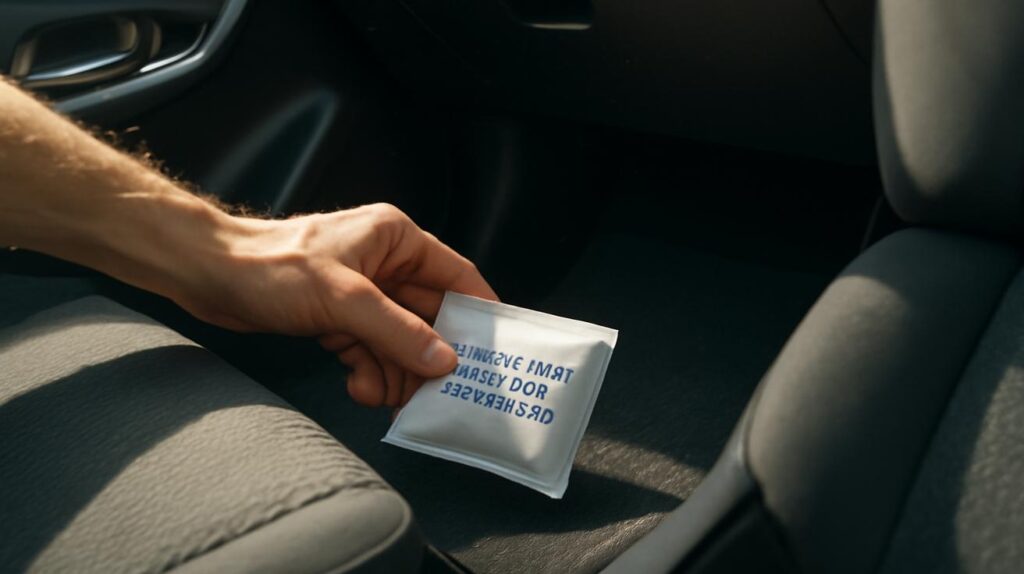
After heavy use—beach days, ski trips, muddy hikes—taking a moment to pull out the mats and let them breathe outside the car is more powerful than it looks. Beneath them, air can move. Surfaces that otherwise stay cool and clammy can dry before they become long-term moisture pockets. If something spills, blotting is just the first step; the second is time and air. Windows cracked in a secure place, doors opened for a few minutes when you return home, maybe even a small fan or dehumidifying product placed inside for a day or two if things got seriously wet.
Inside the ventilation system, a little habit shift goes a long way. On the last few minutes of a drive on a humid day, switching off the air conditioning while leaving the fan running can help dry out the evaporator coil. Instead of parking with a damp, cold core inside your dash, you arrive home with a system that’s had a chance to blow off some of that moisture. Over time, this can mean fewer sour, wet smells blasting out every time you hit the “AC” button.
None of these rituals make headlines. They are small, quiet acts that add up to one major change: the car stops being a constant host to trapped moisture. And when moisture has fewer places to hide, odors have fewer places to be born and fewer ways to cling.
When the Nose Finally Relaxes: Living With a Drier, Quieter Cabin
There’s something strangely intimate about the way a car smells. It becomes part of how you remember seasons and years. The winter you drove home from late shifts, the summer you ferried sandy kids to and from the lake, the autumn when rain seemed to follow you everywhere. Each era leaves an invisible trace in the fabric and foam. When you finally gain control over the dampness, you start to reclaim that story.
Imagine stepping into your car after rain and being greeted by… essentially nothing. The seats are dry, the mats feel solid, the air is neutral. You turn on the fan, and there’s no sudden gust of “old AC” air, just a quiet current of whatever season you’re driving through—cold winter air, warm spring breeze, the late-summer scent of hot pavement and cut grass sneaking through fresh filters. Your car’s scent stops overshadowing the world outside the glass.
Over weeks and months of better moisture control, previously entrenched smells soften. The mysterious “wet dog even when there’s no dog” smell fades. That invisible fog of stagnation lifts. It doesn’t happen overnight, and it doesn’t feel dramatic most days. But one afternoon, you give a friend a ride and they say nothing about the smell at all. They just buckle up, settle in, and talk about where you’re headed. The car disappears into the background, the way a comfortable room does: present, but not shouting.
That’s the quiet victory. When moisture shrinks back to its rightful, temporary place—rain in, then rain out; spills cleaned, then dried—the interior regains its balance. Odors don’t need a constant battle of sprays and perfumes. They simply lose their grip. The air grows lighter, the fabrics less haunted, and driving becomes once again about the road, the landscape rolling by, the music in the speakers—not the ghost of a thousand damp mornings trapped in the upholstery.
Frequently Asked Questions
Why do car odors seem worse on humid or rainy days?
Humid air carries odor molecules more easily and helps them linger longer, making smells feel stronger. Moisture also wakes up hidden damp areas in your car—under mats, in seats, inside vents—where microbes and old spills release more noticeable odors when the air is moist.
Can moisture control really make existing odors fade, not just be covered up?
Yes. When you reduce moisture, you weaken the conditions that allow odor-causing microbes to thrive. Over time, with drier surfaces and freer air movement, many smells gradually dissipate instead of returning once air fresheners wear off.
How can I tell if moisture is trapped under my car’s carpet or mats?
Lift the mats and press on the carpet and padding underneath. If it feels cool, spongy, or slightly squishy, or if you notice light rust on seat rails or a musty smell close to the floor, you likely have trapped moisture.
What simple habits help keep my car drier day to day?
Open doors or windows for a few minutes after wet drives, use removable mats and dry them outside the car, avoid sealing the car tight with soaked items inside, and on humid days, run the fan for a couple of minutes after turning off the AC before you park.
Is a bad smell from the air vents always a sign of mold?
Not always, but it often indicates moisture buildup combined with dust or organic material in the HVAC system. It may be mold or bacterial growth on the evaporator coil or in duct surfaces, especially if the smell is strongest right when you turn on the fan or AC.
Do air fresheners help with moisture-related odors?
Air fresheners can temporarily mask smells but don’t address the underlying moisture. Without drying out the car and removing damp sources, the odors usually return as soon as the fragrance fades.
Can sunlight alone fix long-term moisture and odor problems?
Strong, dry sunlight with good ventilation can help a lot, especially for mild dampness. But deeply soaked padding, leaks, or long-standing moisture may require lifting carpets, drying foam layers, or fixing seals and drains to fully resolve odors.