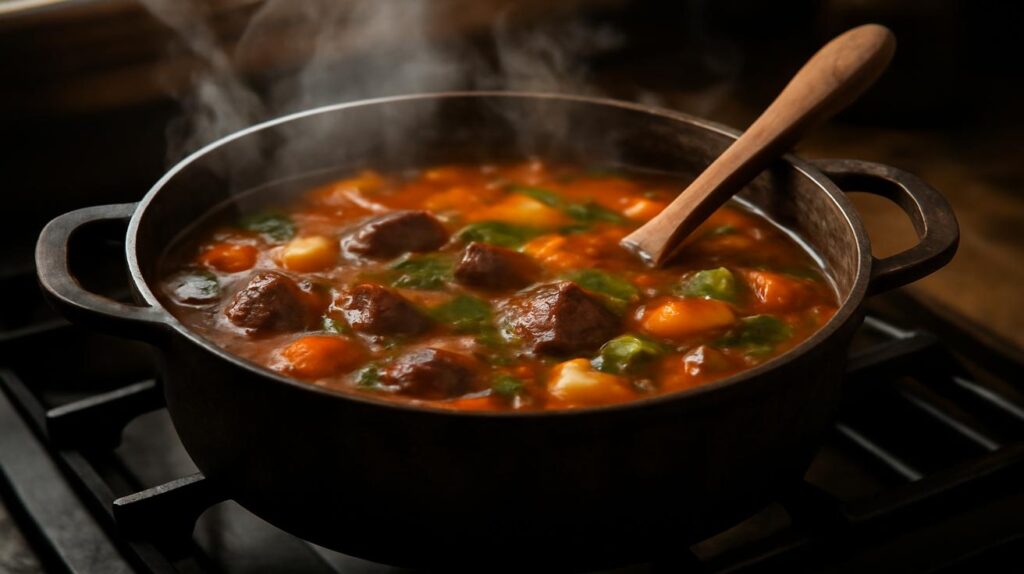
The first cold day has a sound. It’s the faint clink of the heater waking up after its long, dusty summer sleep; the dry rustle of leaves tumbling down the street; the distant bark of a dog that suddenly realizes the air has changed. Maybe, if you listen closely enough, it’s also the quiet rumble of your own stomach, asking—no, insisting—for something warm, deep, and satisfying. That’s the day this soup belongs to. The kind of day when you step inside, cheeks stinging from the wind, and everything in you wants to slow down, stir a pot, and let the house fill with the scent of garlic, onions, and hope.
The Day the Soup Calls Your Name
The weather doesn’t just turn cold all at once. It edges in. A chill sneaks under the doorframe, into your sleeves, the gap at the back of your neck. The sun looks the same, but the light feels thinner, like it’s passing through frosted glass. You notice you’re walking a little faster from the car to the front door, one hand already reaching for warmth that isn’t there yet.
On that kind of afternoon, a salad feels like a joke and a sandwich like an apology. This is soup weather—the kind of soup that’s more like an embrace than a course. Not a delicate consommé in a porcelain cup, but a bowl-heavy, spoon-standing, rib-sticking kind of meal. The kind that leaves a fog of steam on your glasses when you lean in too fast for the first bite.
You shrug off your coat and stand in the quiet of your kitchen. It always starts the same way: a cutting board, a knife, an onion. The rhythm of the blade, the release of that sweet-sharp scent that makes your eyes sting a little and your stomach growl a lot. As the onion hits the pan with a soft hiss, the room begins to shift. Cold day or not, this is where warmth starts—right here in the pot.
The Anatomy of a Hearty, Cold-Weather Soup
A truly hearty soup doesn’t happen by accident. It’s a small, thoughtful architecture of flavor and texture, a layering of simple things that become something bigger together than they could ever be alone. It starts with fat and aromatics, leans into vegetables that can stand a long, slow simmer, and calls in beans, grains, or potatoes to bring the kind of substance that makes a bowl feel like dinner, not a prelude.
For cold weather, this particular recipe leans rustic: carrots that go silky and sweet at the edges, celery that melts quietly into the background, potatoes that soak up broth like memory. There’s garlic, of course—always garlic—and a generous tumble of chopped greens at the end, so the bowl doesn’t feel like a farewell to freshness, but a bridge between seasons.
Then there’s the question of protein. Some nights demand the deep savor of browned sausage or shredded chicken, pulled apart with fingers still warm from the steam. Other nights call for lentils, cannellini beans, or chickpeas—the kind of earthy, plant-based comfort that feels both honest and substantial. The beauty of this soup is that it doesn’t really mind what path you choose. It has room for you to improvise, to use what you have, to quietly turn scraps and leftovers into something a little bit magical.
Gathering What You Need
You don’t need expensive ingredients or a special occasion. You need a little time, a little patience, and a willingness to stand at the stove for a few minutes while the onions begin to change color and the house begins to change mood. Here’s the basic backbone of this cold-weather soup—a starting point, not a prison.
| Ingredient | Quantity | Notes |
|---|---|---|
| Olive oil or butter | 2–3 tbsp | For sautéing aromatics |
| Onion, diced | 1 large | Yellow or white |
| Carrots, chopped | 2–3 medium | Peeled if you like |
| Celery, chopped | 2–3 stalks | With leaves if available |
| Garlic, minced | 3–5 cloves | Adjust to taste |
| Potatoes, cubed | 2 medium | Waxy or all-purpose |
| Cooked beans or lentils | 2 cups | Cannellini, chickpeas, or green/brown lentils |
| Broth (veg or chicken) | 6–7 cups | Low-sodium preferred |
| Greens, chopped | 3–4 cups | Kale, chard, or spinach |
| Herbs & spices | To taste | Bay leaf, thyme, smoked paprika, black pepper |
Everything beyond this list is personality. A heel of Parmesan rind for depth. A splash of white wine to deglaze the pan and pull up every browned bit. A pinch of chili flakes for the kind of warmth you feel on your lips as much as your hands. You can lean Mediterranean with rosemary and tomatoes, or more farmhouse-classic with thyme and parsley. The soup doesn’t mind. It just wants to simmer.
The Slow Alchemy on the Stove
There’s an almost ceremonial sequence to making this kind of soup. You could rush it—but then you’d miss the part where the kitchen transforms, and honestly, that’s half the point.
First, the pan warms—medium heat, not impatient—and the oil spreads in a thin, glossy pool. The onion goes in with a soft sigh, and you stir, watching its edges grow translucent. After a few minutes, a little color begins to appear—just at the tips, a light gold. That’s when the carrots and celery tumble in, bright and crisp, clicking against the sides of the pot.
Salt at this stage isn’t just seasoning; it’s a coaxing. It pulls moisture from the vegetables and encourages them to soften, to slouch a little into themselves. You stir slowly, scraping the bottom of the pot, making sure nothing sticks, nothing burns. The smell shifts from sharp to mellow, savory and a little sweet.
Then the garlic. Always later, always just long enough. You stir it through the softened vegetables, waiting for that puff of fragrance that rises up from the pot and makes you close your eyes for a moment. This is the sign—barely a minute—that the garlic is ready and anything more would be too much.
Next comes your chance to deepen flavor. Maybe it’s a spoonful of tomato paste, rubbed into the vegetables until it stains everything a rusty red. Maybe it’s that splash of wine, a quick hiss of steam and the quiet tap of your wooden spoon as you loosen the browned bits stuck to the bottom. This is where the soup begins to taste like it took all day, even if it didn’t.
Building a Bowl That Eats Like a Meal
This is the part where the soup earns its keep. The potatoes slide in, pale and starchy; then the beans or lentils, something with enough heft to hold their shape through a good simmer. You pour in the broth, and for a moment, everything looks thin, loose, and scattered. Don’t worry. The magic is in the simmer.
You add your bay leaf, your thyme sprigs, your crack of black pepper. Maybe a pinch of smoked paprika, if you’re in the mood for something that feels like the memory of a campfire. The heat nudges up just until the surface trembles with tiny bubbles, steam rising in gentle waves that fog the nearby window.
For the next 25 to 35 minutes, the soup teaches you patience. You might wander away, fold some laundry, answer an email, pull on thick socks. But the house keeps changing, quietly. The broth starts to cloud with starch from the potatoes and beans, thickening almost imperceptibly. The carrots turn tender enough to split easily with the side of a spoon. The aromatics—onion, garlic, celery—slip from distinct identities into one round, deep background note.
Toward the end, you fish out the bay leaf and taste. It’s a small, private moment at the stove: a spoonful lifted, blown on, sipped. Maybe it needs more salt. Maybe a squeeze of lemon for brightness, or a scatter of fresh herbs to wake up the whole pot. The soup tells you what it needs, if you let it.
The Last-Minute Green Flourish
The greens wait until the very end. They’re the punctuation mark, the thing that keeps the soup from feeling like a sepia photograph of winter. Kale works beautifully here—Tuscan or curly, chopped into ribbons. Chard brings a gentle earthiness and silky stems. Spinach is the quickest, wilting in what feels like seconds.
You drop the greens into the simmering broth and stir, watching as they collapse into themselves, turning the pot from autumn tones to something more alive, more dimensional. It only takes a few minutes for them to soften. You taste again, checking the balance: enough salt to feel complete, enough acidity to feel awake.
If you like a thicker texture, you can take a ladleful or two of the soup—broth, vegetables, beans—and blitz it in a blender before returning it to the pot. Suddenly the broth clings a little more to your spoon, feels more like a stew without losing its soul as a soup.
Serving Warmth in a Bowl
By the time the soup is ready, the world outside the window has grown dim. Streetlights flicker on; the sky trades its blue for graphite. Inside, though, the air is warmer, softer, scented with something that feels like nostalgia even if you’ve never made this recipe before.
You ladle the soup into bowls—the good heavy ones, the ones that retain heat and require both hands to carry. The broth glows amber and gold around chunks of potato, coins of carrot, flecks of green. A wisp of steam curls upward and you instinctively lean in, closing your eyes for a moment to breathe it in. Garlic, herbs, vegetables that have given up their edges to the long, gentle heat.
This is the moment for small, indulgent touches. A drizzle of olive oil, pooling in tiny circles on the surface. A handful of grated hard cheese, snowing down and melting just where it lands. A twist of black pepper that lands in dark constellations across the top. Maybe a torn piece of crusty bread on the side, its edges catching the light, waiting to be dragged through the last streaks at the bottom of the bowl.
You sit. Maybe alone, wrapped in a sweater and a silence that feels more chosen than lonely. Maybe at a table with other hands reaching for spoons and bread, other voices rising and falling around you. Either way, the first spoonful is a small revelation: the heat on your tongue, the softness of the vegetables, the quiet strength of beans or lentils, the hint of herbs at the back of every bite.
Making It Your Own, Night After Night
The beauty of a recipe like this is that it’s less of a strict formula and more of a language you learn to speak over time. Once you’ve made it once, you start to see all the ways it can bend and flex to match your mood, your pantry, the particular kind of cold pressing against the windows that day.
- Want more richness? Add browned sausage or shredded roast chicken as the soup simmers, or finish with a splash of cream.
- Craving more earthiness? Toss in mushrooms with the onions at the start, or add barley for a nutty chew.
- Need a little heat? Stir in red pepper flakes with the garlic, or add a spoonful of harissa or chili paste at the end.
- Keeping it vegan? Use vegetable broth, a good olive oil finish, and maybe a spoonful of miso or nutritional yeast to deepen the flavor.
- Cooking for tomorrow, too? This soup lives happily in the fridge for several days, thickening and deepening with each passing night.
Each pot becomes a small reflection of where you are and what you have. A few fading vegetables in the crisper, a stray can of beans, leftover roast vegetables from another meal—it all finds a home here. There’s a quiet satisfaction in turning what might have gone to waste into something that makes people close their eyes after the first sip.
The Quiet Rituals of Cold-Weather Cooking
There’s something almost meditative about stirring a pot while the wind rattles the windows. Cold-weather cooking isn’t showy. It’s not about quick sears and dramatic flames. It’s about patience, repetition, the slow surrender of ingredients to time and heat.
In a world that often asks you to move faster, respond quicker, be reachable at all hours, a hearty soup on a cold day asks something different. It asks you to wait, to listen to the small sounds of simmering, to check in on the pot every now and then like you’re checking in on a sleeping child. It asks you to trust that given enough time, simple things will become something extraordinary.
And when the soup is done, when the bowls are scraped clean and the pot sits rinsed on the drying rack, the warmth lingers longer than the meal. It hangs in the air, in the faint scent of garlic and herbs, in the pleasant heaviness in your limbs as you curl up afterward with a book, or a movie, or the easy quiet of an early night.
The weather will turn cold again tomorrow, and the day after that. But now you have a small, reliable kind of answer—a recipe that doesn’t just fill you up, but gathers the whole day into something that feels gentle and kind.
Frequently Asked Questions
Can I freeze this hearty soup?
Yes. Let the soup cool completely, then transfer it to airtight containers, leaving a little space at the top for expansion. It will keep well in the freezer for up to 3 months. Thaw overnight in the fridge and reheat gently on the stove, adding a splash of water or broth if it has thickened too much.
How can I make this soup more protein-rich?
Add extra beans or lentils, or stir in cooked shredded chicken, turkey, or crumbled sausage. You can also finish the soup with a dollop of Greek yogurt or a sprinkle of grated cheese for a bit more protein and richness.
What if I don’t have fresh herbs?
Dried herbs work well. Use about one-third the amount you would use of fresh herbs, and add them earlier in the cooking process so they have time to soften and release their flavor. A good mix is dried thyme, oregano, and a bay leaf.
Can I make this soup in a slow cooker?
Yes. Sauté the onions, carrots, celery, and garlic on the stove first for best flavor, then transfer to a slow cooker with the potatoes, beans, broth, and seasonings. Cook on low for 6–8 hours or on high for 3–4 hours. Stir in the greens during the final 20–30 minutes.
How do I keep the vegetables from getting too soft?
Cut the vegetables into larger chunks if you prefer more bite, and keep the simmer gentle rather than boiling. You can also add more delicate vegetables, like zucchini or peas, later in the cooking process so they hold their texture better.