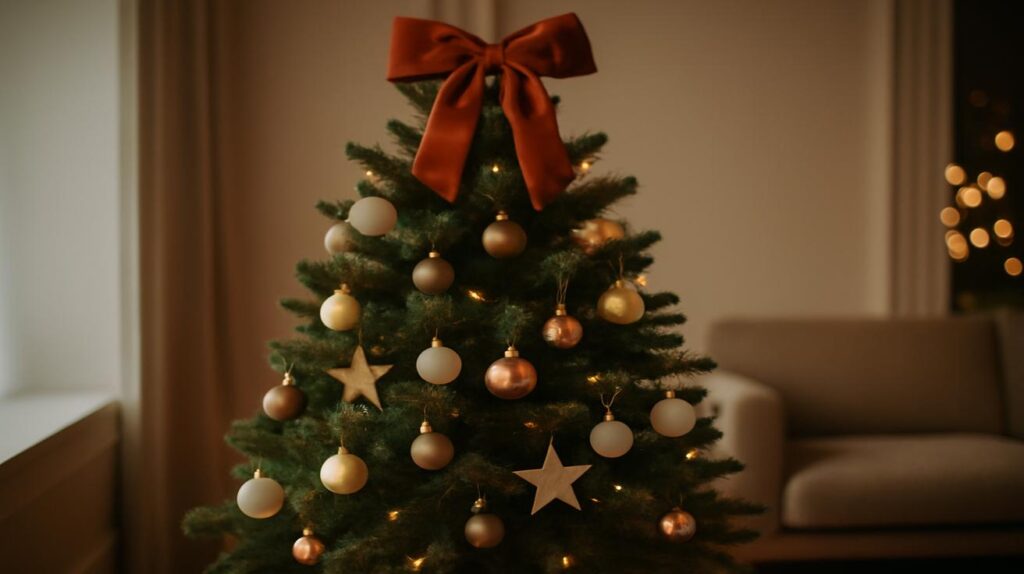
The first time I noticed something was missing, it was Christmas Eve and the tree was already glowing. The room smelled like pine and cinnamon, the kind of scent that digs into your memory and refuses to leave. White lights twined up the branches in neat, gentle spirals; glass baubles caught the glow and tossed it back in tiny constellations. But when I stepped back to admire the whole thing, my eyes shot straight to the top—and stopped. No star. No angel. No gaudy glittered explosion claiming the crown. Instead, a simple velvet ribbon cascaded down from the highest branch, like a waterfall of color, tied in a loose, elegant bow.
“The tree topper is dead,” my friend said, appearing beside me with a glass of mulled wine. “Nobody does those anymore. This is what decorators use now.”
She gestured toward the ribbon, and suddenly the entire tree looked different. Calmer. Taller. As if the absence of the traditional topper had freed it from something heavy and outdated. It was still a Christmas tree, still festive and warm, but it felt…current. Effortless. Surprisingly luxurious.
The Quiet Fall of the Traditional Tree Topper
Somewhere between vintage tinsel and LED light shows, the classic tree topper quietly began to lose its throne. For decades, that crowning ornament was the main character of the Christmas tree—a glowing star, a porcelain angel, a glitter-clad something, tilting dangerously as the month wore on. It was usually the last piece to go on, placed with great ceremony, often by the youngest person in the room or the tallest, depending on the family ritual.
But walk into many professionally decorated homes or boutique hotels now, and you’ll notice something different. The top of the tree is no longer shouting. It’s whispering. Instead of hard plastic stars or heavy glass figurines, you’ll see soft, draping ribbons. Rich, oversized bows. Sometimes just a simple cluster of branches and florals, but more often than not, ribbon is the new ruler of the tree.
Ask interior stylists, and they’ll tell you: the old-school tree topper throws off the balance. It can make even a beautifully curated tree look dated or top-heavy. The modern aesthetic has shifted toward trees that feel styled rather than stuffed, elegant rather than overloaded. And the ribbon—of all simple things—has become the understated hero that finishes the tree without screaming for attention.
The Rise of the Ribbon: Why Decorators Swear by It
Stand in a room with a ribbon-topped tree and you’ll notice the difference almost immediately. There’s a sense of flow, a vertical line that draws your eye from base to top in one smooth journey. The ribbon doesn’t sit on the tree; it belongs to it, woven in and out of the branches, then spilling from the crown like the final brushstroke on a painting.
Decorators love ribbon for one simple reason: it transforms a tree from an object covered in ornaments into a fully styled installation. Instead of a single point of interest crammed at the top, the ribbon creates movement. It tells your eyes where to go. It elongates short trees, softens sparse ones, and makes even an inexpensive artificial tree feel custom and intentional.
There’s also a practical angle, quietly driving this shift. Traditional toppers are awkward to store, break easily, and never quite sit straight unless you wrestle with the top branch and a fistful of floral wire. Ribbon, on the other hand, rolls up neatly in a drawer. It’s lighter, safer, and endlessly reusable. You can change the entire mood of your tree simply by changing the color, texture, or pattern of the ribbon, all without buying a new statement piece each year.
And in a world where trends move quickly and people crave flexibility, that kind of adaptability is gold. One year your tree can be moody forest green and black velvet. The next, it can be joyful red plaid and gold satin. The tree itself doesn’t change; the story you wrap around it does.
How the Ribbon Changes the Whole Tree
Ask any decorator and they’ll mention this: a ribbon “topper” is never just about the top. The magic happens because the ribbon connects the crown to the rest of the tree. It doesn’t just perch on the highest branch; it travels.
Imagine a wide, wired ribbon in deep champagne, tied softly at the uppermost branches. From that single knot, long tails spill down, weaving behind ornaments, reappearing two or three levels below, then vanishing again into the shadows of the branches. It feels almost like the tree is wearing a gown, draped with intention rather than dressed with random sparkles.
This helps solve one of the oldest Christmas tree problems: the “cluster effect.” So many trees end up with dense ornament coverage in the middle and near the bottom, while the top third looks patchy or oddly bare. Traditional toppers did little to fix that—they just added more weight and chaos at the very top. Ribbon, though, allows you to visually tie together different sections of the tree, creating rhythm and balance.
The New Star of the Show: Styles of Ribbon Tree “Toppers”
Just as we once debated star vs. angel, we now unofficially debate ribbon styles. Not all ribbon-topped trees look the same, and that’s part of their charm. The topper is no longer a single object; it’s a technique—one that can shift depending on your personality, color palette, and how formal or playful you want your tree to feel.
The Waterfall Cascade
This is the style that first caught my eye at my friend’s house. A generous bow sits near the top—not comically large, but full and relaxed, with loops that don’t look strangled by zip ties. From the center of that bow, three or four long strands of ribbon fall down the tree in soft, loose lines. The effect is romantic and grand, without being ostentatious.
The waterfall cascade works particularly well on tall trees, where that vertical emphasis makes the entire display feel stately. It’s also forgiving: even if your ornaments aren’t perfectly placed, the ribbon lines bring cohesion, creating the impression of intentional design.
The Woven Crown
Instead of one big focal bow, this style uses multiple shorter sections of ribbon arranged at the top, then tucked into the tree in a spiral pattern. Think of it as a crown that slowly dissolves into the branches. The top looks full and lush, with ribbon peeking out between ornaments like glimpses of fabric in a layered outfit.
The woven crown is ideal for those who want a more subtle “no topper topper.” There isn’t a single point grabbing attention; instead, the top third of the tree feels soft, abundant, and finished, without a rigid shape marking the crown.
The Structured Statement Bow
For people who miss the ceremony of placing “something” significant at the top, the structured bow steps in as a perfect compromise. Think of a large, beautifully crafted bow—often wired, with precise loops and long tails—mounted securely near the highest branch, but not stabbing into the ceiling like a nervous satellite dish.
This look nods to tradition while staying contemporary. It satisfies those who still want a moment of reveal—“Now we put on the topper!”—without returning to brittle plastic stars that clash with more refined décor. The bow can be bold and glamorous, or clean and minimal, depending on the ribbon you choose.
Choosing the Right Ribbon: Texture, Color, and Character
The moment you start shopping for ribbon with your tree in mind, you realize it’s not just an accessory. It’s the backbone of your whole design. The wrong ribbon can make a tree feel cheap or overdone; the right one can make even dollar-store ornaments look intentional and chic.
| Ribbon Type | Look & Mood | Best For |
|---|---|---|
| Velvet (wired) | Rich, soft, luxurious, light-absorbing | Elegant, moody, or hotel-lobby style trees |
| Satin or Silk (wired) | Sleek, reflective, glamorous | Formal, classic, metallic-accented themes |
| Linen or Cotton | Natural, relaxed, organic | Scandi, farmhouse, and minimal looks |
| Plaid or Patterned | Playful, cozy, nostalgic | Family trees and traditional Christmas color schemes |
| Sheer or Organza | Light, airy, softly glowing | Delicate, ethereal, or all-white trees |
Wired ribbon is the secret weapon here. It’s what allows loops to hold their shape, tails to drape with intention, and “waterfalls” to curl just enough to feel alive. Non-wired ribbon can still be beautiful, especially for a relaxed or rustic tree, but it won’t give you the sculptural presence most decorators aim for at the top.
Then comes color. The modern decorator rarely chooses ribbon that fights with the ornaments. Instead, the ribbon usually leads the palette. Pick your ribbon first—say, deep forest green velvet with a faint gold edge—and let everything else follow. Ornaments, florals, even the tree skirt can echo or gently contrast that central choice. Suddenly, your tree looks like it was designed, not accumulated.
How to “Top” Your Tree with Ribbon: A Gentle How-To
There’s a small moment of panic the first time you skip the star. The top of the tree, naked and pointy, feels unfinished, like a sentence without a period. But once you understand the basic motions of a ribbon topper, that nervousness is replaced by playfulness. It becomes less about perfection and more about seeing what feels right.
Start Before the Ornaments
Most decorators begin with lights, then ribbon, then ornaments. It feels counterintuitive if you’ve always treated the topper as the last triumphant flourish, but ribbon needs room to breathe. When you add it early, you can tuck it into the branches naturally, adjusting and retucking until the cascades or spirals feel organic.
To create a simple cascade topper, cut long lengths of ribbon, secure them near the top with a bit of floral wire or a discreet twist tie, and let them fall. Then, working your way down, gently pinch and tuck the ribbon into the branches every foot or so, letting it billow slightly between contact points. This creates that loose, luxurious drape rather than a flat line that clings stiffly to the tree.
Think in Layers, Not One Big Bow
Even if you love a dramatic bow at the top, the trick is to build it in layers. Start with two or three long tails fixed at the upper branches. Add a medium bow over that point, then, if desired, a larger bow layered over the first, rotating the loops slightly so they don’t all sit in the same direction. This avoids the dreaded “gift-wrapped box” look and instead gives the bow dimension and softness.
Step back every so often. The tree will tell you what it needs—a bit more volume on one side, another cascade to balance a heavy ornament cluster, or perhaps a quieter top if the rest of the tree is already exuberant. Ribbon is forgiving; you can always pull it out and try again.
Sentiment vs. Style: Do We Really Want the Topper to Die?
For some, the idea of abandoning the traditional tree topper feels almost disloyal. The angel that’s been in the family for forty years. The star a grandparent brought from another country. The lopsided felt crown a child made in school. These objects carry stories as heavy as their glitter, and they don’t fit neatly into the narrative of tasteful, grown-up decor.
But perhaps the “death” of the classic topper isn’t about erasing those memories; it’s about changing their role. That heirloom angel doesn’t lose her power if she moves from the top of the tree to a shelf vignette, or a place of honor on the mantle, lit softly by candles. The star passed down through generations can sit in a shadow box each year or lean casually against a stack of Christmas books. In some ways, freeing these sentimental objects from precarious perches at the top of a tree makes them safer, more visible, and more appreciated.
Meanwhile, the ribbon quietly handles the work of elegance. It becomes the framework, the visual architecture that lets everything else—ornaments, keepsakes, memories—shine in a more cohesive way. Your tree no longer revolves around a single object; it becomes a lived-in story from top to bottom.
So yes, in the language of design, the tree topper is dead. In the language of feeling, it’s simply retired from its old job, given a gentler, more thoughtful role elsewhere in the room.
The New Christmas Silhouette
If you step back from a room where a ribbon-topped tree stands quietly glowing, you’ll notice something subtle but important. The tree is no longer punctuated by a hard point. The outline is softer, more organic. Instead of a star stabbing the air, you see a plume, a fall, a crown that seems to belong to the branches rather than sit atop them.
This is the new Christmas silhouette: trees that feel less like displays and more like living sculptures. Their tops are finished, but not shouting. Their decorations are intentional, but not rigid. They reflect a broader mood in how we want our homes to feel—edited, calm, but deeply personal.
One day, a child growing up now will probably explain it to someone else without thinking: “No, we don’t put a star on top; we do ribbon instead. That’s how it’s done.” And somewhere in a box in the attic, an old angel will be waiting—not forgotten, just resting between appearances, part of the family story even if she no longer rules the highest branch.
For now, as you stand in front of your own undecorated tree, the top leaning slightly to one side, the decision hangs in the air. Do you reach into the box for the star you’ve always used, or do you pick up a length of ribbon and let it spill between your fingers, testing how it feels to start a softer tradition?
Either way, Christmas will come. The lights will glow. The room will smell like pine and cinnamon. But if you choose the ribbon, you may find yourself doing what I did that night in my friend’s living room: staring up at the gentle fall of fabric from the crown and quietly admitting, almost reluctantly, how right it looks.
Frequently Asked Questions
Is it really “wrong” to use a traditional tree topper now?
No. It’s not wrong at all—it’s simply less common in professionally styled spaces. The shift toward ribbon is about aesthetics and balance, not rules. If a star or angel holds deep meaning for you, there’s always a way to include it, whether at the top, on a lower branch, or in a separate display.
How much ribbon do I need for a standard tree?
For a 7–8 foot tree, decorators often use between 9 and 18 meters of ribbon, depending on how full and dramatic they want the effect to be. If you’re new to ribbon, start with less; you can always add more sections.
Can I mix a small topper with ribbon, or should I choose one approach?
You can absolutely mix both. Many people use a modest star or figurine at the top, then soften and extend its presence with ribbon cascades or woven strands. The key is scale—keep the topper smaller and let the ribbon do most of the visual work.
What width of ribbon works best for tree toppers?
Wider ribbons—around 5 to 10 centimeters—tend to look more luxurious and are easier to shape into bows and cascades. You can mix in narrower ribbons as accents, but using only very thin ribbon can make the tree look busy rather than refined.
Does the ribbon trend work on small or tabletop trees?
Yes, but with adjustment. On smaller trees, use narrower ribbon and simpler bows or mini cascades to avoid overwhelming the proportions. Even a single, neatly tied ribbon at the top, with just a short tail or two, can give a small tree a polished, modern finish.