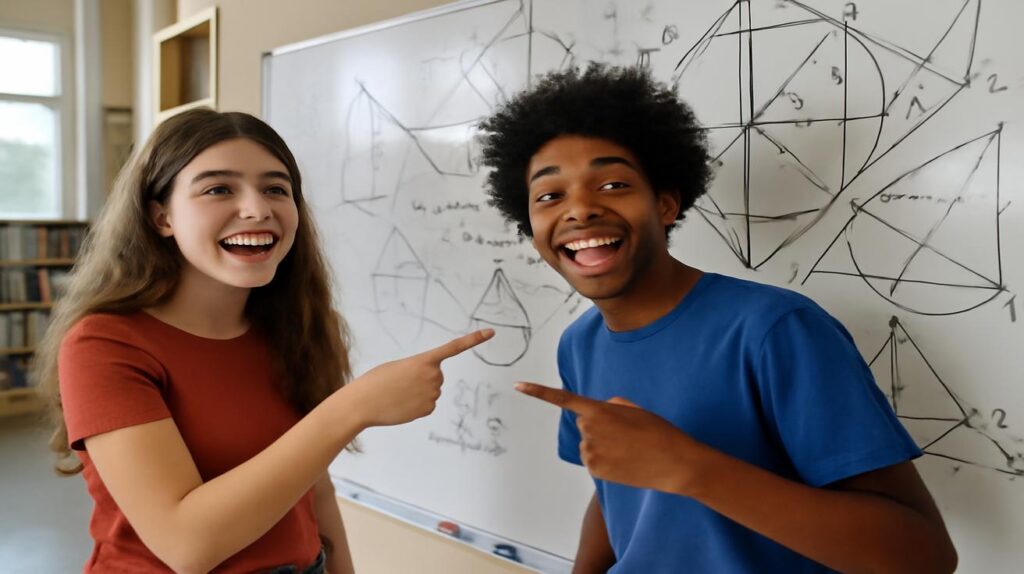
The classroom smelled faintly of dry erase markers and teenage nerves. Outside, the Florida sky was smearing itself into late-afternoon peach, but inside, two high school students were chasing a ghost that had haunted mathematics for more than two thousand years. On the whiteboard, triangles leaned at awkward angles, lines crisscrossed like spiderwebs, and somewhere in the mess of symbols and arrows, Pythagoras himself—if he’d been around—might have arched an eyebrow.
When Homework Becomes History
It didn’t start with a grand mission to rewrite the story of math. It started like most teenage afternoons do: a school bell, a bit of boredom, the rustle of notebooks. Calcea Johnson and Ne’Kiya Jackson, two American teenagers from New Orleans, were just doing what their teachers asked—working through geometry problems that had lulled generations of students into daydreams.
But something was different in this classroom. Their teacher had nudged them toward a puzzle hidden in plain sight: Pythagoras’ theorem. The old familiar friend of high school math: a² + b² = c². Three symbols that have strutted across the pages of history, from ancient Greece to standardized tests, from chalkboards to computer code.
For thousands of years, mathematicians have known that if you take a right triangle, square the two shorter sides, and add them, you get the square of the longest side. More than 370 proofs of this have been found—by everyone from Euclid to Einstein, by Chinese scholars and Indian mathematicians, by artists and engineers. You would think, by now, the story was complete, every corner lit, every shadow explored.
But there was a rule. An unwritten line in the sand modern mathematicians had drawn: you can’t use trigonometry—functions like sine, cosine, and tangent—to prove Pythagoras’ theorem. Because those functions themselves are built on the shoulders of right triangles. To use them would be like saying, “This book is true because this book says so.” Circular. Self-referential. Off-limits.
And yet, in a small classroom far from the marble halls of academia, two teenagers began to wonder: what if there was a way to walk the edge of that circle without stepping inside it?
The Ancient Triangle and the Modern Mind
To feel the magnitude of what they did, you have to go back—to a time long before calculators and laptops, even before paper as we know it. Pythagoras, or perhaps his followers—historians still argue about the origins—were obsessing over shapes and numbers on the sun-warmed stones of ancient Greece. The right triangle became their favorite puzzle piece.
Picture a right triangle drawn in the sand: one angle squared off perfectly, the other two leaning in like shoulders. The sides pressed against that right angle are called legs; the one stretching across from it is the hypotenuse. And the discovery that the square of the hypotenuse equals the sum of the squares of the legs was like finding a master key. It unlocked architecture, astronomy, navigation—an invisible engine behind the visible world.
The theorem spread along trade routes and empires, brushed by the hands of Babylonian scribes, Indian astronomers, and Chinese philosophers. Over centuries, proofs multiplied like wildflowers. Geometric proofs with rearranged shapes. Algebraic proofs with elegant manipulations. Visual proofs that made you feel the truth before you could even articulate it.
Still, as trigonometry evolved—a language of angles and ratios—it leaned, quietly but firmly, on the Pythagorean relationship. Sine and cosine live in a world where the sum of their squares must equal one, a shadow of that a² + b² = c² etched onto the unit circle. To use trig to justify Pythagoras was to spin in a logical loop.
That loop became a kind of mythic “do not enter” sign. For centuries, it stood unchallenged. Until two teenagers, squinting at those very trigonometric relationships, found a crack in the wall.
Two Students, One Impossible Question
The air in a math classroom at the end of the day has its own texture: a mix of fatigue and possibility. Calcea and Ne’Kiya, students at St. Mary’s Academy in New Orleans, weren’t supposed to be rewriting history. They were supposed to be learning it.
They started with something deceptively simple: trigonometric identities. Relationships like sin²θ + cos²θ = 1, burned into countless study guides and scribbled onto the margins of exams. These identities feel like rules of the universe, handed down like weathered tools. But their teacher nudged them to pull at a thread: could they treat these not as starting assumptions, but as things to be earned from more primitive truths?
In the quiet clatter of working after school, they did something most adults rarely attempt: they questioned the foundation. What if, they asked, we built everything from scratch—using only geometry, only ratios of sides, only the most basic properties of similar triangles? Could we construct a version of trigonometry that didn’t secretly borrow from Pythagoras’ theorem?
This is where their work became radical. They weren’t just trying to prove a famous formula; they were trying to build a ladder around the circular logic that had kept trig-based proofs off the table for centuries. Instead of using sine and cosine as defined on the unit circle (which assumes Pythagoras), they worked with them as pure ratios in right triangles, then climbed step by step, making sure not to smuggle in the very theorem they were trying to prove.
The process wasn’t glamorous. It was scratch paper and eraser dust, late nights and second guesses. Angles labeled with Greek letters, lines drawn, redrawn, re-labeled. But somewhere along the way, they discovered something that no one had ever formally published: a method of proving Pythagoras’ theorem using trigonometric ideas—without using the theorem to define those ideas in the first place.
The Day the Math World Looked Up
Imagine walking into a room full of professional mathematicians with your high school notebook in your hands. The room is buzzing with quiet conversations, the faint thump of laptop keys, the low murmur of people who have spent decades sharpening their minds on hard problems. You are, by almost any measure, not supposed to be here as a speaker.
Yet in 2023, at a meeting of the American Mathematical Society, that’s exactly what happened. Johnson and Jackson presented a new path to an old truth: a trigonometric proof of Pythagoras’ theorem that didn’t break the logical rules.
Their work, rooted in clever uses of similar triangles and angle relationships, builds trigonometric expressions carefully, brick by brick, until the Pythagorean relationship emerges—not as an assumption, but as a destination. In doing so, they slipped through a gap that had remained invisible to mathematicians for centuries. They didn’t demolish the old house of geometry; they found a new staircase in it.
For the math community, it wasn’t just the content that stirred attention—it was the authors. Two young Black women, still teenagers, stepping into a tradition that has often shut them out or written them into the margins. Their success was both a mathematical event and a cultural moment: a reminder that talent is not confined to certain neighborhoods, certain genders, certain ages.
Suddenly, people who hadn’t thought about math in years were reading headlines. Pythagoras trended. Geometry, usually a quiet background character, stepped into the spotlight for a brief, electric moment.
| Aspect | Traditional Story | Johnson & Jackson’s Twist |
|---|---|---|
| Who proves Pythagoras? | Ancient scholars, famous mathematicians, textbook authors. | Two modern American teenagers in a high school classroom. |
| Main tool used | Geometry, algebra, visual rearrangements. | Trigonometric ideas built from scratch, avoiding circular logic. |
| What’s new? | More variations on known geometric proofs. | A non-circular trig-based proof long thought out of reach. |
| Why it matters | Preserves and explains a classic theorem. | Expands how we can rigorously build trigonometry and teach geometry. |
What Their Proof Changes for the Rest of Us
For most people, proofs sound like something remote and sterile: black marks on white pages in books no one volunteers to read. But a proof is really a story. It’s how we know something is true, not just this time, not just in this room, but everywhere, always.
In that sense, Johnson and Jackson didn’t just add a technical result; they added a chapter to a human story we all quietly live inside. Their work suggests that even in a field as ancient and well-trodden as geometry, we haven’t hit the edge of the map. That triangle you sketched half-heartedly in a notebook years ago? It still has secrets.
Their proof also has practical ripples. It offers teachers a fresh way to connect geometry and trigonometry, a new narrative bridge between worlds often taught as if they were neighboring but unrelated towns. Picture a classroom where students see how trig can be built from geometric first principles and then used—carefully—to revisit Pythagoras from a new angle. Instead of feeling like they’re memorizing disconnected facts, they begin to sense the weave of the fabric.
And then there’s the symbolic weight. Two teenagers from a historically Black Catholic school presenting at a major mathematical conference throws a bright, necessary light on who we imagine as “real mathematicians.” It challenges a quiet cultural assumption that breakthroughs spring mostly from cloistered geniuses with advanced degrees.
The truth is gentler and wilder: curiosity doesn’t check your age or resume, and the universe doesn’t reserve its secrets only for people with titles. Sometimes, it opens a door in a classroom that still smells like dry erase markers.
The Sensory Life of a Triangle
Math is often spoken of in dry terms, as though all the color has been bled out of it, but geometry is an intensely sensory thing if you let it be.
Imagine running your finger along the edge of a right triangle sketched on graph paper. The shortest leg steps upward; the base stretches horizontally, parallel to the table’s edge. The hypotenuse leans between them, a small, defiant diagonal. Now imagine coloring in little squares along each side, building perfect grids outward like quilts.
On the two legs: smaller, denser blankets of color. On the hypotenuse: one larger square, its edges tilted. Pythagoras’ theorem whispers that if you could scoop up all the tiny squares from one leg and pour them into the other, you’d exactly fill the tilted quilt. No more, no less. Not a single square missing. That’s not just algebra; that’s a delicate balance you can almost feel.
Now stand in a field at dusk, phone forgotten, and look at a power line triangle against the sky: pole, ground, wire. The length of the wire, the height of the pole, the stretch of ground—they’re locked together in that same quiet relationship. On a ship’s deck, a navigator angles a line from mast to horizon. In a forest, a biologist estimates the height of a tree by stepping back, measuring shadow and angle.
You begin to realize Pythagoras isn’t just a classroom formula; it’s a thread woven through landscapes and skylines. And somewhere in New Orleans, two young women followed that thread in their minds, tugging gently until a new pattern emerged.
Beyond the Theorem: Why Stories Like This Matter
Underneath the specifics of triangles and trig lies a broader question: what counts as discovery? Is it only “new” if it uncovers something no one has ever thought of, or is it also new when it arranges known pieces in a way that was once believed impossible?
The world of mathematics is strange in this way. Sometimes a “new” result doesn’t add a brand-new fact so much as it adds a new path—another way up the same mountain. Johnson and Jackson’s work doesn’t change the truth of Pythagoras’ theorem; it changes how we can get there. It expands the map of understanding.
And that matters—for education, for inspiration, for who feels welcome in the room where questions are being asked. When students see people their age, who might share their background, not just learning math but contributing to it, a mental door clicks open. The subject shifts from a wall of requirements to a field of possibilities.
This story also reminds us of something quietly radical: that the frontier of knowledge is not just in far-off labs or deep-space telescopes. It’s in classrooms and after-school study sessions, in kids who don’t yet know what they’re “not supposed” to be able to do. It’s in the way a teacher phrases a challenge, in the spark that crosses a student’s face when they realize, Wait—what if…?
For centuries, Pythagoras’ theorem has been a case closed, a settled law. Now, thanks to two American teenagers with sharp pencils and stubborn curiosity, it has become, once again, a living story. Not because the theorem was wrong, but because our ways of knowing it were not yet complete.
Frequently Asked Questions
Did these teenagers really “disprove” Pythagoras’ theorem?
No. They did not disprove the theorem; they confirmed it in a new way. Pythagoras’ theorem is still true. What Calcea Johnson and Ne’Kiya Jackson did was find a new proof—specifically, a trigonometric-style proof that avoids the usual circular logic that has long kept such proofs off-limits.
Why can’t you normally use trigonometry to prove Pythagoras?
Traditional definitions of sine, cosine, and other trigonometric functions rely on right triangles or the unit circle, both of which already assume the truth of Pythagoras’ theorem. So if you use trig defined this way to prove Pythagoras, you’re using the theorem to prove itself. That circular reasoning is considered invalid in rigorous mathematics.
What makes Johnson and Jackson’s approach different?
Their work builds the needed trigonometric relationships from more basic geometric ideas, like similar triangles and angle properties, without assuming Pythagoras’ theorem along the way. Only after this foundation is laid do they use those relationships to derive the familiar a² + b² = c² result. That sidesteps the logical circle.
Is their proof officially accepted by mathematicians?
Their work gained attention after being presented at a meeting of the American Mathematical Society, which is a serious platform. As with any new result, mathematicians examine, critique, and refine the details over time. But the core idea—that they found a non-circular trig-based route to Pythagoras—has been widely recognized as significant and genuinely new.
Why should non-mathematicians care about this story?
Because it shows that big ideas can come from unexpected places. Two high school students stepped into a two-thousand-year-old conversation and moved it forward. Their story is about curiosity, persistence, and the power of education to open doors. Even if you never use trigonometry again, it’s a reminder that the world is still full of discoveries—and that who gets to make them is changing in real time.