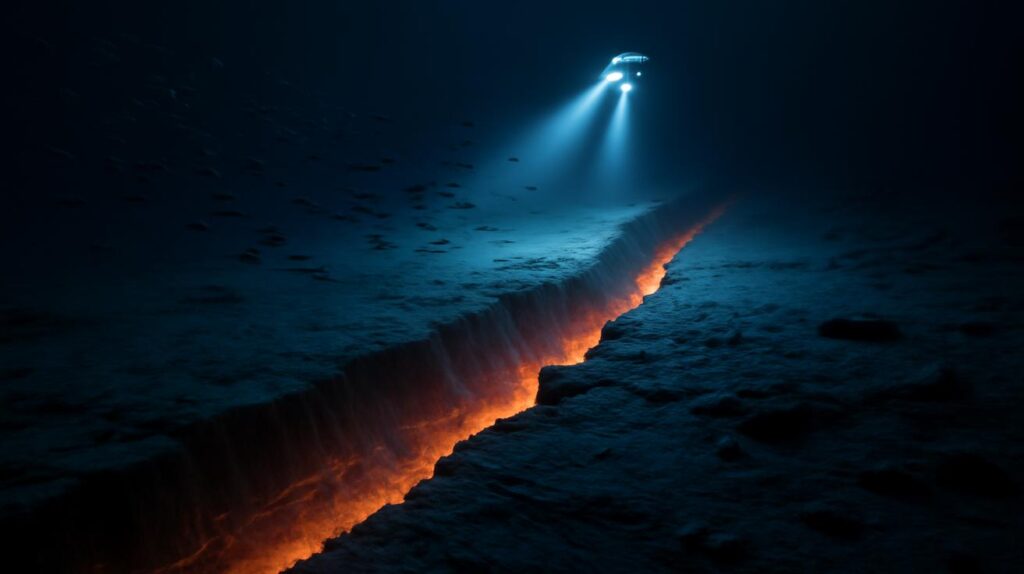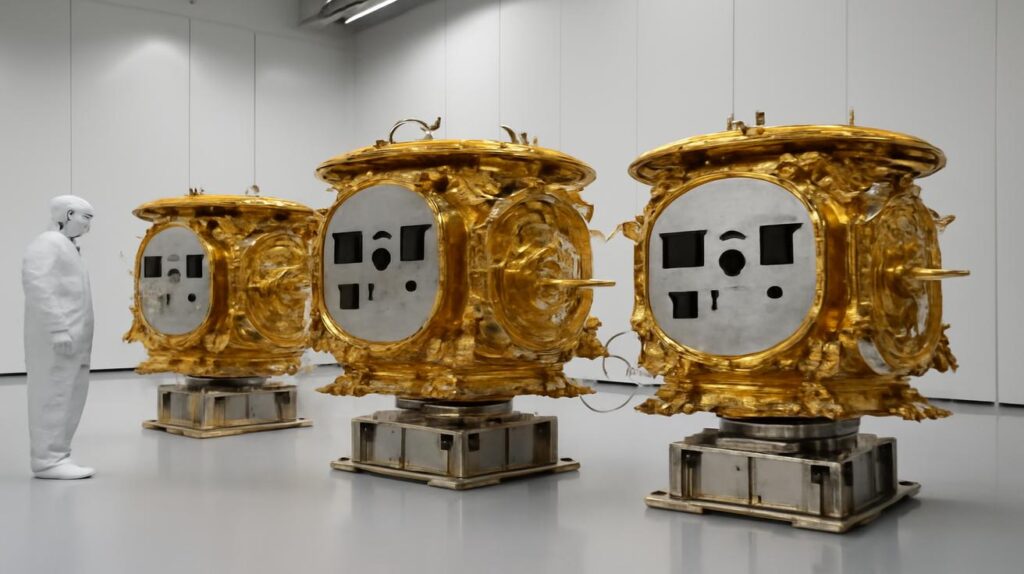
On a cold morning not far from now, three identical spacecraft will pull away from Earth like slow-moving fireflies. They will not be headed for Mars, or Jupiter, or any glamorous postcard destination. Instead, they are going hunting for ripples in reality itself—tiny shivers in space and time that Albert Einstein predicted more than a century ago. Humanity has been waiting 110 years for this moment, watching equations and chalk dust and computer code pile up, all to answer a question that sounds almost mystical: does the fabric of the universe actually tremble when something colossal happens far away?
The Quiet Sound of a Violent Universe
Imagine standing beside a perfectly still mountain lake at dawn. Mist clings to the surface; the air is cold enough to taste. Then, far across the water, something heavy falls in—a stone, perhaps, or a tree limb sliding from a cliff. You don’t see the impact. You don’t hear the splash. But a few moments later, a faint ripple kisses the shore at your feet. It’s proof that something powerful happened, somewhere else.
This, in essence, is what gravitational waves are. Except the “lake” is spacetime itself, the invisible framework that underlies everything: stars, planets, your heartbeat, your coffee cup. When titanic objects—black holes, neutron stars, maybe even phenomena we haven’t imagined yet—crash together or whirl around each other, they disturb that fabric. Waves move outward at the speed of light, stretching and squeezing space as they pass. Distances change ever so slightly. Reality pulses.
Einstein’s general theory of relativity, published in 1915, implied these ripples had to exist. In 1916, working through the math more deeply, he predicted them outright. But he didn’t think we’d ever be able to detect them. The effect, he argued, would be too small. Too fleeting. Lost in the noise of the cosmos.
He underestimated our stubbornness.
On Earth, we finally heard the universe “ring” in 2015, when the LIGO observatory captured gravitational waves from two colliding black holes more than a billion light-years away. That first detection was like hearing a faint chime in the distance. Since then, LIGO and its European and Japanese cousins have been listening to the sky like a network of exquisitely tuned ears. But they are ground-based instruments, and the Earth is a noisy place—rattling with trucks, earthquakes, wind, and even the gentle pull of the tides.
To truly hear the deep bass of the universe—the slow, heavy waves from monstrous black holes millions of times more massive than the Sun—we need to leave the planet behind.
The Triptych in the Sky
Picture three spacecraft, each about the size of a small room, drifting in a perfect triangle millions of kilometers apart. They float together around the Sun the way a formation of birds might circle an invisible thermal. Thin, pale laser beams ping back and forth between them, over and over, measuring the distance between each pair of craft with absurd precision—down to a fraction of the width of an atom.
This is the essence of the space-borne mission humanity has been working toward: a triptych in orbit, three pieces making one instrument. On its own, each spacecraft is just another robot in the void. Together, the trio forms a gigantic gravitational-wave observatory, an equilateral triangle of light stitched across the vacuum.
If a gravitational wave passes through this triangle, it distorts the distances between the spacecraft by a whisper. One side gets a little bit longer. Another side gets slightly shorter. The laser beams notice. That change—so small it would make a human hair look like a skyscraper in comparison—is recorded as a signal, a note in the universe’s grand symphony.
This space triptych has been in planning and development for decades, under different names and designs, passing through feasibility studies, technology demonstrations, and political wrangling. It represents an international promise that took root in the shadow of Einstein’s equations and has slowly grown through generations of scientists and engineers who may never see the launch themselves.
Their dream is now almost ready to leave the launchpad.
A Cosmic Observatory You Can’t Visit
You will never stand on the deck of this observatory. There will be no astronaut selfies framed against its body. No human will ever float past its instruments with a wrench in hand.
Instead, this triptych will exist as a ghostly structure, defined less by metal and electronics than by pure geometry and light. Its arms—millions of kilometers long—will be made entirely of laser beams and mathematics. Its “mirror” segments are actually exquisitely polished test masses, floating in almost perfect free-fall inside each spacecraft, protected from every possible disturbance.
The technology that makes this possible reads like purposeful science fiction: micro-Newton thrusters that can nudge a spacecraft with the force of a falling feather; drag-free control systems that let the test masses drift untouched, while the craft dances around them to block solar radiation and other nudges; lasers whose frequency must be fiercely stabilized so they don’t “jitter” more than the incredibly faint signals they’re trying to measure.
And beneath it all lies trust—trust in centuries of physics, in engineering so delicate it’s almost an art, and in the astonishing predictability of gravity itself. For the mission to work, we have to place instruments in an invisible grid of spacetime and wait, patiently, for the universe to tap it like a drum.
Listening to the Deep Notes
Ground-based detectors like LIGO listen to higher-pitched gravitational waves: short, sharp chirps from smaller black holes and neutron stars colliding in the final seconds of their dance. The space-based triptych, drifting far from Earth’s noise, will listen lower. Much lower.
It is tuned to a realm of waves with periods from seconds to hours—cosmic bass notes produced by supermassive black hole binaries at the centers of merging galaxies, by compact objects orbiting these titans, and perhaps by entirely new forms of physics. These objects move more slowly, take longer to collide, and sing deeper songs than anything we can pick up from the ground.
Think of it as the difference between listening to a solo violin and an orchestra’s full double-bass section. The violin is beautiful, bright, urgent. But the double bass gives a piece its weight, its gravity, its sense of inevitability. A space-based detector lets us hear those heavy, slow notes that have been vibrating through the universe for billions of years.
Some of the signals this mission might detect will be predictable years in advance. The orbits of massive binaries are slow and stately; their gravitational waves are like a warning drumroll that builds and builds before the inevitable crash. Others may arrive unannounced, surprises flung in our direction by a universe that is far from done surprising us.
From Ideas on Paper to a Machine in the Void
For most of the 110 years since Einstein’s prediction, gravitational waves existed in a strange twilight between theory and reality—a ghost built from math. The story of how they traveled from chalkboard diagrams to orbiting observatory is something of a quiet epic in itself.
It started with theoreticians in the early twentieth century, arguing over whether these waves were “real” or just convenient bookkeeping in Einstein’s elegant but unforgiving equations. Later, clever astronomers noticed that a pair of neutron stars, locked in a tight mutual orbit, were slowly spiraling closer together in exactly the way predicted if they were losing energy to invisible waves. Gravitational waves became more than a theory; they became the only explanation that fit the data.
Then came the era of lasers, vacuum tubes, and enormous interferometers—machines like LIGO that hurled beams of light down long tunnels to measure the tiniest changes in distance. The first versions were noisy, hopeful, and largely silent. But with each upgrade, each refinement of mirrors and suspensions and data analysis, the instruments grew more sensitive. They learned to listen past the rustle of Earth.
When the first direct detection happened in 2015, it was the scientific equivalent of a dam breaking. A century-old prediction had taken physical form. The universe, it turned out, was loud. Black holes collided. Neutron stars merged in bright flashes of gamma rays and heavy elements. We were, suddenly, not just looking at the universe, but hearing it.
And almost immediately, attention shifted upward—toward space, where the really deep listening could begin.
The Space Triptych at a Glance
It can be easy to get lost in the poetry of “ripples in spacetime” and forget that at the heart of this mission are tangible, engineered objects: spacecraft, lasers, thrusters, computers. To ground the vision, here’s a compact snapshot of how this triptych will live and work in space.
| Feature | Role in the Mission |
|---|---|
| Three-spacecraft triangle | Forms a giant interferometer to measure minuscule distance changes caused by passing gravitational waves. |
| Arm length (millions of km) | Extremely long baselines increase sensitivity to low-frequency “bass” gravitational waves from supermassive objects. |
| Free-falling test masses | Act as nearly perfect reference points, shielded from forces other than gravity. |
| Ultra-stable lasers | Measure distance variations smaller than a fraction of a proton’s width over millions of kilometers. |
| Drag-free control | Uses micro-thrusters to let the spacecraft “follow” the test masses without disturbing them. |
What We Hope to Discover Out There
Underneath the engineering lies an almost childlike curiosity. We are building this vast, fragile ear in space because we want to know how the universe became the way it is. Many of the questions it may help answer are less about exotic mathematics than about our cosmic biography.
Supermassive black holes, the colossal anchors at the centers of galaxies, are among the mission’s main targets. We can see the stars and gas swirling around them. We can watch their jets lance outward. But we still don’t truly know how they grew so huge or how often they collide with each other when galaxies merge.
Gravitational waves from these mergers will carry a detailed record of their mass, their spin, and the intricate choreography of their orbital dance. By listening to them in low-frequency waves, the space triptych will act like a galactic historian, reconstructing the life stories of these dark giants. Each signal is a fossil, a time capsule from an era when the universe looked very different.
Then there are the “extreme mass ratio inspirals,” a phrase that sounds like an obscure punk band but describes something staggeringly dramatic: a smaller, dense object like a stellar-mass black hole or neutron star slowly spiraling into a supermassive black hole. Every orbit, every tiny change in trajectory, writes a line in the poem of gravitational waves. For months or years, the signal builds and complicates, encoding the geometry of spacetime around the giant black hole in exquisite detail.
Decode that signal, and you are testing Einstein’s theory in one of the most extreme laboratories nature has to offer. If gravity behaves differently there than expected—even slightly—it could point toward deeper physics, perhaps even a long-sought bridge between general relativity and quantum mechanics.
A New Way of Being Human in the Cosmos
It’s easy to treat missions like this as something that “scientists” and “space agencies” do—remote, technical, out of reach. But if you step back for a moment, there’s something profoundly human about the whole enterprise.
We are a species that paints the night sky on cave walls and also writes its equations on whiteboards. We tell myths about the stars, then build machines to argue with those myths. We are never satisfied with just looking. We want to feel the universe, to touch it, even if the “touch” is a faint ripple crossing an interferometer millions of kilometers wide.
When the space triptych begins operations, its data will pour quietly back to Earth—streams of numbers, patterns of noise and signal that most of us will never see directly. But those patterns will be translated into stories, images, sounds. Just as the first LIGO detection was turned into an audible “chirp” that humans could literally listen to, these deeper, slower waves may be rendered into something we can sense.
It’s not hard to imagine future children lying under a planetarium dome, not just seeing galaxies merge on the screen above them, but hearing the slow, rising hum of their gravitational waves translated into sound. What feels like pure abstraction today becomes part of our sensory world tomorrow.
In that sense, the mission is not only about physics. It is about expanding the ways we are able to experience existence. For the first time, we are on the verge of inhabiting a universe that is not just luminous but sonorous—a universe we can both see and hear across impossible distances.
The Weight of a Century
When Einstein scribbled his equations by the light of gas lamps and early electric bulbs, he could not have known that his ideas would give birth to a silent machine in deep space, listening to the songs of dying stars. He imagined a universe governed by geometry and curvature, by fields and tensors, and then left it to those who came after him to see how far those ideas could be pushed.
In the 110 years since, humanity has done something quietly astonishing. We have turned abstract mathematics into gently trembling mirrors, into lasers and control loops, into rockets that carve fire through the sky and leave behind machines that float in the gentle darkness between worlds.
There is something poetically fitting that the mission now poised to launch in search of his waves is itself a kind of triptych—not just three spacecraft, but also a threefold fusion of theory, technology, and imagination. None of the three could have done this alone. The equations by themselves are just symbols. The technology without the equations would be blind. Imagination without either would have nowhere to land.
Soon, all three will meet in orbit around the Sun.
And when the first low-frequency gravitational waves finally register in that vast triangle of light—when the distances between spacecraft twitch by a measurement too small to name—we’ll know that we’ve added a new sense to our species. We’ll have proven that patience, curiosity, and a stubborn trust in our own ideas can reach all the way from a page of equations in 1916 to a silent, listening machine millions of kilometers from home.
Humanity has waited 110 years for this moment. The lake is calm. The instruments are ready. Somewhere out there, in the distant dark, a stone is falling into the water. The ripples are on their way.
FAQ
What exactly are gravitational waves?
Gravitational waves are ripples in the fabric of spacetime, produced when massive objects accelerate—especially in violent events like black hole or neutron star mergers. They stretch and squeeze distances as they pass, but the effect is incredibly tiny.
Didn’t we already detect gravitational waves?
Yes. The first direct detection was made in 2015 by the LIGO observatory on Earth. Since then, several ground-based detectors have observed many events. The space-based triptych will complement them by listening to lower-frequency waves that ground detectors cannot access.
Why do we need a detector in space?
Earth is noisy: seismic activity, human vibrations, and atmospheric effects limit how long and how low in frequency ground detectors can listen. In space, far from these disturbances, we can build a much larger, more stable observatory sensitive to slow, powerful waves from supermassive black holes.
What kinds of objects will this mission study?
The mission will focus on supermassive black hole binaries, smaller objects spiraling into them, and other low-frequency sources. It might also detect signals from early-universe processes or unexpected phenomena that don’t fit current theories.
How sensitive is this space triptych?
Its lasers will measure changes in distance over millions of kilometers that are smaller than a fraction of the width of a proton. This extreme sensitivity is what allows it to detect the faint stretching and squeezing of spacetime caused by distant gravitational waves.
When will we start getting results?
After launch, the mission will undergo a commissioning phase to test and calibrate its systems. Once fully operational, it is expected to gather data for years, gradually building a catalog of gravitational-wave sources and refining our picture of the universe.
Why is this mission considered the fulfillment of Einstein’s prediction?
Einstein predicted gravitational waves over 100 years ago but doubted they could ever be detected. Ground-based detectors proved him wrong for high-frequency waves. A space-based triptych extends that success into the low-frequency realm he could never have imagined us reaching, turning his once-abstract ripples into a fully mapped, multi-octave cosmic symphony.