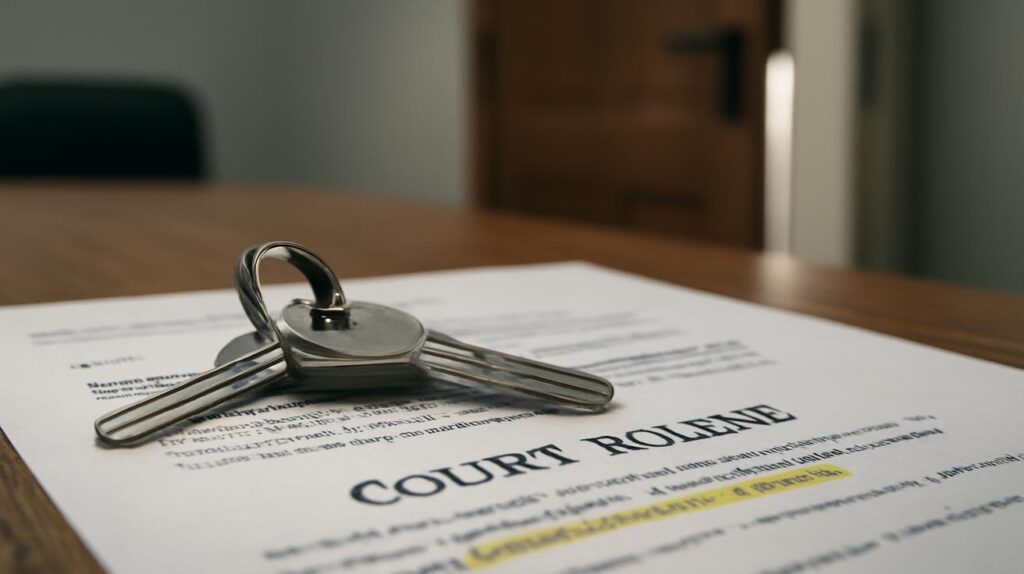
The keys lay on the kitchen counter like a tiny accusation—two brass teeth, a plastic tag, and a story that, somehow, would end up in court. Outside, the hallway smelled of fresh paint and someone else’s curry. The moving truck was gone. The apartment was as hollow as a seashell. Yet the tenant, exhausted and a little numb, walked out without handing those keys back to the landlord in person. Life was already pulling them toward the next thing—new job, new city, new rent. The keys would become an afterthought.
The Day the Lease Ended
Walkthrough day is always a strange kind of ritual. Rooms that once felt intimate suddenly feel like a stage set after the final curtain. Nail holes show up like freckles. Dust gathers in the corners the furniture used to hide. This was the backdrop when the lease quietly reached its last day.
The tenant had done most things right. Rent paid through the final month. Walls roughly cleaned, fridge wiped, trash tied up and carried down three flights of echoing stairs. A forwarding address scribbled on the move-out form. One last glance at the empty living room where, months earlier, friends had sat on the floor with pizza boxes and too-loud laughter.
But everyone who’s ever moved knows this: endings are messy. That particular day, the tenant’s phone buzzed with texts from movers, the new landlord, a boss asking if they could start earlier than planned. There was no grand, ceremonial key handoff. No photograph of the landlord and tenant shaking hands like actors in a rental brochure. The keys stayed on the counter. The tenant shut the door, which now locked behind them from the hallway, and walked away.
Later, when the landlord stepped into the quiet unit and saw those keys, something else began moving—slowly at first, like a storm forming over distant water.
A Technicality Becomes a Battlefield
It started with an email, as these things often do. The tenant had already started arranging furniture in their new place when their inbox lit up with a subject line that felt like a slap: “Additional Rent Owed – Failure to Return Keys.”
The landlord’s message was crisp, cool, and vaguely threatening. Because the keys had not been “formally returned,” the landlord claimed, the tenant had not truly surrendered possession of the apartment. And if the tenant hadn’t surrendered possession, then logically, the lease must still be rolling on. Attached was a spreadsheet: daily rent calculations for extra days after the lease end, plus administrative fees and a line item that simply read “inconvenience.”
The tenant read it once, twice, three times, the words growing heavier. The apartment had been empty. They’d moved out on time. Their rent had been paid. The idea that a pair of keys left on a countertop could cost hundreds—maybe thousands—felt both absurd and frightening. Still, in that subtle way housing law often works, it was at least plausible enough to make them doubt themselves.
There was a choice to make: pay up and move on, or push back. Many tenants swallow hard and pay, afraid of damaged references, collections, or court. This time, the tenant wrote back, firmly: “I vacated the apartment on the final day of the lease. The keys were left inside the unit. I do not owe additional rent.”
The landlord replied with something even colder than the first message: “We will see you in court.”
Inside the Quiet Drama of a Housing Courtroom
Housing court isn’t grand or cinematic. It doesn’t feel like the television dramas where juries dab their eyes and judges slam down gavel after gavel. It smells faintly of paper, dust, and old coffee. The chairs are worn. People fidget with envelopes stuffed with printed emails and lease agreements, their lives compressed into manila folders.
On the day that would settle the fate of those keys, the tenant sat at a narrow table, heart racing in a way no spreadsheet could capture. The landlord arrived with a certain practiced confidence—arms full of printouts, notes, and a copy of the lease, highlighted and tabbed.
When their case was called, the landlord spoke first. The argument was simple, sharply defined, and delivered with the certainty of someone who’d done this before:
“Your Honor, the tenant failed to return the keys on the final lease date. Our written policy, communicated at move-in, clearly states that possession is not considered surrendered until keys are returned to our office. Because of that, we were unable to access and re-rent the unit promptly. We are seeking additional rent and fees for the days of continued possession.”
The judge listened, eyes steady, hands folded on the bench. They’d heard variations of this story many times. Landlords arguing that a missed step meant extra rent. Tenants insisting they had no idea such a technicality even existed.
Then it was the tenant’s turn. Their voice shook at first, but steadied as they talked through the timeline. Final rent paid. Apartment empty. Keys left inside on the kitchen counter. Photographs of bare rooms, timestamped on the last day of the lease, glowed faintly on printed pages.
“I wasn’t living there,” the tenant said. “I moved out on time. I didn’t keep the keys. The apartment was completely empty. I believed I’d turned it back over.”
What the Court Actually Saw
What the judge had to decide wasn’t whether the landlord’s policy existed. It did. The lease mentioned keys. The move-out documents mentioned keys. But in the cool light of law, a policy is not a magic spell. It does not override reality.
The judge’s questions slipped under the surface of the landlord’s certainty:
- Was the unit occupied after the end of the lease?
- Did the landlord have a reasonable way to access the apartment?
- Did the tenant intend to stay, or had they clearly moved out?
- Had the landlord actually been prevented from re-renting?
The landlord insisted that, without a formal handoff of the keys, they could not be sure the tenant had truly left. But under gentle, steady questioning, another picture emerged. The landlord had entered the apartment shortly after the lease ended. They had seen that it was empty. They had picked up the keys from the kitchen counter themselves. They’d scheduled cleaning. They’d even taken photos—“for our records,” as they put it.
So, by their own actions, they acknowledged something crucial: the tenant was gone, and the apartment was back under the landlord’s control.
The judge leaned back, glanced over the stack of documents one last time, and then spoke in that measured tone that makes law feel both distant and deeply personal.
“The court finds that the tenant surrendered possession of the premises at the end of the lease term. The mere failure to hand keys directly to the landlord does not, on its own, extend the tenancy or justify charging additional rent. The landlord had access to the unit, knew it was vacant, and took control of it. The claim for extra rent is denied.”
In that small, fluorescent-lit room, it was more than a technical ruling. It was a quiet rejection of a subtle power play.
Why the Decision Matters Beyond One Set of Keys
On its face, this was a small, local case. No news cameras hovered in the hallway. No reporters crowded around the courthouse steps. But in the everyday drama of renting, it echoed like a stone dropped into a pond.
Because behind that little brass key was a bigger question: How far can a landlord stretch a technicality to squeeze a few more days of rent?
Here’s the heart of it: in most places, the law cares less about a symbolic gesture—like dropping keys into a landlord’s palm—and more about the actual facts of possession.
- If the tenant has moved out their belongings,
- stopped using the property,
- and the landlord knows the place is empty and can get inside,
then the tenancy is generally considered over. The landlord can’t look back later and pretend they were powerless, trapped by a missing key, unable to re-enter the unit.
That doesn’t mean keys are unimportant. They matter, practically and symbolically. But they aren’t a secret lever that turns finished leases into open-ended money machines.
To understand what this kind of decision means on the ground, it helps to lay out how small details can turn tense at the end of a lease:
| Situation | What Tenants Often Assume | What Some Landlords Try to Claim |
|---|---|---|
| Tenant moves out on time, leaves keys on counter | “I’m done. They can go in anytime.” | “No key handoff, so you still owe rent.” |
| Tenant forgets to drop keys off until next morning | “Minor slip. The place was empty anyway.” | “Another day of rent, maybe late fees.” |
| Landlord enters unit right after lease ends | “They’ve taken the place back. I’m done.” | “We still consider you in possession for billing.” |
| Unit sits empty, no attempt to re-rent | “Not my problem anymore.” | “We’ll bill you for every lost day.” |
This ruling drew a line through that confusion. It told landlords: you don’t get to pretend the world stopped because a key never crossed a desk. And it told tenants: the story of your lease doesn’t hinge on one moment of handoff, but on the reality of whether you truly left.
Between Fear and Fairness
What lingers, long after courtrooms empty and emails stop, is the feeling that housing can be precarious in ways most contracts are not. People fear the power landlords might hold: the ability to blacklist, to withhold deposits, to make future renting harder. That fear can turn even a shaky claim into a reluctant payment.
In that tension—between fear and fairness—small legal decisions carry an outsized weight. They whisper into the ears of thousands of unseen tenants and landlords: “This is reasonable. That is not.”
For tenants, this particular whisper offers a few quiet reassurances:
- Moving out on time, in good faith, matters more than a ritualistic gesture.
- Landlords can’t manufacture extra rent out of thin air if they have the unit back.
- Technicalities have limits; they’re not infinite traps.
For landlords, it sends its own message:
- Clear, honest move-out procedures are better than gotcha rules.
- Courtrooms notice when policies clash with reality.
- Charging extra rent should be tied to real loss, not convenient interpretation.
In a world where so many people live at the mercy of rising rents and shrinking options, moments of clarity like this one matter. They are small, but they sketch out the boundaries of what we’re willing to call fair.
What Tenants Can Do at the End of a Lease
If this story has a quiet, practical moral, it’s this: you can’t control everything, but you can leave a trail.
When your own lease winds down, and your soon-to-be-former home stands echoing and empty, there are a few simple choices that can make your exit harder to dispute:
- Photograph every room after everything is moved out—floors, walls, appliances. Capture the emptiness.
- Time-stamp those photos and keep them somewhere safe.
- If you leave keys inside the unit, document it. A quick photo of them on the counter, a brief email to the landlord: “I’ve moved out; keys are on the kitchen counter.”
- Whenever possible, follow the landlord’s written instructions for returning keys—but don’t panic if something small goes sideways.
- Save your final rent receipts and any move-out forms or emails acknowledging your departure date.
None of these are magic shields. But together, they draw a clear picture—one a judge can see if the story ever ends up in that dusty, fluorescent room.
What Landlords Can Learn From Letting Go
There’s a quieter lesson here for landlords willing to hear it. A relationship that may have lasted years is ending. A home is changing hands again. Treating that moment like a trap—a chance to squeeze out extra dollars through technical ambiguity—turns what could be a clean farewell into a memory of distrust.
The judge’s ruling didn’t strip landlords of their rights. It simply asked them to ground their claims in reality: Was the unit truly lost to them? Were they honestly unable to access it? Or had they already stepped inside, turned on the lights, and started preparing for the next tenant?
Letting go, in this sense, is both a legal and human act. It says: we see that you’ve moved on. We accept the end as an end.
The Keys, at Last, Mean Nothing
In the story that remains, the keys are almost an afterimage. The tenant went home—home now being a different building, a different set of locks, a different streetlight outside the window. The landlord went back to their rounds of listings, showings, paint touch-ups, and new leases. Life, like a river finding its course, moved on.
No one framed those keys. No one marked the court date on a calendar like an anniversary. They faded, as physical objects do, scratched and re-cut and passed to someone else, then maybe dropped into a drawer with rubber bands and old receipts.
But somewhere behind them is a principle that will quietly outlast the brass: a tenant who leaves on time, who truly walks away, cannot be held hostage to a moment they missed, a step they fumbled, a key they failed to physically hand from one palm to another.
In the end, the court said what many renters have long hoped the law would say out loud: you may be tired, overwhelmed, distracted on that final day, but if you honestly move out and your landlord takes the place back, those last, forgotten keys do not give anyone the right to keep charging you for a home that is no longer yours.
Frequently Asked Questions
Does a landlord always need the keys back to end a tenancy?
No. While returning keys is strongly recommended, many courts focus on whether the tenant has actually moved out and whether the landlord has regained control of the unit. If the apartment is empty and the landlord knows it and can access it, the tenancy is typically considered over.
Can a landlord charge extra rent just because keys weren’t returned?
Not automatically. A landlord generally needs to show that the tenant still had possession or that the landlord was genuinely prevented from accessing or re-renting the unit. Simply pointing to a missing key, without real loss or blocked access, is often not enough.
What if I accidentally leave the keys inside the apartment?
Take photos of the empty unit and, if possible, of the keys where you left them. Email or message your landlord right away, explaining where the keys are and confirming that you’ve moved out. This helps show your intent to surrender possession.
Can a landlord keep my security deposit if I didn’t return the keys?
They may be allowed to deduct the reasonable cost of rekeying or replacing keys, depending on your lease and local law. However, that doesn’t necessarily mean they can charge extra rent days if you’ve clearly vacated.
What’s the best way to protect myself at move-out?
Follow written move-out instructions, document the condition of the unit with photos or video, return keys as directed (or, if that fails, clearly document where you left them), and keep email records confirming your move-out date and final payments. These simple steps can be invaluable if any dispute arises later.



