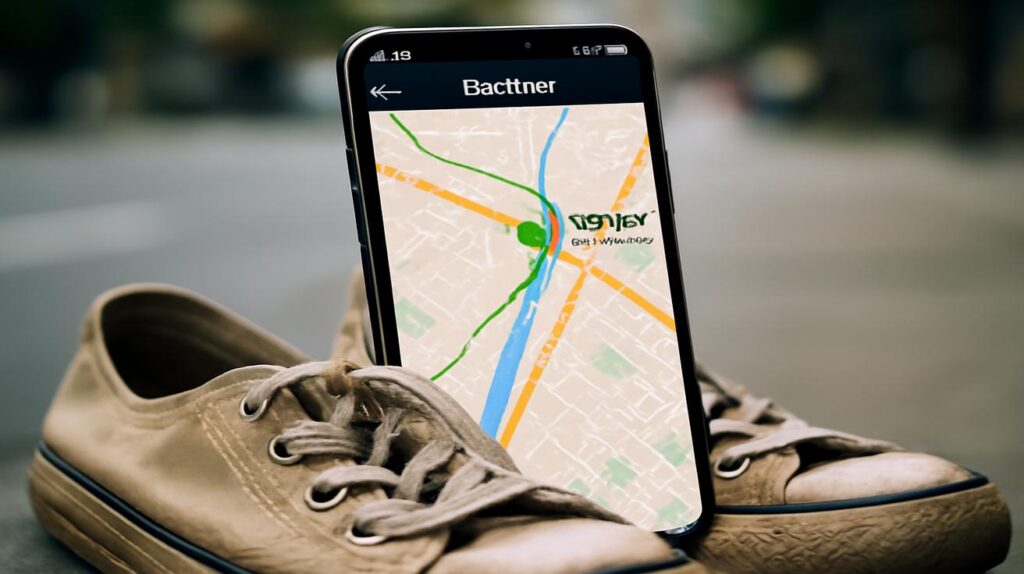
The sneakers left his hands on a gray Tuesday, tucked into a plastic donation bin that smelled faintly of detergent and dust. He watched them disappear through the swinging flap, the way you watch a small piece of your life slip quietly into the anonymous river of “stuff” we give away. The bin clanged shut. For most people, that’s where the story would end—out of sight, out of mind. But for Daniel, that’s where it started. Because inside the right sneaker, nestled under the insole, was a tiny white circle he’d pressed there with a mix of curiosity and unease: an AirTag.
The Idea That Wouldn’t Leave Him Alone
It began, as odd experiments often do, with a question that wouldn’t stop echoing in his head.
Where do donations actually go?
He’d stood in his apartment one weekend, staring at a pile of clothes and shoes destined for charity. Faded jeans, a jacket with a broken zipper, a T-shirt from a race he never ran, and the sneakers—gray, worn at the toes, a ghost of a logo still clinging to the side. They were too scuffed to sell for much, too intact to throw away. Perfect donation material.
As he folded them into a bag, his phone pinged with another article about textile waste and global secondhand markets: mountains of clothing piling up on beaches, bales of shirts shipped halfway around the world, garments burned or buried when there were simply too many. He’d read numbers that felt like fiction: billions of tons of fabric each year, traveling in loops that seemed anything but charitable.
What if, he thought, I could actually follow just one thing?
He had an AirTag he wasn’t using, still in its blister pack from a tech-enthusiast phase. The idea slid into his mind, light and slippery: slip the AirTag into something he was donating, and watch where it went. Not to spy on a person, not to catch anyone doing anything wrong. Just to trace the path of an object after the moment we call it “donated” and feel absolved.
He peeled the plastic, clicked the AirTag to life, and named it in his phone with a faint smirk: “SneakerTracker.” Then he lifted the insole of his right shoe, pressed the AirTag into the hollow underneath, and laid the insole back down. It felt mischievous and slightly unsettling, like planting a listening device in his own belongings.
When he slipped the sneakers into the donation bag, they looked harmless. Just another pair in the great tide of almost-trash.
The Slow Drift of a Pair of Shoes
The first days were quiet. He checked the app more often than he’d admit.
The AirTag’s little dot sat in one place on the map, pinned to a corner of the city where the charity’s central sorting warehouse sat—a huge rectangle of a building he’d only ever seen from the highway. The sneakers had arrived, at least.
He imagined the scene there: forklifts whirring, cardboard boxes being slit open, the smell of old clothes and stale cologne. Like an airport for objects, he thought. Everything passing through, nothing staying. The tag’s tiny location updates felt like heartbeats inside that chaos.
On the third day, the dot moved.
It slid across the map like a slow comet, tracing a route along the freeway, through an industrial stretch lined with warehouses, then pausing on the edge of a neighborhood he rarely visited. He zoomed in. The destination was another facility with an unremarkable name, something like “Regional Redistribution Center,” a phrase that meant nothing and everything at once.
The sneakers waited there for two more days, their icon quietly glowing on his phone. Each time he checked, he tried to imagine their world: stacked in a bin with other shoes, tangled laces, mismatched pairs, soles lined with the grit of a hundred small journeys. He thought about how we imagine donation as a simple arrow—us to “them”—when in reality the arrow blooms into a maze.
When the dot moved again, it didn’t go far. This time, the route zigzagged through city streets and stopped in front of a place that surprised him: the address of a local thrift store he’d passed countless times but never entered. It sat beside a laundromat and a pawn shop, its windows crowded with faded posters and plastic mannequins in last decade’s dresses.
The sneakers had come home, in a way—back into public life.
A Quiet Visit to the Thrift Store
He went on a Thursday afternoon, when the sky was bleached white and the city felt tired. The thrift store parking lot was almost empty, the asphalt shimmering faintly with heat. He stood for a second with his hand on the car door, his phone still open to the map, the little blue dot of himself closing in on the AirTag’s gray circle.
Inside, the first thing that hit him was the smell: not bad, exactly, just dense. Fabric and plastic and dust, a thousand overlapping stories sewn into cotton and leather. Racks squeaked as people pushed through hangers. Somewhere, a radio played a song that had been popular three summers ago.
He wasn’t sure what he expected. To walk in and see a glowing halo over his shoes? To recognize them from across the room like an old friend at a party?
In reality, they were just another pair among rows and rows of footwear.
He found them on the second aisle of shoes, three shelves up, balanced between glittery children’s sneakers and a pair of men’s dress shoes with scuffed toes. His sneakers looked smaller than he remembered, shrunken by context. A price sticker clung to the heel, the numbers written in blue marker: $7.99.
He picked one up, feeling the slight give of the insole under his thumb, knowing the AirTag was still there. He half-expected his phone to chirp, as if recognizing the reunion. But nothing happened.
He stood there longer than anyone normally stands looking at used shoes. People passed behind him with armfuls of jackets, kitchenware clinked faintly somewhere in the aisles, a child laughed too loudly near the toys. All the while, he turned the sneaker slightly in his hands, feeling an odd tenderness for it, this object that now held a secret map of its own travels.
He put the shoe back.
Leaving it there felt like turning a page instead of ending a book. The experiment wasn’t over. The truth was, he was curious about what would happen next—whether anyone would buy them, whether they’d move again, whether the donation story was really as simple as he’d long assumed.
The Jump from Charity Shelf to Street Stall
The sneakers stayed on that shelf for just over a week. He knew this not by staking out the thrift store but by watching the AirTag’s location, which remained pinned to that same address, give or take a few meters. He checked less often now, letting days pass between glances, as if allowing the story to unfold without his constant prodding.
On a rainy Sunday, the dot moved again.
Not across the city this time, but out of it. The route on the map trailed along a main road that skirted the river, then curved into a sprawling area he recognized vaguely: an open-air market district that seemed to appear and disappear depending on the day. He’d only ever seen it in glimpses—tents by the roadside, vans unloading boxes before sunrise, flashes of tarps and cardboard.
When he zoomed in, the location hovered among a tangle of narrow streets with no clear storefronts labeled. Just a density of activity, unnamed but alive.
He waited a full day before going. Something about the move from the predictable grid of thrift stores to this shifting maze made the whole thing feel bigger, less controlled. He wasn’t sure what he’d find—or if he’d find anything at all.
The next morning, he drove there at dawn.
The market was still waking. Trucks idled at the edges, their backs yawning open to reveal towers of cardboard boxes and black plastic bags. Tarps billowed as people clipped them into place, the slap of canvas echoing against the low buildings. The air was a mix of damp earth, exhaust, and the faint sweetness of fruit from a nearby produce stall setting up.
He parked on a muddy patch of ground and followed his phone. The blue dot of himself slid between the tight gray lines of alleys, closing in on the AirTag’s signal. With each step, the noise increased: the clatter of metal poles, the murmur of early customers, the thud of boxes set down with practiced efficiency.
The market felt like a living thing, breathing through hundreds of hands.
Finding His Sneakers in a Sea of Stories
He turned a corner and walked straight into a corridor of secondhand goods.
It was like stepping into the backstage of the global wardrobe. Shirts hung in dense waves from overhead lines, swaying slightly as people brushed past. Jeans were folded in tall, precarious stacks on plastic tables. Mountains of shoes spilled out of crates, tumbling over each other in a confusion of laces and soles.
His phone buzzed softly in his palm as the AirTag’s “precision finding” mode kicked in, a faint arrow nudging him forward, left, right. He followed it, weaving around shoppers who were already deep in the slow, attentive work of searching—for a bargain, for something nice, for something good enough.
The signal led him to a stall about halfway down the alley. It wasn’t a store, exactly, just a rectangle of space staked out by four metal poles and a faded blue tarp. The stall overflowed with shoes: sneakers, sandals, boots, flats, all arranged in clusters on the ground, on low tables, on a wooden pallet.
The vendor, a man in a dark jacket and a knit cap, was kneeling next to a heap of sneakers, matching pairs and lining them up. He glanced up once, gave Daniel a neutral nod, then went back to his work.
There, near the front edge of the stall, were the sneakers.
They looked smaller still, now that they shared space with hundreds of other shoes, many of them brighter, newer, or more obviously branded. The price was different too—no neat sticker this time, just a handwritten sign taped to a plastic crate: “Used sneakers: 2 pairs for [local currency].”
His sneakers, which had once cost him more than he cared to remember, were now part of a bulk deal.
He stood in front of the stall pretending to browse, running his fingers along shoes he didn’t care about. All the while, his gaze kept snagging back on that familiar gray pair. It was like recognizing your own handwriting in a stack of anonymous notes.
He reached down and picked one up.
The vendor watched him with mild interest, sensing a potential sale. Around them, the market churned forward: the call of another seller hawking clothes a few stalls down, the sharp laugh of a woman trying on a sequined jacket, the clink of a metal scale at a nearby fruit stand.
He turned the sneaker over in his hands, thumb pressing again into that same spot under the insole, where the AirTag still slept.
What the Table Revealed
Later that evening, back at home with the day still humming in his bones, Daniel opened a notebook and tried to make sense of what he’d seen. He pulled up the AirTag’s location history and traced dates and places, turning the path of his sneakers into something he could look at all at once, not just as dots on a screen.
He sketched a small table, then refined it on his laptop, lining up columns of where, when, and what he’d noticed. It wasn’t scientific. It was anecdotal, human-sized. But it told a story that felt bigger than a single pair of shoes.
| Stage | Location Type | Approx. Time Spent | What It Felt Like |
|---|---|---|---|
| Drop-off | Charity donation bin | A few hours | Quick, anonymous, almost too easy |
| Sorting | Central warehouse | 2–3 days | Invisible labor, hidden scale |
| Redistribution | Regional center | 2 days | A transit hub, objects in limbo |
| Retail | Local thrift store | About 1 week | Quiet shelves, waiting for a buyer |
| Resale | Open-air market stall | Unknown (still there) | Loud, crowded, fully alive |
Looking at the table on his small phone screen, it struck him how mobile this one pair of shoes had been in such a short time. In a few weeks, they’d passed through more hands, more spaces, than he had. They had their own migration pattern, part of a vast flock of objects circling quietly through the world.
Invisible Economies and Unseen Distances
Talking to the vendor at the stall had been an exercise in gentle curiosity. Daniel had asked where the shoes came from, gesturing vaguely at the dozens of pairs around them.
“Different places,” the man had said with a shrug. “Some from people around here. Some from collection centers. Sometimes I buy from others who bring bales.”
He’d spoken of shoes in bulk: kilos, bales, lots. Not as individual pairs with histories, but as units in a flow. The vendor was part of a chain that predated and would long outlast Daniel’s small experiment. For him, the shoes were inventory, livelihood, bargaining chips in the daily hustle of making enough to go home with.
Standing there, Daniel felt the strange duality of it: these objects were both intensely personal and completely impersonal. He could still remember buying those sneakers, the first run he took them on, the muddy trail where he’d slipped and laughed with a friend. Yet here they were, stripped of all that, reduced to size and condition and negotiable price.
He thought about the comfort we take in the idea of “donating” as a purely good act. We imagine a direct line: from our closet to someone who needs what we no longer do. But the reality he’d glimpsed was far more complex—a web of warehouses and secondhand shops and informal markets, each with their own economies, rules, and pressures.
And every node in that web depended on something we rarely like to admit: there is simply too much stuff.
When Curiosity Starts to Sting
On the drive home from the market, the thrill of the experiment dulled into something quieter and heavier. The AirTag had done exactly what it was built to do—it showed him where his property went. But seeing that path laid bare came with an aftertaste.
He found himself wondering about consent, about surveillance, about who gets to trace whom. He’d hidden a tracker in an object that would eventually belong to someone else. Even if he never used it to follow a person, the potential was there. It made him squirm a little in his seat.
At a red light, he opened the app and stared at the “SneakerTracker” icon, now resting at the coordinates of the market. The ethical lines felt blurrier than they had when this was just an amusing idea in his apartment.
He imagined someone buying the shoes. Maybe a teenager hunting for a cheap pair for school. Maybe a father balancing the cost of shoes against the week’s groceries. Whoever it was, they wouldn’t know that inside the right shoe, under their foot, was this tiny device quietly whispering its location to a stranger.
It didn’t matter that he’d intended no harm. The imbalance of knowledge alone felt wrong.
By the time he reached home, he’d made up his mind. He opened the app one last time, watched the little dot pulse near the market, and tapped “Remove Item.” The icon blinked. A message appeared confirming that the AirTag was no longer linked to his account.
The connection severed with a digital sigh. Somewhere in a crowded stall under a blue tarp, a tiny white circle sat in a shoe, now mute and unobserved.
The Weight of What We Let Go
In the weeks that followed, Daniel found himself looking differently at the things he owned—and the things he planned to give away. The donation bin at the corner of his street no longer looked like a simple portal of goodness, but like the mouth of a complicated system he’d only lightly touched.
He still believed in passing things on, in recirculation instead of landfills. But the AirTag experiment had drilled a small, persistent question into his thinking: What happens after “away”?
He stopped imagining his generosity as the end of the story and started thinking of it as the middle—a single beat in a much longer narrative written by others: sorters in vast warehouses, drivers of unmarked trucks, cashiers at thrift stores, street vendors under tarps, buyers under economic pressure, and finally, the people who would wear what he once wore.
Sometimes, walking past the open-air market district on the highway, he’d glance toward the cluster of tarps and think of those sneakers. By now, they were probably on someone’s feet, carrying a body through puddles and across sidewalks, the AirTag invisible and inert beneath each step.
In an odd way, that thought comforted him. The shoes had completed yet another transformation—from prized purchase to forgotten item, from donation to commodity, from commodity to possession again. Their story had moved beyond the reach of his phone screen, beyond the map’s neat lines.
Objects, he realized, are constantly slipping out of our narratives, continuing on in other people’s lives. We like to think we know their stories end to end, but we mostly just hold them for a chapter or two.
FaQ
Did he break any rules by putting an AirTag in donated sneakers?
He used the AirTag on his own property at the moment of donation, which is generally allowed. However, once the shoes were resold, a tracker inside them could become a privacy concern for the new owner. That gray area is what ultimately led him to disconnect the AirTag.
Could the AirTag actually track a person who bought the shoes?
Yes, in theory. AirTags are designed to track items, but because people carry items, they can indirectly track people. Apple has built-in alerts to warn iPhone users about unknown trackers traveling with them, and similar protections are emerging on other platforms—but relying on those alone is ethically shaky.
Is this what usually happens to donated clothes and shoes?
Not always, but it’s common. Many donations are sorted, some are sold locally in thrift stores, and a portion gets routed into bulk secondhand markets or export streams. The path can involve multiple intermediaries before an item reaches its next long-term owner.
What did this experiment really show?
It revealed that “donation” is less a final act of giving and more an entry into a complex system of sorting, reselling, and redistribution. A single pair of sneakers moved through warehouses, a charity shop, and an informal market—all within a few weeks.
Should people stop donating because of this?
No. Donation can still extend the life of usable items and reduce waste. The takeaway isn’t to stop giving, but to donate more thoughtfully: offer items in good condition, support organizations you trust, and stay aware that what we let go doesn’t simply vanish—it continues its story in ways we rarely see.