On a cool Tuesday morning, just after the sun had slipped over the rooftops, Ellen sat at her kitchen table with a notebook, a mug of tea, and a quiet sense of resolve. At 67, she had woken with a thought that wouldn’t leave her alone: “I don’t want to spend my time with people who make me feel small.” Somewhere between her first sip of tea and the creak of the house settling into the day, she began writing down names. Some with a small star next to them. Some with a question mark. One or two with a simple line drawn firmly through.
It wasn’t that Ellen suddenly hated anyone. It was that, in a way she couldn’t ignore anymore, she felt the weight of every minute. Friends she used to keep out of habit now felt like heavy coats in summer—once necessary, now just too much. She didn’t have the language for it yet, but what she was doing is something psychologists see more and more in people after 60: a deep, and often liberating, rethink of who we call “friend.”
A quieter but sharper lens: why friendships feel different after 60
There’s a moment many people over 60 can point to, even if it’s more of a feeling than a specific day: the realization that life is no longer a wide, endless horizon, but a precious, clearly defined stretch of time. It’s not a morbid thought so much as a clarifying one. Doctors call it “shifting time perspective.” Psychologists have another name for it: socioemotional selectivity. Most people just call it “I don’t want to waste my time anymore.”
When you’re 20, friendships can feel like an open experiment. You collect people like souvenirs: from college, from work, from parties, from chance encounters at 2 a.m. You hang out because everyone else is. You say yes to almost everything. The point is more connection, more experiences, more stories.
But after 60, something subtle and powerful happens. The lens tightens. The question shifts from “Who’s around?” to “Who really matters?” You start noticing how you feel after you spend time with someone. Energized? Calm? Seen? Or drained, tense, vaguely smaller inside your own life?
Psychologists say this change is not only normal but profoundly healthy. Research shows that as people age, they instinctively move away from relationships that create stress, conflict, or emotional noise—and move toward those that feel steady, meaningful, and kind. It’s less about shrinking your world and more about refining it.
This is one of the strangest gifts of getting older: the courage to treat your time as the rare resource it always was.
Why letting go can feel like grief—and relief
Rethinking friendships after 60 is not simply making a tidy list and crossing out names. It can feel like rearranging the emotional furniture of your entire life. There are shared histories, rituals, inside jokes that span decades. Maybe they were there for your wedding, or your divorce, or that night you sat on the floor together and cried over something neither of you can quite remember now.
So when the thought comes—“I don’t feel good around this person anymore”—there can be guilt, or even shame. It may feel disloyal to admit that the friend who knew you at 25 doesn’t really see you at 65.
Psychologists talk about “relational grief”: the quiet mourning that happens when a relationship ends not with a fight, but with a realization. You might grieve who that person used to be to you. You might grieve who you were back then. You might miss the old version of yourself who fit that relationship so well.
But alongside the grief, there’s usually something else: relief. Relief at not forcing yourself through yet another lunch that leaves you tense. Relief at not replaying that slightly cutting comment three days later. Relief at no longer stretching yourself thin to maintain something your heart has already quietly released.
From a mental health perspective, that relief is a signal. It’s your nervous system relaxing. It’s your body acknowledging: “This was costing me more than I admitted.” When older adults step away from relationships that consistently stir up anxiety or resentment, psychologists see lower stress levels, better sleep, and even improved physical health markers over time.
Walking away, carefully and kindly, is not a betrayal of your past. It’s an act of loyalty to your present self.
How priorities shift: from “more friends” to “truer friends”
In midlife and beyond, the criteria for “a good friend” quietly changes. It’s less about who’s most exciting and more about who feels emotionally safe. A small, steady circle begins to mean more than a wide network of acquaintances.
Older adults often mention some recurring themes when they describe friendships that still feel right:
- Low drama, high trust: You’re not bracing for criticism, competition, or gossip. There’s room to be imperfect.
- Shared values, not just shared history: You may have known each other for years, but now what matters is whether you respect each other’s choices and worldview.
- Emotional reciprocity: You’re not always the listener, the fixer, the cheerleader. Care moves in both directions.
- Space for change: They let you evolve—slower, quieter, more spiritual, more outspoken, more you—without punishing you for it.
Psychologists see a clear pattern here: people over 60 become more selective, but also more deeply invested in the relationships they keep. The circle may shrink, but the quality goes up. For mental and emotional health, that’s a good trade.
Instead of splitting yourself between many surface-level connections, you get to pour your attention into a few deeply nourishing ones. And attention, at this stage of life, is one of the greatest gifts you can offer or receive.
The subtle red flags that are harder to ignore with age
With time comes a certain emotional honesty. Behaviors you used to brush off as “just how they are” begin to grate. You start recognizing patterns that quietly wear down your spirit:
- The friend who only calls when they need something.
- The constant critic who frames hurtful remarks as “just being honest.”
- The historian who keeps you frozen in your 30-year-old mistakes.
- The subtle dismissals: eye rolls when you talk about a new interest, tone of voice when you share a fear.
In your 20s, it might have felt easier to shrug these things off. After 60, they feel heavier. Time widens your perspective: you’ve likely survived enough storms to know what real support looks like—and what it doesn’t. Your tolerance for emotional erosion naturally lowers.
Psychologists would say your inner boundaries are becoming clearer. You are less willing to compromise your peace for the sake of “keeping the peace.” This isn’t becoming rigid; it’s becoming precise about what your nervous system can hold.
The unexpected health boost of pruning your social circle
The phrase “cutting people off” can sound harsh, but in reality, what many older adults are doing is more like careful pruning. Gardeners know that pruning isn’t punishment for the plant; it’s what allows it to thrive. You remove what’s dead, draining, or crowding the healthy growth.
Social scientists see this same logic in late-life friendships. High-conflict, one-sided, or chronically stressful relationships act like emotional clutter. They activate the body’s stress response again and again: higher blood pressure, tense muscles, poor sleep, scattered focus. Over months and years, that takes a toll.
By contrast, supportive, calm, and joyful connections act as a protective buffer. They’re linked to better immune function, sharper cognition, slower decline in physical ability, and even longer life expectancy. It’s not magic; it’s biology. When you regularly feel safe and seen, your body spends less energy managing stress and more energy repairing, regulating, and renewing.
So when people over 60 quietly step back from certain friendships, they’re not just rearranging their social lives. They may be improving their actual health profile. Choosing who gets your time is, in this light, a form of preventative care.
A simple comparison: how friendships change across decades
Here’s a gentle snapshot that many people recognize in their own lives:
| Life Stage | Friendship Focus | Common Question |
|---|---|---|
| 20s–30s | Exploration, large social circles, shared activities | “Who is fun to be around?” |
| 40s–50s | Balancing family, career, long-term bonds | “Who understands my responsibilities?” |
| 60+ | Depth, emotional safety, shared meaning | “Who helps me feel at peace and truly myself?” |
Notice how the question evolves—from entertainment, to understanding, to peace and authenticity. The friendships that fit each stage are understandably different.
Making room for new kinds of friends
One of the sweetest misconceptions about getting older is that your chance to form new friendships is somehow behind you. Psychologists, and countless real-life stories, say otherwise. Rethinking old friendships often opens up space—emotionally and practically—for new, unexpected connections.
When your days are not swallowed by obligation-driven relationships, you may find a quiet curiosity returning. You start noticing the neighbor who always waves, the familiar faces in your book group, the person at tai chi who laughs at the same parts you do. You may feel drawn to people you wouldn’t have befriended at 25: different generations, different backgrounds, a different pace of life.
These later-life friendships can be surprisingly vibrant. Free from some of the earlier life pressures—competing careers, dating messiness, unspoken expectations—they’re often built on something simpler: shared presence and genuine enjoyment.
Starting smaller, but starting anyway
If you’re out of practice making friends, the prospect can feel awkward. But psychologists suggest that small, consistent gestures matter more than grand efforts:
- Sitting in the same spot each week at a class or group, so faces become familiar.
- Asking one follow-up question when someone shares something, instead of letting the moment pass.
- Inviting a casual acquaintance for coffee with a specific time and place, rather than a vague “We should get together.”
- Sharing a little more of yourself each time, testing for warmth and reciprocity.
None of this guarantees a lifelong friend, of course. But every small risk you take to connect is a vote in favor of the future, a refusal to let your social world quietly shrink around you.
How to know when it’s time to rethink a friendship
For many people, the hardest part is not the decision to step back—it’s believing they’re allowed to. Decades of being polite, reliable, and agreeable can make it feel “selfish” to reconsider your place in someone’s life.
Psychologists often suggest a gentle internal check-in. Ask yourself, thinking about a particular friendship:
- How do I usually feel in the days leading up to seeing them?
- After we spend time together, do I feel lighter or heavier?
- Is there space for my needs and feelings, or do I mainly hold theirs?
- Do I feel I can be my current self, or do I have to shrink, perform, or pretend?
If the answers point to ongoing discomfort, it doesn’t mean you must end the relationship overnight. Rethinking can take many forms: seeing someone less often, shifting the kind of conversations you have, setting firmer boundaries, or, in some cases, letting the connection naturally fade.
Healthy change is often quiet. It might look like responding more slowly to certain invitations and more eagerly to others. It might look like prioritizing people who leave you feeling grounded and choosing not to chase those who consistently leave you uneasy.
Compassion—for them, and for yourself
It can help to remember that the friend you are rethinking is also a person in transition. They, too, have their own history, fears, and limitations. You don’t need to turn them into a villain to recognize that the relationship no longer fits.
Compassion doesn’t mean staying; it means stepping back without bitterness when you can. It means blessing what the friendship gave you in its season and freeing both of you to find what you need now.
You are not the same person you were decades ago. It makes sense that not all of your relationships will travel the entire distance with you.
Honoring the friendships that remain
For all this talk of pruning and letting go, the heart of this shift after 60 is not loss—it’s appreciation. When the noisy, draining, or obligatory connections fall away, what remains comes into sharper focus.
You begin to notice the quiet miracles:
- The friend who remembers the name of the doctor you were nervous about seeing and asks how it went.
- The one who sits with you in silence, fully present, when there’s nothing to “fix.”
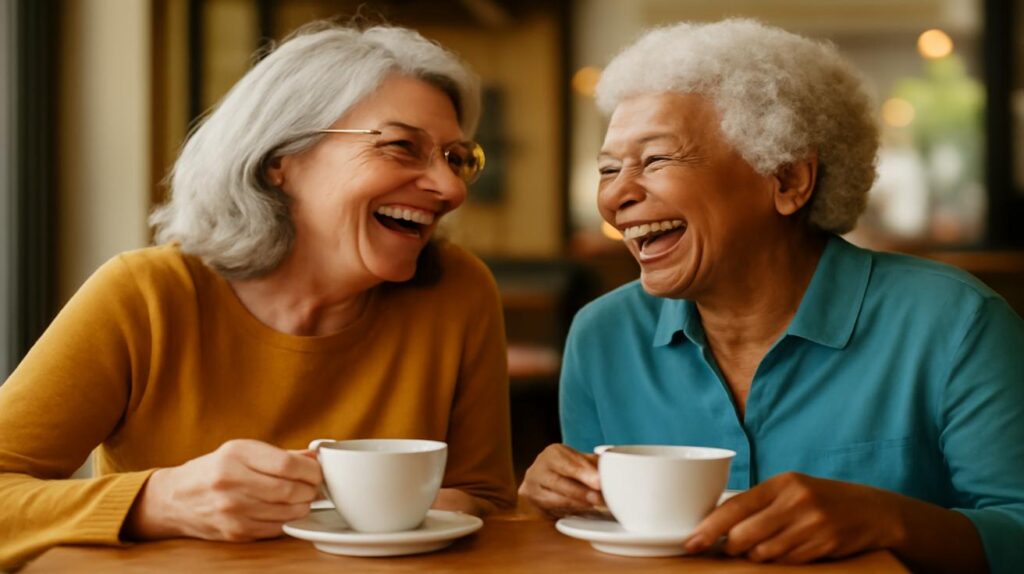
- The laughter that erupts over something small and ridiculous, reminding you that joy is still very much alive.
- The friend who accepts that some days you’re tired, or slow, or sad—and doesn’t take it personally.
These are not small things. In later life, they are riches. When psychologists measure well-being in older adults, the most powerful predictors are not income or accomplishments; they’re the quality of close relationships, the felt sense of being loved and accepted.
This is why the great friendship reshuffle after 60 is, at its core, healthy. It’s your mind and heart working together to protect that sense of being genuinely connected—to yourself, and to a few carefully chosen others.
On that morning in her kitchen, when Ellen finished her list, she didn’t rush to call anyone or make dramatic declarations. Instead, she circled three names. Then she picked up her phone and sent each of them a simple message: “Thinking of you today. Grateful for you.”
Her life didn’t become instantly simpler. Some relationships untangled slowly, almost imperceptibly. Others surprised her by deepening when she began showing up more honestly. But over time, she noticed something unmistakable: the space around her grew clearer, calmer, kinder.
It wasn’t that she had fewer friends. It was that, at last, she could see who truly felt like home.
FAQ
Is it normal to want fewer friends after 60?
Yes. Many people naturally prefer a smaller, closer circle as they age. This isn’t a sign of becoming antisocial; it reflects a shift toward depth, comfort, and emotional safety in relationships.
Does distancing from old friends mean I’m being selfish?
Not necessarily. Choosing relationships that support your mental and emotional well-being is a healthy boundary, not selfishness. You can care about someone and still recognize that the connection no longer fits who you are now.
How do I handle guilt about ending or cooling a friendship?
Guilt often comes from long-standing habits of putting others first. Try reframing your decision as an act of self-respect, not punishment. You can step back kindly, without blame, and still honor what the friendship once meant.
What if I want new friends but feel too old to start?
You’re not too old. Many people form meaningful friendships later in life through classes, community groups, volunteering, or shared hobbies. Focus on small, consistent interactions rather than instant closeness.
How can I tell if a friendship is good for my health?
Notice how your body and mind feel around that person. Do you feel calmer, lighter, and more yourself—or tense, drained, or on edge? Long-term, relationships that leave you feeling safe, respected, and seen are the ones that support both emotional and physical health.