The first sign that something was wrong was not the sight of a fin or the slap of a tail, but the sudden, absolute silence. One moment the ocean around the old sloop was busy with life—splashes of dolphins at the bow, the soft creak of rigging, the murmured half-conversations of a crew lulled by a long blue afternoon. The next, the sea seemed to inhale and hold its breath. The dolphins stopped leaping. The air itself felt tighter, as if the horizon had shrunk. Those aboard would later struggle to explain it, but they all agreed: they felt the fear in the water before they saw it.
A Quiet Ocean Turns Violent
It began as the sort of day sailors tell their friends about later in nostalgic tones. The sun hung like a patient lantern over a glassy swell. The boat—forty feet of weathered fiberglass and rusted fittings—slid lazily through a long, rolling sea, the sails full but relaxed. A faint salt haze sat on the horizon, blurring the line where water met sky. The crew, five of them on a casual coastal passage, had that loose, talkative energy that comes after days at sea.
They had picked up the dolphins just after dawn. First a pair, then a small pod, tracking the sloop, weaving in and out of the bow wave, slicing up through the surface in arcs of liquid silver. Every few minutes someone would lean over the lifelines to watch them, the way their eyes seemed to glance up through the water, curious and unafraid. Dolphins around a boat are, to many sailors, like a blessing. A good sign. Guardians, almost. You never feel alone when they’re there.
By midafternoon, the pod had grown. Fifteen, maybe twenty animals now, moving in loose formation. Sometimes they vanished for minutes, reappearing off the stern or off to port, as if circling the boat in a protective ring. The crew joked that they were being escorted, that the dolphins had adopted the vessel as an odd, lumbering cousin.
That’s why the change was so shocking. One of the sailors, a woman named Elena, was standing at the bow pulpit, fingers wrapped around the salt-sticky rail. She watched the nearest dolphin, only a few arm-lengths away in the water. Its sleek gray body rose and fell, smooth and sure. Then she saw its motion stutter—just once, like a breath held too long. Its head turned sharply, not towards the boat this time, but away, out into the open sea. A heartbeat later, it dove, hard and fast, leaving a sudden empty patch of water at the bow.
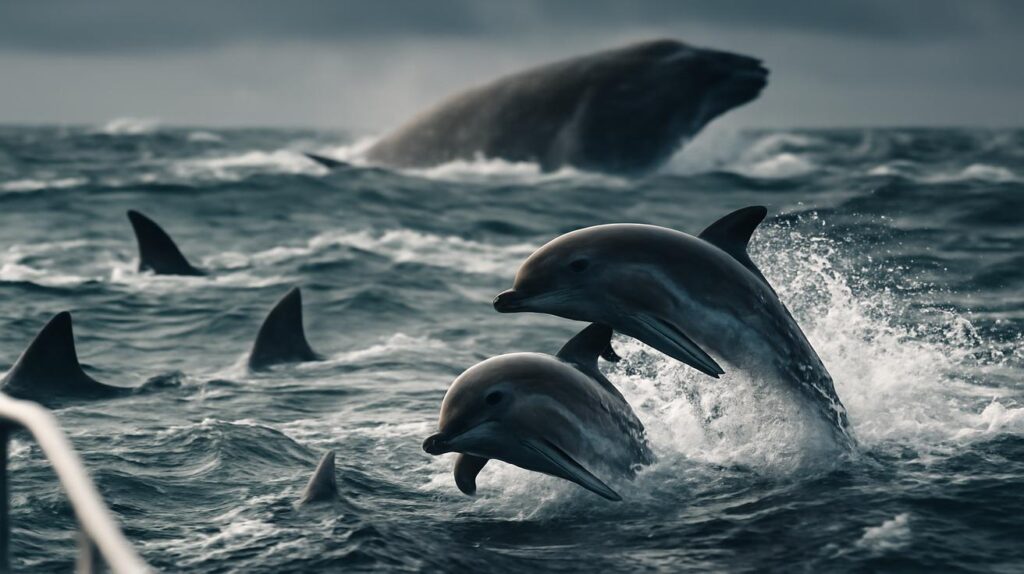
Within seconds, the others followed. The ocean around the sloop became a tangle of white trails as dolphins broke formation and scattered, arrowing off in different directions, some vanishing straight down into the blue, others bolting laterally, slicing away from the hull as though it had become dangerous. The joyous bow-riding play was gone; this was not drifting curiosity but flight. Something else had arrived.
Whales on the Horizon, Trouble Beneath
The first shout came from the stern. “Whale off port quarter!” The words ricocheted down the cockpit. Everyone turned, hands shading eyes. Out beyond the lazy slap of their own wake, the sea bulged. A long, dark shape broke the surface, the size of a small truck, water streaming off its back. Then came the exhale—a thunderous, wet boom of air rushing from ancient lungs, followed by a tall, ghostly plume of mist.
“Humpback,” someone guessed. It was close enough to see the barnacle-scabbed ridges on its back, the ridgeline of its dorsal fin. Before they could even finish the word, another spout rose a little farther off, then another. Three whales, maybe four, surfacing in ragged sequence, each exhale echoing across the water like distant gunfire.
There was a beat of disbelief. To be joined by dolphins was good fortune; whales, too, felt like some kind of wild lottery. Cameras appeared from below, lenses poking over the rail. The crew leaned on the lifelines, giddy, dizzy with the luck of it. In the stories we like to tell about the sea, this is where the moment would stay: benevolent giants, a friendly escort of dolphins, humans bearing witness.
But the ocean was building another story under their hull.
From the masthead, a small wind vane clicked slightly to starboard, catching a breath of cooler air. The boat shifted, rolling to port as a longer, heavier swell pushed beneath it, a rhythm different from the easy chop they’d been riding for hours. This wave had weight, a slow, deliberate force. The whales surfaced again, closer now, angled toward the path of the moving sloop as if converging on some invisible intersection.
Off the port bow, a patch of water twitched. Just a flutter at first—ripples folding over each other as though something brushed the underside of the surface. Then, from that same spot, two dolphins exploded outward, not up in graceful arcs but sideways, low, bodies barely breaking free of the sea as they thrust themselves away at sharp angles. Their splashes were sharp, hurried. Fear, made visible.
The Sudden Arrival of Shadows
When the first dorsal fin appeared, it was almost understated. A gray-black triangle, slicing up through the water and vanishing just as quickly. It could have been a trick of the light, a wave crest, anything. No one even called it out. Then a second, larger fin cut the surface cleanly a few boat lengths away, followed by the unmistakable bulk of a great fish rolling under the thin skin of the sea.
“Shark,” said the captain quietly. It wasn’t the word itself that chilled the air, but his tone. It had none of the excited crackle that had accompanied the whales. This was sober, flat—an acknowledgment, not an invitation.
There is something about a shark’s motion that announces itself as different, even to those who know little about the ocean. Where dolphins twist and play, changing direction with the improvisational energy of songbirds, a shark moves like a line drawn with deliberate pressure. Its track through the water is heavy, direct, purposeful. The first of them circled around the stern, just deep enough that only its back occasionally shone in the sun, the faint pale flash of a belly rolling beneath.
Seconds later, another fin appeared off the starboard beam. Then a third. The crew’s attention, scattered a moment ago between dolphins and whales, whipped into a single point of focus. The sloop drifted in a slow, innocent arc, while the sharks traced more urgent geometries beneath it.
The dolphins, once so close you could almost touch them, were now distant, their sleek forms flashing at the periphery, grouped tightly and moving fast. Their clicks and whistles—those cheerful, rapid-fire bursts of sound that had been almost constant all afternoon—dropped away into disjointed, panicked stabs of noise. The ocean had not gone quiet after all. It had changed languages.
The whales seemed to feel it too. One surfaced unexpectedly close, so close that the boat rocked on the slap of its flukes. Its massive head broke the water with a surge, barnacles catching the light in rough white constellations. For a heartbeat, its dark eye was visible above the surface, a single, glossy planet staring towards the little vessel and the ring of predators threading around it. Then it slipped under again, its tail lashing a long, foaming scar across the sea.
Encircled by Hunters
The sloop was no longer sailing; it was hovering, its momentum stolen by shifting winds and the distracting spectacle around it. The captain eased the helm, trying to hold a line, but the boat’s path now felt trivial compared to the movements below. The sharks—four, then five, then perhaps more—had settled into a loose orbit around the hull, each making slow, widening passes that intersected and overlapped. They were not interested in the boat; they were interested in what the whales and dolphins had brought into their world.
From the bow, Elena watched a particularly large shadow glide just beneath the surface. For a second, the water cleared enough that she could see its full outline: the thick, torpedo body, the pectoral fins spread like blunt wings, the powerful tail moving with frightening economy. Its dorsal fin looked almost absurdly tall at this proximity, its edge sharp as a chiseled blade. As it angled slightly, sunlight slid over the curve of its head, revealing the pale underside of a great white shark.
Adrenaline prickled along spines. The harmless distance of documentary footage vanished. This was not behind a screen or filtered through a narrator’s calm. This was the raw, disordered closeness of real life at sea, where fate can arrive in the shape of a fin and there is nowhere to go but deeper into the story.
One of the crew, Jonah, edged back from the rail, fingers unconsciously tightening around the shrouds. “They’re hunting,” he said, the word half-question, half-statement. No one answered. They didn’t know, not really. But the water around them seethed with intent—too much motion, too many bodies pivoting on hidden fulcrums.
The dolphins, once a scattered ring, had consolidated into a dense cluster off the port bow. They moved with startling coordination now, their lines tightening and loosening like muscles flexing. At the edges of the group, a few individuals darted out in brief, aggressive lunges, then whipped back into formation, as though testing boundaries, distracting something unseen in the deeper blue. Every so often, a smaller body—perhaps a juvenile—would appear in the center of the cluster, sheltered by a living wall of muscle and speed.
Meanwhile the whales had drifted farther off, still surfacing in their own ponderous rhythm, but now their path seemed less random. They rose, exhaled, and rolled with purposeful slowness, as if aware of the turbulence below, as if choosing their own distance with care. Each time one surfaced, the sharks adjusted, some vector in their wide, circling dance changing by degrees only they could read.
A Sea of Signals
To the human eye, chaos reigned. Yet beneath the surface panic, an ancient order was playing out—predators and prey, opportunists and guardians, each reading a language written in current and vibration. The sailors watched from their awkward pedestal of fiberglass and rope, stranded between two worlds, their senses too dull for the subtleties, too sharp for the fear.
In that suspended moment, time seemed to stretch. The crew moved more softly, speaking in whispers as if loud voices might crack the fragile membrane separating them from the frenzy below. A coffee mug, forgotten on the cockpit bench, tipped with the slow roll of the hull and spilled its contents across the teak, dark liquid pooling unnoticed. The smell of coffee mingled with salt and a faint, iron tang rising from the sea—fish, blood, or imagination, no one could say.
The boat’s instruments kept up their indifferent reporting. Depth: steady. Speed: nearly zero. Wind: backing slightly, losing strength. The world of numbers, of planned routes and tidy log entries, seemed irrelevant here. What mattered was the texture of the water against the hull, the shifting shadows, the sudden, jerking movements of animals that had long outgrown the tidy boundaries of human understanding.
Every few seconds, a shark would break the surface just enough for its dorsal fin to slice a line through the air, leaving a scribble on the sea. A few times, a tail slapped hard enough to send up a small geyser of spray, each impact resonating through the hull like a muted drumbeat. The dolphins’ high-frequency world buzzed at the edge of hearing—little squeals and pops, frantic and insistent.
Then, suddenly, the pattern broke.
The Flashpoint
Off the starboard beam, two dolphins launched themselves clean out of the water, bodies fully airborne in parallel arcs, landing with heavy crashes of foam. Behind them, for a split second, the broad, pale shape of a shark’s snout breached, jaws slightly open, showing the ghostly flash of teeth before it vanished again. The crew didn’t quite see it so much as feel it—an electric jolt through their chests. The chase was no longer abstract.
A third dolphin spun violently at the surface, its tail thrashing in short, jagged bursts. Around it, the water boiled as at least two sharks converged from below, gray backs twisting just under the thin sheen of sea. The pod tightened, crowding toward the disturbance, several dolphins angling their bodies to slam sideways into the intruding shapes, ramming with force. The crew could hear, or thought they heard, a low, throbbing hum through the hull—the sonic shock of bodies colliding at speed.
One of the whales surfaced closer than any had before, its enormous head breaking through a churning field of foam. This time it did not slip away immediately. Instead, its tail rose slowly, impossibly high, hanging in the air for a breathless second, water streaming from its edges in glittering curtains. Then it came down with stunning violence, a thunderous slap that sent a sheet of spray fanning across the sea and rocked the sloop hard to port.
The impact was more than sound. It was a message, flexed muscle and displaced water rippling through the whole neighborhood. The sharks scattered for a moment, their paths disrupted, their careful arcs dissolved. The dolphins seized that small rupture in the pattern, surging as one, driving their cluster out of the tight ring that had formed around them.
From the cockpit, it was impossible to tell exactly what was happening, only that suddenly there was more distance between the pod and the vessel. The nearest shark rolled sideways, its pale belly flashing like lightning under the keel before it veered away. The water around the boat stilled fractionally—still alive, but no longer boiling.
Retreat and Aftermath
As quickly as it had tightened, the noose began to loosen. The sharks did not vanish—they rarely do in such stories—but their orbit widened, their motions less insistent. A few slipped deeper, their silhouettes fading into the color gradient of the sea. The great white that had passed so close to Elena’s outstretched hand angled away, heading toward the open expanse where the whales had been moments before. It moved with the same unhurried authority, a sovereign returning to patrol its wider realm.
The dolphins did not come back to the bow. They kept their distance now, reformed into a more compact shape further off, gradually sliding toward the hazy horizon. A few still leapt, but the arcs were shorter, more subdued, like runners glancing over their shoulders even as they move on. Within minutes, they were only occasional flickers at the edge of vision.
The whales, too, began to fade from the scene. One last spout lifted, white against the pale blue sky, then another more distant, and then only the echo of their exhalations remained in memory. The sea exhaled with them. The swell eased back toward its earlier, lazier rhythm. The wind found its voice again, filling the sails with a reassuring drone. Somewhere in the cabin, the ice in the cooler clinked dully as the boat resumed her slow, forward crawl.
What lingered was not the sight of sharks’ fins or the spray of whale tails, but the raw sensation that had gripped every person aboard: the feeling of standing in the middle of someone else’s storm. They had seen not a neatly framed battle between good and evil, not a cinematic showdown, but a fleeting blur of survival and opportunity, played out along lines drawn thousands of generations before humans ever carved hulls and called them seaworthy.
| Element | What the Sailors Saw | What It Likely Meant in the Ocean |
|---|---|---|
| Dolphins fleeing in all directions | Playful bow-riding turned instantly into frantic, scattered dives. | A rapid shift from curiosity to evasive behavior as large predators arrived. |
| Whales surfacing nearby | Multiple humpbacks exhaling loud, misty blows around the boat. | Large baleen whales likely feeding or transiting through rich hunting grounds. |
| Sharks circling the vessel | Several large dorsals and heavy bodies gliding in slow arcs around the hull. | A group of apex predators keying in on prey activity and possible feeding opportunities. |
| Violent tail slaps and splashes | A whale’s tail crashing down, dolphins and sharks scattering briefly. | Defensive or communicative displays, using force and sound to disrupt hunters. |
| Return to calm | Animals gradually dispersing, sea and sky softening back to quiet. | The feeding opportunity shifted elsewhere; the brief convergence dissolved. |
What the Ocean Was Saying
Later, sitting in the dim glow of the cabin as the boat rocked gently toward its night anchorage, the crew tried to make sense of what they had seen. The conversation moved in circles, much like the sharks had: Were the whales protecting the dolphins? Were the sharks there because of the whales? Had any animal been injured? They replayed it frame by mental frame, each person seeing the moment of crisis differently.
Marine biologists would probably explain it in cooler terms: a dense patch of food, perhaps a school of baitfish or smaller predators, had drawn in multiple levels of the food web. Dolphins, ever the agile mid-level hunters, darted in first. The whales, filter feeders on a grander scale, capitalized on the same abundance. Sharks, tuned to the vibrations of chaos and the scent of opportunity, arrived to take their share or scavenge what the others dislodged.
In that reading, the boat was incidental, just another floating object in a vast, living equation. The panic the sailors perceived in the dolphins might be understood as calculated evasive maneuvering; the apparent intervention of the whale’s massive tail slap, a coincidence of timing. The sea, after all, is full of such collisions—moments that feel personal and orchestrated, but are really just overlapping orbits of hunger and movement.
Yet anyone who has spent time far from shore knows there is a truth beneath the scientific language: we do not stand above these dramas. We slip through them, briefly, like a shadow over a reef. Out there, the sharp line between “observer” and “participant” blurs. When dolphins flee in panic at your bow, when massive sharks circle your vessel and whales loom like submerged hills around you, you are not just watching. You are inside the weather system of life itself.
That day, the sailors carried away no tidy moral, no heroic act, nothing to fold neatly into a human-centered story. What they brought back was a feeling—of awe edged with dread, of proximity to forces utterly indifferent to their presence. They had seen the ocean shrug off its postcard calm and reveal, for a few long minutes, the wild, beating heart that never truly rests beneath the surface.
When they told the story later—on docks and in dim harbor bars, around kitchen tables still smelling of salt—they found themselves reaching for sensory fragments: the dead stop of the dolphins, the hollow thump of a whale’s tail through the hull, the thin gleam of a shark’s eye as it turned. They spoke of how small the boat had felt, how huge the water, how the horizon seemed to lean in.
Somewhere out there, that patch of sea has long since drifted and changed, its brief congregation dissolved. The dolphins kept moving. The whales followed some internal map beyond our charts. The sharks vanished into their fluid, patrolling silence. But the memory of that chaotic ocean scene remains anchored in human minds—evidence that the world still holds places where we are not the main event, only witnesses passing through the spray.
Frequently Asked Questions
Were the sailors ever in real danger from the sharks?
From what is known about shark behavior, the sharks were primarily interested in other marine life, not the boat or the people on it. Large sharks occasionally investigate vessels, but direct attacks on boats are extremely rare. The psychological impact—seeing massive predators so close—often feels far more dangerous than the actual risk.
Why did the dolphins suddenly flee from the bow?
Dolphins often react quickly to the presence of large predators. When sharks enter the area, especially multiple large individuals, dolphins may shift from playful behavior into defensive or evasive mode, tightening their pod formation, moving away from confined spaces (like the narrow zone near a hull), and making sudden, coordinated dives or sprints.
Were the whales protecting the dolphins from the sharks?
It’s tempting to read the whales’ dramatic tail slaps as deliberate defense, and in some cases whales—particularly humpbacks—have been observed interfering with predators. However, it’s also possible the whales were simply communicating with each other, feeding, or responding to the same disturbance that alarmed the dolphins. Without clear, repeated observations, it’s difficult to assign a single motive.
Why do sharks, dolphins, and whales sometimes appear together?
These animals often overlap around rich feeding areas. Baitfish schools, spawning events, or upwellings that concentrate nutrients can attract multiple species. Dolphins may herd fish from below, whales filter massive volumes of water for smaller prey, and sharks move in to hunt or scavenge among the disruption. To human eyes, this convergence can look chaotic and dramatic, but it’s part of a complex, layered food web.
What should sailors do if they find themselves in a similar situation?
The safest response is to stay calm, avoid sudden engine changes that might further agitate the animals, and keep limbs inside the boat. Observe from a respectful distance without attempting to feed or interact. If possible, note the location, time, and behavior for later reporting to marine researchers. Above all, remember that you are an uninvited guest in an active, wild ecosystem, and your role is to watch—not to intervene.