The first time I heard about the “hidden” setting on a bathroom fan, I was standing in a stranger’s hallway, shoes damp from an autumn rain, staring up at a yellowed plastic vent cover. The house smelled faintly of pine cleaner and something else—an earthy, sour note that clung to the corners like a shadow. The home inspector with me, a man who had spent thirty years crawling through attics and under foundations, tapped the vent with his pen and sighed.
“There it is,” he said. “The most ignored switch in the whole house. This thing could have saved them a small mold forest in the attic.”
I remember blinking at him. It was just a bathroom fan, humming away like every other one I’d ever seen. But as he climbed up on a step stool, popped off the plastic cover, and pointed to a tiny dial almost invisible behind a dusty baffle, I felt the peculiar thrill of realizing I’d been missing a quiet, everyday piece of wisdom my entire adult life.
It turns out there’s a little-known vent setting—sometimes a discreet switch, sometimes a hidden humidity sensor or timer—designed to let the fan keep working long after you’ve turned out the light and walked away. Building scientists and indoor air experts swear by it, saying it can cut bathroom-related moisture problems—and resulting mold—by more than 40%. And almost nobody uses it.
The Bathroom Weather You Never See
Step into your bathroom after a long, hot shower and you can feel the air wrap around you—heavy, warm, beaded with droplets on the mirror. But the real story isn’t the visible steam swirling in front of your face; it’s the invisible moisture that seeps into drywall, sneaks into ceiling cavities, and settles into every porous surface like fog rolling into a valley.
Imagine your bathroom as a tiny, personal weather system. You’re the warm ocean. The tile, paint, studs, and ceiling are the shoreline and hills. Every shower sends up a cloud—moisture-laden air rushing toward any cooler surface it can find. When it hits those surfaces, it condenses, leaving behind microscopic wet spots. The fan above your head is supposed to be the wind system that carries the cloud away before it can settle. But here’s the problem: our habits don’t match the way moisture actually behaves.
Most people flip the fan on as they step into the shower and flip it off the moment they step out, like a polite gesture. Done! Ventilated! But your bathroom doesn’t dry out just because you’ve turned off the tap.
Moisture lingers in the air and inside surfaces long after the steam on the mirror has faded. In many homes, humidity levels stay elevated for 20, 30, even 45 minutes after the water is shut off. Without continued ventilation, all that moisture simply spreads slowly into the rest of the house or tucks itself into corners and cavities—prime habitat for mold spores, which need only three things: moisture, organic material, and a little bit of time.
Experts in building science have run the numbers. In side-by-side comparisons, bathrooms that use continuous or extended fan operation—often enabled by a simple overlooked setting—show mold and moisture problems reduced by more than 40%. Less peeling paint, less musty odor, fewer dark spots blooming at the edge of the ceiling.
The Quiet Setting Hiding in Plain Sight
That little dial the inspector showed me? It was a “run-on” timer: a built-in control that lets the fan keep running automatically for a set amount of time after you turn the light or switch off. Some models hide this dial behind the vent cover; some tuck it behind a tiny removable plug; newer fans sometimes have a humidity-sensing setting instead—a mode where the fan decides for itself when the bathroom is still too damp, then kicks in or stays on until the air is dry enough.
Ask a handful of homeowners whether their bathroom fan has this option and you’ll mostly get blank stares. Many don’t realize the feature exists; others see it once when they move in, then forget about it. A few turn it off on purpose, worried about energy use or noise, without realizing they’re trading a few cents of electricity for hundreds or thousands of dollars in future repairs—and the chronic, subtle health toll of breathing in mold-tinged air.
These are the settings that building pros quietly nudge people toward when they think no one is listening. “Set your timer to run at least 20 to 30 minutes after every shower,” they’ll say. “If you’ve got a humidity sensor, use it. Let the fan decide when the room is truly dry.”
Hidden, often pre-installed, and almost never explained, this is the overlooked vent setting that shifts your fan from a polite accessory into a real moisture-control tool. It doesn’t require a remodel, a new window, or a dehumidifier humming in the corner—just a few minutes of curiosity and a small twist of a plastic wheel.
Listening to the Room Breathe
Spend a morning paying attention to your bathroom as if it were a living thing, and you’ll realize it has its own rhythm of inhaling and exhaling. The fan is the breath. Flick the switch, and you can feel the faint tug of air being pulled up and out, the door shivering almost imperceptibly as the pressure shifts.
On a cold day, the mirror fogs faster. On a summer afternoon, the humidity hangs heavier, clinging even when the room feels warm and open. Every shower is a small storm, and without enough time for clearing, the air never fully resets before the next one rolls in.
The genius of that extended run or humidity-sensing setting is that it takes this breathing rhythm seriously. Instead of treating the fan like a momentary background noise, it lets the room finish its exhale. When experts talk about a 40% or greater reduction in mold risk, they’re really pointing to that simple fact: dryness is not a moment; it’s a process.
Home performance specialists have walked into thousands of homes where the story is written plainly in the walls. Black speckles at the corner of the ceiling above the shower. Softened drywall around the fan vent. In multi-story houses, sometimes the real damage isn’t even in the bathroom at all, but hidden in the attic, where warm, moist bathroom air has been dumping for years because the fan was underused or improperly vented. One change—a fan that runs long enough and often enough—can begin to rewrite that story.
| Bathroom Fan Habit | Moisture & Mold Impact |
|---|---|
| Fan off, or used only during shower | High lingering humidity; strong mold growth potential, frequent condensation. |
| Fan on during shower, off immediately after | Moisture reduced but not cleared; moderate risk, especially in small or windowless baths. |
| Fan on for 20–30 minutes after shower (manual) | Significantly lower humidity; mold risk notably reduced. |
| Fan set to extended run or humidity-sensing mode | Optimized drying; often >40% reduction in moisture-related issues over time. |
From a distance, these differences feel abstract. Up close, they show up as the smell of the room when you first open the door, the life of the paint on your ceiling, the way your lungs feel after years of showering and breathing that air. The overlooked setting doesn’t just change a number on a humidity meter—it changes the daily feel of a space you step into half-awake every morning.
Finding the Hidden Control in Your Own Home
Here’s where this stops being theory and starts being tactile. You can go and check your own bathroom right now. The search itself is oddly satisfying, like discovering a secret compartment in a familiar piece of furniture.
Start with the basics: flip on the fan, listen to its pitch, and stand beneath it. Gently pull or pry off the vent cover; most snap out with a soft tug on the sides or a gentle squeeze of two metal springs. Behind that dusty grille, in the nest of plastic and metal, look for a tiny dial, slider, or switch. It may be labeled with minutes (5–10–20–30) or with icons that look like a little clock. That’s the extended run control.
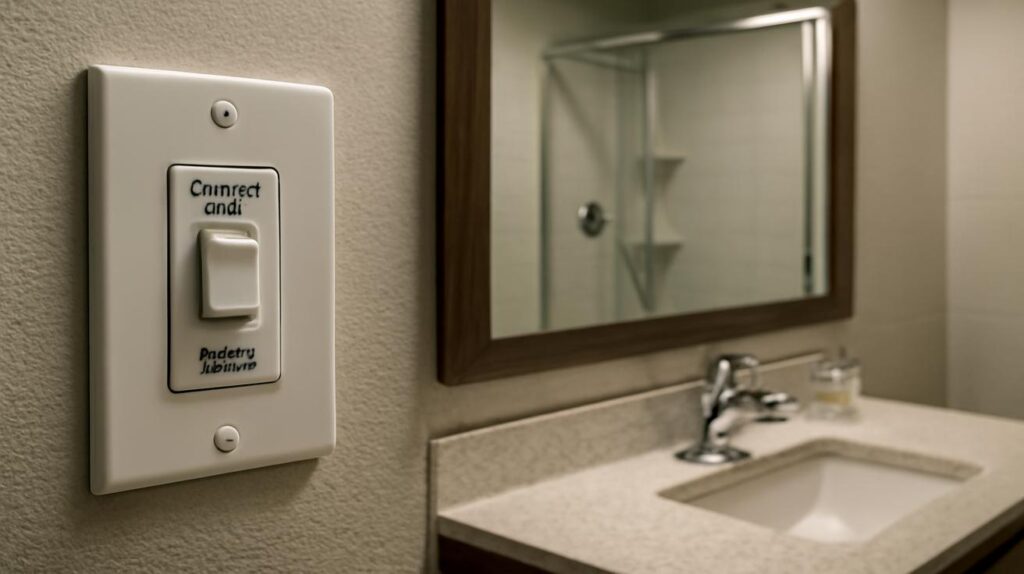
On some fans, you’ll find a separate wall switch shaped differently from the light switch—sometimes a preset timer where you tap “10,” “20,” or “30” minutes. On others, the whole system is built around a humidity sensor: a small nose on the fan casing or a wall control labeled with percentage numbers, like 50%, 60%, 70%. Set it lower, and the fan will run more often, automatically kicking on when steamy air builds up.
If you see nothing, no dial, no sensor, it doesn’t mean your bathroom is doomed; it just means this piece of quiet technology hasn’t moved into your house yet. Many people install a separate retrofit timer switch on the wall for the same effect. But if the setting is there, hiding in the housing, you’re a few seconds away from changing how your bathroom ages.
Most experts recommend setting that internal timer for at least 20 minutes after use, often 30 in small or windowless bathrooms. If you’re using a humidity sensor, a target of around 50–60% relative humidity is a common sweet spot—low enough to discourage mold, high enough to be comfortable and not run the fan endlessly.
Why This One Setting Works So Well
On paper, the claim sounds bold: more than 40% reduction in mold-related moisture problems, just from using a setting you’ve probably never touched. But the physics behind it are plain and elegant.
Mold doesn’t need a flood to thrive. It needs persistent dampness. Think of a log in the forest. After a single rain, it darkens and glistens but dries again under breeze and sun. After repeated soaking with no time to dry, it softens, breaks down, grows threads of soft, living green and black. Your bathroom surfaces are just smoother, painted versions of that log.
Extended fan operation changes the moisture curve. Instead of humidity spiking during your shower and then slowly sliding down over an hour or more, the fan lops off the tail of that curve. It pulls the moist air out while it’s still swirling, before it can deeply soak into drywall and trim. Over months and years, those shorter “wet periods” add up to significantly fewer opportunities for mold to get established.
Building researchers who compare fan strategies often see that homes with properly sized fans, vented outdoors and allowed to run long enough, have far fewer condensation stains, fewer swollen baseboards, and fewer mold patches. Air changes matter; time matters even more.
There’s another layer here too: health. The musty scent that some people shrug off as “just an old bathroom smell” is, in many cases, the signature of mold and its byproducts. For those with asthma, allergies, or other sensitivities, that background presence can mean headaches, tight breathing, or a constant low-level irritation that’s easy to blame on anything but the air itself.
So the overlooked setting isn’t just about protecting paint. It’s about nudging your indoor environment a little closer to what our bodies quietly ask for: air that doesn’t carry yesterday’s dampness, lungs that don’t have to trade comfort for cleanliness.
The Trade-Off: Energy, Noise, and Peace of Mind
There’s a moment, usually right after people discover the extended run or humidity mode, when hesitation creeps in. Won’t it waste electricity? Won’t the noise drive me crazy if the fan hums long after I’ve left the room?
Modern bathroom fans, particularly those built for continuous or extended use, are surprisingly thrifty. Many draw about as much power as a typical LED bulb, sometimes less. Running a fan for an extra 20–30 minutes after each shower usually adds only a small handful of dollars to your annual energy bill—often far less than you’d spend on a new tub of grout cleaner, let alone drywall repair.
Noise is another story, and one worth paying attention to. Older fans can whir, rattle, or drone like a tired airplane. But that, too, is a clue: a very loud, clattering fan may not be moving air efficiently. Many newer models are designed to run quietly at lower “sones” ratings, often soft enough to blend into background household sound. If your existing fan is unbearable, you can still use a timer setting and simply close the door while it runs on, letting it do its work like a distant, dutiful wind.
The trade-off, in practice, tends to feel lopsided: a faint mechanical hum traded for paint that doesn’t peel, grout that stays bright, a ceiling that doesn’t grow freckles of black. And the deeper you breathe in your own bathroom over the years, the more that hum begins to register not as a nuisance, but as a small, consistent promise that the room will be ready for you again tomorrow.
Letting Small Habits Do Big Work
In a world of bold renovations and dramatic before-and-after photos, it’s oddly comforting that something as modest as a hidden fan setting can matter so much. No demolition, no jackhammers, no shopping carts filled with tile. Just the quiet choice to let the room breathe for a little longer each day.
The home inspector who showed me that tiny plastic dial all those years ago didn’t give a sales pitch. He just adjusted it with a practiced twist and said, “There. That should make this bathroom a lot happier.” The phrase stuck with me—this idea that a room could be happier, that the walls could settle into a new rhythm of wet and dry, that the ceiling, spared years of slow soaking, might remain clean and bright for the next family.
Walk into your own bathroom the next time the mirror is fogged and the air feels thick. Look at the fan not as a bit of humming background noise, but as your home’s way of exhaling. Somewhere in that plastic housing or on the wall, there may be a small control just waiting to be used—a quiet switch between a space that slowly surrenders to damp, and one that stays clear, dry, and quietly alive for many years.
Turn it. Set it. Then step out into the hallway and listen for a moment as the fan keeps going, carrying the last of the steam away. That soft, persistent hum might be one of the most overlooked sounds of a healthier home.
Frequently Asked Questions
How long should I run my bathroom fan after a shower?
Most experts recommend running the fan for at least 20 minutes after a shower, and up to 30 minutes in small or windowless bathrooms. An extended run or timer setting automates this so you don’t have to remember.
How do I know if my bathroom fan has an extended run or humidity setting?
Remove the vent cover and look for a small dial, slider, or switch, often labeled with minutes or a clock icon. On the wall, you might see a timer switch or a humidity control labeled with percentage numbers. Some newer fans also have a small sensor on the housing.
Does running the fan longer waste a lot of energy?
Typically, no. Modern bathroom fans are low-power devices. Running a fan an extra 20–30 minutes after showers usually adds only a small amount to your yearly energy use, often far less than the cost of repairing moisture damage.
Can this really reduce mold by more than 40%?
Studies and field experience from building scientists show that bathrooms with properly sized, correctly vented fans used in extended or humidity-sensing modes have significantly fewer moisture and mold problems—often more than 40% fewer compared to poorly ventilated spaces.
What if my fan is very loud or old?
A very noisy fan may be a sign of age or poor design. You can still use a timer to improve ventilation, but you might also consider upgrading to a quieter, more efficient model. Many modern fans are designed for continuous or extended use without much noise.
Is opening a window enough instead of using the fan?
Opening a window can help, especially in dry or breezy weather, but it is not as reliable as a properly vented fan. On humid or still days, a window may do very little to remove moisture. The fan offers consistent, predictable air removal.
What if my bathroom doesn’t have any special settings at all?
You can still improve things by manually running the fan longer after showers, or by installing a wall timer or humidity-sensing switch. These small upgrades are usually simple for an electrician and can greatly reduce moisture buildup over time.