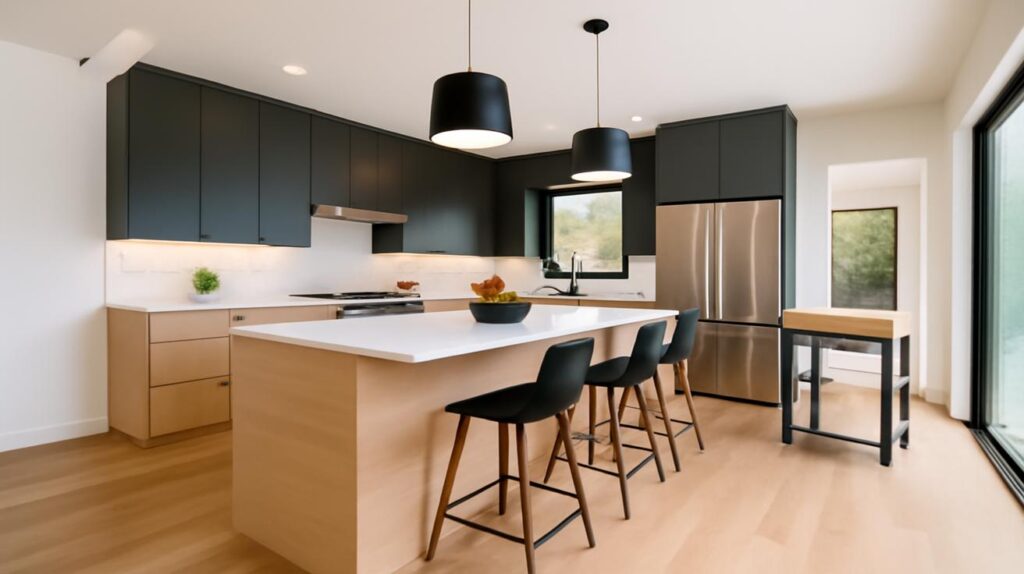
The first thing you notice is the quiet. No hulking block in the center, no sharp corners waiting for your hip, no family members orbiting one crowded surface like bees around a single flower. Just…space. Light moving easily across the room. A long, elegant counter that seems to hover, anchored at one end and open at the other, like an inviting extension of the living room itself. Someone slides onto a stool, tucks their feet onto a low, warm footrest, and sets a laptop down while a pot simmers within arm’s reach. The cook, for once, doesn’t have their back turned to everyone. The room feels less like a workstation and more like a living, breathing part of the home.
The quiet revolution against the kitchen island
For nearly two decades, the kitchen island has ruled modern home design like an unquestioned monarch. Builders drew floor plans around them. Real estate listings flaunted them. Entire Pinterest boards were dedicated to waterfall-edge marble slabs and oversized pendant lights dangling theatrically over their polished surfaces.
But as 2026 approaches, a new conversation is happening around dinner tables and in design studios. Homeowners are quietly asking: Is this giant block in the middle of my kitchen actually…in the way?
The shift didn’t start with some dramatic design manifesto. It began as more people actually lived in their “dream kitchens” long enough to notice what worked and what didn’t. Parents realized that kids running laps around a central island while someone carried boiling pasta water is a collision waiting to happen. Remote workers discovered that perching at a bar stool with overhead pendants glaring into their laptop screens isn’t exactly ergonomic. And anyone who has tried to host a gathering in a small or medium-sized kitchen knows the frustration of ten people trying to congregate around one crowded block of stone.
In response, designers began to whisper about something softer, more fluid: peninsula workstations, extended counters, and multifunctional “culinary consoles” that hug walls or flow gently into living spaces instead of clogging the center. These new layouts don’t just look different — they completely change how a home feels.
The peninsula era: where the kitchen finally joins the party
Imagine standing at a cooktop that’s part of a long counter stretching out into the room, forming an L-shape that gently frames the kitchen rather than barricading it. You can look out toward the living area, the dining table, the window. Someone can sit at the far end of the peninsula with a glass of wine, flipping through a cookbook, while you chop herbs and chat without shouting around a monolithic block.
This new era isn’t about a single, rigid formula; it’s about the rise of flexible, attached surfaces: peninsulas, extended sideboards, narrow prep counters, and hybrid dining-work bars. Together, they are quietly replacing the old center-stage island as the heart of the kitchen.
Why? Because these attached forms solve problems the island never really could. They give you:
- More uninterrupted walking space through the center of the room.
- Better opportunity for built-in storage along walls and under counters.
- Smoother visual flow between kitchen, dining, and living zones.
- More flexible seating arrangements without the “bar on all sides” feel.
Instead of treating the kitchen as a stage surrounded by an audience, the peninsula idea treats it as a shared studio: everyone can participate without feeling like they’re all fighting for the same one-square-meter of countertop.
From obstacle to invitation
One designer recently described the change as moving from a “block in the way” to a “bridge that connects.” An island stands apart, like a monument to efficiency. A peninsula or console reaches out toward you. It says: sit, lean, join in. It doesn’t dominate the space; it shapes it.
In open-plan homes, this subtle shift is profound. The counter no longer slices the room in two; it softly outlines a zone. Instead of the kitchen being “over there” and the living room “over here,” the two overlap — in a way that feels human, not cluttered.
What’s replacing the island: the rise of the culinary console
Designers have begun using a new phrase for this movement: the culinary console. Picture something leaner than a traditional island, often attached at one end to a wall or cabinetry, with carefully planned storage and seating. It may extend into the room, curve slightly, or even float on slim legs for an almost furniture-like feel. It’s not a block. It’s a piece of working sculpture.
You might see:
- A long, slim peninsula that doubles as both prep area and breakfast table.
- A U-shaped workstation hugging three sides of the cook, leaving the center open.
- A wall-mounted console with hidden drawers, power outlets, and tucked-under stools.
- A low-profile counter that gently steps down into a dining-height table.
Instead of grouping everything in the middle, storage is pushed cleverly to the periphery: tall pantry walls, deep drawers by the stove, sliding organizers in the corners. The center of the kitchen becomes a passage, not a parking lot.
The elegance of breathing room
At first glance, these new layouts can feel almost daringly empty. No copper pot rack or majestic slab of marble demands attention the moment you walk in. But stay awhile, and the elegance emerges in how the room behaves when people move through it.
There’s room to pass behind someone without that awkward sideways shuffle. Guests can cluster naturally along the open edges of the console instead of becoming trapped in a ring around the island. Chairs can be tucked fully under the counter, leaving the floor clean. It’s a kind of understated luxury, the kind you feel in your shoulders more than see in a photo: the luxury of not bumping into things.
Real-life shifts: how homes are quietly transforming
Listen to the stories from people who’ve swapped an island for a peninsula or console, and a pattern emerges. They rarely talk first about aesthetics. They talk about how they move.
There’s the couple who renovated their narrow townhouse kitchen. The island they inherited from the previous owners had only 30 inches of clearance on one side and 36 on the other — technically within guidelines, but practically tight for two people cooking together. They replaced it with a wall-attached peninsula, opening up the center of the room. “It’s wild,” they say, “we gained only about a meter of floor space, but the kitchen feels twice as big.”
Or the family who turned their island into a long L-shaped console that wraps one side of the room and then extends into a built-in banquette. Now, instead of bar stools lined up like an airport counter, they have a soft corner bench where kids sprawl with homework while dinner simmers nearby.
Even in larger homes, the trend holds. Luxury kitchens are trading one massive island for two slimmer, linear counters running parallel — or skipping the island entirely and opting for a sculptural peninsula that flows into a dining table. The focus is on circulation, sightlines, and what designers call “moments of pause”: spots where someone can rest a glass, plug in a device, or simply lean and watch without blocking the cook.
A trend driven by how we live now
This shift isn’t happening in a vacuum. It tracks closely with how our daily rhythms have changed. Kitchens are now:
- Remote offices, with laptops and video calls sharing space with coffee mugs.
- Homework stations, where kids spread out projects and snacks simultaneously.
- Wellness hubs, where juicers, air fryers, and meal-prep containers all demand counter space.
- Social stages, where intimate gatherings often never make it past the kitchen threshold.
An island can handle some of this, but it tends to compress all these activities into one central rectangle. The new generation of culinary consoles and peninsulas stretches them out, giving each activity its own edge, its own nook, its own quiet border along the flow of the room.
Practical magic: why the 2026 replacement simply works better
Trends come and go, but the designs that stick usually have practicality baked into them. The reason these island alternatives are spreading so fast is simple: they make everyday tasks easier.
| Feature | Traditional Island | Peninsula / Culinary Console |
|---|---|---|
| Circulation space | People circulate around all sides; center can feel crowded. | Clear central path; activity is pushed to the edges. |
| Safety | More corners and collision points in busy households. | Fewer edges in the middle; better for kids and pets. |
| Storage potential | Good, but often limited by circulation on all sides. | Can integrate with full-height cabinets and walls. |
| Social connection | Guests circle around; cook often stands in the center. | Guests align at the open edge; cook faces into the room. |
| Adaptability | Fixed block; hard to repurpose. | Can extend, curve, or step down into table height. |
Beyond the numbers and diagrams, there’s a more subtle practicality at play: maintenance and visual calm. With less emphasis on a single monumental slab, there’s more freedom to mix materials intelligently. Tougher, easy-clean surfaces where chopping happens, warmer woods or textured laminates where people sit and touch. Instead of obsessing over a perfect, stain-proof island top, homeowners can think in zones and moods.
More practical, more elegant — and yes, more beautiful
Something interesting happens when designers break away from the “big island or bust” mentality: they get more creative. Without the obligation to drop a massive rectangle into the center of every plan, there’s room for curves, angles, and unexpected transitions.
A console might narrow at one end, like the tail of a river, where you only need enough space for a vase and a cup of coffee. A peninsula might round gently at the seated edge, so knees and hips never meet sharp corners. Shelving might float above one section, turning a workspace into a moment of display and personality: a ceramic bowl from a trip abroad, a stack of weathered cookbooks, a small trailing plant catching the morning light.
Elegance here is not about extravagance; it’s about intention. Every inch of counter and cabinet has a purpose, and that purpose is often to support how people really live — not how a magazine spread looks at golden hour.
How to know if it’s time to say goodbye to your island
If you’re staring at your current kitchen and wondering whether this new wave is for you, the answer doesn’t lie in following a trend for its own sake. It lies in noticing your own daily choreography.
Ask yourself:
- Do people constantly bump into each other moving around the island?
- Does the room feel smaller than it should, given its square footage?
- Do chairs and stools always seem to be in the way?
- Do you wish you had more continuous counter along a wall, instead of isolated in the middle?
- Does the island mostly collect mail, bags, and clutter rather than serve as a functional workspace?
If several of these ring true, a peninsula or culinary console might not just be an aesthetic upgrade — it could be a daily quality-of-life improvement.
In some cases, the answer isn’t even a full renovation. Homeowners have removed bulky islands and replaced them with slim, furniture-like consoles on legs, preserving storage with drawers and shelves underneath. Others have reconfigured one side of their island, attaching it to a side wall or column, instantly changing circulation and calm.
The heart of this trend is flexibility. In a world where the kitchen has to wear many hats, a single, immovable block in the center of the room starts to feel like a relic from another era.
The emotional shift: from showpiece to sanctuary
There’s also a quieter, emotional piece to this design shift. For years, the kitchen island became a kind of status symbol: bigger, shinier, more spectacular. But as more people seek homes that feel grounding rather than performative, the priorities are changing.
A kitchen doesn’t need to show off. It needs to welcome. The 2026 replacement for the island — these graceful peninsulas and consoles — feels less like a stage and more like a long wooden table at a favorite café, the kind your elbows know by heart. It’s a place to set down not only your groceries, but your day.
Looking ahead: the future of the modern kitchen
Design trends can be fickle, but some moments mark lasting shifts in how we think about home. The gradual goodbye to the oversized kitchen island feels like one of those moments — not because islands are inherently bad, but because our lives have grown bigger and more complex than a single surface can gracefully hold.
In their place, we’re seeing a more nuanced landscape of counters and consoles: practical, elegant, human-scaled. Kitchens that feel less like showrooms and more like living ecosystems, tuned to the rhythms of whoever calls them home.
In a few years, we may look back at the era of mandatory mega-islands the way we now look at built-in wall units from the 1980s: a strong idea for its time, but not the last word. The next chapter is already being written in homes where space is open, movement is easy, and connection is built not around a monument, but along a quiet, generous line of countertop.
The future of the modern kitchen isn’t in the middle of the room anymore. It’s reaching outward — toward the window, toward the table, toward the people you love — one elegant peninsula, one thoughtful console, one spacious breath at a time.
FAQ
Are kitchen islands going completely out of style?
No. Islands will still make sense in some large kitchens, especially where there’s ample circulation space. The shift is that they’re no longer the automatic default. Designers are questioning whether an island is truly needed, or whether a peninsula, console, or alternative layout might serve the space more gracefully.
Is a peninsula better than an island for small kitchens?
Often, yes. In compact rooms, a peninsula can provide generous counter space without clogging the center. It usually allows for better movement, more wall storage, and a clearer separation between cooking and dining zones, all while keeping the room feeling open.
Can I convert my existing island into a peninsula or console?
In many cases you can. A contractor or kitchen designer can assess whether the island can be repositioned, attached to a wall or column, slimmed down, or reconfigured. Sometimes, simply reducing its size or changing its orientation dramatically improves flow.
Will removing an island hurt my home’s resale value?
Not if the result is a better-functioning, more spacious-feeling kitchen. Many buyers now prioritize circulation, storage, and multipurpose spaces over the presence of a big island. A well-designed peninsula or console can be just as — if not more — appealing than an oversized block in the middle of the room.
What materials work best for these new consoles and peninsulas?
Durable composites or stone near cooktops and prep zones, paired with warmer woods, laminates, or even furniture-grade finishes where people sit and gather, work especially well. The beauty of these new forms is that they invite mixing textures: a hardworking surface where you chop, and a softer, more tactile edge where you rest your hands and your coffee cup.