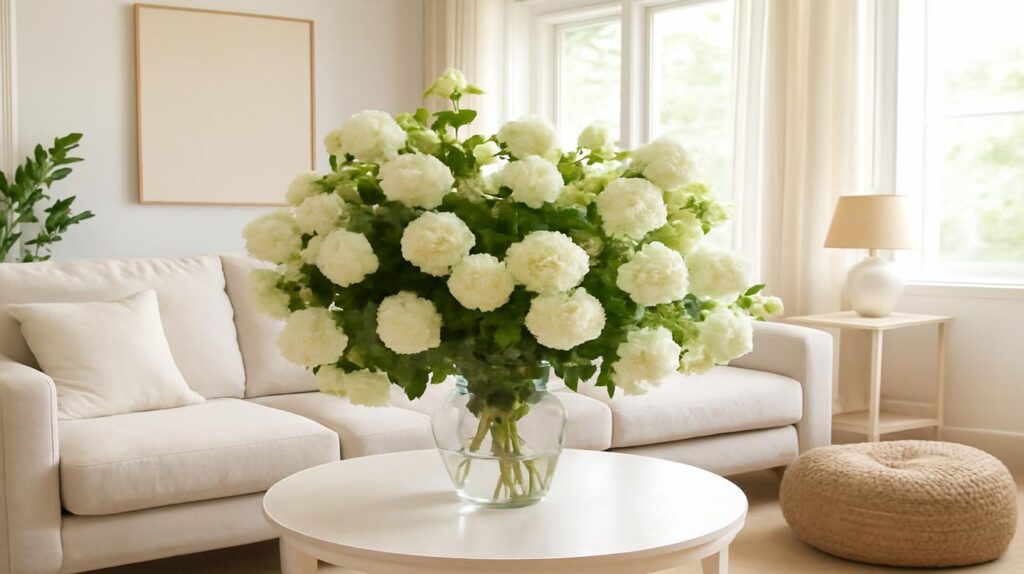
The first time I brought a snowball bloom into a living room, the whole space seemed to inhale. The house had been quiet a moment before—muted grays, soft fabrics, the low hum of a heater in late March. Then I set a tall glass vase on the coffee table, its neck crowded with those round, frothy globes of white and pale lime, and suddenly the room felt like it had just thrown open its windows to spring. My client stopped mid-sentence, turned, and simply said, “Oh.” That quiet, startled “oh” is the sound snowball blooms are made for.
The Moment Snowball Blooms Cross the Threshold
Decorating, at its heart, is about the moment of crossing. The way you move from hallway to living room, from busy day to quiet evening, from outside weather to inside sanctuary. There’s always a threshold. And few things mark that passage as quickly—or as gently—as a vase of snowball blooms waiting for you on a console, sideboard, or low coffee table.
If you’ve never met them in person, snowball blooms (most often Viburnum opulus, sometimes hydrangea varieties) look almost too perfect, like they’ve been sketched from memory by someone enchanted with the very idea of “flower.” Each stem holds a rounded cluster of tiny petals, forming a sphere that seems soft even before you touch it. In early spring, they often open a bright, citrusy green, then ripple slowly into soft ivory, then white—a little time-lapse of the season right in your hands.
When I carry an armful of them into a home, I always notice how people react. Shoulders drop. Voices lower. Even in the most modern, polished spaces—black metal, clean lines, sculptural furniture—the presence of these airy globes introduces a kind of friendly softness. They don’t shout for attention like red roses or display the drama of orchids. Instead, they glow. They invite you closer. And they have this uncanny ability to make a living room feel not staged, but lived in—and loved.
That’s the secret most decorators eventually learn: we’re not just placing objects; we’re changing the way a room feels in your chest. Snowball blooms do that in seconds.
The Science of Softness: Why Our Eyes Relax
There’s a quiet science behind why snowball blooms enchant us so instantly. Part of it lies in their shape. Our eyes are drawn to rounded, repeating forms—clusters, orbs, ripples. They read as gentle, familiar, even safe. A snowball bloom is basically a small galaxy of repeating circles, all converging into one soft sphere. Your brain barely needs to work to make sense of it, and that ease registers as calm.
The colors do the rest. Whether they’re still a tender green or fully white, snowball blossoms act as natural light reflectors. They bounce brightness back into the room. In darker spaces, this is almost magical; one vase acts like a mild, organic lamp, picking up whatever daylight filters through and scattering it across walls and surfaces. At night, they catch lamplight in delicious, subtle ways—no glare, just a mild, milky glow.
I’ve watched these blooms transform city apartments with a single move. In a small, shadowy living room overlooking a brick wall, we placed snowball stems in a broad, low bowl on the coffee table. The client, who had always complained her space felt “flat,” sat down after we finished and stared. “It’s like the room suddenly has depth,” she said. She wasn’t imagining it. Those layered petals create tiny gradations of shadow and highlight that trick the eye into seeing more dimensionality in the room as a whole.
Beyond all that, there’s the emotional imprint of spring itself. Snowball blooms carry something powerful: a whisper of seasons turning, of late frosts melting, of longer evenings arriving. You don’t need to know their botanical name to feel that story the instant they enter the room. It’s as if the living room borrows a breath of garden air without you needing to open a single window.
How Snowball Blooms Quietly Re-Write Your Living Room
Living rooms are often a tug-of-war between personality and practicality. You want the room to look beautiful, but also to hold your scattered mail, your TV remotes, your coffee mugs, the book you swear you’ll finish. In the real world, we rarely live in those eerily pristine spaces you see in glossy photos. But snowball blooms have this remarkable talent for making even a lived-in room feel considered and intentional.
Place a simple vase of them on a clutter-prone coffee table and suddenly everything else looks a bit more purposeful, almost curated. The sneakers left by the sofa, the half-folded blanket, the open laptop—they all seem to orbit something graceful instead of just piling up at random. It’s not that the flowers “fix” the mess; it’s that they give the eye a comforting anchor, a point of softness from which to view everything else more kindly.
And then there’s the way they handle style. Snowball blooms are chameleons. In a minimalist room with low furniture and neutral textiles, they look sculptural and modern—clean white globes rising from a clear cylinder, stark and elegant. In a boho living room, they look lush and nostalgic in an old ceramic jug or mismatched pitcher. In a more traditional space, they echo cottage gardens and country houses, wonderfully at home in a heavy glass vase or silver urn.
I often tell clients: if your living room feels like it’s arguing with itself—too many colors, a new rug that doesn’t quite match, pillows you’re not sure about—bring in snowball blooms. Their subtly changing green-to-ivory palette has a harmonizing effect. They bridge cool and warm tones, sit comfortably near woods and metals, and never feel like they’re competing. It’s as if they arrive carrying a quiet truce between all the other objects in the room.
The Invisible Story Snowball Blooms Tell
Every living room tells a story to anyone who steps inside. Some say, “We live for weekends and movies”; some say, “This is where we work, eat, and do everything else.” When snowball blooms appear, the room’s story shifts just slightly. Suddenly it also says, “Someone here noticed the season.”
That small detail—a branch cut from a neighbor’s yard, or a bundle picked up at the market—tells guests you care about more than just furniture and throw blankets. It says you’re tuned to what’s happening outside, that your living room isn’t a sealed box but a space in conversation with the world beyond the windows. Even if your view is a fire escape and a brick wall, that vase of snowball blooms is a reminder that somewhere close by, something is quietly blooming.
Placing the Magic: Where Snowball Blooms Belong
One of the joys of decorating with snowball blooms is how forgiving they are in placement. They don’t need a pedestal or perfect light. But how and where you put them can change the entire mood of your living room.
On a low coffee table, a wide, low vase filled with shorter stems creates a soft, cloud-like presence right at eye level when you sit down. They’ll become an instant conversation piece without blocking faces or sightlines. On a console behind a sofa, taller branches feel like they’re growing out of the furniture, adding height and movement without any construction or built-ins.
Near a window, snowball blooms practically hum. Their pale petals drink in natural light and reflect it back into the room with a gentle halo. In the late afternoon, when sunlight slides sideways, you’ll often notice a subtle glowing edge to each bloom, as if someone outlined them with a fine brush of light.
Even corners benefit. Every living room has a spot that feels a bit forgotten—the side table no one uses, the small stool where objects go to wait. Slip a small jug of snowball blooms there and the corner wakes up. It suddenly reads as “intentionally quiet” instead of “accidentally ignored.”
To make these decisions easier, it helps to think about snowball blooms not just as flowers but as living design elements—pools of light, soft spheres, vertical lines. Here’s a simple guide I often share with clients when we’re playing with placement:
| Placement Spot | Best Vase Style | Effect on the Room |
|---|---|---|
| Coffee table (center) | Low, wide bowl or squat cylinder | Creates a soft focal point; anchors the seating area. |
| Console behind sofa | Tall, narrow glass vase | Adds height and gentle drama without blocking views. |
| Side table by armchair | Small ceramic jug or pitcher | Makes a cozy reading nook feel inviting and intimate. |
| Window ledge or near window | Clear glass vase | Maximizes reflected light; enhances the sense of airiness. |
| Empty corner or stool | Medium-height rustic vase | Turns dead space into a gentle, intentional vignette. |
You don’t need a decorator’s eye to experiment. Try a spot for a day. Notice how your living room feels when you walk in from outside, or when you sit down in the evening. Snowball blooms are excellent teachers; they’ll quickly show you where your room longs for a bit more softness or light.
The Ritual of Bringing Spring Indoors
There’s another, quieter reason these blooms captivate so quickly. It isn’t just how they look; it’s what they ask of you.
To bring snowball blooms into your living room, you usually have to take a small pause—at the grocery store, the florist, or in your own backyard. You choose stems, you carry them home, you trim them at the sink, you fill a vase with water, and you decide, deliberately, where they’ll live. In a world that celebrates speed, this is a rebellion of slowness.
When I visit clients year after year, I notice who has taken this ritual into their own hands. Often, a person who once said, “I don’t know anything about flowers” will now text me a photo in April of a great armful of snowball branches they’ve cut themselves, proudly exploding over their coffee table. The living room hasn’t necessarily changed—the same rug, same sofa, same books on the shelf—but it feels more inhabited, more awake.
Snowball blooms, like all seasonal flowers, give us an excuse to mark time more tenderly. “It’s snowball season,” someone might say, the way another person notes the first frozen day, or the first evening they eat dinner outside. When those bright green clusters appear, you know you are in a particular slice of the year. Your living room is no longer an all-purpose, all-season, neutral box; it’s the spring living room now, wearing its seasonal accent with quiet pride.
A Tiny Guide to Making Them Last
You don’t need expert skills to keep snowball blooms cheerful for days, but a little care goes far—enhancing that daily moment of enchantment every time you pass through the room.
- Give stems a fresh diagonal cut before placing in water to help them drink more easily.
- Strip away leaves that would sit below the water line to keep it clear longer.
- Use cool, clean water and change it every couple of days.
- Keep the arrangement out of harsh, direct sunlight and away from heating vents.
- If stems start to droop, re-cut the ends and place them in slightly warm water for a brief revive.
Even as they age, snowball blooms remain beautiful. The petals papery, the colors fading into a creamy, antique shade—your living room gets to hold not just the vibrancy of new bloom, but the dignity of their soft decline. Watching that progression, day by day, is its own quiet pleasure.
Why We Keep Coming Back to Snowball Blooms
Ask any decorator about their “reliable magic trick” and you’ll get a handful of predictable answers: a well-placed mirror, a carefully scaled rug, the right bulb in the right lamp. But if you ask which natural element they reach for when a living room feels flat, tired, or a little too composed, you’ll often find snowball blooms on that shortlist.
It’s not simply their beauty—though that’s undeniable. It’s their balance of presence and humility. They rise to any occasion without demanding it. They charm without overwhelming. They soften without cluttering. They bring nature in without the drama or maintenance of a full houseplant collection.
Most of all, they remind us that our living rooms are living. That the sofa where you nap and the coffee table where you drop your keys can also be the stage for something fleeting and delicate and absolutely unnecessary in the practical sense—and yet, completely necessary in the deeper one.
Maybe that’s why, when a client walks into their newly refreshed living room and sees snowball blooms waiting on the table, their first response is rarely a full sentence. More often, it’s a small inhale, a pause, and that soft, surprised “oh.” It’s the sound we make when something inside us recognizes home—not just as a place we live, but as a place where beauty is allowed to arrive, unannounced, in the form of a round, generous bloom.
And for a decorator, there’s no better measure of success than that.
FAQ
How long do snowball blooms usually last in a living room?
With fresh water and trimmed stems, snowball blooms typically last 5–10 days indoors. Cooler rooms and indirect light can help extend their life. Even as they fade, they often dry into a lovely, antique-looking arrangement.
Do snowball blooms have a strong scent?
Most common snowball viburnums have a very light, subtle fragrance, often barely noticeable in a living room. They’re a good choice if you’re sensitive to strong floral scents but still want the presence of fresh blooms.
Are snowball blooms hard to arrange for beginners?
Not at all. Their naturally rounded shape does most of the work for you. Simply gather a few stems of varying heights, trim them, and place them loosely in a vase. They look beautiful even in the most relaxed, unstructured arrangements.
What colors do snowball blooms come in?
Most classic snowball blooms move from bright green to creamy white as they mature. Some hydrangea “snowball” varieties can soften into pale blush or lime tones, but the iconic look is that cloud of green-into-ivory spheres.
Can I mix snowball blooms with other flowers in my living room?
Yes. They pair wonderfully with delicate branches, eucalyptus, tulips, or simple greenery. However, many decorators prefer them on their own so their spherical shape and subtle color shifts can take center stage without distraction.
Where in a small living room should I place snowball blooms?
In compact spaces, a coffee table, side table, or windowsill works best. Choose a modest vase and keep the arrangement simple. Even a handful of stems can instantly brighten and soften a small room without feeling crowded.
Do I need special vases for snowball blooms?
No special vases are required. Clear glass cylinders, ceramic jugs, or simple bowls all work well. The key is to match the vase to the mood of your room—sleek and minimal for modern spaces, textured or rustic for cozier, more relaxed interiors.