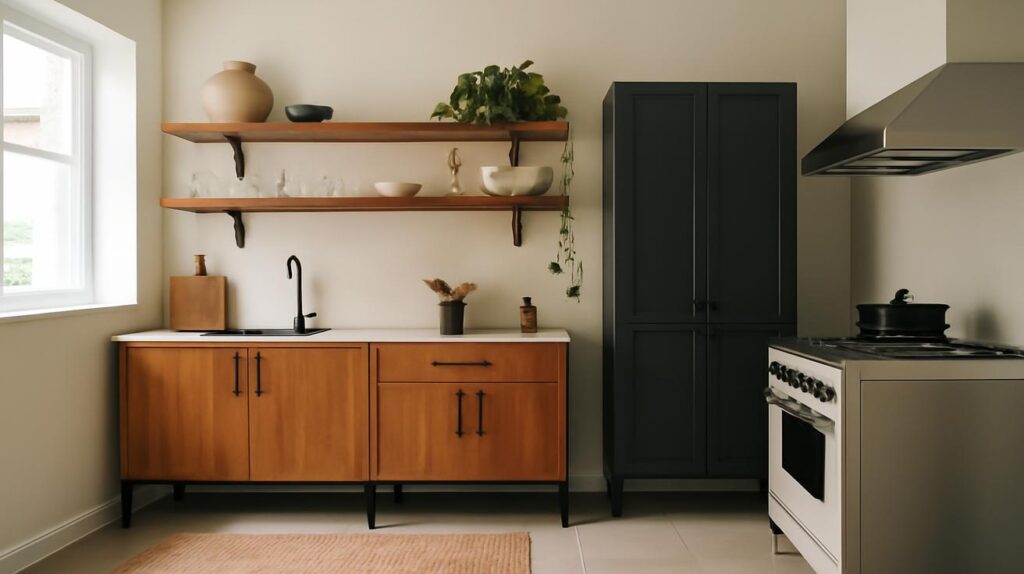
The first thing you notice is the light. It pours in through the kitchen window without crashing into a wall of bulky cupboards, slips across open shelves and bare, wipe-clean surfaces, and settles softly on bowls, jars, and cast-iron pans that suddenly look like they belong in a gallery. Something is missing—and that’s exactly the point. No towering laminate monoliths, no swollen chipboard doors hanging askew, no mysterious smell creeping from the dark corner where the mop bucket lives. This is a kitchen built on a quiet little rebellion: goodbye kitchen cabinets, hello something simpler, cheaper, and startlingly beautiful.
The Quiet Rebellion Against the Boxed-In Kitchen
For decades, the story of a “proper” kitchen was written in straight lines of cupboards. You could measure success in soft-close hinges and perfectly aligned doors. Storage meant boxes: above, below, all around. Dark, heavy, expensive boxes.
And then, for many of us, the cracks started to show—literally. Doors warped from steam rolling off a simmering pot. Chipboard swelled and bubbled at the slightest whisper of a leak. A strange patch of mould appeared behind a cleaning caddy, then spread like an ink stain. Those glossy cabinets, once the star of the showroom, slowly turned into maintenance projects you couldn’t quite keep up with.
At the same time, something else changed. We started cooking more at home. We shopped differently—less bulk, more fresh. We began to crave space and light instead of more storage for things we didn’t really need. And into that gap slipped a new idea, quietly at first, then faster:
What if the best kitchen doesn’t have cabinets at all?
Across social feeds, in design magazines, in tiny apartments and sprawling farmhouses, the same style keeps popping up: open, breathable, and refreshingly honest. Open shelving instead of wall units. Freestanding pieces instead of built-in blocks. Powder-coated metal frames, industrial rail systems, and sealed plywood instead of moisture-greedy MDF. A kitchen that looks like it’s meant to be used, not just photographed.
The New, Cheaper, Non-Warping Alternative
The new trend isn’t one single product; it’s a shift in the way we think about “fitted” kitchens. At its heart are three main characters: open shelving, freestanding storage, and metal-framed or moisture-resistant units. Together, they quietly sidestep most of the problems that have plagued traditional cabinets for years.
Open Shelves: The Anti-Cupboard
Open shelving is the most visible part of this shift. Planks of solid wood or bamboo mounted on simple brackets. Slim metal shelves lining a sunlit wall. Narrow ledges running just below eye level, filled with jars of lentils, stacks of plates, and a bottle of olive oil within easy reach.
There is no door to warp, no hinge to break, no hidden corner where condensation can gather and slowly bloom into mould. Everything is out in the open, constantly aired. A shelf made from sealed hardwood or sustainable plywood doesn’t swell and blister from the daily theatre of boiling kettles and simmering pots the way cheap chipboard doors do.
And here’s the unexpected twist: because you see everything, you own less. You reach for what you actually use. Your shelves become not only functional, but expressive. Instead of hiding your kitchenware, you curate it. Everyday bowls become part of the décor. A favourite mug finally gets the stage it deserves.
Freestanding Pieces: Furniture, Not Fittings
Then there’s the furniture-style approach: instead of long, continuous base cabinets, you get islands on legs, butcher’s blocks, stainless-steel prep tables, and sideboards repurposed as kitchen units. They stand away from the wall. They have breathing room underneath. You can see the floor run unbroken beneath them—an instant sense of space.
Many of these pieces are built from solid materials: metal, sealed wood, or compact laminate designed for punishment. They don’t rely on flimsy edging and veneers to stay pretty. They don’t disintegrate because of one unnoticed spill that dripped through a gap in the countertop and soaked the cabinet side panel for a week.
Freestanding units are also, almost always, cheaper to replace. You can mix and match over time: start with a metal prep table and one open-shelf unit, add a second-hand sideboard later, then a slim tall pantry with moisture-resistant boards. No need to commit thousands upfront to a fully fitted set. Your kitchen evolves as your budget—and your life—does.
Why This Trend Doesn’t Warp, Rot, or Turn Fuzzy with Mould
The usual enemies of a kitchen are steam, splashes, and the little leaks you notice only when it’s too late. Traditional cabinets—especially the affordable ones—are made from MDF or chipboard wrapped in a thin skin of laminate or foil. Once moisture sneaks past the edges, it swells, warps, and becomes a playground for mould.
The new wave turns that vulnerability on its head by changing two big things: airflow and materials.
Airflow: Let the Kitchen Breathe
When you remove boxy wall units and tightly sealed base cabinets, you strip away the still, dark pockets where moisture loves to linger. Open shelves have air on all sides. Freestanding units on legs let air travel beneath and behind. A kettle puffing steam into the air doesn’t trap that damp inside a cupboard where a tea towel quietly absorbs it forever; it just drifts away.
Mould doesn’t flourish where air moves freely. It prefers forgotten corners, the gap behind the cleaning products, the sealed-off back of a cabinet pressed tight against a cold wall. This trend simply doesn’t give it the same real estate.
Materials: From Chipboard to “Life-Proof” Surfaces
Many of the new non-cabinet kitchens lean on materials that shrug off water instead of soaking it up:
- Powder-coated steel frames that don’t warp and are easy to wipe down.
- Stainless steel prep tables, borrowed from restaurant kitchens built for daily abuse.
- Birch plywood or other high-grade ply, sealed at the edges and finishes, which is vastly more stable and water-resistant than cheap particle board.
- Compact laminate and solid-surface tops that don’t flinch at boiling water or spills.
The result: no swelling doors, no spongy side panels, no bottom edges puffing out like pastry. Even if you splash, spill, or occasionally forget about that drippy dish rack, your kitchen doesn’t quietly rot behind closed doors.
How This “Cabinet-Free” Kitchen Saves Money
One of the most surprising things about this trend isn’t its look—it’s the price. A fully fitted kitchen with rows of cabinets, corner carousels, matching end panels, and fancy handles can chew through your budget before you even pick a worktop. The new approach slices off big chunks of cost from the very beginning.
Here’s a simple comparison of how costs often break down in a traditional cabinet-heavy kitchen versus a lighter, open, cabinet-free style:
| Aspect | Traditional Cabinet Kitchen | Cabinet-Free / Open Kitchen |
|---|---|---|
| Wall storage | Full-height wall units, multiple doors, hinges | Few or no wall units; simple open shelves |
| Base units | Continuous run of fitted cabinets | Freestanding tables, carts, and a few key units |
| Materials | MDF/chipboard with laminate fronts | Metal frames, sealed ply, solid wood, simple surfaces |
| Labour & fitting | Precise measuring, complex fitting, multiple trades | Simpler installation; more DIY-friendly |
| Long-term costs | Door replacement, hinge repairs, water-damage fixes | Occasional shelf refinishing; swap-out individual pieces |
You’re not just saving on big boxes of board and hardware; you’re saving on the labour it takes to stitch them together to the millimetre. Many open kitchens rely on items that arrive mostly assembled, or that can be installed without a specialist fitter. You can pick up a robust metal prep table for a fraction of what an extra row of cabinets would cost, and you don’t need a professional to screw it to the wall.
Even better, you can build slowly. Maybe you start with a new worktop and a couple of wall shelves, then swap one bulky base cabinet for a freestanding island with drawers. Next year, you might add a tall metal pantry rack and say goodbye to the last wall unit over the stove. The kitchen becomes a story told over time, not a one-off purchase that has to be perfect on day one.
Living with Fewer Cabinets: Real Life, Not Just Pinterest
Of course, the question that lingers behind all this loveliness is simple: is it actually practical? The answer depends on how you live—but in many cases, it’s more practical than the cupboard mazes we grew up with.
Owning What You Use (and Loving How It Looks)
Open shelving and freestanding units quietly encourage a small revolution in how much you own. When everything is visible, you naturally qualify what earns a place. That fifth set of mugs you never liked much? It doesn’t make the cut. The three chipped mixing bowls that wobble on the counter? Recycled, replaced, or repurposed.
What’s left is a kitchen where almost everything you see has a job and a story. Your favourite cast-iron pan sits on a hook by the stove. The stack of plates you reach for every single day lives at arm’s height. A row of spices becomes a colourful ribbon within easy reach of the chopping board. You don’t rummage; you reach.
Cleaning: Less Hidden Dirt, More Easy Wiping
Yes, open shelves can gather dust. But so do the tops of tall cabinets—only up there, you forget about it for years until you climb up one day and wonder how anything could be that sticky.
In an open kitchen, dirt has nowhere to hide. A quick weekly wipe of exposed shelves is simpler than deep-cleaning the inside of swollen cupboards, clearing out mysterious crumbs from a corner that only sees daylight twice a year. Freestanding units on legs make it easy to sweep and mop underneath. There’s no toe-kick void full of runaway peas and lost pasta shells.
And because your things are out in the open, you notice when something gets grimy. You don’t discover mouldy jars at the back of a unit three years past their best-before date, because there simply is no dark back-of-the-unit to forget about.
Designing Your Own Cabinet-Free Kitchen
So how do you translate this trend into your own space without feeling like you’ve just moved into a half-finished café? It’s less about copying a photo and more about asking a few honest questions: what do you actually use, where do you stand when you cook, and how much closed storage do you truly need?
Start with Zones, Not Boxes
Imagine your kitchen divided into zones: prep, cook, wash, store. Instead of lining each wall with identical boxes, choose individual pieces that serve each zone well:
- A sturdy metal or wooden prep table near the cooker, with hooks or a rail for utensils.
- Open shelves above the work area for plates, bowls, and daily glassware.
- A deep, freestanding unit or sideboard for dry goods, with baskets or crates inside for easy sorting.
- A slim rack or tall open pantry for bottles, jars, and tins.
Keep the items you use every day within a single turn and reach of where you cook and wash. Anything occasional—festive platters, slow cookers, giant serving dishes—can live lower down or in a nearby room, out of the main flow.
Mix Open and Closed, Instead of All or Nothing
“Goodbye kitchen cabinets” doesn’t have to mean stripping every hinged door from your life. Many of the most successful versions of this trend keep a few closed units for things you don’t want on display: rubbish and recycling, cleaning products, that drawer of random-but-essential bits.
Think of it as a 70/30 balance: most of your everyday items live on open shelves or in visible drawers; a smaller portion hides away in robust, moisture-resistant closed units. You still reap the benefits—less mould, less warping, more air, more light—but with the calm of having some private storage.
Choose Materials with Patina in Mind
The charm of a cabinet-free kitchen often lies in how it ages. Metal frames that pick up tiny scuffs, wooden shelves that mellow in tone, a ceramic jar that chips but becomes more beloved. When you choose materials, think not about how they look brand new, but how they’ll feel lived with.
Solid woods you can sand and reseal. Metals you can wipe down endlessly. Simple glass jars that can be replaced without hunting down a discontinued line. This isn’t a showroom; it’s a working room. The trick is to let it work hard and still feel beautiful.
Why This Trend Is Spreading So Quickly
This isn’t just an aesthetic shift; it slot neatly into a broader cultural mood. Homes are flexing more than ever—doubling as offices, studios, classrooms. The idea of locking thousands into a rigid fitted layout that might not suit your life in five years suddenly feels… old-fashioned.
A cabinet-free or cabinet-light kitchen is easy to adapt. You can add another shelf, move a table, rotate a rack, repaint or replace one small element without starting all over again. If you move house, some of your kitchen comes with you. That beloved island, those shelves that perfectly fit your jars—you don’t have to leave them behind.
It also aligns with a shift toward owning less, but better. Fewer gadgets, more multi-use tools. Fewer duplicate plates, more pieces you enjoy every day. In that world, you simply don’t need fifteen metres of closed cupboards to store “just in case” items.
And then there’s the emotional piece. A kitchen without looming cabinets feels lighter. Standing in such a space, you can see out the window, across the room, into the next. People drift in and perch on stools at a freestanding island. Kids grab their own cups from low open shelves. Friends can help themselves without needing a tour (“second cupboard from the left, top shelf, behind the blender…”). The kitchen stops being a row of doors and becomes, once again, a place to gather and move and cook.
FAQs
Won’t everything on open shelves get dusty or greasy?
Some dust is inevitable, but daily-use items rarely sit long enough to collect much. Keep shelves close to where you cook stocked with things you touch often—plates, bowls, glasses, oils, spices. Less-used or decorative items can live farther from the hob, where grease in the air is lower. A quick wipe as part of your normal cleaning routine is usually enough.
Do I have to get rid of all my existing cabinets to follow this trend?
No. Many people transition gradually. You might remove a single wall unit and replace it with shelves, or swap one base cabinet for a freestanding island. The goal isn’t purity; it’s a kitchen that works better, breathes more, and uses more durable, moisture-resistant elements where it matters.
Is a cabinet-free kitchen suitable for small spaces?
Yes, often especially so. Removing upper cabinets can make a tight kitchen feel wider and brighter. Taller open shelving, pegboards, and rail systems can provide vertical storage without the visual heaviness of full cupboards. Just be deliberate about what you keep: small spaces benefit from editing down to what you truly use.
How do I hide ugly essentials like bins and cleaning products?
You can keep a few closed units specifically for these. A single moisture-resistant under-sink cupboard, a pull-out bin concealed within a freestanding unit, or a slim, enclosed cabinet in a corner can discreetly handle the less glamorous items while the rest of your kitchen stays open and airy.
Will a kitchen without many cabinets hurt my home’s resale value?
Trends vary by region and buyer, but more people now appreciate flexible, furniture-style kitchens that feel unique and easy to adapt. If resale is a concern, maintain a balance: some closed storage for practicality, plenty of open, modern elements for style. Quality materials and a thoughtful layout will usually matter more to future buyers than the sheer number of cabinet doors.