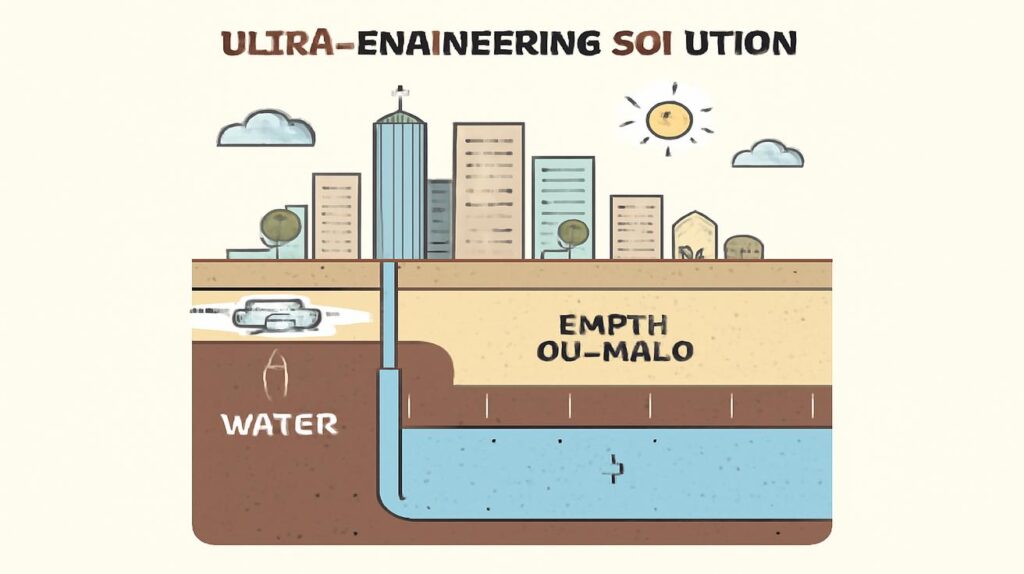
The ground beneath your feet is not as solid as it seems. In some of the world’s largest cities, the earth is slowly sinking—millimeter by millimeter, year after year—dragging roads, subway lines, homes, and entire neighborhoods down with it. It’s a quiet catastrophe, happening too slowly for the human eye yet fast enough to ruin buildings within a single lifetime. But beneath this unsettling story of collapse, there is a surprising twist: in a few places, engineers have learned to push back. By pumping water into depleted oil fields and exhausted underground reservoirs, they’ve managed to slow, and in some cases nearly stop, the steady sag of the land.
The City That Learned to Breathe Again
Picture a city at dawn: the light is pale, soft, and hazy, filtering through a forest of concrete towers and neon signs. The streets are still damp from the night, the gutters carrying a thin ribbon of water toward storm drains. Cars slide past in low murmurs. Somewhere beneath them, tens or even hundreds of meters below, is a dark, porous world of rocks and empty spaces—the ghostly remains of oil and water once pumped out to fuel a growing metropolis.
For decades, engineers drilled and sucked and tunneled through these subsurface layers, extracting crude oil, natural gas, and groundwater as though the earth were a bottomless pantry. At first, the surface barely reacted. City life continued, vertical and ambitious. Then the ground began to change.
In some neighborhoods, residents noticed cracks climbing up the sides of buildings like slow-motion lightning. Doors wouldn’t close properly. Pavements buckled and lifted. The city’s carefully laid infrastructure began to warp, a subtle but relentless twisting under the pressure of the sinking earth.
The cause was simple physics. Remove fluid from the tiny pores inside underground rock formations, and the grains of rock compact. Imagine a sponge saturated with water; when you squeeze out the liquid, the sponge shrinks. Oil fields and groundwater aquifers behave in much the same way. As oil and water were extracted, the underground sponge lost its buoyancy. The land above responded by settling downward, pulled by gravity into the newly compacted space.
What startled engineers was not just that this could happen, but how fast. In parts of Asia, some urban areas were sinking by more than 20 centimeters a year. In others, gradual subsidence accumulated to several meters over the span of a few decades—enough to alter floodplains, twist rail lines, and crack bridges.
Faced with mounting damage and rising insurance costs, city planners and petroleum engineers converged on a desperate question: if taking fluid out of the ground made the land sink, could putting fluid back in help it stay up?
Reversing the Flow: The Strange Art of Pumping Water Down
The idea sounds backwards at first. We’re used to thinking of wells as one-way straws, pulling oil or water from deep underground. But in some of the world’s major oil and gas fields that underlie big cities, the pipes now run in both directions.
In vast technical control rooms, operators monitor pressure gauges and flow meters like physicians reading vital signs. Instead of only sending pumps into action to draw hydrocarbons from the ground, they also use them to push water back in—carefully, slowly, and with constant monitoring. The water is often treated, recycled, or drawn from nearby sources. Its purpose is not to replenish drinkable aquifers; it’s to hold the rock formations open, to prop up the microscopic spaces once occupied by oil.
If the image of pushing water into a former oil field feels abstract, think of a deflating balloon. As oil extraction progresses, the pressure inside the reservoir drops. The overlaying layers of rock, and ultimately the city itself, begin to settle toward this low-pressure void. By injecting water back into the reservoir, engineers effectively re-inflate the system—not to its original state, but enough to resist the most dramatic collapsing forces.
In cities built over oil basins, some of these injection projects have been going on for decades, evolving quietly as part of the standard lifecycle of an oil field. What began as a way to squeeze extra oil from aging reservoirs—commonly known as “waterflooding”—took on a second, unexpected role: a defense against subsidence.
The transition from purely extractive thinking to a more balanced, pressure-managed approach did not come easily. It meant new costs, new monitoring equipment, and a willingness to accept that the value of a barrel of oil had to be weighed alongside the structural integrity of a city’s foundations. Over time, seismic surveys, satellite radar (InSAR), and GPS towers started to show the results. In some locations, the purple and red zones on subsidence maps—areas sinking fastest—began to fade to orange, then yellow, even pale green. The ground hadn’t stopped moving entirely, but its downward slide had slowed dramatically.
Feeling the Invisible: How the Ground Tells Us It’s Sinking
Subsidence is almost always invisible in the moment. You don’t feel the earth slip under your shoes. There is no sudden jolt, no cinematic rumble. Instead, the clues arrive in fragments of daily life: a puddle that refuses to drain, a staircase that seems slightly off-kilter, a low-lying alley that suddenly floods with each heavy rain.
From space, however, the story is far clearer. Using radar signals bounced off the earth’s surface, satellites can track changes in elevation to within a few millimeters. When researchers overlay these maps on city plans, strange patterns emerge. Industrial districts where oil and water have been extracted for years show up as slow, wide “bowls” of sinking land. Areas above pressurized injection wells sometimes form subtle “domes,” rising slightly or stabilizing in an otherwise sagging landscape.
It is in these maps that the impact of decades-long water injection becomes unmistakable. Neighborhoods that once sank rapidly now sink much more slowly, the gradient softening around former oil fields that have been carefully re-pressurized. It’s not magic and not a miracle—just the physical response of rock to changing pressure—but to the people whose homes have stopped cracking, it can feel almost miraculous.
Still, stabilization is not always evenly shared. Some areas benefit from pressure control while others, farther from injection sites or above different geology, keep slipping down. The city becomes a patchwork of futures: some districts resting, some sinking, some teetering between.
Living in a Slowly Changing Landscape
Residents often sense these differences before the data confirms them. A taxi driver might swear that a certain underpass floods more now than it did in his childhood. A shopkeeper notices that the line where they once swept water out of their doorway is now inches above the sidewalk. An engineer in a utilities department battles an endless series of pipe leaks as joints twist and warp underground.
For those paying close attention, the city acquires a slightly liquid quality—as if solid structures were resting on something soft and restless. In this context, the notion of pumping water back into the earth becomes more than a technical fix; it becomes a kind of quiet reassurance, a promise that humans are learning to treat the subsurface as more than just a warehouse of resources.
What We Gain – and What We Risk – By Pushing Water Back Underground
Injecting water into depleted reservoirs sounds elegantly simple, but it comes with trade-offs. The earth is not an empty tank waiting to be refilled. It’s a complex, fractured system of rocks, faults, and ancient fluids. Push too hard, and you might trigger new problems.
The most frequently discussed risk is induced seismicity—small earthquakes caused or nudged by human activity. When engineers increase the pressure in deep rock formations, they also change the forces along nearby faults. Most of the time, these changes are subtle. Occasionally, they may be enough to encourage a stuck fault to slip.
This doesn’t mean that all injection causes earthquakes, nor that oil-field waterflooding is inherently dangerous. It does mean that each injection project must be curated with care. Engineers study local geology, monitor seismicity, and adjust injection volumes and pressures. Pressure management becomes almost an art: enough water to support the overlying land, not so much that the earth shudders in response.
Another subtle trade-off is that water-injection projects tend to be highly localized. They work best where subsidence is closely linked to pressure changes in known reservoirs—places where oil extraction is the primary cause. In cities where the main driver of sinking is groundwater pumping for drinking water or irrigation, or the sheer weight of rapid urbanization on soft sediments, the solution must be different. There, the hero is often not water injection, but water restraint.
| Approach | Main Goal | Typical Setting | Key Benefit |
|---|---|---|---|
| Water injection into oil fields | Maintain reservoir pressure | Depleted hydrocarbon basins | Slows land subsidence, extends oil recovery |
| Reduced groundwater pumping | Protect aquifers and land surface | Rapidly growing cities, farming regions | Stabilizes sinking zones, preserves water |
| Managed aquifer recharge | Refill groundwater with captured surface water | River basins, floodplains | Mitigates subsidence, stores water for dry seasons |
| Stronger building foundations | Adapt structures to moving ground | Already subsiding urban districts | Buys time and safety despite ongoing sinking |
Water injection stands out in this toolkit because it directly addresses one critical piece of the puzzle: subsurface pressure. Where that pressure shift is the main culprit, it can be remarkably effective. Where it isn’t, the method becomes just one part of a much larger story of adaptation.
Oil Fields as Unlikely Climate Allies
There’s an odd irony in this narrative. Oil fields—symbols of extraction and carbon-heavy growth—are becoming, in some ways, guardians of the ground above them. The same wells once drilled to pull fossil fuels up are now used as conduits to push water down, propping up city districts that might otherwise slump more quickly toward the sea.
Some engineers now see depleted reservoirs as multi-purpose tools. If they can safely hold water to protect against subsidence, could they also store other fluids? Discussions about carbon capture and storage (CCS) draw from the same basic knowledge of subsurface behavior: how pressure moves, how rocks respond, how long-term monitoring should be done.
In this context, the practice of water injection becomes more than a narrow technical adaptation. It looks like the beginning of a broader reimagining of what it means to manage the underground. Instead of treating it only as a source of wealth to be extracted, we begin to see it as an infrastructure in its own right—a system whose stability is intimately tied to the resilience of cities on the surface.
Standing on a sidewalk above one of these old oil fields, you wouldn’t know any of this is happening. The air smells of exhaust and street food, not crude oil. The only visible pipes are the ones feeding water to apartment blocks, not the pumps running quietly many kilometers below. But hidden in that vertical distance is a new kind of relationship between a city and its geology, careful and tentative, negotiated by engineers, geologists, and policymakers who understand that what we do beneath the surface echoes above it for generations.
The Emotional Geography of a Sinking City
For residents, the story of subsidence is not written in pressure readings and reservoir models. It’s written in worry: Will my house crack again this year? Will the next flood reach the doorstep? Will the insurance company still cover damages, now that everyone knows the land is sinking?
Slowing subsidence with water injection doesn’t erase these questions, but it can soften them. In neighborhoods where sinking has tapered off, people report a different kind of confidence. They repaint instead of relocating. They invest in repairs, plant trees, build shallow gardens. The city, which once felt like it was literally falling away from under them, regains a sense of permanence, however partial.
This is not universal, and it is not perfect. In some districts, the sinking continues. In others, the ground has stabilized but the memory of damage remains etched in walls and in the stories people tell. They remember the year doors jammed, the season when floods grew worse, the first time they heard the term “land subsidence” on the news and realized it was not a faraway problem but their own.
In that sense, the engineering triumph is also a human one. By learning how to balance extraction with reinjection, cities send a quiet signal: we are not helpless in the face of geologic change. We caused much of this, and we can, to some degree, reshape its trajectory.
Where the Story Goes From Here
The practice of pumping water into depleted oil fields to slow land subsidence is still evolving, and its long-term legacy is uncertain. Yet its broader lesson already feels clear: the ground is not passive. Treat it carelessly, and it responds—slowly at first, then with accumulating force.
As climate change pushes sea levels higher and storms grow stronger, cities built on sinking land face a double exposure. They are moving down even as the water moves up. In this race of vertical inches, every millimeter regained through better subsurface management matters. Water injection alone will not save those cities, but it may buy them precious time: time to improve drainage, strengthen buildings, rethink zoning, and redesign waterfronts.
It also invites a deeper cultural shift. For most of our history, we built as if the ground were forever. Foundations were assumed to be fixed, something you could pour concrete into and forget. Now, more and more, we are realizing that the earth beneath cities is dynamic—breathing, shifting, responding to what we do.
This new awareness is unsettling, but also oddly hopeful. If the land reacts to our actions, then our actions matter. If pulling liquids from the earth can make a city sink, then pushing water back in with care can help it steady. The ground beneath us becomes not just a platform, but a partner—one we must learn to understand, respect, and manage with a patience measured not in quarterly reports but in decades.
Look down at the pavement next time you’re in a big city. Feel that illusion of stillness, the way your weight disappears into the concrete. Somewhere far below, old wells may be humming gently as they push water into rocks that once yielded oil. It’s an almost invisible exchange: the city sending something back, acknowledging an old debt, asking the earth—not to forgive—but at least to hold a little longer.
Frequently Asked Questions
Does pumping water into depleted oil fields really stop land subsidence?
It rarely stops subsidence completely, but it can significantly slow it in areas where pressure loss from oil extraction is the main cause. By restoring some of that lost pressure, the rock layers compact less, which reduces the rate at which the surface sinks.
Is the injected water drinkable groundwater?
Usually not. The water used for injection is often treated industrial water, seawater, or other non-potable sources. It is pumped into deep hydrocarbon reservoirs, not into shallow aquifers used for drinking water.
Can water injection cause earthquakes?
In some geological settings, changes in subsurface pressure from injection can increase the likelihood of small earthquakes. Because of this, projects are closely monitored, and injection rates and pressures are adjusted to minimize seismic risk.
Is this solution useful for all sinking cities?
No. Water injection helps most where subsidence is linked to oil and gas extraction. In many cities, the main driver is groundwater pumping or soft, compressible soils. There, solutions tend to focus on reducing groundwater use, managing aquifer recharge, and adapting infrastructure.
Will water injection into oil fields become more common in the future?
It is likely to remain important in cities built over major oil basins, especially as awareness of subsidence grows. At the same time, it will be just one part of a broader set of strategies for managing the underground in a warming, urbanizing world.