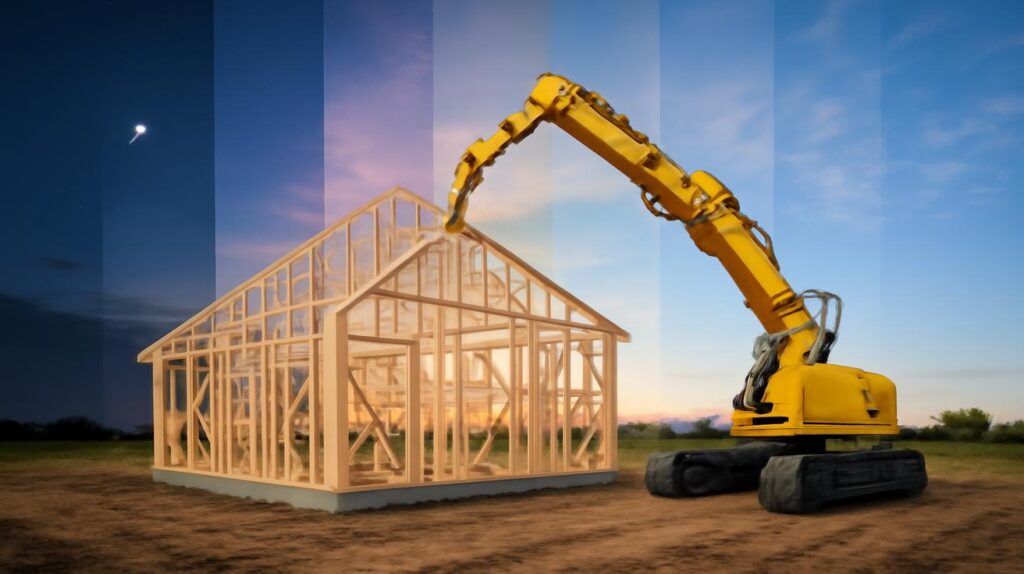
On a quiet patch of dusty ground at the edge of a growing city, dawn creeps in pink over an unfinished foundation. There’s no rumble of diesel engines, no shouted instructions over the grind of cement mixers. The site is still, except for a soft mechanical whir—the sound of something large waking up. As the sun lifts itself over the horizon, a long, articulated arm begins to move with deliberate grace. It sweeps across the empty slab and, line by careful line, starts to draw a house out of thin air.
The Day a House Was Printed from Nothing
Imagine you drive by an empty lot on your way to work in the morning. It’s just a rectangle of concrete, a couple of stacked pallets, a fenced perimeter, and a strange machine sitting in the middle, like an oversized metal spider. You think, Maybe they’re starting a new house here. You picture the usual timetable: weeks of framing, months of delays, workers in hard hats coming and going through rain and heat.
Then you drive home that evening. The sun is low and golden, the air smells like hot asphalt and cut grass. You glance over at the lot—and stop. Where there was only concrete in the morning, now there’s a full set of walls. Doorways. Window openings. The silhouette of a 200 m² home, standing there as if the ground had just decided to grow it.
There are no piles of lumber, no dangling cords, no shouting. Just that same robotic arm, now wet with a chalky, cement-like paste, resting under the glow of a temporary light. In less than 24 hours, it has built the structural shell of an entire house.
This isn’t science fiction anymore. Around the world, robotic construction—sometimes called robotic 3D printing or automated on-site manufacturing—is sliding quietly from bold experiment into workable reality. And the implications are massive: for the people who build homes, for the people who need them, and for the shape of our cities in a warming, crowded world.
The Robot That Draws in Concrete
If you stand close enough, you can hear the house being born. It’s not the roar and clang of conventional construction; it’s more like an enormous inkjet printer humming, every motion preplanned and exact. A pumping system pushes a thick, fast-setting concrete mixture through a hose to the robotic arm. The nozzle moves along a preprogrammed path, laying down bead after bead of material, like icing on a cake—only this “icing” solidifies into a wall you can lean your weight against.
The robot does not pause for a coffee break. It does not check its phone. It does not misread the blueprint. Guided by a digital model, it knows exactly where each doorway goes, how much curve to give the corner of a wall, where to leave channels for plumbing and electrical lines. It moves as if it can already see the home fully formed, just waiting in the code.
Technically, this is a kind of 3D printing, but on a human scale. The machine deposits layers of a special construction mix, each layer fusing to the one below it. In many designs, a full 200 m² floor plan—the kind of space that could easily fit a three-bedroom family home—can be printed in about 24 hours of active machine time, sometimes paused only to allow strategic curing.
Walk around one of these fresh-printed houses while the material is still damp and you smell wet stone, like air after heavy rain. The walls feel ribbed under your fingertips, each layer a visible line in a vertical record of the robot’s path. Later, those surfaces can be smoothed, coated, or celebrated for their layered texture, the way visible brushstrokes are left in a painting.
The Rhythm of a 24-Hour Build
The pace of it feels almost unsettling. We’re used to homes being slow things—built over seasons, watched like saplings as they grow from foundation to framing to finish. In the time it usually takes to schedule a crew and deliver materials to site, a robotic system can spin a digital model into standing walls.
The day might look something like this:
- Hour 1–3: The machine maps the site, calibrates itself, and begins printing the base layers of the walls, ensuring precise alignment with the foundation.
- Hour 4–10: Exterior and interior walls climb steadily, doorways and window frames traced into existence. The outer perimeter of the home takes shape.
- Hour 11–18: Structural reinforcement layers and details are printed; channels and recesses for utilities are integrated into the walls.
- Hour 19–24: Final wall layers reach full height; lintels, curved surfaces, or special design features are added. The robot winds down; the house rests and cures.
When the machine stops, you don’t have a fully finished home—there is still the roof, windows, services, and interior finishes to install—but you have completed what is often the most time-consuming and labor-intensive portion of construction: the structural envelope.
What Changes When a Home Takes One Day?
Buildings are more than walls and roofs. They’re also time. Time to plan, to secure permits, to hire trades, to manage delays, to fix mistakes. When you compress the time it takes to physically build a house, everything around that process begins to shift as well.
From Scarcity to Speed
Around the world, housing scarcity is no longer a distant policy problem; it’s a felt, daily pressure. Rents are rising, young people are discouraged from even imagining home ownership, and entire communities are pushed to the edges of cities or into overcrowded apartments. In disaster-stricken regions, families can wait years for replacement homes that never quite arrive.
A robotic construction system doesn’t automatically solve the housing crisis—land prices, policy, and inequality still matter—but it attacks one stubborn piece of the puzzle: how quickly and affordably we can turn empty land into safe, durable shelter.
Picture a regional housing authority tasked with building homes for hundreds of displaced families. Traditionally, they might contract several builders, each limited by human crews, weather delays, and the slow choreography of manual construction. Now, imagine they deploy a fleet of robotic builders—each capable of printing a 200 m² house in a day or two of site work. Instead of stretches of inactivity and long gaps between stages, there’s a rapid, almost rhythmic emergence of new dwellings.
Costs, Labor, and New Kinds of Jobs
For workers, the story is complex and emotional. There’s a fear that robots are here to replace people—to reduce a proud, skilled trade to monitored machinery. On the ground, though, the picture is subtler.
Robotic builds still need human hands. People set up the machines, handle material supply, check quality, calibrate sensors, and plan the digital models. Traditional trades step in after the walls are printed: roofers, electricians, plumbers, finish carpenters, and interior specialists all have crucial roles. Construction doesn’t vanish; it changes texture.
The brutal, backbreaking labor of lifting heavy blocks in scorching sun, or spending months exposed to dust and noise, can be reduced. Instead, more work shifts toward operating, maintaining, and improving the technology. Training becomes essential: teaching former manual laborers to become robot operators, site technologists, or quality-control specialists who ensure the machine’s performance matches safety standards.
| Aspect | Traditional Build | Robotic 24-Hour Build |
|---|---|---|
| Structural wall time (200 m² house) | Weeks to months | ~24 hours of active printing |
| Labor intensity on site | High, many workers needed | Lower, smaller skilled team |
| Material waste | Significant off-cuts and errors | Precisely controlled, minimal waste |
| Design flexibility | Curves and custom shapes costly | Organic forms relatively easy |
| Exposure to hazardous conditions | Frequent, especially in harsh climates | Reduced, more tasks managed remotely |
For project budgets, the promise is straightforward: fewer labor hours spent on basic structural work can mean lower costs per unit, especially when building at scale. Those savings can, in principle, translate to lower home prices or allow agencies to stretch funding further. Yet the real-world outcome depends on who controls the technology and how willing we are to embed affordability into policy.
Living Inside the Machine’s Imagination
Walk into a finished robotic-built home and you may not immediately notice what makes it different. There’s a front door, a hallway, a kitchen that smells like new paint and unstained wood. Light pours in through large windows; the floor is smooth under your bare feet. It feels like… a house.
But if you run your hand along certain interior walls where the finished coat is thin, you might feel the faint rhythm of those printed ridges. If the architect embraced the method rather than hiding it, you might stand in a softly curved living room, where the wall arcs gently around a cluster of chairs instead of meeting at a sharp 90-degree angle. Niches might be seamlessly printed into the walls—rounded shelves to hold plants, books, or the small treasures of a lived life.
Because robots are guided by digital models, complexity doesn’t scare them. A curved façade or wave-like corridor is no more confusing than a rectangle. The design constraints shift from what humans can easily measure and cut to what the printing material and structural logic will support. That means more organic shapes, more experimentation with light wells, airflow, and thermal mass—design tools that can keep homes cooler in heat, warmer in cold, and more responsive to their climate.
Homes as Software
The idea that a house can be updated like software is starting to peek over the horizon. If a home’s core structure is generated from a digital file, you can imagine a future where:
- Designs are shared, improved, and adapted like open-source code.
- Communities co-create layouts that reflect their cultural and practical needs.
- Structural improvements—better insulation patterns, smarter wall profiles—can be pushed to future builds with a simple software update.
In such a world, a housing authority or cooperative might maintain a “library” of approved home templates: compact units for single residents, flexible multi-room homes for families, communal facilities, all tweakable around a shared structural logic. Instead of each house being drawn from scratch, they’re iterated, versioned, and improved over time—tested on real lives, in real climates.
Robots, Climate, and the Shape of the Ground
The story of building faster is inseparable from the story of building smarter for a warming planet. Construction is a major source of carbon emissions, both in the materials themselves and in the energy used to assemble them. Housing, especially poorly insulated housing, becomes an ongoing energy drain over decades.
Robotic construction offers a few potential environmental advantages. The first is precision: using exactly as much material as needed, where it is needed. The second is compatibility with alternative mixes and local materials, from low-clinker cements to combinations that incorporate recycled aggregates or even locally sourced earth in some experimental systems. The third is the ability to design thickness, cavities, and forms that improve passive thermal performance.
Imagine a house in a hot, dry region printed with thick, gently curved exterior walls that soak up the day’s heat and release it slowly at night. Or a coastal community building flood-resilient dwellings, where the robot prints raised, integrated platforms designed from years of climate modeling data. When the “builder” is fundamentally a programmable system, integrating climate science and local ecology into its instructions becomes more straightforward.
None of this is automatic. A robot is not inherently sustainable or ethical; it’s a tool. It can be used to throw up flimsy boxes for profit, or to create long-lasting, climate-resilient housing with care. The values and regulations we choose will decide which path is taken.
Between Promise and Unease
Stand at the edge of that printed house as the evening cools and the machine falls silent, and there’s a strange feeling that’s hard to name. Awe, certainly: a building has just risen in a single day, shaped not by swinging hammers but by silent algorithms. Relief, too, if you’re one of the many for whom a secure, affordable home feels out of reach. Maybe this is one way we break the bottleneck.
But there is also unease. The same technology that can speed up the creation of dignified housing can also speed up the spread of cheaply built sprawl, the erasure of local building traditions, and the consolidation of power in the hands of those who own the machines and the software that drives them.
Craft is at stake. Construction is not just an industry—it’s a culture of skills passed hand to hand, father to daughter, master to apprentice. What happens when fewer people learn how to lay brick, frame a wall, or read a physical blueprint? Do those skills vanish, or do they migrate into new forms—carpenters who also code, masons who also maintain robotic systems?
There is also the question of beauty. Will robotic housing lead to endless repetition—rows of identical, optimized boxes—or could it open a new era of expressive, locally tuned architecture accessible to more than the wealthy few? Here, again, the technology is neutral; the outcome will be the result of choices by planners, designers, and communities.
For the person who will eventually live in that 200 m² home, much of this may feel abstract. What they will notice first is different: the coolness of the thick walls on a hot day, the way morning light finds its way into the kitchen, the sound of rain hitting the roof. They will care that the house is safe, dry, and theirs. Whether it was built by twenty people over many months or by a tireless robot in a single day may become just another chapter in its origin story.
FAQs
Can a robot really build a complete house in 24 hours?
Not the entire finished home, but the main structural walls of a 200 m² house can now be built in around 24 hours of active robotic printing. After that, human crews still install the roof, windows, doors, utilities, and interior finishes.
Are robot-built houses safe and durable?
Yes, when properly engineered and inspected. The printed structures are designed to meet local building codes, with reinforcement and material mixes tailored for strength, fire resistance, and longevity—similar to conventional concrete construction.
Will robotic construction take away construction jobs?
It will change jobs rather than simply erase them. Some manual roles may shrink, but new positions appear around operating, maintaining, and programming the robots, as well as the ongoing trades needed for finishing and servicing buildings.
Are these homes actually cheaper?
They can be. Robotic construction reduces labor time and material waste, especially at scale. However, final prices depend on land costs, regulations, and how much of the savings are passed on to buyers or tenants.
Do robot-built houses all look the same?
They don’t have to. Because the process is driven by digital models, it’s relatively easy to create varied floor plans, curves, and custom details. Whether we end up with uniform or diverse designs depends on how architects, communities, and developers choose to use the technology.