The inspector doesn’t even look at you at first. He’s listening to your car. You sit behind the wheel in the fluorescent half-light of the TÜV hall, fingers sticky on the steering wheel, watching his expression for the slightest twitch. The air smells of brake dust, rubber, cold coffee. Somewhere a hydraulic lift sighs. Your heart keeps time with the ticking of your cooling engine. In theory you did everything right: oil change, washed the car, even vacuumed the crumbs from under the seats. But as the inspector walks slowly around your car, flashlight beam sliding over metal and glass like a judgmental spotlight, you realize something: this is not about how clean your dashboard looks. This is about what’s hiding in the places you never look.
The Silent Judge in the Grey Hall
TÜV day always feels a little like exam day. You think you know your car, but now a complete stranger will decide, in fifteen clinical minutes, whether it’s still trustworthy enough for the road. Nothing dramatic, you tell yourself. And yet your body betrays the tension: shoulders tight, jaw clenched, eyes tracking every movement of the inspector’s pen on the checklist.
This quiet drama repeats itself every day in testing halls all over the country. Thousands of cars line up, each with a story, each with a driver hoping to hear that one word: “bestanden”. But the reality is more sobering. Quite a few cars are sent away with a red mark on their report – some for issues that could have been avoided with a quick look under the car, a spin of a wheel, or a glance at a dashboard light.
The real nightmare isn’t failing the inspection; it’s failing for something simple, obvious, and preventable. Like going to a job interview with spinach in your teeth. The car equivalent of spinach, as it turns out, comes in five particularly common forms.
1. Lights and Signals – When Your Car Goes Half-Blind
The first place the inspector usually checks is the easiest to understand: lights. That’s also where many cars stumble immediately. You watch as he walks to the front, gestures for you to turn on the headlights, the indicators, the fog lights. The floor glows with reflections. He frowns. One side blinks more lazily, or not at all. The script for failure has begun to write itself.
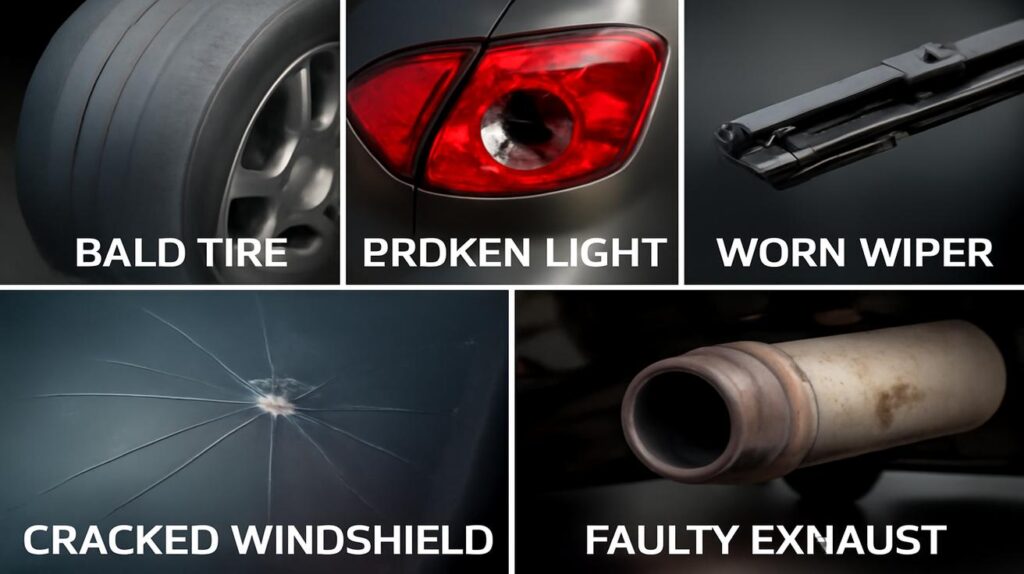
Defective lighting is one of the most common reasons for TÜV trouble. A single dead indicator bulb or a misaligned headlight can be enough to earn you a firm “durchgefallen”. It sounds trivial, but imagine driving down a rainy autobahn at night while the car behind you can’t see your brake lights clearly. Suddenly that tiny broken bulb isn’t so tiny anymore.
Most of the time the problem is painfully simple: a bulb that’s burned out for weeks without you noticing, a cracked taillight letting moisture in, a headlight beam pointing too high and dazzling oncoming traffic. Sometimes it’s a dirty lens so fogged with road film that only half the light makes it out into the world.
Before TÜV, you can give your car a simple “light walk”: park close to a wall at dusk and try every combination—low beam, high beam, fog lights, hazard lights, indicators, brake lights, reverse light. Get a friend, a neighbor, or that guy across the street who’s always washing his car to help you check the rear lights. The ten minutes this takes can save you the embarrassment of failing for something you could have spotted in your own driveway.
The Quick-Check Table: Where TÜV Nightmares Begin
Here’s a compact overview of the five usual suspects that often turn a relaxed inspection into a sudden fail:
| Common Defect | Typical Warning Sign | TÜV Risk Level |
|---|---|---|
| Defective lights & indicators | Bulbs out, warning symbols, uneven brightness | Very high – often immediate fail |
| Worn brakes | Grinding noises, longer stopping distance, pulsation | Critical – safety-relevant defect |
| Tires below minimum tread | Smooth tread, cracks, uneven wear | Very high – especially in wet conditions |
| Suspension & steering play | Vibration, knocking over bumps, vague steering | High – direct influence on vehicle control |
| Rust & structural damage | Visible corrosion, flaking metal, holes in sills/floor | Extremely high – can mean “no go” on the spot |
2. Brakes – The Invisible Line Between Control and Chaos
It’s one thing when a light fails. It’s another thing when the system that can save your life at 130 km/h starts giving up. Brakes are the unseen heroes every time traffic suddenly compresses in front of you. Coincidentally, they’re also one of the biggest TÜV dealbreakers.
In the testing hall, this moment comes when your car climbs onto the brake test stand. The rollers start to hum under the wheels, the inspector leans into the open door and says, almost casually, “Ahora fuerte, de freno.” You plant your foot, and your entire car shudders as the system measures how evenly and strongly each wheel slows down.
What you can’t see, the machine reveals without mercy: a sticking caliper on one side, a brake disc worn to a rusty lip, a rear brake so weak it’s basically coasting along for the ride. Any major imbalance or insufficient braking force sets off alarm bells in the report.
Your car usually warns you long before it comes to this. Maybe you’ve noticed a scraping sound when braking, like metal whispering against metal. Maybe the car pulls a little to the left when you slow down, or the pedal feels soft and spongy, dropping lower than it used to. These are not “it’ll be fine” signals; these are your car’s equivalent of waving a red flag.
If you’re unsure, find an empty stretch of road and do a controlled test: from about 50 km/h, hit the brakes as if a ball just rolled in front of your car. Does the car stay straight? Does the pedal feel firm? Do you hear anything odd? The goal isn’t to play amateur mechanic, but to listen. If your own quick check makes you uneasy, TÜV certainly will not be kinder.
3. Tires – The Four Handprints Holding You to the Road
On a wet November day, your car’s entire connection to the road is four rubber patches roughly the size of your hand. That’s all that stands between grip and gliding, control and spinning. It’s almost poetic – and a little terrifying when you picture it. Which is why TÜV takes tires very, very seriously.
With surprising tenderness, the inspector will run a hand along your tires, eyes narrowed, scanning for cracks, bulges, and the all-important tread depth. Legally, you must have at least 1.6 mm of tread. In reality, many experts start to get nervous once you drop below 3–4 mm, especially for winter tires.
If you’ve ever hydroplaned – that strange, floating feeling when your steering suddenly goes light in the rain – you know how quickly things can go wrong. Worn tread can’t channel water away effectively, and the car begins to surf on a thin film of water. TÜV inspectors know the physics; they’ve seen what happens afterwards.
Most drivers don’t check tread depth regularly, but it’s as easy as using a one-euro coin: stick the edge into the tread. If the golden border is clearly visible, your tires are getting dangerously close to the limit. Also, look where the tread has worn: if the center is bald but the sides look okay, you may be running too much air pressure. If the inner edge is worn more than the outer, your alignment could be off.
Then there’s the age factor. Even with “good” tread, old rubber hardens and loses grip. Tiny cracks appear in the sidewalls. The DOT number on the tire tells you its birth date – once your tires push past six to eight years, TÜV looks at them with added suspicion. A car that otherwise passes can still fail on the spot because its “shoes” are simply too tired.
4. Suspension and Steering – When Your Car Starts to Feel “Loose”
At some point you might have driven over a pothole and thought, just for a second, that the car didn’t recover as cleanly as it used to. A soft wobble, a hollow knock from somewhere beneath your feet, the steering wheel quivering in your hands. Easy to ignore in daily traffic. Impossible to hide on TÜV day.
The suspension and steering are what make your car feel planted or nervous, precise or vague. Worn shock absorbers, tired bushings, cracked springs, or excessive play in the steering joints are not only annoying, they’re safety-relevant. TÜV tests them with a level of thoroughness your commute rarely demands.
On the shaker plate, your car is made to dance. The platforms vibrate, the wheels are forced in different directions, and the inspector watches how the suspension and steering components react. Any clunk, delayed reaction, or visible play gets a mark. Play in the steering, in particular, is taken very seriously; it’s the distance between your intention and the car’s reaction.
You can often sense these problems ahead of time. Does the car bounce several times after you press down hard on the front or rear and release? Do you hear knocking noises over cobblestones? Does the steering wheel sit crooked when you drive straight, or does the car drift without your input? These are your early warning signs.
Driving a car with a vague front end is like hiking a narrow mountain path in loose shoes. Most of the time you’ll be fine. But the chance that something goes wrong when it really matters – an evasive maneuver, a sudden lane change – is higher than you want to gamble with. And TÜV, thankfully, isn’t in the gambling business.
5. Rust and Structure – When the Body Starts to Give Way
Rust is different. Lights and brakes and tires you can swap. But when rust starts eating into the bones of the car – the sills, the floor pan, the suspension mounting points – the conversation at TÜV becomes noticeably more serious. Suddenly, this isn’t about minor repairs; it’s about whether the car is still a safe shape to protect you in an accident.
You may have seen the first orange blooms on a wheel arch and thought, “Cosmetic.” Maybe you dabbed on some touch-up paint, out of sight, out of mind. But rust never sleeps, and it loves to hide where you don’t bend down to look: under plastic covers, behind mud flaps, along seams under the car where winter salt and moisture quietly do their work.
In the testing hall, the inspector kneels, flashlight in hand, and begins the metal ritual: pressing, tapping, prodding. Healthy metal sounds sharp and feels solid. Rusted, weakened metal gives way, crumbles, or flexes too easily. If a structural part can be penetrated with a screwdriver or shows advanced corrosion, the verdict is clear: no sticker.
For many older cars, this is the moment of truth that decides whether they get another two-year lease on life or are gently nudged towards retirement. A hole in a non-structural body panel is one thing. A rusted-through sill where a jack point should be, or a corroded suspension mount? That’s another league entirely.
What you can do long before TÜV day is simple, if a bit uncomfortable: take a flashlight and actually look under your car. Check the sills, the edges of the floor, the areas around jacking points. Look for bloated paint, bubbling underseal, flaking layers. If you can catch rust early, a simple treatment or welded patch can save both your wallet and your car’s future.
Turning TÜV From Nightmare Into Quiet Routine
As your car rolls back out of the hall, the inspector peels the backing off a small round sticker and presses it onto your plate with the casual ease of someone who does this a hundred times a day. For you, it was a small emotional roller coaster; for him, it was simply another car, checked, measured, judged.
The difference between leaving with a sigh of relief and driving home frustrated with a red-marked report is often not fate or bad luck. It’s preparation. The five most common TÜV killers are not exotic, mysterious failures. They’re everyday wear-and-tear issues we grow blind to because they deteriorate slowly, week by week, trip by trip.
If you treat your car like a living travel companion rather than a sealed box that “just works until it doesn’t”, you start to notice things. The tired headlight beam. The slightly longer braking distance. The tire that looks a shade more worn than its siblings. The vague steering on a windy day. The brown freckles of rust at the edge of a seam.
Take one quiet afternoon before your next TÜV appointment and give your car this small ritual of attention:
- Walk around it at dusk and test every light and signal.
- Check your tires for tread depth, cracks, and bulges.
- Listen to your brakes during a few firmer stops.
- Feel how the car behaves over bumps and during gentle swerves.
- Glance underneath with a flashlight for obvious rust or damage.
It doesn’t turn you into a mechanic, and it doesn’t replace professional service. But it does something more subtle: it makes TÜV day less of a dreaded judgment and more of a confirmation of what you already know about your car. The grey hall, the cold light, the clipboard – they lose a little of their power when you walk in already aware of your car’s real condition.
And if, despite all this, the inspector eventually looks up and says, “We have a problem with the brakes,” or “These tires have to go”? Then the nightmare is actually a gift. Better a firm no in the controlled calm of a testing center than a catastrophe on a rainy night when those same defects would choose their own dramatic moment to reveal themselves.
FAQ – TÜV, Defects, and How to Stay Relaxed
How often does my car have to go to TÜV?
In most cases, passenger cars must be inspected every two years. New cars get their first inspection after three years, then switch to the two-year rhythm. Always check your registration and the sticker on the rear license plate for the exact due date.
What happens if my car fails TÜV because of one of these defects?
You receive a detailed inspection report listing all defects. For major safety-relevant issues, the car fails, and you usually have one month to fix the problems and present the car again for a follow-up inspection. This re-check often focuses only on the noted defects but still has to be passed to get a valid sticker.
Can I drive my car if the TÜV has expired or I failed the inspection?
Driving with an expired TÜV sticker can lead to fines and, above all, liability issues in the event of an accident. If the car has been officially classified as unsafe, you may only drive it directly to a repair shop or back home, depending on the severity of the defects and local rules.
Is it worth doing a pre-check in a workshop before TÜV?
Yes, especially for older cars. Many workshops offer low-cost or package-priced pre-checks. They can often fix small issues like bulbs, minor brake problems, or damaged wipers immediately, saving you a failed inspection and the hassle of a second appointment.
How can I tell if my car is really “TÜV-ready”?
You can’t replace a proper inspection yourself, but you can reduce surprises: keep up with regular maintenance, pay attention to noises and changes in driving behavior, check lights and tires monthly, and address warnings on the dashboard promptly. A car that feels tight, brakes straight, rolls quietly, and shows no obvious defects stands a far better chance of leaving the grey hall with that precious sticker on the plate.



