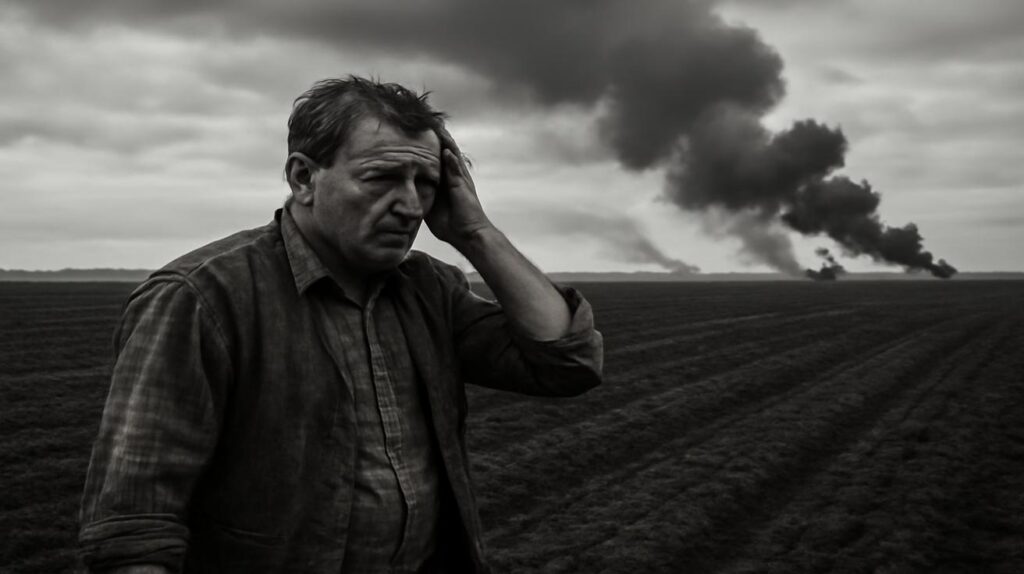
The soil looks almost edible. Scoop it up and it clings to your fingers, dark as coffee grounds, rich with a faint, earthy sweetness. In late autumn light, the fields of central Ukraine resemble a vast, rumpled velvet cloak stretching to the horizon. Wind moves over it in low waves, rattling the dry stalks left behind after harvest. Somewhere a tractor growls and coughs; a dog barks; a crow drops down, poking at the surface as if it, too, knows the treasure buried in this black skin of the earth.
The Taste of Black Gold
For generations, people here have had a quiet habit: they pinch some soil between their fingers, raise it to their nose, and decide—by the smell, the texture, the way it crumbles—whether a piece of land is worth their time, their sweat, perhaps even their life.
The soil that inspired such rituals has a name: chernozem, literally “black earth” in Russian and Ukrainian. Once it was praised simply as a miracle of nature, an almost mythic gift: thick, sponge-like, saturated with nutrients and organic matter that give it an inky color. You can dig a spade in and find the same dark hue stretching down through the profile, as if the land has been drinking in life for thousands of years and never stopped.
In the 19th century, travelers crossing the steppe wrote astonished letters home. They swore they’d never seen anything like these plains, where a single hectare—about the size of a soccer field—could produce more wheat than entire smaller European farms. The world’s breadbasket, they called it. Farmers called it something simpler and more intimate: black gold.
That same black gold now sits at the heart of a new, tense story—one where old rivalries between Ukraine, Russia, and Kazakhstan are being fertilized not just by history and politics, but by the very soil under their boots.
Soil That Binds—and Divides
The magic of chernozem is not superstition. It’s science etched into every crumb. Under a microscope, this soil is a wild, bustling city—billions of microorganisms working in concert, breaking down plant residues, binding nutrients, storing carbon. The structure is crumbly, like chocolate cake. It soaks up water during rains and releases it slowly during drought, a quiet generosity that gives crops a fighting chance when skies turn stingy.
Ukraine, Russia, and Kazakhstan share this natural inheritance. Together, vast belts of chernozem run like shadows across their maps, especially in the steppe zones and river valleys. This soil doesn’t care about borders. It doesn’t care which flag waves above it. It is continuous, ancient, indifferent.
People do care, though. And in the last three decades—since the Soviet Union imploded and land that was once “ours” became “yours” and “mine”—chernozem has become more than a natural resource. It has become a currency of power, a diplomatic bargaining chip, and sometimes, the quiet motive behind violence that never makes it into headlines.
From State Fields to Auction Lots
Imagine a farmer named Oksana in central Ukraine. Her grandparents spent a lifetime on a collective farm, working land no one truly owned. The state owned it. They planted, harvested, and trudged home with sore backs and ration coupons. When the Soviet Union collapsed, everything changed in theory—but on the ground, things moved slowly, awkwardly, painfully.
Land that had been one giant, state-run entity was suddenly parceled out on paper. Certificates of ownership were issued, maps redrawn. Some people ended up with narrow, ribbon-like plots that made little sense. Others signed over their rights to local agribusinesses for quick cash or promises of steady rent. Corruption seeped into the cracks. Maps didn’t match reality. Boundary stones “moved” in the night.
For years, many Ukrainians were barred by law from selling their farmland outright. The intent was noble—protecting rural communities from predatory land grabbing. But the unintended result was a shadow market. Leases were signed under the table. Politically connected companies consolidated vast tracts. By the time the moratorium was lifted in 2021, the best chernozem—the darkest, deepest, least eroded—was already entangled in a web of opaque deals.
Oksana, like many smallholders, found herself caught between neighborly tradition and emerging corporate muscle. Only a thin line, sometimes just a shallow ditch, separated her strip of rich soil from a powerful agribusiness next door. When prices for wheat and sunflower oil climbed, the tension was almost physical. Every centimeter mattered.
It doesn’t take soldiers and tanks to start a land conflict. It can begin with something smaller: a tractor furrow that edges ten centimeters too far. A new fence post mysteriously planted just inside someone else’s parcel. A drone flight over a field to “check the borders,” prompting someone on the ground to reach for a shotgun.
Boundaries Drawn in Dust
Across Ukraine’s chernozem belt, stories like these stack up. Farmers accuse each other of cutting across field margins, of tearing up grassy borders that once served as windbreaks, of pouring cheap fertilizer that leaches into neighboring soil. Sometimes it’s deliberate: stretch a field just a bit, blur the lines, see if anyone notices. Sometimes it’s desperation: debts mounting, harvests unstable, a sense that the only way to survive is to squeeze every grain from every square meter.
When good soil is scarce—or when access to it feels threatened—old informal systems of cooperation crumble. Where neighbors once lent each other combines and shared wells, now they hire lawyers, install surveillance cameras, and argue over satellite images in overheated village council meetings. The soil stays silent, but its value speaks through raised voices and slammed doors.
These micro-conflicts rarely make the news. Yet they form a tense ground layer beneath the more visible, geopolitical struggles playing out over the same black earth.
Three Countries, One Belt of Black Earth
Look at a satellite map of Eurasia and trace your finger from western Ukraine, across southern Russia, then down into northern Kazakhstan. You’ll be following the great arc of the steppe—once home to nomads and wild horses, now lined with grain silos, rail lines, and industrial-scale farms.
Ukraine, Russia, and Kazakhstan are all agricultural giants, and their shared foundation is chernozem. This matters to the entire planet. Together, they supply a significant portion of the world’s wheat, barley, corn, and sunflower oil. A drought in northern Kazakhstan or a disrupted planting season in southern Russia doesn’t just mean lean times in local markets; it sends tremors into bread prices in North Africa and the Middle East, and it complicates food aid programs thousands of kilometers away.
In this triad, Ukraine is the symbol—fields of black soil turned into headlines as war and occupation redraw control over land. Russia is the powerhouse—massive, mechanized farms running across regions like Kursk and Voronezh, where chernozem still lies thick but is increasingly strained by intensive methods and climate shifts. Kazakhstan is the quiet partner—expansive, less known to outsiders, yet holding enormous potential and grappling with its own balancing act between grazing, cropping, and conservation.
When one country’s harvest falters, another’s may grow stronger. But the competition isn’t just about tonnage. It’s about who secures the best land, who controls the export routes, and who can promise reliability to an anxious world worried about the next supply shock.
Black Soil, Red Lines
Soil itself may not cross borders, but the debates around it do. Russian and Ukrainian agronomists, once colleagues in Soviet institutes, now find themselves reading each other’s research through a lens of suspicion. Ideas about how to manage and preserve chernozem—reduced tillage, cover crops, rotational grazing—risk being overshadowed by the blunt arithmetic of control: hectares under our flag versus theirs.
Kazakhstan, caught between these two larger neighbors and heavily tied into Russian transport networks, walks a careful line. It wants to expand exports, attract foreign investment to its farming sector, and leverage its black soils without becoming a pawn in somebody else’s geopolitical chessboard. Every new grain terminal, every long-term land lease to external investors, becomes a quiet calculation of risk and allegiance.
The Human Cost Hidden in Every Furrow
It’s easy to talk about soil in abstract terms: yields, tons, export capacity. It’s harder, but more honest, to remember the humans whose lives rise and fall with each planting season.
In villages across Ukraine’s fertile south and east, the war has brought this reality into brutal focus. Some of the world’s finest soil is now pocked with craters. Mines rust silently beneath the surface of former wheat fields. Farmers drive their tractors with new fear, scanning the ground not just for rocks that might damage a plow, but for unexploded ordnance that could tear their machines—and their lives—apart.
For those who remain, the questions are raw: Who owns the crop in an occupied field? Who has the right to sell it? If a local collaborator signs over leases to an outside company, is that contract legitimate? Years from now, when the guns fall silent, whose name will be on the title deeds to those wounded hectares of black earth?
Across the border, in Russia’s chernozem regions, families feel different but related pressures. Some sons have been called up, leaving fields understaffed. Sanctions squeeze supplies of machinery parts and high-quality seeds. Local officials push for larger, more consolidated farms that can meet export quotas and showcase resilience. The farmer with fifty hectares and an aging Belarus tractor finds himself overshadowed by an agroholding with ten thousand hectares and political connections reaching to Moscow.
Kazakhstan’s countryside tells another chapter. In some northern districts, the black earth is newly plowed, reclaimed from steppe that once hosted mobile herds of horses and sheep. Old-timers remember grasslands that stretched unbroken. Younger farmers, under pressure to intensify production, roll their planters over land that still holds the memory of hooves. The soil, enriched by centuries of prairie roots, yields generously at first—but its generosity isn’t infinite. Without careful management, even chernozem can thin, wash away, blow off as dust in sudden spring winds.
Black Gold on a Warming Planet
Under the quiet drama of boundary disputes and land deals, a larger, more implacable force is at work: the climate is changing, and the black soil is changing with it.
Chernozem is not just a medium for plants; it is a vast storehouse of carbon. Those deep, dark layers are made from centuries of grasses, roots, and microbial life. Disturb them—plow them too deeply, leave them bare and baking in summer heat—and they release that stored carbon into the air.
Climate models now show central Eurasia swinging between longer droughts and more intense downpours. That’s a nightmare recipe for soil: parched periods that weaken its structure, followed by heavy rains that carve gullies and wash away the top layer. In parts of Ukraine and Russia, farmers peer down at unexpected ravines after a wet spring, watching black earth slide into rivers, their heritage literally dissolving.
Some have started experimenting with less intrusive ways of farming. They leave crop residues on the surface, use lighter equipment, plant cover crops in between main harvests. These methods can protect chernozem, keeping it intact and alive. But they also require investment, training, and patience—three things in short supply in places where political uncertainty and economic stress overshadow long-term thinking.
In Kazakhstan, too, the tension is visible. Vast fields that once lay fallow in long rotations are now pushed harder, with shorter breaks and heavier use of fertilizers. The temptation is clear: every extra ton exported means more revenue in state coffers, more leverage in trade talks. But every pass of the plow, every abandoned shelterbelt of trees, makes the land a little more vulnerable to the next dry year, the next dust storm rolling off a bare horizon.
A Table of Uneasy Abundance
Strip away the borders and flags, and the region’s agricultural landscape can be seen, bluntly, in numbers—hectares and harvests tugging at each other.
| Country | Approx. chernozem area (million ha) | Key crops on black soil | Role in global food markets |
|---|---|---|---|
| Ukraine | 30+ | Wheat, corn, sunflower, barley | Major exporter; “breadbasket” reputation |
| Russia | 60+ | Wheat, barley, sunflower, sugar beet | Top wheat exporter; key regional supplier |
| Kazakhstan | 15–20 | Wheat, barley, oilseeds | Important grain exporter to Asia & neighbors |
Behind these estimates lie countless individual decisions: a family deciding whether to lease its plot to a large operator; a regional governor negotiating export quotas; a foreign investor eyeing satellite images of dark, unbroken fields and seeing opportunity where locals see home.
Between Conflict and Care
There is a quiet, almost tragic irony running through this story: the same soil that once symbolized abundance and resilience is now a pressure point, amplifying old tensions and birthing new ones.
A Ukrainian farmer standing at the edge of a cratered sunflower field may not use words like “geopolitics” or “global food security.” She might simply say, “My land is wounded.” A Russian farmer watching his small enterprise squeezed by larger neighbors may not talk about “resource nationalism,” but he’ll know, in his bones, that those who command the best soils hold a certain kind of power. A Kazakh herder, nudged off traditional grazing routes by expanding grain farms, may not map his loss to world grain prices, but he will feel the shrinking of his horizon.
Yet the soil itself offers a different kind of lesson. Chernozem takes centuries to form. Prairie grasses and steppe herbs live, die, and decay, layering organic matter grain by patient grain. Microbes weave it, earthworms knead it, roots puncture it. What humans see as a commodity is, in ecological time, a slow, cumulative miracle.
If there is a way out of the current tangle—out of neighbor-against-neighbor disputes, of simmering resentment between states, of the slow erosion of one of the planet’s most precious resources—it likely lies in shifting how this “black gold” is valued. Not just as a ticket to export revenues or a bargaining chip at the negotiating table, but as a living system with limits and rights of its own.
That shift is not easy in a world where governments measure success in quarterly trade balances and farmers measure survival in the yield at the end of the season. It will require institutions that can mediate land conflicts fairly, science that is shared across borders instead of hoarded, and a kind of political imagination that sees soil not as a line of division but as a shared, fragile inheritance.
Standing in a field of chernozem at dusk, boots sinking a little with each step, the air cool and smelling faintly of straw and damp earth, such ideas don’t feel abstract. They feel like common sense. You wouldn’t burn a family heirloom for a quick burst of warmth. You wouldn’t pull the beams from your roof to build a bonfire. And yet, in treating black earth as fuel for conflict, as something to be claimed and depleted rather than cared for, that is exactly what we are doing.
The world is watching these dark fields now—sometimes through satellite lenses, sometimes through the grain prices scrolling across a trader’s screen, sometimes through the worried eyes of a mother reading that food might grow more expensive, that bread might shrink on the table. But the future of this soil will not be decided in distant offices alone. It will be decided in the quiet choices made at field edges, in village halls, in the corridors of ministries in Kyiv, Moscow, and Astana.
Somewhere tonight, a farmer in one of these countries will still do what their grandparents did: bend down, pinch a little soil, rub it between thumb and forefinger. They’ll feel the texture—fine, almost silky, full of life. For a moment, before politics and fear flood back in, they might remember the older story of chernozem: not as a prize to be fought over, but as the ground that has always, stubbornly, tried to feed us all.
Frequently Asked Questions
What exactly is chernozem?
Chernozem is a very fertile, dark-colored soil rich in organic matter and nutrients. It forms over long periods under grassland vegetation, especially in temperate steppe regions. Its high humus content gives it a nearly black color and excellent structure for retaining water and supporting crops.
Why is this soil called “black gold”?
It’s called “black gold” because its productivity can rival the value of mineral resources. Fields of chernozem can produce high yields of grains and oilseeds with fewer inputs than poorer soils, making it extremely valuable for both local farmers and national economies dependent on agricultural exports.
How is chernozem linked to conflict in Ukraine, Russia, and Kazakhstan?
The link is indirect but powerful. Control over fertile land shapes wealth, political influence, and food exports. Disputes over ownership, boundaries, and access to the best soils fuel local conflicts between farmers, while at the state level, competition for agricultural dominance deepens tensions, especially when layered onto pre-existing geopolitical rivalries.
Can chernozem be degraded or lost?
Yes. Although very fertile, chernozem is not indestructible. Intensive plowing, overuse of chemicals, loss of protective vegetation, and climate extremes can cause erosion, loss of organic matter, and structural damage. Once severely degraded, it can take centuries—or longer—to recover.
What can be done to protect this “black gold” for the future?
Key measures include reducing deep tillage, keeping fields covered with plants or residues, restoring windbreaks and shelterbelts, using crop rotations and cover crops, and resolving land disputes fairly so farmers can plan for the long term. Cross-border cooperation on research and sustainable practices is also crucial, since the chernozem belt stretches beyond any single country’s borders.