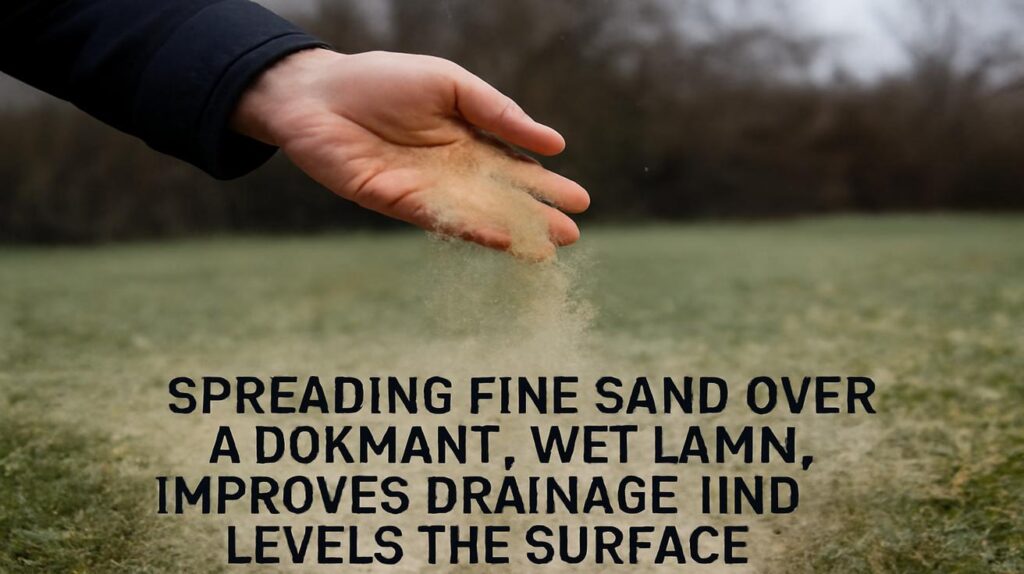
The first time I saw someone tipping wheelbarrows of sand across a green lawn in the cold, grey light of February, I was convinced they’d lost their mind. The air had that metallic bite that makes your breath visible, the soil was still clinging to winter’s chill, and there was this neighbor of mine, calmly shaking sand over his grass as if he were standing on a summer beach. I watched from my kitchen window, coffee in hand, secretly judging. Sand? On a lawn? In February?
When Winter Grass Starts Whispering
A few days later, I bumped into him by the fence. He was inspecting the turf like a jeweler examining a gem. I asked the question I’d been chewing on: “Why on earth are you putting sand on your lawn in the middle of winter?”
He laughed, the way people do when they recognize a younger version of themselves in your confusion. Then he knelt down, brushed his fingers through the blades, and told me something that changed the way I look at grass forever.
“By the time you see problems in summer,” he said, “they were already brewing in winter. February is when the lawn whispers what it needs. Sand helps you hear it—and fix it—before it starts shouting.”
I crouched beside him, the cold soaking through my knees, and for the first time I really looked at the lawn. It wasn’t just a flat green carpet. There were subtle dips where water had collected after rain, thin patches where moss tried to muscle its way in, and thatch—a matted layer of dead grass—clinging like an old rug to the soil. He pushed his fingers deeper, parting that layer.
“See this?” he said. “This is like a soggy blanket on your lawn’s chest. The roots are suffocating. Sand helps the soil breathe again.”
The idea felt counterintuitive. Sand, to me, belonged to beaches and children’s sandboxes, not frozen suburban lawns. But he kept talking, and slowly, the strange ritual of February sand-spreading began to make sense—practical sense, earthy sense, the kind that smells faintly of wet soil and clear intention.
The Quiet Science Beneath Your Feet
If you’ve ever stepped onto a golf green and felt that springy, perfectly even cushion underfoot, you’ve already met the secret: topdressing, often with sand. What looks like a simple dusting is really a carefully timed conversation with the soil. February just happens to be one of the best months to start talking.
By late winter, your lawn is in a kind of suspended animation. The grass is resting, growth is slow, and the soil is holding onto winter’s moisture like a sponge. Every footstep you take, every heavy wheelie bin dragged across it, presses that soil tighter. Over time it becomes compacted—granules squeezed so tightly that water, air, and roots struggle to move.
Now picture sand: thousands of tiny, hard, rounded particles that don’t cling together the way clay or silt does. When you spread a thin layer over the lawn and brush it in, those particles slip into gaps in the soil. They don’t lock; they prop. Suddenly, water can drain more freely. Air finds pathways down to the roots. The soil loosens just enough to let life in without turning into a bog.
In February, the magic is amplified. You’re ahead of the spring rush. The sand settles in while the grass is still quiet, ready to cradle new roots when growth picks up. Worms pull particles deeper, mixing them gently. Frost heave—the subtle up-and-down movement of soil as it freezes and thaws—helps open tiny channels that sand sneaks into. You’re working with the season, not against it.
My neighbor explained it in simple terms: “Think of your lawn’s soil as lungs. Sand is like teaching it how to inhale again after years of shallow breathing.”
The Unexpected Benefits of a Sandy February
Spreading sand in February doesn’t just tweak drainage. It touches almost every part of your lawn’s health, often in quiet ways you don’t notice until summer arrives and your grass stubbornly refuses to burn out the way your neighbor’s does.
There’s the leveling effect, for starters. Ever tripped over a sneaky dip while mowing? Those small hollows and humps are more than annoyances—they cause uneven growth, scalping from the mower, and puddles where moss and disease lie in wait. A thin layer of sand, worked into low areas over several seasons, gradually smooths the lawn into a more even, forgiving surface.
Then there’s thatch, the underworld of your lawn—the interlocking web of dead stems and roots that can build up like felt. Some thatch is normal, but too much acts like a thatched roof over the soil: water hangs around on top, disease spores party in the damp, and the actual soil beneath stays oddly deprived. Sand woven into that layer helps it break down faster and encourages new roots to navigate down into real soil, not just sprawl in the thatch.
And there’s one more gift, less talked about but deeply practical: winter wetness. February often leaves lawns sitting in a slow, reluctant thaw. The ground feels spongy, footsteps linger as prints. Sand helps speed the escape of that excess water, drying the surface just enough to discourage moss and fungal problems that thrive in persistent damp.
I didn’t know any of this that first winter. All I knew was that my neighbor’s lawn looked suspiciously better than everyone else’s by June. While other gardens around us glowed patchy and stressed, his turf was thick, luminous, and almost impossibly even. And every February, there he was, walking with a barrow full of sand and a quiet, satisfied smile.
What Kind of Sand, and How Much, Really?
Of course, not all sand is created equal, and this is where many well-meaning gardeners go wrong. I learned that the hard way.
The spring after that conversation by the fence, I marched into a building yard and ordered the first sand I saw—sharp sand for construction. It looked right: gritty, coarse, appealingly rough. I spread it enthusiastically across my lawn in thick, hopeful layers. It didn’t blend, it sat. And then it crusted. My grass, once merely average, looked as if it had been dragged through a minor dust storm.
When my neighbor saw it, he winced. “Too much, wrong type,” he said gently. “You wanted washed, medium-grain sand. Playground sand is too fine and clumpy, building sand can be limey or heavy. You want something that drains, doesn’t bind, and doesn’t bring any surprises.”
He was right. The goal isn’t to bury your grass; it’s to lightly dress it, the way a chef dusts sugar over a cake. For most home lawns, a thin layer—around 3 to 5 millimetres—is enough. You should still see the grass tips poking proudly through the sprinkle. Spread too much, and you smother the blades and stress the roots. Spread too little, and you’re just decorating.
There’s also the question of how much lawn you’re dealing with. I remember scribbling rough calculations on the back of an envelope, soil-smudged fingers trying to keep up with my neighbor’s estimates. To make life easier, here’s a simple guide you can glance at when planning your own sandy February ritual:
| Lawn Size | Sand Depth (Approx.) | Sand Volume Needed* |
|---|---|---|
| 25 m² (small yard) | 3–5 mm | 0.1–0.15 m³ (4–6 bags of 25 kg) |
| 50 m² (typical garden) | 3–5 mm | 0.15–0.3 m³ (6–12 bags of 25 kg) |
| 100 m² (larger lawn) | 3–5 mm | 0.3–0.6 m³ (12–24 bags of 25 kg) |
| *Volumes are approximate and may vary with sand density. | ||
Spread the sand using a shovel or scoop, then use the back of a rake, a brush, or even a piece of flat timber to drag it across the surface. The aim is evenness, not perfection. As you work, the grains will tuck themselves into low spots, flowing like a subtle tide through your lawn’s miniature landscape.
The Feel of February: Turning Chore into Ritual
One of the reasons I’ll always spread sand in February now has nothing to do with science and everything to do with sensation. There’s something grounding about it—literally and figuratively.
The air is cool enough that you don’t break into a summer sweat. Birds are beginning to sound restless in the hedges, testing their spring songs. The soil has that deep, earthy smell that only appears in late winter: a scent of thawing, of stored-up life quietly stretching. You push the wheelbarrow across the grass, its weight humming through the handles. You lift a shovel of sand and it falls in a slow, pale cascade, a soft hiss as it lands on the green.
As you rake, you start to notice things you’d missed for months—the tiny divot where the kids always cut the corner, the faint yellowing in that one shady part under the tree, the way the ground rises ever so slightly near the old stump. Sand-spreading forces you to tune in. The lawn stops being background scenery and becomes a place with stories, patterns, and needs.
My neighbor once told me, “February is when I re-meet my garden after winter.” I didn’t understand at first, but now I do. While the rest of the world is still half-asleep, you are already starting the year’s first quiet conversation with your patch of earth.
Pairing Sand with Subtle Care
Sand isn’t a miracle cure. It’s more like good posture for your soil—supportive, corrective, invisible once you get used to it. To really see the difference, it’s best paired with a few other gentle February habits.
Before you spread anything, take a brisk walk across your lawn. Feel for spongy or squelchy areas, listen for the suck of water under your weight. If you have a garden fork or aerator, you can lightly spike these patches first, creating channels for the sand to fall into. You don’t need to go overboard; a few well-spaced holes are enough to help the sand and air reach deeper.
After spreading and brushing in your sand, resist the urge to do more. This is not the moment for heavy fertilisers or aggressive mowing. The grass is still resting. Think of February sand as a quiet adjustment, a nudge in the right direction. When spring arrives and your lawn wakes up, it will already be standing on firmer, freer ground.
If your soil is very clay-heavy, repeated light sand-dressings over several winters can slowly transform its character. Not instantly, not dramatically, but steadily. Water will stop pooling as easily. The soil will crumble more willingly between your fingers. Roots will explore, rather than cower in the top few centimetres.
There’s also a strange psychological effect: once you’ve invested a slow, intentional February morning in your lawn, you’ll find yourself caring for it differently all year. You notice when it thirsts, you spot weeds earlier, you mow with just a touch more patience. Sand, in a way, invites you into a more attentive relationship with this green space you cross every day.
The Long Game: Summer Starts in February
The real proof of February sand doesn’t arrive with fanfare. It reveals itself quietly, weeks later, when daffodils are nodding and the first real mowing of the year hums through the neighborhood.
Your mower glides more smoothly over the leveling you’ve started. The blades cut more evenly because the hollows are slowly being filled. After a spring shower, you notice water beading and sinking rather than sitting in stubborn puddles. When an early heatwave hits, the grass doesn’t scorch quite as fast. Its roots, now exploring a better-aerated soil, can sip moisture from deeper layers.
By midsummer, the difference is unmistakable. While some lawns wear drought like a permanent frown—brown patches, thin stripes, bald spots—yours holds its color a little longer, bounces back a little quicker after each hot spell. Friends might ask what brand of seed you’re using, what hose, what feed. You can tell them, if you like. Or you can smile and remember that chilly February morning, the hiss of sand over grass, the way you quietly rewrote the season before it began.
Because that’s really what this is about. February sand-spreading is an act of faith in the unseen. You’re working when nothing appears to be happening. You’re tending to conditions, not symptoms. You’re choosing to garden not just with your hands, but with your patience.
Common Missteps (and How to Dodge Them)
Over the years, I’ve made most of the mistakes you can make with sand and a lawn. If you’re tempted to pick up a shovel next February, a few warnings from the trenches might help:
- Don’t bury the blades. If your lawn looks like a beach with a hint of green rather than a lawn with a dusting of sand, you’ve gone too far. Aim thin, always.
- Avoid dusty or salty sand. Sand left outside in heaps, especially near roads or coastlines, can carry contaminants or salt. Always choose clean, washed sand designed for horticulture or turf.
- Don’t fight frozen ground. If your soil is rock-hard from frost, wait. Let it soften slightly so the sand can settle, not skid away with every gust of wind.
- Know your soil. If you already have very sandy soil, you might not need more sand. In that case, mixing sand with a fine compost for topdressing can balance structure and nutrients.
- Be patient with results. One February won’t undo a decade of neglect. But each winter you repeat the ritual, you add another gentle layer of improvement.
Whenever I catch myself rushing the process, I think back to my neighbor on that grey morning, unhurried, moving across his lawn with the ease of someone who understands time differently. Gardens have a long memory. They reward people who act before problems scream for attention.
Frequently Asked Questions
Is February really the best month to spread sand on a lawn?
February is ideal in many temperate climates because growth is slow, the ground is softening from winter, and you can prepare the soil structure before spring growth begins. If your winters are very harsh or the ground is deeply frozen, you may need to wait until late winter or early spring when the soil is workable but the grass is still relatively dormant.
Won’t sand dry out my lawn in summer?
Used correctly, sand improves drainage and aeration without causing excessive dryness. Water can move through the soil profile more freely, but the roots also grow deeper, which helps grass access moisture stored further down. Overdoing sand, or using it on already very sandy soil, can create dryness issues, so moderation and soil awareness are key.
Can I just use play sand from a home store?
Play sand is usually very fine and can compact more easily, which reduces the drainage benefits you’re aiming for. It’s better to use a washed, medium-grade horticultural or turf sand. If play sand is your only option, mix it with fine compost in equal parts to improve its structure before spreading.
How often should I topdress my lawn with sand?
Most home lawns benefit from a light sand topdressing once a year, often in late winter. Very compacted or heavy clay lawns may need two light dressings a year (late winter and early autumn), but always in thin layers. Watch how your lawn responds and adjust frequency rather than committing to a rigid schedule.
Can I combine sand spreading with overseeding?
Yes, and February or early spring can be a good time in many regions. Typically, you’d scarify or lightly rake the lawn, spread seed, then apply a very thin topdressing of sand (or sand mixed with compost) to protect the seed and improve seed-to-soil contact. Just keep the sand layer light so emerging seedlings aren’t smothered.
Is sand topdressing suitable for every type of lawn?
Most ornamental and utility lawns benefit from sand topdressing, especially those on heavy or compacted soils. Very sandy soils or highly specialized meadow-style lawns may not need it. If in doubt, dig a small test hole and look at your soil. If it’s sticky, heavy, or forms clods, sand will likely help. If it’s already loose and gritty, focus more on organic matter than sand.
Will I see an immediate difference after spreading sand?
Visually, the lawn may look a little dusty for a few days until the sand settles and rain or watering helps wash it in. The biggest benefits—better drainage, improved root growth, smoother surface—show up over weeks and months rather than overnight. Think of sand topdressing as part of a long-term conversation with your lawn instead of a quick cosmetic fix.