The man at the end of the park path moved like the afternoon sun had nowhere else to be. Not walking. Not exercising in the way we’ve come to define it. He would rise slowly from a bench, turn, lower himself back down—pause—then stand again. His hands hovered an inch above the wood, as if he were practicing letting go. A few steps forward. A careful pivot. A slow, deliberate step sideways. To every jogger passing by, he was probably just an old man fidgeting in the shade.
But if you watched long enough, you saw a pattern: down, up, twist, step, recover. His shoes scuffed the gravel, his fingers brushed the bench for a moment of balance, his breath matched his rhythm, soft but intentional. There was nothing heroic about it. No sweatband. No fitness watch. No gym membership. And yet, this quiet choreography held something most people in their seventies—and younger—are desperate for but rarely name out loud: more good years in which their body still feels like their own.
The Silent Crisis After Seventy
We tend to talk about aging in big, blunt milestones: retirement, grandkids, “slowing down.” But inside those gentle phrases is a quieter crisis that doesn’t get nearly enough attention: the moment the body stops trusting the ground.
It rarely announces itself. First, you skip the stairs “just this once.” Then you avoid low chairs because getting up feels vaguely risky. You walk a little more carefully on uneven paths. You stop carrying laundry down the basement steps. You don’t say, “I’m afraid of falling.” You say, “I’m just being careful.”
And yet, falls are what truly steal healthspan—the number of years you can live with real physical freedom. For people over 70, one awkward step, one twist of the torso, one misjudged reach can trigger a cascade: a hip fracture, a long hospital stay, a lost ability to live independently. It’s not that the body can’t move anymore. It’s that it hasn’t been practicing the kinds of movements life quietly demands: bending, rotating, lowering, catching, shifting, and getting back up from awkward positions.
That’s where the habit of “going for a walk” or “hitting the gym once a week” starts to show its limits. Daily steps are good. Treadmills are fine. But neither truly trains the skill that keeps you living well into your eighties and nineties. Because the secret, especially after seventy, isn’t more exercise. It’s a very specific pattern of movement that your future self will quietly thank you for every single day you can still tie your shoes standing up.
The Movement Pattern That Aging Bodies Secretly Crave
Here’s the twist: the key pattern isn’t a machine in a gym, or a certain number of miles, or a flawless yoga pose. It’s a messy, practical, deeply human constellation of motions that your body evolved for and then forgot when all the chairs, escalators, cars, and conveniences arrived.
This pattern has a name that sounds almost too simple: getting down and getting back up again—on purpose, in many ways, from many angles. That’s it. Ground-to-stand movement. But hidden inside that simple description is a rich, protective training ground for your muscles, your joints, your balance system, and even your nervous system.
Think about everything that happens when a 75-year-old person goes from standing to the floor and back up safely:
- The ankles and toes flex and adjust to keep balance.
- The knees bend deeply instead of just shuffling along in a straight line.
- The hips rotate and hinge to lower the torso with control.
- The spine twists and leans as the person reaches for support.
- The hands and arms take partial weight and learn the reflex of catching and pushing.
- The inner ear and eyes are constantly recalibrating where “upright” is as the head changes levels.
It’s not pretty like a fitness video. It’s awkward. It’s slow. Sometimes it involves a chair, a coffee table, or the edge of a bed. Yet this exact pattern is what protects someone when real life throws chaos into their path: a rug corner, a slippery leaf on the sidewalk, a grandchild sprinting unexpectedly into their legs.
When you don’t practice this pattern, the body forgets the exits. It loses confidence in low positions. It panics closer to the floor. The first fall becomes a trauma, not just physically but neurologically. When you do practice this pattern—carefully, intentionally, progressively—it does something miraculous: it teaches your whole system, “We’ve been here before. We know what to do.”
The Everyday Choreography of Staying Capable
Talk to people in their eighties and nineties who still move with an ease that surprises you, and a theme emerges. They’re rarely the ones who brag about their step counts or their gym routines. Instead, they tend to live in a quiet choreography of varied movement:
There’s the woman who still gardens, sinking onto her knees to pull weeds, rising with her hands in the dirt. The man who insists on picking up dropped items himself instead of waiting for someone younger. The grandmother who sits cross-legged on the floor to play cards with her grandchildren and then gets up without making it a spectacle. The retired teacher who practices getting up from the rug every day next to her couch “just in case.”
What they’re all doing—sometimes without naming it—is rehearsing their relationship with the ground. This isn’t exercise in the traditional sense. It’s skill practice. Protective practice. Neural rehearsal. And it taps three overlooked pillars of healthspan that typical “cardio plus strength” prescriptions partially miss:
- Multi-directional strength: Not just pushing weight in one straight line, but twisting, reaching, and bracing in every direction you might need in real life.
- Dynamically responsive balance: The kind of balance that doesn’t just keep you upright when still, but lets you recover from an unexpected wobble.
- Confidence in low positions: Knowing in your bones (and joints and muscles) that if you end up close to the floor, you have options.
Start to notice how rarely modern life gives us those three things, especially after retirement. Sofas are high and soft. Cars are engineered so you barely have to bend. We outsource heavy lifting, deep cleaning, and anything remotely awkward. In protecting ourselves from discomfort, we quietly starve the very systems that protect us from catastrophe.
Designing a Ground-to-Stand Ritual After Seventy
So what does this “specific movement pattern” actually look like in daily life if you’re over seventy—or caring about someone who is?
Imagine it less like a workout and more like a ritual. A small, sacred appointment with your future self. Here’s how a gentle, realistic version might unfold for someone who isn’t frail, but isn’t especially athletic either:
- Start with a trustworthy anchor. A sturdy chair. The edge of a bed. The arm of a couch. Something that doesn’t move when you do.
- Practice partial descents. From standing, reach back and sit down slowly, feeling your legs work the whole way. Then stand up, using your hands as much as you need. That’s one rep of the pattern.
- Add angles. After a week or two, let one hand touch the seat first, then the other, as if you’re lowering yourself a bit farther. Turn slightly to one side as you sit. Raise your arms out front. Let your body feel the small changes.
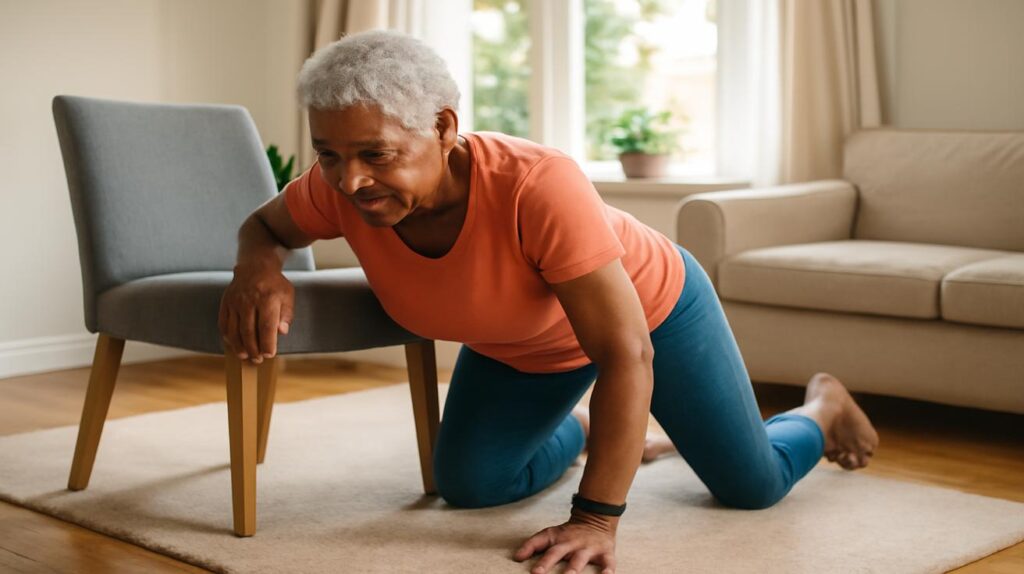
- Explore the near-floor. When it feels safe, practice kneeling with support. One knee down, then the other. A hand on the chair, the other on the floor. Pause. Breathe. Reverse the path and come back up.
- Eventually, flirt with the real floor. Maybe you sit on a cushion placed on the rug. Maybe you lie back halfway, then push yourself up. One slow variable at a time.
All the while, the point is not grace. It’s familiarity. It’s telling your body, “The world is not just the band of space between your knees and shoulders. You belong all the way down here, too—and you know how to get back.”
Done three to five times a week, this pattern quietly changes the architecture of your aging body. Your thighs adapt. Your hips remember deep angles. Your hands regain strength as true supports, not just decorative appendages. Your mind softens the edge of fear around anything that involves the word “down.”
| Movement Layer | Example After 70 | Healthspan Benefit |
|---|---|---|
| Sit-to-stand | Slowly rising from a chair without “dropping” into it | Leg strength, blood pressure stability, independence |
| Kneel-and-rise | Getting down on one knee to reach a low shelf | Hip mobility, balance, floor confidence |
| Ground-to-stand | Lowering to the floor with support, then standing back up | Fall recovery skill, core strength, coordination |
| Rotational reach | Turning and reaching to the side arm of a chair | Spinal mobility, reaction ability, daily comfort |
Beyond Steps and Sets: What Science Is Whispering
For years, public health messages have focused on two big movement pillars: aerobic activity (like walking) and muscle-strengthening sessions (often at the gym). Those are still important. But a growing body of research around aging, falls, and functional independence hints at something more nuanced.
Older adults who can move from the floor to standing without support—or with minimal support—tend to have lower mortality risk than those who can’t. Not because the test itself is magical, but because it compresses so many capacities into a single, simple act: strength, joint range, balance, coordination, and confidence. In some studies, the ability to perform this movement strongly correlates with how long and how well people live, even when you control for age and other health factors.
Then there’s the often-ignored factor of power—not just strength, but how quickly that strength can be expressed. The ability to “catch” yourself when you stumble, to push the ground away fast enough to right your center of mass, is a matter of timing as much as muscle. Repeated ground-to-stand practice, even at low speed, quietly trains the nervous system to move more efficiently when it counts.
It’s not that daily walks and weekly gym visits fail. They’re good for the heart, the lungs, the mood. But they’re mostly linear and repetitive. They don’t demand the unpredictable shifts, the multi-joint angles, and the low-to-high transitions that a single misstep in the kitchen might suddenly require.
This is why that man in the park might live a quieter but richer healthspan than the person who proudly logs 10,000 flat, identical steps a day while avoiding the ground like a foreign country. When we zoom out, the message from the body itself is fairly clear: “Don’t just move more. Move more like life.”
Making It Personal: Stories from the Ground Up
Consider Maria, 78, who hadn’t sat on the floor in over a decade. It wasn’t a dramatic decision—just a gradual avoidance. Too much trouble. Too much fear of getting stuck. When her daughter suggested gentle floor practice with cushions and a sturdy coffee table, Maria laughed. “What for? I’m not a child.” But she agreed to try.
The first week, she only knelt on one knee next to the couch, both hands braced, heart racing as if the carpet were a cliff edge. Over the next month, she learned to sit on a thick cushion and shift her weight. She practiced rolling onto one hip, then the other, always with a hand on the furniture. By the end of three months, she could sit on the bare rug and lean back on her hands. One day, when a pencil rolled under the couch, she surprised herself by sliding down, grabbing it, and getting back up before she had time to be afraid.
“It wasn’t the pencil,” she said later. “It was this feeling like I belonged on my own floor again. Like my house wasn’t full of dangerous low places.”
Or take Arthur, 82, who had always been a “walker.” He logged his steps, wore the shoes, took the same route every morning with religious consistency. But when his doctor asked him to get down on the mat for a simple mobility assessment, his legs shook. His hands fluttered. His breath shortened. He realized he had built endurance for distance—but not resilience for height changes.
He began integrating a five-minute routine: five slow sit-to-stands from a firm chair, three partial kneels holding onto the kitchen counter, and one “almost to the floor” descent next to his bed. Within weeks, the same distance walks felt easier. Stairs felt less menacing. His world expanded—not because he moved farther, but because he could now trust himself in more places.
These are not fitness transformations in the glossy-magazine sense. No dramatic before-and-after photos. Just an elderly woman who no longer dreads dropping a pill bottle, and an older man who isn’t secretly terrified of hotel bathtubs.
This is what healthspan really looks like up close: tiny reclaimed freedoms, one awkward, practiced descent at a time.
Bringing Grounded Movement Into an Ordinary Day
If you’re over seventy—or planning ahead for the person you’ll eventually be—the invitation isn’t to suddenly become a floor athlete. It’s to weave this pattern into the fabric of your daily life, gently and consistently, the way you might drink water or brush your teeth.
1. Anchor It to Something You Already Do
Pick a daily moment—waking up, watching the evening news, waiting for the kettle to boil. Each time, practice a miniature groundward movement, tailored to your level. Maybe it’s three slow sit-to-stands before you settle into your favorite chair. Maybe it’s one careful kneel to pick something up that you’ve placed there on purpose.
2. Respect Fear, But Don’t Obey It Blindly
If the floor feels like an enemy, begin higher. Practice lowering your center of mass just a little: bending deeper at the knees while holding onto the counter, or placing one hand on the seat of a chair while you gently bend your hips. Let your nervous system adapt gradually. Courage is often just fear that’s been given time and repetition.
3. Use the Environment as Your Training Partner
Sturdy bed frames, railings, heavy tables, even the wall can become part of your practice. Slide a hand along the wall as you move from standing to sitting. Place one knee on the couch and then on the floor. Think of your home not as something to tiptoe through, but as a landscape that can either shrink or expand your capabilities, depending on how you move in it.
4. Listen for the “I Can Still Do That” Moments
The goal is not athletic performance; it’s preserving small joys. Sitting on the grass for a picnic. Going to a grandchild’s school play without worrying about auditorium seats. Reaching the lower cupboard without calculating how dangerous it might be. When you practice ground-to-stand movement, pay attention to these everyday victories. They’re your real progress markers.
5. Share the Pattern, Not Just the Advice
If you have aging parents, relatives, or neighbors, resist the urge to lecture them about falling. Instead, invite them into the pattern gently. Offer a chair, sit beside them, and practice slow sit-to-stands together. Turn vulnerability into companionship. Aging is less frightening when it’s done in the company of someone who sees your strength as well as your risk.
Choosing How You Want to Meet the Ground
In the end, we don’t get to negotiate with gravity. Sooner or later, every body meets the ground—through illness, fatigue, or simply the forward march of time. The choice we do have, especially after seventy, is how familiar that meeting will feel.
We can arrive there as strangers, shocked and unprepared, hoping that medical systems and luck will reassemble us. Or we can arrive as frequent visitors, already fluent in the in-between spaces, having practiced the art of lowering and rising so many times that even if we can’t do it perfectly, we at least know the script.
The man in the park probably doesn’t think of himself as someone who’s “extending his healthspan.” He might just say his legs feel better when he practices standing up and sitting down. But his body knows. With every careful descent, every awkward twist, every deliberate push off the bench, he’s keeping open a door most people let quietly close long before it has to.
After seventy, it’s not really about logging more miles or faithfully attending a weekly gym session. Those can help, but they’re just chapters. The story that matters most is whether you still have a relationship with the ground—and with your own ability to leave it.
Every day you choose to practice that pattern, in whatever small, safe way you can, you’re not just moving. You’re casting a vote for more years in which tying your shoes, picking up a book, or sitting on the floor with someone you love still feels beautifully, reassuringly possible.
FAQ
Is this type of movement safe for everyone over 70?
Not automatically. If you have severe arthritis, recent surgery, advanced osteoporosis, serious balance issues, or have already had falls, you should talk with a healthcare provider or physical therapist before starting. The pattern can be modified for nearly everyone, but the starting point and level of support need to be individualized.
How often should someone over 70 practice ground-to-stand movements?
For most older adults, aiming for three to five brief sessions per week is realistic. Even five to ten minutes at a time can be effective, especially when combined with light walking and everyday activities. Consistency is more important than intensity.
What if I can’t get to the floor at all right now?
Then you simply begin higher. Practice very slow sit-to-stands from a firm, stable chair. Add support from your hands as needed. Later, you can experiment with partial kneeling using the couch or bed for support. The goal is progress, not perfection; even improving your sit-to-stand ability can greatly protect your independence.
Do I still need regular walking or gym exercise if I do this?
Yes. Walking supports cardiovascular health, mood, and endurance. Strength and balance exercises from the gym or classes can add extra benefit. The ground-to-stand pattern doesn’t replace those—it fills a gap they often miss. Together, they form a more complete foundation for aging well.
How can caregivers support an older adult in practicing this safely?
Caregivers can help by setting up a safe environment: clear floors, sturdy furniture, good lighting, and possibly a mat or cushion. Stand nearby without pulling or yanking, offer a steady hand if requested, and encourage very small, manageable steps instead of pushing for big changes. Above all, respect the person’s pace and dignity—this is about building confidence, not testing limits.