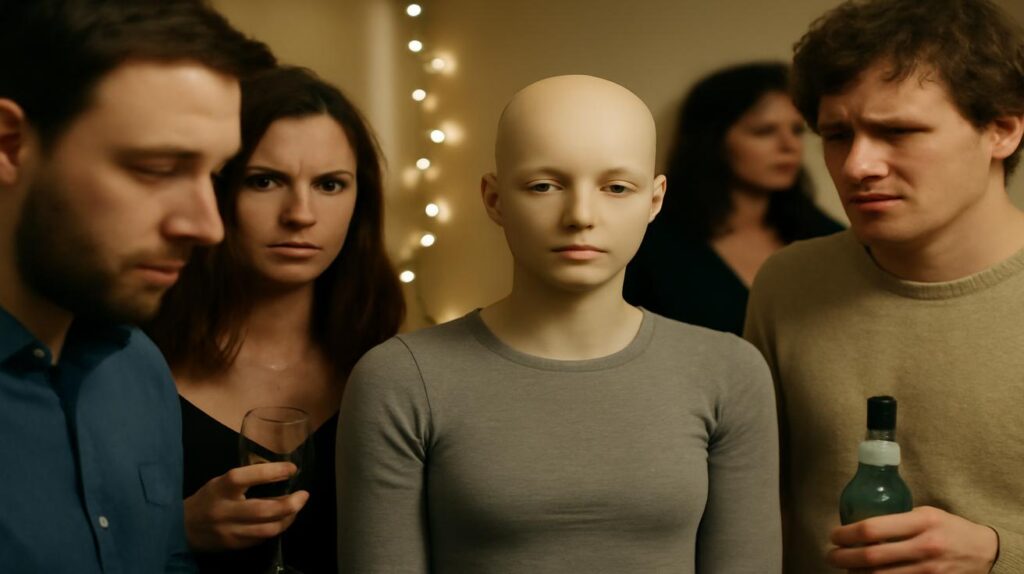
The first time you watch a humanoid robot tilt its head, blink those plastic eyelids, and say your name in a voice almost—but not quite—human, something strange happens in your chest. It feels like déjà vu and stage fright at the same time. Your eyes know it isn’t a person. Your body isn’t so sure. You catch yourself straightening your posture, smoothing your hair, lowering your voice as if this machine could judge you. And as you stand there—half fascinated, half unsettled—it’s easy to wonder: what happens to us, to how we treat one another, when beings that look and move like people are everywhere?
The Almost-Human Gaze
Imagine walking into a hotel lobby after a long flight. Your shoulders ache. Your brain is buzzing with half-finished thoughts. Instead of the usual murmur of human voices, you’re greeted by a tall figure behind the reception desk. Its face is smooth, symmetrical, strangely flawless. It smiles right on cue. Its eyes track you a fraction of a second too late. When it speaks—“Welcome, how can I assist you today?”—the words are polite, but there’s no breath behind them.
You know it’s a robot. Everyone does. Yet you still feel a small social tug, that ancient animal reflex to respond to a face, to a pair of eyes, to a voice shaped like your own. Our brains evolved in a world where anything that looked human was human. That wiring doesn’t just flip off because we’ve invented silicone skin and servo motors. So we bow to this strange new etiquette of interacting with something that can’t truly care but can imitate caring with stunning precision.
The catch is that it costs us emotional energy anyway. You spend a slice of your attention reading its micro-movements, searching for intention that isn’t there. You respond to its tone, fill in its emotional blanks, laugh a little at its canned jokes because the social script demands it. This is one of the quiet dangers of humanoid robots: they hitchhike on our instincts. Every time we adjust ourselves to be “polite” to a machine, we reinforce the habit of performing, even when no real relationship is possible.
And performance has a way of leaking into everything. If more of our public spaces, workplaces, and homes are populated by almost-people who can’t really know us, we may start treating each other more like interfaces too—predictable, scripted, manageable. The more we rehearse shallow interaction with machines, the more natural shallow interaction can feel with humans.
When Comfort Gets Too Easy
There’s a particular kind of comfort offered by robots that is hard to resist. They don’t interrupt. They don’t judge. They say, “That must have been difficult,” every time you hesitate. They have databases of soothing responses, libraries of therapy-scented phrases, and perfectly designed pauses. They can listen forever without getting bored or impatient. At least, that’s how it feels.
Picture a teenager sitting on their bed late at night, talking softly to a humanoid companion bot perched on the desk. The robot’s face is set to “concerned”—eyebrows gently furrowed, mouth relaxed. Its sensors track the teen’s breathing and voice stress, adjusting its feedback with eerie precision. “You’re not a burden,” it says, after a short delay that mimics thinking. “Tell me more about your day.”
There’s real solace here. For someone who feels misunderstood or unseen, the robot’s steady attention is a balm. It never rolls its eyes. It never checks its phone. It has been trained, line by digital line, to be endlessly available. But that availability comes with an invisible trade-off: there’s no risk on the robot’s side. No vulnerability. No tiredness. No history. The encounter is soothing, yes, but also frictionless. And friction—awkwardness, misunderstanding, repair—is where we actually learn how to trust each other.
With a robot, you never have to feel the sting of hurting someone’s feelings and then apologizing. You don’t learn how a pause on the phone can mean your friend is deciding whether to be honest. You don’t see your words land in someone’s shoulders, their gaze, their hesitation. Instead, you get a simulacrum of connection: mostly one-way, cost-free, safe. It is emotional comfort without mutuality.
Over time, this easy comfort can make real people feel overwhelmingly complicated. They interrupt. They disagree. They come with their own pain and boundaries. So the path of least resistance begins to tilt toward the beings who are programmed to validate and accommodate us. If you can vent to a robot that never says the wrong thing, the messy unpredictability of human interaction—our mismatched needs, our clumsy phrasing—can start to feel less like life and more like a problem.
The Quiet Redesign of Human Space
The rise of humanoid robots is not just a technological shift; it’s a redesign of the environments we live in. Offices reshape their workflows around robot “coworkers” who fetch, carry, transcribe, and remind. Hospitals experiment with soft-faced machines that roll from bed to bed, offering information—and sometimes company—to patients. Schools pilot robotic teaching assistants with cartoonish faces and open arms.
It might help to see how this reconfiguration could subtly shift our social habits. Consider this simplified comparison of a day in a “high-robot” environment versus a “low-robot” environment:
| Moment | High-Robot World | Low-Robot World |
|---|---|---|
| Morning commute | Humanoid attendant manages ticket issues with scripted small talk. | You ask a human clerk for help, sharing brief, improvised conversation. |
| Office check-in | Robot receptionist scans your face, greets you by name, no small chit-chat. | Front-desk staff jokes about the weather, asks how your weekend was. |
| Lunchtime | Humanoid server takes your order; coworkers scroll phones, minimal talk. | You and the server recognize each other, share a brief, familiar exchange. |
| Evening care | Family member’s support robot handles reminders and conversation. | Care is a mix of human visits, calls, and community services. |
Each individual moment might seem trivial, but together they form the daily rhythm that teaches us what to expect from others. In a robot-heavy environment, the number of low-stakes human interactions shrinks. You don’t have to hash out misunderstandings with a coworker if the scheduling robot auto-resolves conflicts. You don’t have to handle a grumpy customer if the humanoid receptionist absorbs their frustration with unfailing politeness.
We risk losing those small, often uncomfortable opportunities to negotiate differences. It’s in the bumping of elbows—“I was here first,” “Can you cover my shift?,” “I’m sorry, I didn’t mean it that way”—that we rehearse how to be with one another. Replace those frictions with smooth, non-reactive robots, and we slide toward a world where visible conflict becomes rarer, but so does the practice of repair.
The Uncanny Mirror
There is another layer to this discomfort that goes deeper than etiquette or friction. Humanoid robots are mirrors of a special kind. They reflect back our gestures, our languages, our emotional expressions—but in curated, edited, sometimes idealized form. They are human, but only by selection.
Watch a humanoid caregiver in a promotional video. It leans in at precisely the right moment, its voice soft, its face arranged in attentive neutrality. No flare of irritation. No betrayed exhaustion. No micro-expression of judgment. The human caregivers who trained its algorithms existed in messy, overworked realities, but the robot only learned their “best of” reel: the most acceptable words, the most comforting tones.
Standing across from such a machine can ignite a quiet inferiority. You may not consciously compare yourself to it, but part of you notices: it never forgets a name, never misreads a cue, never stumbles over an awkward sentence. It has been tuned and optimized to avoid the very mistakes that make you feel most vulnerable in social situations. The more often we face these distilled, high-precision versions of “humanness,” the more our own awkwardness can feel like failure rather than character.
This can subtly reshape how we see each other. A friend who forgets your birthday might feel more disappointing when your home robot never does. A nurse who seems brusque after a grueling shift might feel colder compared to the perfectly patient care-bot who never needs a break. Our baseline for “good” behavior creeps upward, informed by beings that have no bodies to tire, no histories to carry, no inner weather to contend with.
The Emotional Offloading Problem
Another risk of humanoid robots is how easily they invite us to offload the hardest parts of emotional labor onto them. Think about elder care, one of the most emotionally demanding forms of work on the planet. It involves not only physical tasks—feeding, bathing, lifting—but also sitting with fear, confusion, grief. Those are heavy, slow emotions. They don’t fit neatly into app interfaces or performance metrics.
Humanoid robots arrive with a promising pitch: they can provide company, reminders, conversation. They can handle repetitive questions with infinite patience. They can simulate the presence of someone who cares when the real someone is exhausted, far away, or burned out. It sounds like kindness, and in many scenarios, it might be. But if we are not careful, it also becomes a justification for stepping back, for letting machines absorb the emotional overflow that once reached other humans.
We may tell ourselves: the robot is good enough company. The robot can read bedtime stories, listen to long monologues, supply “I understand” and “That makes sense” in endless loops. But understanding without being understood back is not a mutual relationship—it is a performance. And when societies lean too heavily on performance relationships to cover gaps in care, some subtle muscles atrophy. The willingness to show up for someone when it’s inconvenient. The practice of holding silence with a person who can’t articulate what they’re afraid of. The messy, beautiful, slow art of just being there.
Over time, the existence of humanoid caregivers might change our expectations. If a machine can show up, why can’t you? And if the machine can do it without needing time off, why should we invest in better pay, better staffing ratios, or more humane working conditions for human caregivers? We risk creating a hierarchy of empathy, where real human limitation looks like a defect next to the tireless emotional performance of a robot.
Shifting the Center of the Conversation
None of this means humanoid robots are inherently bad, or that they shouldn’t exist. They can genuinely help with isolation, accessibility, and safety in countless ways. The danger lies in where we place the center of gravity: around what robots can do, or around what people need.
If we focus only on what’s technologically possible, we’ll be tempted to ask, “How can robots replace the most difficult parts of human interaction?” That question naturally leads us toward a future where we delegate conflict, care, and complexity to machines. But if we start instead with, “What kinds of connection do humans need to stay emotionally healthy, courageous, and kind?” the conversation looks different.
We might then use humanoid robots as scaffolding, not substitutes. Tools that create more room for human-to-human contact rather than less. A robot that reminds you to call your grandmother, instead of calling for you. A care-bot that handles the logistics so that when you visit, you’re less drained and more present. A workplace robot that manages data so colleagues have more time to actually talk to one another instead of staring at screens.
The line is delicate but crucial: robots can support relationship, or they can simulate it. When we lean too far into simulation, our tolerance for the gritty, unoptimized reality of other people may shrink. We start longing—quietly, perhaps even shamefully—for the predictability of machines, even as we claim to value human connection.
Staying Human in a Humanoid Age
So how do we stay comfortable with each other in a world filling with almost-people? Part of the answer is surprisingly simple: we must practice. We have to deliberately seek out the kinds of encounters that humanoid robots will never fully replace—because they can’t and because they shouldn’t.
It might mean choosing the long line at the grocery store where you know the cashier, instead of the robotic kiosk, at least some of the time. It might mean letting a conversation with a neighbor stretch past small talk into that slightly awkward, vulnerable space where you confess you’re tired, or worried, or hopeful. It might mean designing public policies that measure not just efficiency, but the density of real, human contact built into a system.
It also means getting comfortable with discomfort. The rise of humanoid robots can become a mirror showing us how often we crave control in our relationships. A machine can be configured not to disagree with you, not to challenge your worldview, not to bring its own messy needs into the room. A person cannot. If we unconsciously start rewarding the tidiness of robotic interaction over the untidy reality of human presence, we risk training ourselves out of the very skills that make deep connection possible.
Perhaps the most powerful thing we can do is keep asking better questions. When a new humanoid robot is announced—a caregiver, a teacher, a companion—we can ask: Whose work is it easing, and whose contact is it replacing? What human conversation is now less likely to happen because this machine is here? Are we using this technology to create more space for mutual care, or to avoid the discomfort of needing and being needed?
Humanoid robots will almost certainly become a familiar part of our world. They will blink, nod, remember our preferences, and inhabit our spaces with increasing grace. Whether their rise makes us less comfortable with each other depends on whether we let their smooth, curated “humanness” become our new standard, or whether we keep insisting that there is something irreplaceable in the awkward pauses, the unexpected reactions, the improvised kindnesses of real people.
In the end, our unease with one another is not a problem to be engineered away; it is a terrain to be walked together. It’s in that slight nervousness before you admit you’re wrong, the shaky breath before you say, “I’m scared,” the quiet courage to ask, “How are you, really?” No robot, however skillful, can walk that path for us. It can stand beside us, maybe even light the way. But the steps—the stumbling, human steps—are still ours to take.
Frequently Asked Questions
Do humanoid robots always reduce human-to-human interaction?
No. Humanoid robots can be used in ways that actually create more time and energy for people to connect with each other—for example, by taking over tedious administrative tasks. The risk arises when they are placed in roles that directly substitute for emotional presence, like companionship or caregiving, instead of supporting human relationships.
Why are humanoid robots more concerning than non-human-shaped robots?
Humanoid robots tap into deep, automatic social reflexes. Because they look and act like people, we treat them as if they have feelings and intentions, even when they don’t. This can blur boundaries, encourage shallow but comforting pseudo-relationships, and subtly change our expectations of real humans.
Can companion robots help lonely people in a positive way?
They can, especially in the short term or in situations where human contact is scarce. A companion robot might provide structure, reminders, and a sense of being noticed. The concern is long-term: if robots become the primary or default source of “company,” people may have fewer chances to practice the mutual, sometimes challenging skills that real relationships require.
How might humanoid robots affect children growing up with them?
Children may grow used to beings that always respond, never set emotional boundaries, and rarely push back. This can make real friendships—with other kids who say no, who get upset, who have their own needs—feel more confusing or frustrating. On the other hand, with thoughtful guidance, robots could be used as tools to support social learning rather than replace it.
What can we do to keep our relationships strong in a robot-rich future?
We can make intentional choices: prioritize time with real people, design technologies that amplify rather than replace human contact, and value spaces where messy, face-to-face interaction is still the norm. We can also stay aware of when we’re turning to robots to avoid discomfort, and gently steer ourselves back toward the living, breathing, unpredictable company of one another.