The first time I saw it, the video felt like a lullaby: soft lighting, piano music, a woman’s hands gently massaging another woman’s scalp until her eyes fluttered closed. The captions floated across the screen like promises: “Detox your scalp.” “Reverse thinning.” “Stimulate miracle hair growth—at home.” The comments were a chorus of hope and urgency. “Ordering tonight!” “This cured my postpartum hair loss!” “My confidence is back after just three sessions.”
I watched as a glass dropper released viscous amber oil onto a pristine parting of hair, slowly soaking into the skin. A jade comb glided through the strands in slow motion, the foam of an exfoliating scrub blooming along the hairline like sea foam on a shore. It was mesmerizing. It was strangely intimate. It was also, as I would come to realize, a trap—one built on women’s worst fears about their bodies, and polished to a high, soothing sheen.
The Seductive Promise of an “At-Home Scalp Spa”
The term itself feels luxurious, doesn’t it? Scalp spa. It suggests ritual, care, the kind of attention we were never taught to give the skin under our hair. In a culture where “self-care” has been remodeled into a lifestyle aesthetic and sold back to us in pastel bottles, the idea of turning hair care into a spa-like experience is irresistible.
You start with a simple search: “why is my hair thinning at 30?” or “how to fix oily flaky scalp naturally.” Within days, your feeds fill with algorithmic empathy—creators whispering into microphones while brushing their hair, aestheticians in satin robes gliding ultrasonic devices along the scalp, influencers swearing that this one brush, this one serum, this “30-day detox protocol” saved them from hair loss despair.
The formula is always the same. They begin with a confession: “I used to hate my hair.” They show a “before” photo, eyes downcast, roots sparse, scalp visible. Then comes the glow-up: tumbling waves, glossy ponytails, hair swinging like an advertisement in slow motion. And between those images, the bridge: a curated lineup of scalp massagers, microneedling rollers, detox scrubs, scalp peels, and LED helmets—promising not just healthier hair, but a new self.
This is where the danger begins. Because what they don’t say loudly enough is that for many women, especially those dealing with hormonal shifts, genetic predisposition, or underlying medical conditions, no amount of spa-like pampering will “reverse” hair loss. And yet, the promise is whispered so sweetly, over and over, that it becomes hard not to believe it.
The Business of Insecurity Disguised as Self-Care
Hair has always been a currency of worth, especially for women. It’s Biblical, mythic, cultural: the long hair of maidens, the shiny blowout of the “put-together” professional, the cascading curls of shampoo commercials. We’re not just told that hair is part of our beauty; we’re taught it’s evidence of health, youth, desirability, even discipline. To lose it—or even to suspect we might be losing it—is to feel something fundamental slipping away.
Modern marketing knows this intimately. The “scalp spa at home” trend is just the latest evolution of a booming beauty economy that survives on fear: fear of aging, of acne, of cellulite, of visible pores, and now, of every shed hair in the drain. Each product and protocol comes wrapped in the language of empowerment and self-love, but underneath there’s a quiet implication: You are not enough as you are. But you could be… if you buy this.
The new twist is how “wellness” and “science” are woven into the pitch. The word “spa” is paired with “clinical,” “dermatologist-inspired,” “trichologist-approved,” even when there’s no genuine medical backing. TikTok and Instagram are overflowing with creators in lab coats who may or may not have real credentials, holding up scalp tonics and microneedling devices under ring lights. They use words like “follicular environment,” “microcirculation,” “angiogenesis,” and “growth factors” the way others use glitter—scattered everywhere, dazzling and largely unexamined.
The result is a kind of emotional alchemy: a woman’s private worry—“Why does my part look wider?” “Is my ponytail thinner?”—is transformed into a “problem” that needs a product. The more vulnerable she is, the more expensive the solution becomes. Subscription boxes, multi-step scalp “systems,” monthly “detox” kits; they pile up on bathroom shelves like tiny shrines to hope. But hope, in this market, is billable.
The Cost of Chasing Miracle Hair Growth
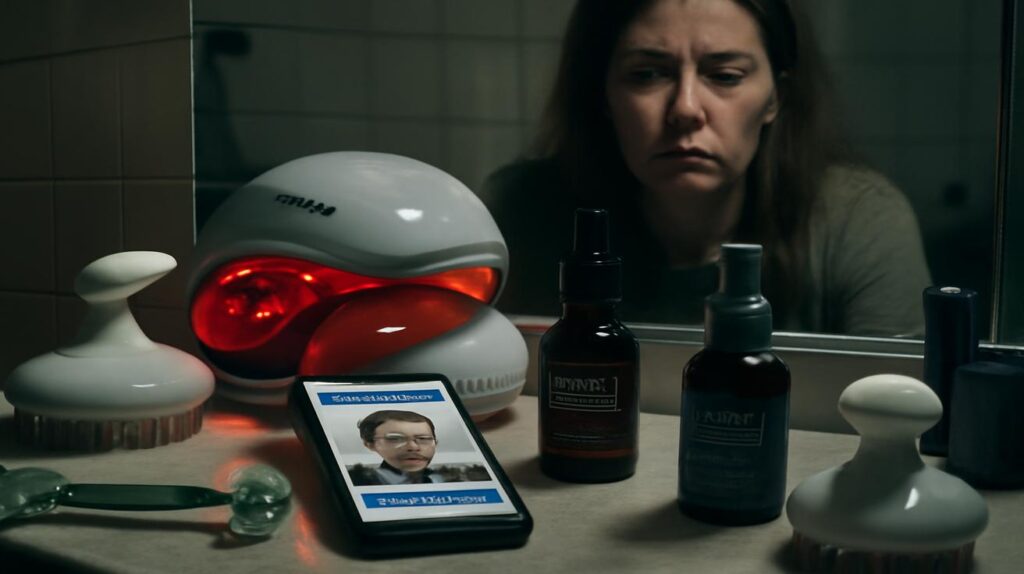
Scroll through “scalp spa at home” content for just a few minutes, and you’ll notice a theme: abundance. Not of hair, necessarily, but of stuff. Specialty combs, scalp massagers in gradient pastels, exfoliating shampoos, clarifying pre-washes, post-wash tonics, oil blends, peptide serums, overnight masks, LED caps, ultrasonic misters. Many women aren’t just buying one item—they’re assembling entire altars to their hairline.
For some, it starts with a $30 scalp scrub. Then a $60 serum. A $90 “professional-grade” massager. An LED helmet clocking in at $400. A microneedling device for $150—plus the $50 “sterilizing solution” sold separately. Before long, the price of “at-home” care rivals the cost of in-clinic treatments, without the safeguard of actual medical supervision.
When you spread these costs over months, it’s easy to minimize them. “It’s only $40 here and there.” “It’s cheaper than going to a trichologist.” But many women quietly bleed hundreds, even thousands, of dollars into a ritual that doesn’t address the root cause of their hair concern—and may sometimes make it worse.
To see the math more clearly, it helps to lay it out:
| Item / Routine | Typical Cost (USD) | Replacement Frequency | Approx. 1-Year Cost |
|---|---|---|---|
| Scalp scrub + clarifying shampoo duo | $40–$70 | Every 1–2 months | $240–$420 |
| “Growth” serum / tonic | $50–$120 | Every 1–2 months | $300–$1,440 |
| Scalp massager / exfoliating brush | $15–$60 | One-time (plus “upgrades”) | $15–$120 |
| At-home microneedling device | $80–$250 | Every 6–12 months | $80–$250 |
| LED hair growth helmet / cap | $250–$900 | Every 2–3 years (often earlier “upgrades”) | $250–$900 |
| Subscription “scalp spa” boxes | $40–$120 / month | Monthly | $480–$1,440 |
| Estimated yearly total for a typical enthusiast | – | – | $1,000–$3,500+ |
For many women, this spending is not happening in a vacuum. It competes with rent, student loans, childcare, groceries, and medical bills. Yet it rarely gets named as what it is: a beauty tax levied on the fear of losing our hair—and with it, our place in a world that worships youth and gloss.
When “Treatment” Becomes Trauma for Your Scalp
For all the soft lighting and soothing music in those videos, the reality on the scalp can be less gentle. A healthy scalp is a living, delicate ecosystem: microbiome, oil production, barrier function, circulation, hair cycle—all balancing one another. When you go to war on that ecosystem in the name of “detox” and “growth,” things can go sideways fast.
Over-exfoliating scrubs can abrade the skin, opening micro-tears that sting under every subsequent product. Harsh clarifying shampoos, when used weekly instead of occasionally, can strip away the very oils that protect the follicles, leaving the scalp tight, itchy, and more reactive. Strong essential oils used neat—or in high concentrations—can cause contact dermatitis, leading to flaking, burning, and yes, sometimes shedding.
Microneedling, a treatment with legitimate medical uses when performed correctly in clinical settings, has become a DIY trend that strays alarming close to self-injury. Rollers with dubious needle quality, used with inconsistent pressure on non-sterile skin, can introduce infection, trigger inflammation, or cause scarring. Meanwhile, LED helmets sold online vary wildly in wavelength accuracy and intensity; some may be harmlessly useless, others may cause headaches or irritation, and very few come with personalized guidance about who shouldn’t be using them.
Underneath all this is a crucial truth most marketing avoids: a lot of female hair thinning is driven by internal factors—hormonal changes, nutritional deficiencies, stress, thyroid disorders, autoimmune conditions, genetic predisposition. No amount of scrubbing, massaging, or device-zapping can override what’s happening inside the body. A scalp spa might make your head feel momentarily lighter, your hair temporarily shinier, but it will not cure iron deficiency, adjust your thyroid levels, or rewrite your DNA.
Yet when results inevitably fall short of “miracle,” the blame rarely lands on the product or the marketing. It lands on the woman. She didn’t use it consistently enough. She started too late. She didn’t buy the full set. The unspoken message: if the miracle didn’t happen, you failed the ritual.
Why We Keep Believing: The Quiet Psychology Behind the Trend
There’s a particular kind of loneliness that hair loss creates. It shows up in the shower drain, on the hair tie that wraps one extra loop around your ponytail, in the way you tilt your head in the mirror to catch the light on your part and see—was it always that wide? It doesn’t feel dramatic enough to seek emergency care, but it feels too shameful to casually mention over coffee. So you go online, late at night, and type your fear into a search bar instead.
The internet answers with community. Thousands of women, all whispering versions of the same grief. “I cried when I saw my scalp in a photo.” “I’m afraid my boyfriend will notice.” “I don’t recognize myself without my hair.” This is where the scalp spa trend hooks into something deeper than vanity. It taps into identity, control, and the longing to fix what feels broken, preferably with your own two hands.
At-home rituals promise exactly that: control. You don’t have to wait months for a dermatologist appointment. You don’t have to face a doctor who might tell you there are limits, or who might dismiss your concern. You can take action tonight. Massage in the oil. Roll the device. Put on the helmet. You can feel like you’re not surrendering to loss—you’re fighting it.
This feeling is powerful, and it’s not inherently bad. There’s genuine comfort in creating small, sensory rituals: the warmth of your fingertips on your scalp, the scent of a calming oil, the quiet act of tending to yourself. The trouble comes when that comfort is exploited to sell false certainty: “This will regrow your hair.” “
We are, many of us, particularly vulnerable to such claims during times of transition: postpartum, perimenopause, after illness, under chronic stress. Our bodies feel unfamiliar; our hair becomes a visible barometer of that transition. Beauty companies know this. They target their ads accordingly. The miracle, as it turns out, is not hair growth. It’s how effectively someone can monetize a fear you whispered only to your pillow.
What Actually Helps a Scalp—and What’s Just Hype
It’s tempting to swing to the opposite extreme and declare all scalp care a scam. But that wouldn’t be true—or fair. Your scalp is skin, and like all skin, it benefits from a certain amount of thoughtful attention. The key is to separate grounded care from miracle-chasing.
Some practices that genuinely support scalp health:
- Gentle cleansing: Washing regularly enough to prevent heavy buildup, but not so aggressively that you strip your natural oils. Frequency will depend on your hair type and lifestyle.
- Occasional clarification: Using a clarifying shampoo once every few weeks if you use a lot of styling products or live in a hard-water area, followed by good conditioning.
- Mild massage: A few minutes of fingertip massage during shampooing can support blood flow and relaxation. No claws, no extreme pressure, no devices necessary.
- Sun and heat protection: Scalp can burn; hats in strong sun and moderate use of hot tools can make a real difference.
- Medical evaluation when there are changes: If you notice sudden shedding, patchy loss, or persistent itching, see a dermatologist or clinician experienced in hair disorders. Labs for iron, thyroid, vitamin D, hormones, and autoimmune markers may be more important than any product.
As for ingredients, some have reasonable evidence in certain contexts (like topical minoxidil, which is a medication, not a spa serum), while others are more about conditioning and comfort than true “regrowth.” Plant oils, for instance, can help with dryness and friction, making hair feel softer and more manageable—which is valuable—but they are not magic seeds that turn a dormant follicle into a lush forest.
The red flags to watch for:
- “Guaranteed regrowth” or “works for every type of hair loss.”
- No mention of possible side effects or limitations.
- Pressure to buy full systems or subscriptions for results.
- A heavy reliance on emotional testimonials without clear, realistic explanations.
- No transparency about concentration of active ingredients or lack of clinical data.
The truth is quieter, less glamorous, and doesn’t fit neatly into a trending sound bite: your scalp deserves care, yes, but no product can rewrite every story your follicles are telling. Sometimes the kindest thing we can do is not to add another layer of product, but to subtract the shame from the mirror.
Reclaiming Hair Care Without Losing Yourself
So where does that leave you, the woman standing at her bathroom sink, scrolling past one more video of glossy hair and whisper-soft scalp massages? Maybe it leaves you here: curious, but cautious. Open to caring for your scalp, but unwilling to sign a blank check drawn from your savings and self-worth.
You can still enjoy the sensory pleasure of a slow, intentional wash day without framing it as a war against aging. You can use a simple, well-formulated shampoo and conditioner and gently massage your scalp under warm water, noticing the way the tension in your neck begins to loosen. You can choose one or two products that feel good and align with your budget, rather than chasing every new launch that claims to finally fix the “problem” of being human.
You can also give yourself permission to seek real, evidence-based help. To ask your doctor about blood tests. To seek out a dermatologist, even if it’s intimidating. To say out loud, to another person, “I’m losing my hair and it’s hurting my confidence,” and let that truth be met with care, not sales pitches.
Most radically, you can begin to entertain the possibility that your worth is not indexed to your hair density. That your softness, your power, your desirability, your presence in the world—all the things we’re told live or die by our reflection—might exist beyond the reach of any brush, serum, or helmet. This doesn’t mean you have to love every strand or pretend hair loss doesn’t sting. It simply means you are more than the fears the industry profits from.
The next time you see a video promising “miracle hair growth” from a home scalp spa, notice what rises in your body. Is it hope? Panic? Envy? Despair? Instead of rushing to the “add to cart” button, pause. Take a breath. Ask yourself: What is this ad telling me about myself? And then ask, more importantly: Is that story actually true?
Your scalp is not a battlefield. It’s skin, quietly doing its job, carrying memories of playground braids and messy buns and all the ways your hair has marked your years. It deserves care, yes. But you deserve something bigger: the freedom to step out of trends that prey on your insecurities and into a relationship with your body that isn’t constantly negotiating with a shopping cart.
Healing that relationship will never come in a bottle. It will be built slowly, in the privacy of your daily rituals, in the conversations you dare to have, and in the gentle decision—again and again—to spend more of your energy on living your life than on chasing miracles in your bathroom mirror.
Frequently Asked Questions
Do at-home scalp spa routines really make hair grow faster?
They can sometimes make hair look and feel healthier, but most at-home scalp spa routines do not significantly alter the biology of hair growth. Hair growth is largely influenced by genetics, hormones, health conditions, medications, and nutrition. Gentle care can support a healthier scalp environment, but “miracle” regrowth claims are usually exaggerated.
Is scalp exfoliation safe to do at home?
Occasional, gentle exfoliation with a well-formulated product can be safe for many people. Problems arise when scrubs are used too often, applied with too much pressure, or contain harsh particles or irritating fragrances. Over-exfoliation can damage the scalp barrier, trigger irritation, and even lead to increased shedding.
Are scalp oils and massages helpful, or just hype?
Light scalp massage with a non-irritating oil can improve comfort, help distribute natural oils, and create a relaxing ritual. It may support blood flow to the area, but this alone rarely transforms hair growth outcomes. Oils and massages are best seen as supportive care, not as cures for medically-driven hair loss.
Should I try at-home microneedling or LED helmets for hair growth?
These tools have some clinical use in medical settings, but DIY use is more complicated. Poor-quality devices, improper technique, and lack of medical guidance can lead to irritation or injury. If you’re considering microneedling or LED therapy, it’s safer to discuss it with a dermatologist or hair specialist who can advise on evidence, suitability, and realistic expectations.
When should I see a doctor about hair thinning instead of relying on products?
You should seek medical advice if you notice sudden or patchy hair loss, shedding that continues for more than a few months, scalp pain or persistent itching, or if hair changes are accompanied by other symptoms like fatigue, weight changes, or menstrual irregularities. A doctor can help identify underlying causes such as hormonal issues, thyroid problems, nutrient deficiencies, or autoimmune conditions—none of which can be fixed by scalp spa products alone.