The first thing you notice is the way the light hits it. Not the length—that’s gone, scattered in soft wisps around your salon chair—but the movement. Your hair, which usually falls flat by midday, suddenly has lift. It doesn’t stick to your head, it doesn’t separate into limp little strings. Instead, it hovers and swirls and somehow looks like… more. Thicker. Fuller. Like you finally woke up with the kind of hair you always assumed belonged to other people in shampoo commercials and effortless street-style photos.
The Secret Life of Fine Hair (and Why Short Cuts Change Everything)
If you have fine hair, you know it’s not just “thin.” Fine hair is about strand size, not just how much of it you have. You might have a lot of hair, but each strand is small in diameter—delicate, light, and easily weighed down. It slips out of clips, flattens under hats, and can go from bouncy to lifeless between your front door and your car.
Here’s where short hair becomes kind of magical. When you cut fine hair shorter, you remove the weight that pulls it straight down. Suddenly, what used to collapse now has structure. Layers can actually lift instead of droop. Styling takes less time, but somehow looks more intentional. And the right short haircut doesn’t just make your hair look thicker—it can make you feel more like yourself, only sharper, bolder, and a little bit freer.
But not every short haircut loves fine hair. Some shapes expose too much scalp. Some lengths flip in odd directions. Some look great for fifteen minutes, then sink like a deflated balloon. The key is choosing a cut that collaborates with your hair’s natural texture and density instead of fighting it.
Let’s walk through four of the best short hairstyles to add volume and make fine hair look gloriously, convincingly thick—along with the textures, face shapes, and lifestyles they suit best.
1. The Textured Bob: Airy, Lived-In, and Effortlessly Full
Imagine hair that looks like it’s always catching a soft breeze. That’s the energy of a textured bob on fine hair. It’s not the stiff, razor-sharp bob of the 90s, but something more relaxed: lightly shattered ends, barely-there layers, and movement that feels accidental in the best way.
On fine hair, a blunt one-length bob can sometimes look sparse at the ends, like the hair just… stops. Texture changes that story. By adding soft, invisible layers and a touch of weight removal, your stylist can build height at the crown and gentle fullness through the sides, without exposing too much scalp.
Why it works so well on fine hair
The textured bob thrives on the very thing fine hair does best: softness. Because your strands are light, they stack beautifully when cut at varying lengths. Instead of lying flat in a single sheet, they overlap and create a subtle, cloud-like volume. The result is a bob that moves when you turn your head, doesn’t cling to your jawline, and feels thicker than it has any right to be.
How to style it for maximum fullness
Styling a textured bob doesn’t have to become a full-time job. The key is to work with your hair’s natural tendencies instead of forcing it into submission:
- Start with a volumizing mousse or a root-lifting spray on damp hair.
- Blow-dry with your head slightly flipped forward, focusing on lifting the roots at the crown.
- Use a round brush or your fingers to bend the ends under or out—whichever feels more you.
- Finish with a dry texturizing spray at the mid-lengths and ends, scrunching gently to create lived-in movement.
The best part? When the wind blows or you tuck your hair behind your ears, the cut still holds its shape. It doesn’t need to be perfect to look intentional. In fact, a bit of natural mess only makes it better.
2. The Soft Pixie: Light, Playful, and Surprisingly Versatile
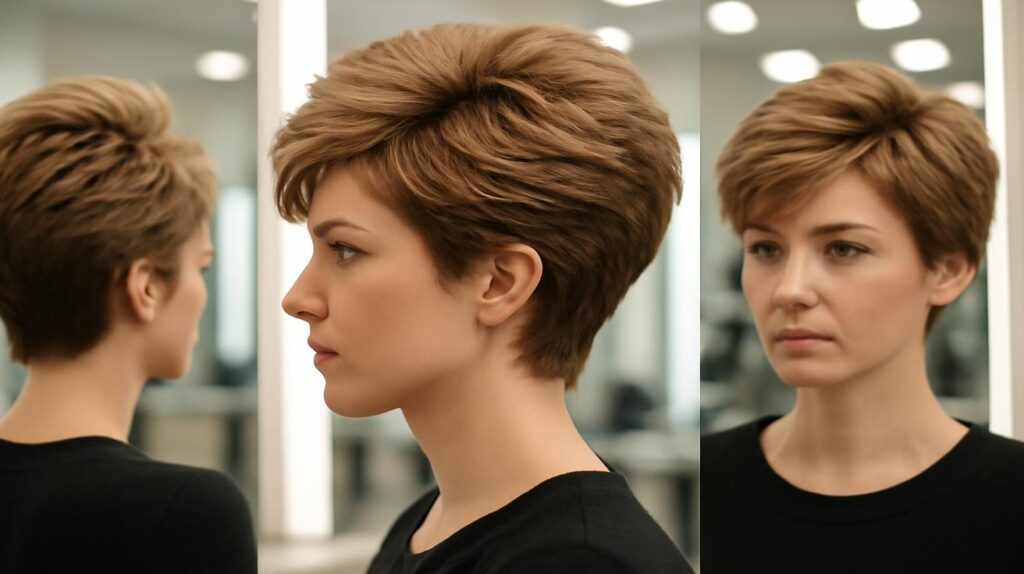
There’s a precise moment, right before the scissors make that first bold snip, when going for a pixie feels equal parts terrifying and thrilling. But if you have fine hair, a well-cut pixie can be transformative—like someone turned the volume dial up on your entire face.
The soft pixie isn’t the boyish, severe cut you might be picturing. It’s feminine (if you want it to be), gentle around the hairline, and layered in a way that makes your hair feel like it’s floating instead of flattening. Think short in the back, slightly longer and piecey on top, with side-swept texture that catches the light.
Why fine hair loves a soft pixie
Fine hair tends to collapse under its own length. A pixie removes that length almost entirely, freeing up your roots to stand, lift, and support the style. Because each strand is lighter, it’s easier to build height at the crown without a ton of product. The cut itself becomes the structure.
Where you might normally see scalp through limp strands, a pixie rearranges that density. The hair is shorter but visually denser. Layers overlap, fringe skims the forehead or temples, and the overall effect is full, feathered, and dimensional.
Styling a pixie without losing your mind (or your morning)
Fine hair and pixies are a dream duo for low-maintenance styling—once you have the right cut. A typical morning might look like this:
- Mist hair lightly with water or a hydrating spray to reset yesterday’s shape.
- Emulsify a pea-sized amount of lightweight styling cream or paste between your hands.
- Push hair forward, upward, or sideways—wherever you want movement and volume.
- Pinch a few pieces at the front or crown for that deliberate, undone texture.
It’s the kind of haircut that makes people think you “just woke up like this,” even though you know it took approximately 37 seconds and one mirror glance.
3. The Layered Shaggy Crop: Volume, Movement, and a Little Rebel Energy
If your inner self is a little wild, a little artsy, and a little allergic to overly “done” hair, the shaggy crop might be your match. This cut borrows inspiration from 70s rock icons but translates it into something short, airy, and modern: a little fringe, plenty of layers, and a shape that almost styles itself.
On fine hair, the shaggy crop is like turning on the “volume” filter in real life. It uses layers not just to add body, but to tell a story—a flick here, a tousled bit there, a fringe that skims the eyebrows or sweeps softly to the side.
How the shaggy crop builds believable volume
Unlike heavy, blunt cuts, the shaggy crop is all about purposeful lightness. Shorter layers on top remove weight so that the hair can lift, while slightly longer pieces around the crown and nape create the illusion of more density. The hair doesn’t sit in a perfect outline; it breaks, moves, and reforms every time you touch it.
This constantly shifting texture distracts the eye from any thin areas and instead focuses attention on movement. It’s less about “thick hair” in the traditional sense and more about visual richness—like adding layers of paint to a canvas until it feels deep and alive.
Styling it to look shattered, not frizzy
The line between textured and frazzled can be thin, especially on fine hair. A shaggy crop respects that line with lighter products and gentle techniques:
- Use a volumizing foam or light mousse at the roots before blow-drying.
- Dry your hair with your fingers, lifting at the crown and twisting small sections away from your face.
- Once dry, apply a tiny bit of texturizing cream or paste on the ends only to define and separate.
- Let it be imperfect. The beauty of this cut is that it looks better when it looks a little lived-in.
It’s the kind of style that feels like it matches a life of spontaneous plans: coffee dates that turn into road trips, slow mornings that unravel into late-night stories.
4. The Graduated Bob: Clean Lines with Clever Volume
If you love structure—sharp collars, crisp shirts, clean silhouettes—the graduated bob may be the shortest path to hair that feels polished but not fussy. Also known as a stacked bob, this cut is shorter at the back, longer at the front, with subtle “stacked” layers at the nape that build volume and shape.
On fine hair, the graduated bob is strategic. It doesn’t just sit there; it lifts. The back becomes a small architectural feat, with layers that support one another like steps, creating a rounded, full shape that looks thick even when your hair isn’t.
Why it flatters so many face shapes
The front of a graduated bob can be tailored to you. Longer pieces that skim the collarbone can elongate a round face. Angled lines that graze the jaw can sharpen softer features. A subtle A-line (shorter in the back, longer in the front) frames the face in a way that feels modern and strong.
Meanwhile, the stacked back adds that crucial illusion of density. You look like you have more hair concentrated in the most visible area, even though nothing has changed about the number of strands on your head.
Styling for shine and structure
This cut loves smoothness with just a whisper of movement:
- Use a lightweight smoothing cream or serum only on your mid-lengths and ends.
- Blow-dry with a round brush, lifting the back to emphasize the stacked shape.
- If needed, use a flat iron just at the front to refine the angle—never flatten the crown.
- Finish with a light mist of flexible hairspray to hold the structure without stiffness.
It’s the hairstyle that says: I woke up like this, but I also have my life together.
Quick Comparison: Which Short Cut Suits Your Fine Hair Best?
Different short cuts flatter different personalities, face shapes, and daily routines. Here’s a quick side-by-side look to help you feel what might be right for you.
| Style | Best For | Volume Level | Styling Effort |
|---|---|---|---|
| Textured Bob | Those who want soft movement and versatility | Moderate, airy fullness | Low–medium |
| Soft Pixie | Anyone ready for a bold, low-maintenance look | High at the crown and fringe | Very low |
| Shaggy Crop | Creative, relaxed, texture-loving personalities | High, tousled volume | Medium |
| Graduated Bob | Structured, chic, and polished style seekers | Moderate–high at the back | Medium |
Making Short Hair Work Harder for You: Color, Parting, and Product
A good haircut is the foundation—but the little choices you make around it can double the illusion of thickness. Think of them as the quiet supporting characters in your hair story.
Color that deepens dimension
All-over, single-tone color can sometimes flatten fine hair visually. Adding soft, subtle highlights and lowlights—just one or two shades from your base—can create the look of more density. Lighter pieces at the surface with slightly deeper tones underneath make the hair appear fuller, especially in shorter cuts where the shape is so defined.
The power of a slightly off-center part
If you’ve worn the same dead-center part for years, your hair has likely learned to lie very, very flat there. Simply shifting your part a little off-center, or alternating sides, can instantly lift roots and disguise sparse areas. Short hair makes this easy: the new shape flexes with your part instead of fighting it.
Choosing products that don’t crush your hair
Fine hair is unforgiving with heavy formulas. The wrong product can take you from airy to oily in an hour. Look for:
- Lightweight mousses and foams instead of thick creams for root volume.
- Dry texturizing sprays rather than heavy oils or waxes.
- Conditioners labeled “lightweight” or “volume” used mainly on mid-lengths and ends.
When in doubt, start with less product than you think you need. You can always add more, but it’s much harder to remove once your hair looks like it skipped straight to day three.
Living in Your New Cut: How Short Hair Changes More Than Just Your Reflection
There’s a moment, sometime after the cut but before you’re fully used to it, where you catch yourself in a shop window or in your phone camera and feel a small jolt of surprise. That’s me? With that hair?
Short hair on fine strands isn’t just about solving a styling problem. It changes the way your face shows up in the world. Eyes seem brighter without strands falling over them. Jawlines emerge. Necks lengthen. Scarves and collars suddenly matter more. You start thinking about earrings again.
And perhaps most importantly, you stop waiting for your hair to behave. Instead of coaxing length into volume it was never built for, you hand the scissors your expectations and ask for something truer: movement, texture, lightness, ease.
The four cuts—textured bob, soft pixie, shaggy crop, graduated bob—are not rules, just invitations. They ask: what kind of life do you want your hair to have? Structured and sleek? Playful and tousled? Somewhere in between?
You don’t have to be “brave enough” or “cool enough” to wear short hair with fine strands. You just have to be curious enough to imagine yourself with more volume, more lightness, and maybe, just maybe, a little more room to breathe.
FAQ: Short Haircuts for Fine Hair
Will cutting my fine hair short really make it look thicker?
Yes, the right short haircut can absolutely make fine hair look thicker. Shorter lengths remove weight that drags hair down, allowing roots to lift and layers to stack, creating the illusion of more density. Cuts like textured bobs, pixies, shaggy crops, and graduated bobs are especially effective.
Which short haircut is best if my fine hair also gets oily quickly?
A soft pixie or a shaggy crop is usually best for fine, oily hair. Shorter lengths are easier to refresh, and you can use dry shampoo at the roots without weighing hair down. These cuts also keep most of the volume at the crown, away from the scalp’s oiliest areas.
Can I still tie my hair back if I choose a short cut for my fine hair?
With a very short pixie, you won’t be able to tie it back. A textured bob or a slightly longer graduated bob may allow for a small low pony or half-up style. If being able to tie your hair back is important, ask your stylist to keep the front and sides long enough to gather.
How often should I trim short fine hair to keep the shape?
Short fine hair usually looks best with trims every 4–8 weeks, depending on the cut. Pixies and sharp graduated bobs may need more frequent maintenance (around every 4–6 weeks), while textured bobs and shaggy crops can often stretch closer to 6–8 weeks and still look intentional.
What should I tell my stylist if I want more volume but I’m scared of going too short?
Bring photos of the general length you’re comfortable with and say clearly: “I have fine hair and I want it to look thicker, but I don’t want it very short.” Ask for light layering, soft texture, and a shape that builds volume at the crown. A collarbone or chin-length textured bob is a great starting point if you’re nervous about losing too much length.