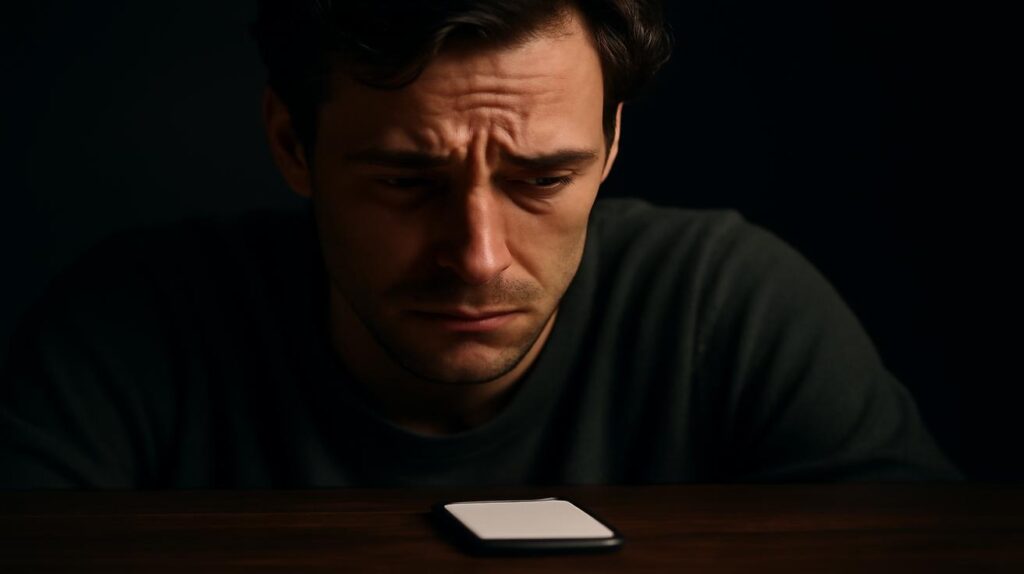
The words you never said don’t just disappear. They hang in the air like mist on a cold morning, clinging to your skin, hiding in your chest. You replay the scene: the friend you didn’t comfort, the apology you swallowed, the “I love you” that stayed stuck in your throat. Days pass, then years, but that moment remains strangely alive—sharper than most of what you actually said out loud. Why do unsaid words echo so much louder inside us than the conversations we actually have?
The Quiet Weight of What We Don’t Say
Picture this: you’re standing by a window, phone in hand, thumb hovering over the call button. You’ve typed a message three times and deleted it three times. Outside, the late-afternoon light is fading, edges of trees turning to silhouettes. Inside, your body is humming with all the things you wish you could say. But you don’t. You place the phone down. You tell yourself, “It’s not the right time.”
On the surface, nothing happens. No argument. No awkwardness. No visible rupture in the story of your life. Yet, deep inside, something shifts—a tightening in your chest, a faint heaviness in your shoulders. You move on with your day, but part of you doesn’t really move on at all.
Psychologists have a word for this feeling that lingers: emotional residue. It’s what accumulates when we censor ourselves, when a truth is ready to be spoken but never finds a voice. That residue doesn’t always look dramatic. Sometimes it’s just a quiet restlessness, a sudden rush of regret while you’re standing in the shower or waiting at a red light. Sometimes it’s a memory that keeps replaying, as if your mind is trying to rewrite the scene with the version where you finally speak.
Some people barely think twice about what they didn’t say. They shrug, let it go, and move on. For others, the words left unsaid feel almost physical, as if they’re lodged somewhere between the throat and the heart. If you’re one of those people, you might have wondered, What’s wrong with me? Why can’t I just let it go?
But here’s the thing: nothing is “wrong” with you. In fact, the way your brain and body respond to unsaid words reveals a lot about how deeply you feel, how strongly you care, and how your nervous system was wired to protect you.
The Brain’s Storyteller: Why Silence Becomes a Plot Twist
Our brains are not merely storage units for facts and memories—they’re obsessive storytellers. Every time something happens, your mind tries to make sense of it, to fit it into a narrative that explains who you are, who others are, and how the world works. And when an important scene is cut short by silence, your brain doesn’t simply accept the blank space. It fills it.
Imagine a conversation with a loved one that ended too soon. You wanted to say you were hurt. You wanted to ask, “Why did you do that?” But you didn’t. Maybe you were afraid of the answer, or of their reaction, or of “making things worse.” So you smiled, swallowed the words, and changed the subject.
Later, when you’re alone, the mind returns to that scene like a loyal but overzealous director. What if I had said something? it wonders. Then it starts to improvise. Maybe it imagines them responding with kindness and understanding—and you feel a bittersweet ache. Or maybe it imagines them getting angry or dismissive—and your chest tightens with anxiety or resentment. The conversation that never happened becomes as emotionally charged as if it actually did.
Psychologists call this counterfactual thinking: the tendency to mentally simulate “what could have been.” This is particularly strong when we feel like we had control over a situation but didn’t act. You could have spoken up. You could have set a boundary. You could have told the truth. You didn’t—so your mind goes back, again and again, to rewrite the script.
For people who are naturally reflective, sensitive, or imaginative, these inner rewrites can be incredibly vivid. Your nervous system doesn’t fully distinguish between a memory of something that happened and a simulation of something that almost did. Your heart rate may increase; your muscles may subtly tense; your breath may catch—all while you’re simply driving home or making tea. The unsaid words live on, not as language, but as sensation.
Why Some Hearts Feel Words More Deeply Than Others
Not everyone is equally affected by words left unsaid. Two people can walk away from the exact same silence and carry entirely different emotional loads. A big part of the difference comes down to temperament and past experience.
Some people have what psychologists call high emotional sensitivity. They notice more: the flicker in someone’s eyes, the pause before a reply, the tiny shift in tone. Their internal world is rich and finely tuned, which means they also feel emotional friction more intensely. When they hold back their words, it’s not just a small choice—it’s a clash between inner truth and outer behavior. That clash hurts.
Then there’s attachment history—the emotional blueprint formed in early relationships. If you grew up in an environment where speaking your mind was met with anger, ridicule, or cold withdrawal, your nervous system might now associate honesty with danger. You may have learned to survive by keeping the most vulnerable parts of yourself tucked away.
Ironically, as an adult, that survival strategy can backfire. The more you care about someone, the more the urge to be honest collides with the fear of being rejected or misunderstood. Each time you stay silent to keep the peace, a small part of you registers the cost. The body remembers these tiny sacrifices of truth, even when the mind tells you, “It’s not a big deal.”
Here’s a simple way to visualize some of the patterns that make unsaid words feel heavier for certain people:
| Inner Pattern | How It Shows Up With Unsaid Words |
|---|---|
| High sensitivity | You replay the silence, feel it in your body, and struggle to “just move on.” |
| People-pleasing | You swallow your needs to keep others comfortable, then feel quietly resentful or drained. |
| Fear of conflict | You avoid hard conversations, then obsess about how they might have gone. |
| Past criticism or shaming | You expect your words to be “too much” or “wrong,” so you keep them in and carry the pain alone. |
| Strong empathy | You worry about how others will feel, so you protect them from your truth—even when it hurts you. |
If some of these patterns feel familiar, you’re not being dramatic or weak. You’re living with a nervous system that has learned to prioritize safety over self-expression—and yet your deeper self still longs to be seen and heard. That tension can make the unsaid louder than any shout.
The Body Remembers the Conversation That Never Happened
Consider a memory that still bothers you—not because of what you said, but because of what you didn’t. Maybe you never apologized. Never confessed. Never spoke up when someone crossed a line. When you think back on it now, notice what happens in your body.
Your jaw may subtly clench. Your shoulders may inch toward your ears. Your stomach might flutter or knot. These are not random reactions. They’re signs that your nervous system is still holding the incomplete story, like a half-finished exhale that never got to leave your lungs.
From a psychological perspective, unsaid words can create a form of unfinished emotional processing. Emotion is meant to move through us: we feel it, name it, express it, and eventually integrate it. When we skip the “express it” part—especially in relationships that matter—the emotion often gets stuck in loops.
Your inner voice might say things like:
- “I should have spoken up.”
- “If I’d told them how I felt, maybe they would have stayed.”
- “Why didn’t I tell them I loved them while I had the chance?”
These are not just thoughts; they’re emotional currents trying to complete their path. Each time they rise and meet silence again—no conversation, no closure—they reattach themselves to your nervous system. The result can be a sense of heaviness, regret, or self-blame that’s hard to shake.
Interestingly, some research suggests that we tend to regret inaction more than action over the long term. That sharp sting you feel about the risks you never took, the words you never spoke, often lingers longer than embarrassment or discomfort from the times you did speak and things got messy. Our inner storyteller is kinder to failed attempts than to the blank spaces where we’ll never know what might have been.
Heart, Brain, and the Fear of Being Truly Seen
At the core, the pain of words left unsaid is rarely just about the words. It’s about the deeper fear wrapped inside them: If I show you who I really am—what I feel, what I need, what hurts—will you still stay?
For some, silence feels safer than that risk. The brain, especially the fear-focused amygdala, is wired to avoid pain. If your history has taught you that honesty leads to rejection or conflict, then not speaking becomes a kind of emotional armor. You avoid the immediate danger—but the cost is carried internally.
Over time, this can shape how you see yourself:
- You might begin to believe your feelings are “too much” or “not important.”
- You may feel like a stranger in your own life, watching yourself play the role of “easygoing” or “unbothered” while knowing a different truth inside.
- You might feel deeply lonely, even in close relationships, because the most vulnerable parts of you never make it into the conversation.
This is why some people seem almost haunted by what they never said. It’s not a simple communication issue; it’s an identity wound. Every unsaid truth whispers, “I don’t fully exist here. I’m editing myself out.”
And yet, the very sensitivity that makes you feel this pain so acutely is also a strength. It means you care about connection, about authenticity, about the kind of honesty that doesn’t just fill the air with noise but actually brings people closer. The ache you feel for the words you never spoke is evidence of a deep longing to live and love more fully.
Turning Unsaid Words into Gentle, Honest Movement
If silence has been your armor, ripping it off all at once rarely works. The nervous system doesn’t respond well to sudden, overwhelming exposure. But it does respond to consistent, gentle experiments in a safer direction.
Instead of asking, “Why can’t I just say what I feel?” try asking, “What is one small way I can let a little more truth into the room?” That might look like:
- Admitting, quietly, “I was actually hurt when that happened.”
- Sending a simple message: “I’ve been thinking about something I never said, and I’d like to share it if you’re open.”
- Writing a letter you might never send, just to let your body experience the words moving outward instead of staying trapped inside.
Therapists sometimes describe this as completing the action. Your mind and body have been frozen at the edge of a truth; even a small step toward expression can start to thaw that freeze. You don’t have to confront every person from your past or engineer dramatic heart-to-hearts. But you can give your inner voice more chances to exist outside your skull.
On an even more personal level, you can start by telling the truth to yourself. Naming out loud—maybe while journaling or walking alone—“I wish I had told them I loved them,” or “I regret staying silent when I was hurt,” is not pointless or indulgent. It is a kind of self-witnessing, a way of saying: I see what I lived through. I see what I held back. And I understand why.
When you offer yourself this kind of compassionate honesty, something subtle shifts. The unsaid words are no longer just accusations echoing inside you. They become teachers—small, painful reminders of how much you yearn to inhabit your life more fully. From there, the next conversation you have, the next boundary you gently set, the next “I feel” you allow to escape your lips becomes not just an act of courage, but an act of repair.
Living With the Echo, Speaking Into It Anyway
There will always be words we didn’t say in time. The apology that waited too long. The gratitude we meant to express. The tender admission we kept to ourselves until the moment passed. Being human means, in part, carrying these small ghosts of possibility.
Psychology helps us understand why some of us feel those ghosts more keenly. A sensitive nervous system. A history of volatile or dismissive reactions. A brain wired to replay unfinished stories. These are not flaws, just conditions—like the weather within which your emotional life unfolds.
When you recognize this, the question shifts from “Why am I like this?” to “How can I walk more kindly with this part of me?” You may never stop feeling deeply affected by the words you didn’t say. But you can let that sensitivity guide you toward speaking more of your truth while you still have the chance.
You might start noticing the small invitations: the pause in a conversation where honesty could slip in; the quiet moment at a kitchen table when you could say, “I appreciate you,” instead of scrolling; the tightening in your chest that signals, “There’s something here I’m not saying.” Over time, the more you respond to those invitations, the less haunted your inner landscape becomes.
The goal isn’t to empty your life of regrets; that’s impossible. The goal is to live in such a way that, when you look back, you can say: I didn’t always get it right. I was scared, often. But whenever I could, I chose to let my heart speak, even if my voice shook.
Words left unsaid will always have a certain power. They will whisper from old memories, from lovers and friends and family you no longer see, from versions of you that were too afraid or too young or too hurt to speak. But as you begin to answer those whispers—not by rewriting the past, but by showing up differently now—the echo changes tone. It becomes less of a torment and more of a guide.
In the end, perhaps the most important conversation is the one you have with yourself: the moment you stop scolding yourself for all the times you stayed silent, and instead listen closely to what that silence was trying, in its own way, to protect. From there, with patience, you can begin to practice a different kind of safety—the kind that comes not from hiding your truth, but from honoring it.
FAQ
Why do I keep replaying conversations I never actually had?
Your brain is wired for counterfactual thinking—imagining “what could have happened.” When a situation feels emotionally important and you stayed silent, your mind tries to “finish” the story by running different versions. This is especially strong if you feel you had control but didn’t act.
Is being so affected by unsaid words a sign of being too sensitive?
It’s a sign of high emotional sensitivity, not a flaw. Sensitive people tend to notice subtle cues, feel emotions intensely, and value authenticity. That combination makes silence feel heavier—but it also makes you capable of deep empathy and genuine connection.
Can I ever get closure for words I never said?
Closure doesn’t always require speaking to the other person. Writing letters (sent or unsent), talking with a therapist or trusted friend, and honestly acknowledging your regret to yourself can help your nervous system “complete” the emotional process, even if the original conversation never happens.
How can I start speaking up if I’m afraid of conflict?
Begin small. Use gentle, first-person language like “I feel…” or “I need…” instead of accusations. Practice in low-stakes situations first. Over time, your nervous system learns that expressing yourself doesn’t automatically equal danger, and the fear slowly decreases.
Is it ever better to leave things unsaid?
Sometimes, yes. Not every thought needs to be shared, and timing, context, and safety matter. The key difference is whether you’re staying quiet from grounded clarity—“This doesn’t need to be said right now”—or from fear and self-erasure. When silence repeatedly hurts you, it may be time to let some of your truth find its way into words.