The first time I met Hannah, she was walking quickly. Not toward anything in particular—just quickly, as if the ground might fall away if she slowed down. A tote bag pulled at her shoulder, straps dug into the fabric of her coat. Her phone sat in her palm like an extra limb, lit with a constellation of apps. She greeted me with the distracted brightness of someone whose mind was three steps ahead.
“Sorry, I’ve been wild today,” she said, exhaling. “So much done. I’ve been on fire.”
Later, when the café had emptied and the whirring espresso machine quieted, I asked her what she had actually finished.
She blinked. “Well, I answered a ton of emails. Cleaned my inbox, practically. Caught up on Slack. Read three productivity articles someone sent me. Cleaned my desktop. Organized my notes. I started a Notion board for my new project. Oh, and I posted on LinkedIn, finally.”
“And the project itself?” I asked.
She looked down at her coffee, then out the window. “I’ll get to it tonight. Once I’m really ready.”
Out on the sidewalk, the late-afternoon light slid down the buildings in slow golden sheets. A cyclist coasted by, unhurried. Somewhere, a dog barked once and then decided it was not worth the energy to continue. But inside, at our small table, there was a familiar tension: that disorienting gap between feeling wildly productive and having almost nothing meaningful to show for it.
The Quiet Illusion of Busyness
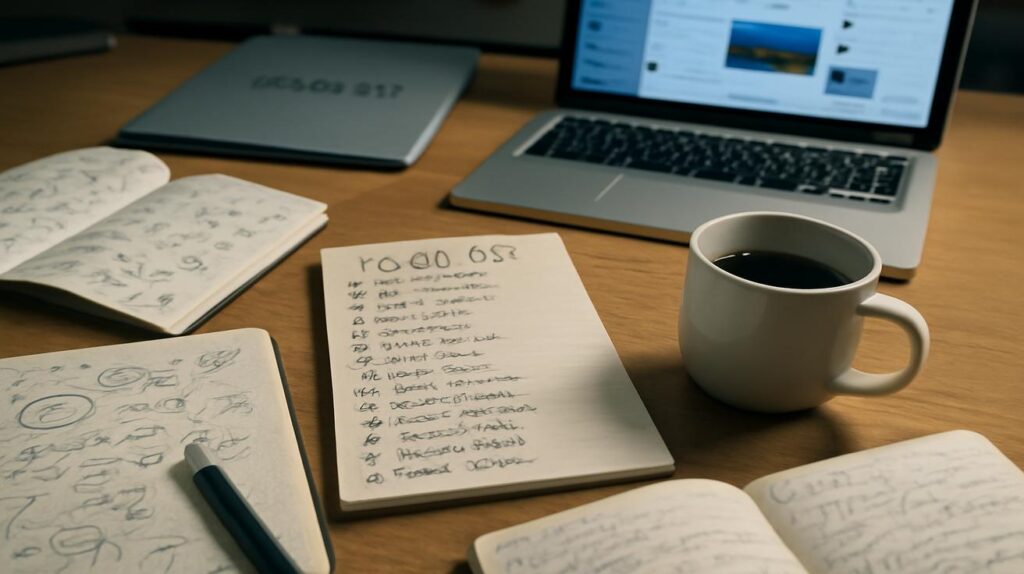
People like Hannah are everywhere. Maybe you are one of them. You move through your days with a low hum of urgency, always “on,” always “catching up.” Your calendar is packed, your to-do list takes on the length and personality of a legal document, and your apps gently vibrate against your pocket like needy birds. You end evenings with a pleasant ache, the sense of having been used up. You were busy. You must have been productive. Right?
But when you try to name the real things you’ve moved forward—the work that actually matters to you, the projects only you can do—your voice gets quieter. You gesture vaguely toward “getting ready” or “laying groundwork.” Deep down, something nags: for all your busyness, you are circling, not landing.
It’s an uncomfortable truth, so most of us dress it up. We say we’re “in a season of research,” “building systems,” “warming up,” “waiting until things calm down.” The modern world praises activity more loudly than impact. If you look frantically occupied, you’re rarely asked whether you’re actually effective.
Yet if you pay attention, there is a pattern. People who feel productive but achieve little tend to move in the same loops, tracing the same grooves until they harden into habit. The pattern is not obvious at first; it’s subtle and oddly soothing. It feels like work. That’s why it’s so dangerous.
The Pattern That Feels Like Progress
The pattern usually begins with a very human impulse: the urge to avoid discomfort. Big, meaningful work is magnetized with friction. It asks you to choose, to risk, to focus, to say no. So we build little rituals and routines around it—not to support it, but to soften it, pad it, delay it until the sharp edges are blunted.
Watch someone who is chronically “productive but stuck” for a week and you will often see some version of this sequence:
- Planning instead of deciding. They create elaborate plans—color-coded, beautifully arranged, constantly refined. But the real decision (“Will I actually do this thing, in this way, by this date?”) is always nudged just beyond the horizon.
- Information instead of action. They consume articles, podcasts, threads, and books about the work. Study feels safe, virtuous even. Every piece of information is a reason they aren’t ready yet.
- Communication instead of creation. They respond quickly to every message, join every meeting, always “available.” Their responsiveness gives a rush of validation: people need them. Meanwhile the core work waits in the quiet, unmessaged corners of their day.
- Optimization instead of execution. New apps, new systems, new notebooks. They fine-tune workflows and automations for a body of work that still doesn’t meaningfully exist.
- Exhaustion instead of satisfaction. At night they feel used up, but the tiredness is smoky and diffuse, not clean and grounded. “I did so much,” they say, “but I’m not sure what I did.”
It feels like standing on a treadmill in a room full of windows showing mountains, rivers, faraway roads. You sweat. Your heart rate ticks up. But when the machine stops, you are still exactly where you began.
There is a quiet cruelty in this pattern: it rewards you emotionally while stealing what you actually want. You get the neurochemical pat on the head—dopamine from checking boxes and clearing badges—without paying the price of doing the hard, uncertain work that could change your life.
How the Day Disappears: A Closer Look
Imagine a single day in the life of someone caught in this pattern. Not a dramatic day—just an ordinary Tuesday.
Morning. They wake up with a flash of resolve: Today is the day I tackle the big thing. For a few quiet seconds, there is clarity. But then the phone is in their hand, almost of its own accord. Notifications bloom: messages, overnight emails, headlines, one more request tagged “ASAP.” The big work recedes, not erased but nudged to “later, when I’ve cleared the decks.”
So they clear. They blast through messages with admirable speed. They jump onto a quick call that turns into three calls and an unscheduled brainstorming session. Someone praises them in a group chat for “turning that around fast.” A small, bright pride sparks in their chest. See? They are needed. They are getting things done.
By late morning, the big work feels heavier. To approach it now would mean shifting mental gears from reactive to deep, from scattered to precise. So instead they “get ready”: they tweak their task list, rename a few digital folders, maybe read an article about deep work. It is extremely important, they tell themselves, to understand focus before attempting it.
Afternoon. A meeting runs long and bleeds into another. By the time there is a patch of open time, they are drained in that peculiar way that comes from mental context-switching. They open the big project file, scan a few lines, feel the slow rise of anxiety—and reach, almost instinctively, for a more immediately rewarding task. Something short, answerable, finishable.
By evening, they have done many things: answered every message, attended every meeting, read useful insights, maintained their reputation as a responsive, involved, dedicated person. When they finally shut their laptop, an ache presses at the base of their skull. They deserve rest. Of course they do.
Just before sleep, they remember the big work, the one thing that really matters. “Tomorrow,” they whisper to themselves in the dark. “Tomorrow, for real.”
And then another Tuesday arrives.
The Hidden Cost: When “Productive” Becomes a Disguise
From the outside, this person looks engaged and hard-working. From the inside, they are quietly haunted. They scroll past people who seem to be finishing things—books, projects, businesses, art—and wonder what secret engine those people have that they lack. Maybe, they think, they just aren’t “that type.”
But often, the difference is not talent, nor time, nor some mystical discipline gene. It is the willingness to feel what busyness protects you from feeling.
That’s the hidden function of the “productive but ineffective” pattern: it numbs certain discomforts.
- The discomfort of clarity. If you define what truly matters, you must also confront how little of your time is spent on it.
- The discomfort of saying no. Real prioritization means disappointing people, letting emails wait, leaving some questions unanswered.
- The discomfort of focus. Depth can feel almost physically painful when you’re used to flitting. Your anxious mind claws at the edges, searching for something easier.
- The discomfort of risk. A finished thing can be judged, ignored, rejected. A perpetually “in-progress” thing cannot.
So you stay in motion. And motion wears a mask that looks very similar to progress. The world rarely asks you to take off that mask, because your busyness serves other people’s priorities beautifully.
The Pattern in a Pocket-Sized Table
To make this pattern concrete, it helps to see the contrast between feeling productive and actually doing meaningful work:
| Feels Productive | Creates Real Progress |
|---|---|
| Clearing inbox to zero | Completing one concrete step on a key project |
| Rewriting your to-do list repeatedly | Picking one task and working on it for 45+ uninterrupted minutes |
| Joining extra meetings “to stay in the loop” | Declining nonessential meetings to protect deep-work time |
| Researching tools, methods, or systems | Shipping a draft, prototype, or decision using what you already know |
| Instantly answering every message | Batching communication and living with a non-zero notification count |
Look closely at where your days tilt. Which column feels more familiar to your nervous system? Which one do you tend to choose when you’re tired, anxious, or trying to avoid the possibility of failing at something that matters?
Breaking the Loop: A Different Kind of Day
Imagine now a different version of that same Tuesday.
You wake up with the same thought: Today is the day I tackle the big thing. This time, you do something quietly radical. Before you touch your phone, you write down, on an almost absurdly small piece of paper: “If I only move this forward today, it will have been a good day.” Just one thing. Not ten.
Maybe it’s “draft first two pages of proposal.” Not “finish proposal,” not “plan entire product”—just two pages. Something that would not impress anyone on social media, that may not even look like much, but that is undeniably part of the real work.
Your brain protests. What about everything else? it hisses. What about the messages? What about staying on top of things? You feel that familiar tug toward the warm, glowing pool of busyness where you know how to swim.
But instead, you make a small bargain with yourself: “Ninety minutes. No inbox, no Slack, no calls, just this. After that, I can go back to the whirlwind.”
When you finally open your laptop, you open only what you need for the big work. The itch to check everything else is almost physical. Your hand twitches toward the inbox icon. You pull it back. Your breathing is a little shallower than usual. You feel like you are ignoring a roomful of people calling your name.
And then, slowly, the noise drops. The big thing is still heavy, but you have your hands on it now. You are not planning it. You are not optimizing around it. You are touching it directly, moving it one small step forward.
The ninety minutes pass. When you emerge and finally check your phone, the world has not burned down. A handful of people were mildly inconvenienced by not hearing from you instantly. Some things waited. And in return, you have something you did not have when you woke up: a real, visible dent in what matters.
The rest of the day might look similar to your old pattern: emails, meetings, minor urgencies. You may still slip into busywork from habit. But the axis of the day has tilted. There is a clear, sturdy beam running through its center now, something solid everything else must orbit.
Do this once, and it feels novel. Do it many times, and it begins to rewire what “productive” means in your body. The warm little rush you used to get from clearing notifications slowly migrates. Now it arrives when you make something real, finish something hard, or move something meaningful from “idea” to “done.”
Recognizing Yourself, Choosing Again
The pattern of feeling productive but achieving little is not a moral failing. It is, in many ways, the default setting of our time. Entire industries are built on keeping you pleasantly engaged in shallow activity. If you have fallen into the loop, it is not because you are weak; it is because you are human, and the world is loud.
But once you see the pattern, you earn a certain responsibility. You cannot keep pretending your problem is just “not enough hours” or “needing a better app.” You know now that the real hinge is not time or tools, but attention and courage: the courage to let some things remain undone so that the right things can be.
Listen to your evenings. When you lie down at the end of the day, what kind of tired are you? There is a kind that feels scattered and thin, like you’ve been poured out across too many surfaces. And there is a kind that feels rooted and clean, like the ache in your muscles after climbing an actual hill instead of walking in place.
You can still answer emails. You can still attend meetings, still research, still care about being reliable and responsive. The shift is simpler and more stubborn than that: it’s about sequence and weight. What comes first. What gets your best hour, not your leftover minutes. What you’re willing, finally, to protect.
For people who feel productive but achieve little, the pattern is almost always the same. But so is the way out: less swirl, more spine. Fewer prepared surfaces, more imperfect steps. The courage to choose a single hill and climb it, even while the treadmill calls your name from across the room.
FAQ
Why do I feel so productive even when I haven’t done anything important?
Because many modern tasks—replying quickly, attending meetings, organizing, browsing for ideas—deliver fast emotional rewards. They look and feel like productivity but don’t necessarily move your deepest goals forward. Your brain learns to equate that quick sense of “busy accomplishment” with true progress.
How can I tell if I’m stuck in this pattern?
Look at the past week and ask: “What did I actually finish that matters to me?” If you struggle to name concrete outcomes, but remember being constantly busy, it’s a strong sign. Another clue: you end most days exhausted yet vaguely unsatisfied, unsure where your effort really went.
What is one small change I can make right away?
Give the first 60–90 focused minutes of your workday to a single important task before checking messages or opening your inbox. Protect it like an appointment with someone you respect. Even if the rest of the day gets chaotic, you’ll have anchored it with real progress.
Does this mean I should ignore emails and messages?
No, but it does mean they shouldn’t own your best attention. Batch them into specific windows instead of reacting all day. This may feel uncomfortable at first, especially if you’re used to instant replies, but most messages can safely wait an hour or two.
What if my job is inherently reactive and full of interruptions?
Many roles are interruption-heavy, but even then you can usually carve out small islands of protected time. Start tiny: 20–30 minutes blocked off once or twice a day for your most important work. Communicate this boundary clearly to colleagues. Over time, these small pockets compound into real outcomes.
How do I stop endlessly planning and actually start?
Shrink the first step until it is almost embarrassingly small—five sentences, one sketch, a rough outline, a single phone call. Commit to doing just that piece, even if it’s imperfect. Action, not more planning, gives you the information and momentum you actually need.