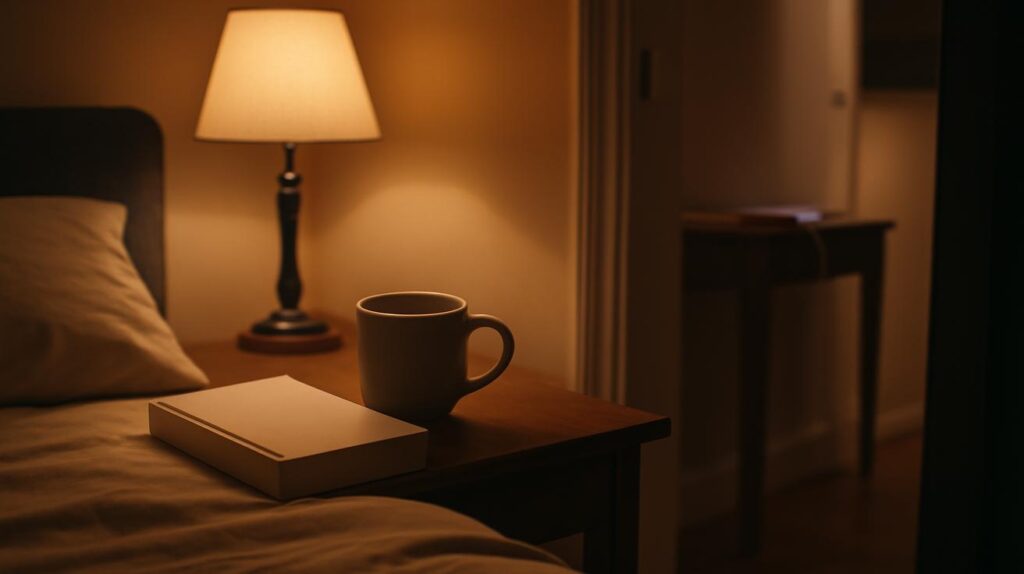
The first time I met someone who truly loved their evenings, it was almost unsettling. He wasn’t rushing, he wasn’t scrolling, he wasn’t gulping down dinner while half-reading emails. He moved through the last hours of daylight as if he were wading into a quiet lake—unhurried, deliberate, listening. And the next morning, when the rest of us shuffled into the world with puffy eyes and half-finished dreams, he arrived with a clear gaze and the kind of calm that can’t be faked. “It’s not the morning that changes everything,” he told me once, rinsing a mug in the dim kitchen light. “It’s the night before.”
The Quiet Pact You Make With Yourself After Sunset
Most of us think of sleep as something that just happens to us, like weather. The day ends, we collapse, we hope for the best. Maybe we check the clock a few too many times, maybe we tell ourselves, “Tomorrow I’ll go to bed earlier.” Then tomorrow comes, and the cycle repeats: one more episode, one more email, one more scroll through other people’s lives. We treat our minds like endless screens that can be powered down in an instant.
But people who reliably wake up feeling rested tend to share a subtle, almost invisible habit. It isn’t an expensive gadget, a special pillow, or a miracle supplement. It’s a quiet decision they make in the evening: they treat the last hour of the day as a bridge, not a dumping ground.
They understand that how you land the day is how you launch the next one. So instead of crashing into sleep like a car hitting the guardrail, they glide toward it. Not perfectly, not rigidly—just gently, with intention. And this evening habit they share isn’t mystical or complicated. In fact, it’s disarmingly simple:
They create a small, repeatable ritual that tells their body and brain, “We’re done now. It’s safe to rest.”
Sounds almost too simple. Yet, like most true things, it reveals its power only when you actually live it.
The 60-Minute Drift: How Rested People End Their Day
Imagine a line drawn in your evening—one soft, invisible boundary. On one side of that line is the world: conversation, tasks, notifications, maybe the hum of traffic outside your window. On the other side is something smaller and quieter: just you, your body, and the sense that you are slowly walking yourself home.
People who wake up well usually guard that last 60 minutes before bed like a secret garden. Not perfectly—there are late nights and chaotic days—but more often than not, they come back to this habit: one protected hour where the night finally gets to be night.
This is what it often looks like in real life:
- The lights get softer—lamps instead of overhead glare, warm bulbs instead of harsh blue-white.
- Screens dim or disappear—the laptop is closed, the phone is facedown or in another room.
- The pace of movement slows—no speed-cleaning, no last-minute mega to-do list, just a gentle tidying, a deliberate closing of the day’s loops.
- The senses shift from input to exhale—warm water on skin, the sound of pages turning, the rhythm of your own breathing.
There’s nothing fancy here. It might be a book, a mug of herbal tea, a shower, some light stretching, or simply staring out a dark window listening to the night. But the real power lies in this: they do it most nights. The routine itself becomes a signal, like a familiar melody your body recognizes before the first note is even finished.
In a world that pushes us to stay “on” until the last second, this hour is an act of quiet rebellion—a promise you make to your future self that says, “You matter more than my notifications.”
The Science Hiding Inside a Soft Lamp
There’s something almost old-fashioned about evening rituals. They conjure images of candlelight, a basin of water, a book by the bed. But beneath the coziness is a very modern truth: your brain is trying to figure out what time it is, and most nights, we’re giving it mixed signals.
Light is one of the body’s loudest clocks. Bright, cool-blue light—especially from screens—tells your brain it’s still daytime. Melatonin, the hormone that nudges you toward sleep, waits in the wings like a stage actor who never gets their cue. The message is: stay alert, keep scrolling, keep thinking.
People who follow that one-hour evening habit are, consciously or not, sending a different message. They dim the room, reduce the glow, switch from sharp light to softer pools of illumination. Their brain hears, “The sun is gone. We can let go now.”
The same goes for stimulation. Every late-night argument, news headline, email, or tense TV episode is a pebble tossed into the still water of your nervous system. The ripples take time to settle. A consistent pre-sleep ritual gently stops tossing pebbles. That’s when the water clears. Heart rate slows. Muscles loosen. Thought spirals lose their grip.
And so the magic of this humble habit is not mystical at all; it’s biological. Instead of slamming on the brakes at midnight, you ease off the gas. Your body doesn’t have to fight its way into sleep—it’s already halfway there.
The Subtle Art of Closing the Day
There’s another piece people don’t always talk about: the emotional noise we carry into bed. Unanswered messages. Half-finished tasks. The thing you said that you wish you hadn’t. The appointment you might forget. The story you told yourself that someone is upset with you.
For people who consistently sleep well, their evening ritual often includes one thin but powerful thread: a small act of closure.
Maybe it’s jotting down three tasks for tomorrow, so their brain can stop spinning solutions in the dark. Maybe it’s writing out one frustration and one gratitude in a notebook, so the day feels less like a blur and more like a chapter that can be set aside. Maybe it’s washing the dishes so the kitchen doesn’t feel like a scolding voice in the morning.
It doesn’t have to be a full “life debrief.” Just a gentle signal: “Today is over. You did enough. You are allowed to rest.” For a nervous system conditioned to always do more, that sentence can feel like a warm blanket.
Designing Your Own Wind-Down: Small, Sensory, Repeatable
The temptation, of course, is to turn this into a project. You might feel that itch: buy a fancy journal, find the perfect tea, reorganize your entire bedroom. But remember—people who have this habit didn’t build it through grand gestures. They built it the way dusk becomes night: slowly, almost imperceptibly.
When you design your own 60-minute drift, think in terms of senses, not rules. What does your body respond to? What actually feels good after a long day—not what you think should feel good, but what genuinely softens you?
Here’s a small way to think about it:
| Sense | Simple Evening Option | How It Helps You Drift |
|---|---|---|
| Sight | Dim lamps, candles, no overhead lights | Signals “night” to your brain; supports melatonin |
| Sound | Soft music, nature sounds, quiet room | Slows nervous system; reduces mental noise |
| Touch | Warm shower, gentle stretching, cozy fabric | Releases tension in muscles; anchors you in your body |
| Smell | Herbal tea, light natural scents, fresh air | Associates certain scents with calm and sleep |
| Mind | Reading, journaling, gentle breathing | Gives your thoughts somewhere to land before bed |
You don’t need to fill every square. Pick two or three that feel natural, almost obvious. Maybe your wind-down looks like this:
- 10 minutes writing down tomorrow’s top three tasks.
- 10 minutes washing your face and brushing your teeth in a dim bathroom.
- 20 minutes reading a paper book in bed with a soft lamp.
- 5 minutes of simple breathing or stretching.
Done. That’s your ritual. Imperfect, flexible, human. Repeat it often enough and your nervous system will meet it like an old friend.
The Gentle “No” That Protects Your “Yes”
Of course, to claim that hour, you have to say no to something. That’s the part we usually skip when we talk about evening habits. To step into your ritual, you are quietly declining at least one of these:
- Another episode.
- Another round of doom-scrolling.
- One more load of laundry.
- Late-night group chats that always go later than you planned.
People who wake up rested are not better than you. They are just practicing a small, consistent boundary in the one place it counts: at the edge of their day. Not a harsh boundary, not an all-or-nothing rule—just a gentle hand on the door, closing it most nights around the same time.
If you’ve ever told yourself, “I’m just a night person” while secretly wishing mornings didn’t feel like a hangover without the party, consider this: maybe you aren’t broken. Maybe your evenings are just too crowded for rest to find a place to land.
When Life Is Messy: Keeping the Ritual When You Can’t Keep the Schedule
Real life is not a controlled experiment. There are night shifts, newborns, late returns from work, friends who need you, urgent deadlines, and those nights when grief or anxiety simply refuses to loosen its grip. On those days, a perfect 60-minute wind-down might feel hilariously out of reach.
But the people who consistently wake up feeling more rested have learned a quiet secret: when you can’t keep the schedule, keep the signal.
Maybe your ideal ritual is an hour. Some nights, it will shrink to ten minutes. That’s still something. That’s still you telling your body, “We’re transitioning now. You’re safe.”
On chaotic evenings, your miniature ritual might look like:
- Turning off overhead lights and using a lamp for the last ten minutes before bed.
- Taking three slow breaths with one hand on your chest before you lie down.
- Whispering to yourself, “Today is done. I’ve done enough.”
Is it as luxurious as a long bath and a chapter of a good book? No. But it keeps the thread intact. And threads, even fine ones, are what keep fabric from falling apart.
Letting the Morning Tell You the Truth
One of the most honest mirrors you have is the way you feel when you wake up. Not every morning—you’ll still have heavy ones, restless ones, the mornings after tough nights. But watch what happens over a couple of weeks of treating your evenings differently.
You might notice that your first thought isn’t, “No, no, no,” when the alarm goes off. You might find your mood less brittle. The day may no longer feel like something crashing into you, but something you are actually stepping into.
Rest doesn’t mean you never feel tired. It means your tiredness is softer, more honest. You are no longer exhausted from arguing with your own biology, from pretending your brain can go from full blaze to pitch black in one click of a power button.
The Habit Beneath All the Other Habits
We live in a culture that loves to optimize mornings. Sunrise routines get all the glory: the green smoothies, cold plunges, workouts, journals, the photos of sun hitting a mug of coffee on a clean wooden table. But people who follow that quiet evening habit know a quieter truth:
Your morning routine is only as kind as your night was.
When you respect the last hour of your day, you unlock something more valuable than productivity: continuity. Your days start to speak to each other. Tonight calmly hands tomorrow a baton instead of flinging it across the room as the lights go out.
And you, moving through this relay of days, begin to feel less like you’re constantly catching up with your own life and more like you’re actually in it—awake, rested, here.
This is the habit beneath all the others: an evening agreement with yourself that says, “I will not use my nights to recover from my days by numbing out. I will use them to gently prepare for the next one by tending to my nervous system.” The tools are simple. The feeling, when you wake up after enough nights like this, is anything but.
You open your eyes and the light coming through the window doesn’t feel like an accusation. It feels like an invitation.
FAQs
How long should my evening wind-down routine be?
Aim for about 60 minutes when you can, but even 15–20 minutes done consistently can make a noticeable difference. What matters most is that you repeat similar cues most nights so your body learns to recognize, “This means we’re going to sleep soon.”
Do I have to avoid screens completely before bed?
Not necessarily, but reducing bright, blue-heavy screen time in the last hour helps. If you must use a device, lower the brightness, use night mode or warm filters, and avoid emotionally stimulating content like intense news, arguments, or stressful shows.
What if my schedule changes a lot, like with shift work?
Focus on the ritual, not the clock. Whatever time your “evening” is, create a brief, repeatable wind-down pattern: dimmer light, less stimulation, and a few calming sensory cues. Your body will still benefit from the consistent signals.
I try to relax at night but my mind won’t stop racing. What can I do?
Give your thoughts a landing place before bed. Try writing down worries, to-dos, or lingering thoughts in a notebook, then gently tell yourself you’ll return to them tomorrow. Pair that with a few minutes of slow breathing or light stretching to help your body unwind along with your mind.
How long will it take before I feel more rested in the morning?
Some people notice a difference within a few nights; for others it takes a couple of weeks of fairly consistent evenings. Think of it like training your internal clock. With repetition, your body begins to trust the pattern and responds with deeper, more restorative sleep.