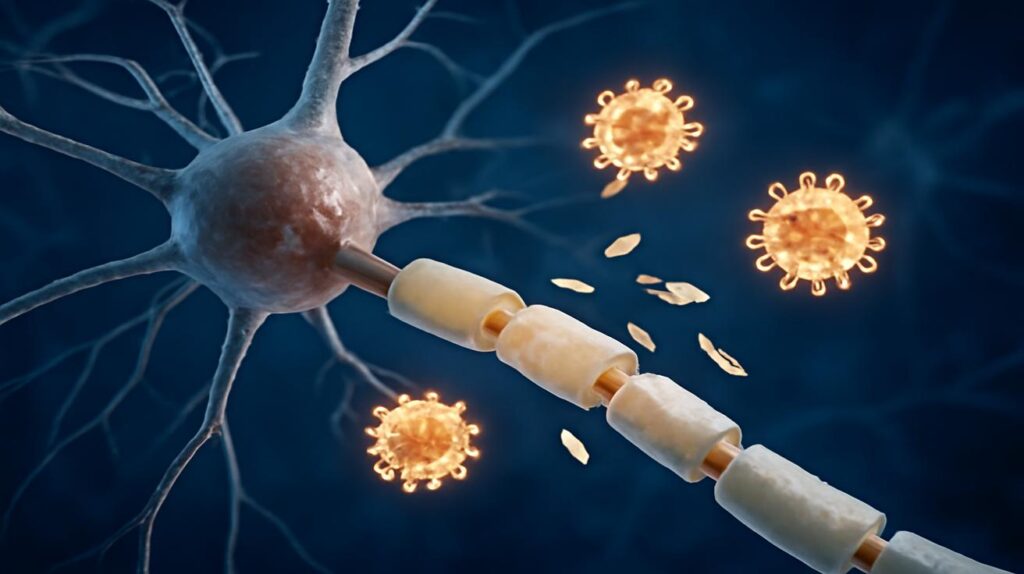
The story begins, oddly enough, with a virus most of us met and then forgot. A sore throat in high school, a fever that wiped out a summer, a lingering tiredness your parents called “just being run-down.” Maybe it was mononucleosis, “mono,” the so-called kissing disease. You recovered, went back to school, got on with life. The virus, though, never left. It slipped into the quiet shadows of your immune system and waited.
Years or decades later, another story begins—this one with numb fingertips, a patch of blurred vision, a spark of dizziness that doesn’t quite go away. Doctors order MRIs, blood tests, spinal taps. The diagnosis arrives like a punch: multiple sclerosis. Two seemingly separate chapters of a life—one teenage sore throat, one adult neurological disease—have long felt disconnected. But now, medicine is finally telling us what many have suspected: these chapters are part of the same book.
The Virus That Never Really Leaves
Epstein–Barr virus, or EBV, is strange only in how ordinary it has become. It’s estimated that about 9 out of 10 adults worldwide carry it. In children it often slips by as a mild, flu-like illness; in teenagers and young adults, it sometimes hits harder as mono, bringing weeks of fatigue and swollen glands. Then, like an actor who exits stage left, EBV appears to vanish.
But it doesn’t. EBV is a master of disguise. It settles into B cells—white blood cells that are part of the immune system—and goes quiet. Virologists call this latency. The virus isn’t multiplying wildly or causing obvious damage; it’s simply residing there, folded into the daily life of the immune system, like a guest who never checked out of the hotel.
For decades, this silent presence was more curiosity than concern. Most people had EBV; most people did not have multiple sclerosis. Surely, scientists thought, there must be something more than a common virus at work in a rare neurological disease.
The Long Answer to a Long-Standing Question
Still, clues kept surfacing in laboratories and clinics around the world. People with multiple sclerosis—MS, for short—almost always had evidence of past EBV infection. Their immune systems bore scars of a familiar battle: antibodies that recognized EBV, and in some cases, unusually high levels of those antibodies. Yet correlation is not causation, and medicine is wary of jumping to conclusions.
The question lingered in the background like uncertain weather: was EBV merely present, or was it a trigger? Was it an innocent passenger, or the driver steering someone toward MS?
When the Evidence Becomes Impossible to Ignore
In recent years, the evidence began to line up with a sense of inevitability. One of the most persuasive pieces came from an enormous, long-term study that followed hundreds of thousands of individuals over many years. Blood samples taken during military service were analyzed; some participants later developed MS, while others did not.
When researchers went back to those early blood samples, a pattern emerged. People who developed MS had almost all been infected with EBV before their symptoms started. Among those who were EBV-negative at first and later became infected, the risk of developing MS jumped dramatically—higher by dozens of times compared to those who never contracted the virus during the study period. No other infection showed this kind of dramatic connection.
For many scientists, this was the turning point. EBV infection didn’t just happen to be there; it consistently preceded the arrival of MS. In the cautious language of science, researchers began to talk openly about EBV as a necessary step in the pathway to MS. Not the only step—but a step that seems to almost always be there.
What Exactly Is Multiple Sclerosis, Anyway?
To understand why this matters, imagine your nervous system as a vast, branching forest of electrical pathways. Your brain sends signals down your spinal cord, which spread out into nerves that move muscles, carry sensations, and balance your body in space. Those nerve fibers are wrapped in a fatty coating called myelin, something like the plastic insulation around electrical wires.
In MS, the immune system turns against that myelin. It attacks, strips, and scars it, leaving behind raw, exposed nerve fibers. This damage creates patches—lesions—that disrupt the flow of signals. The result can be numbness, weakness, difficulty walking, vision problems, fatigue, and a long list of other symptoms that come and go, flare and quiet, leaving people never quite sure what their own bodies will do next.
MS is, at its core, a disease of mistaken identity. The immune system, which is supposed to defend us from invaders, instead becomes confused. Somewhere between virus and host, self and other, a line is crossed. The focus on EBV offers a compelling clue as to how that confusion might begin.
How Could a Common Virus Help Trigger MS?
Scientists are still carefully piecing together the mechanisms, but several theories now stand out, each one like a camera angle on the same mystery.
Molecular Mimicry: When the Immune System Mixes Up Faces
One widely discussed idea is called molecular mimicry. EBV carries proteins on its surface and in its structure that, by sheer bad luck, resemble some of the proteins in human myelin. When your immune system mobilizes to fight EBV, it creates antibodies and T cells tuned to recognize these viral proteins. If some of those viral proteins look just a little too much like self, the immune system may start targeting your own nervous tissue.
It’s like training a search dog to find a particular scent, only to discover that the target smells almost exactly like something in your own house. The dog can’t always distinguish between invader and home. In MS, EBV may be teaching the immune system to attack with such specificity that, someday, it begins to see parts of your own brain and spinal cord as the enemy.
EBV’s Hideout: B Cells as a Trojan Horse
EBV’s favorite hiding place—the B cell—may also be part of the story. In MS, B cells play a surprisingly important role. They don’t just make antibodies; they present fragments of proteins to other immune cells, whispering instructions about what to attack. If EBV lives within these B cells, it may subtly reshape how they behave, nudging the immune system toward chronic misfire.
Treatments that specifically deplete B cells have turned out to be some of the most effective therapies for MS. This doesn’t prove that EBV is the puppet master, but it raises a striking possibility: by removing the cells that harbor EBV, we may be cutting off one of the key engines driving the disease.
Numbers, Risk, and Reassurance
Any time a study claims a strong link between a nearly universal virus and a serious disease, a natural chill runs through the room. If almost everyone has EBV, does that mean almost everyone is at risk of MS?
The answer is more calming than the initial question. While EBV seems to be near-universal in people with MS, the vast majority of people with EBV never develop the disease. EBV is likely a necessary piece of the puzzle, but far from the only one. Genetics, other infections, vitamin D levels, smoking, hormonal influences, and plain bad lottery luck all appear to play roles.
The link between EBV and MS is strong not because EBV is rare, but because MS so seldom appears in its absence. That distinction matters.
| Aspect | Epstein–Barr Virus (EBV) | Multiple Sclerosis (MS) |
|---|---|---|
| How common? | Infects ~90–95% of adults worldwide | Affects ~2.8 million people globally |
| Typical age of impact | Childhood to young adulthood | Usually 20–40 years old |
| What it targets | B cells and throat cells | Myelin in brain and spinal cord |
| Main symptoms | Mono: fatigue, sore throat, fever, swollen glands | Numbness, weakness, vision issues, imbalance, fatigue |
| Current role in research | Top candidate for MS trigger; vaccine development underway | Target for therapies that modulate immune response, especially B cells |
Living With the Knowledge of a Viral Trigger
For people living with MS, hearing that EBV is strongly linked to their disease is not just an abstract scientific point; it is personal. It may bring a rush of remembered fevers, swollen glands, a week in bed as a teenager. It may also bring a sense of validation—an explanation, however partial, for why their immune system turned against them.
One woman might remember the winter of her first year at university, when mono derailed her exams and left her exhausted well into spring. A decade later, she wakes one morning and the right side of her vision is foggy. Months of testing later, her doctor gently explains the MS lesions glowing on her MRI. For years, the two events felt unrelated: one an annoying rite of passage, the other a life-altering diagnosis. Now, they sit on the same timeline, connected by emerging science.
The emotional landscape here is complex. There can be anger—at the randomness, at a virus so common it might as well be woven into human life. There can be fear, wondering what this means for siblings, for children, for friends who also had mono. But there can also be something softer: the sense that MS is not a curse pulled from thin air, but a disease with roots we can finally begin to trace and maybe, someday, prevent.
What This Doesn’t Mean
Knowing EBV plays a major role does not mean that MS is contagious in a straightforward sense. You cannot “catch MS” from someone. EBV is common; MS is not. The path between infection and disease is winding and, for most people, never leads to MS at all.
Nor does this discovery suddenly change daily life for most people with MS. There is no widely available, EBV-specific cure. No test can yet tell you exactly how the virus and your immune system will interact over a lifetime. Instead, this knowledge reshapes the horizon—where prevention efforts might aim, how treatments might be sharpened, where hope for the next generation might reasonably settle.
From Discovery to Action: Where Research Is Heading
In the wake of the strong EBV–MS link, research has taken on a new urgency. If a virus helps pull the first domino, then perhaps we can intervene before they all fall.
Vaccines on the Horizon
One of the most obvious and exciting routes is the development of an EBV vaccine. For decades, the idea lingered more in theory than in practice, overshadowed by more urgent viral enemies. But the weight of recent research has shifted that calculus. An effective EBV vaccine might not only prevent mono; it could, in time, reduce the number of people who go on to develop MS.
There are challenges. Because EBV establishes lifelong latency, a vaccine may need to be given early, ideally before infection, and must be potent enough to block or significantly blunt the virus’s ability to set up residence in B cells. But even partial protection could dramatically reshape the long-term risk of autoimmune complications.
Targeting B Cells and the Viral Shadow
In the clinical world, doctors are already using therapies that fit this new understanding. Medications that deplete B cells—where EBV lies dormant—are some of the most powerful tools available for slowing MS progression and reducing relapses. They were developed before the full EBV story was clear, but now their success seems less coincidental.
Future treatments may become even more precise: therapies that not only reduce B cells but specifically target EBV-infected ones; immune “retraining” that dampens the misdirected responses against myelin while leaving normal defenses intact; even antiviral drugs tailored for the unique dance EBV performs inside the immune system.
A New Narrative for Patients and Families
Beyond the lab and clinic, this emerging science offers something harder to quantify: a reframed story. For years, people with MS have lived under a cloud of unknowns. Why me? Why now? Was it the climate where I grew up, the sun I didn’t see in winter, the cigarettes I tried in college, the infection I never quite shook? The strong confirmation of EBV’s role doesn’t answer every question, but it draws a sharper outline.
It also invites a gentler form of self-understanding. MS becomes less of a mysterious personal failing of the immune system and more of an unfortunate consequence of intersecting forces—genetics, environment, infection. There is no single decision someone could have made, no moment where a different choice would surely have prevented disease. Instead, people can see themselves as part of a larger, unfolding story in medicine, one that is gradually bending toward clarity.
If you walk through a neurology clinic today, you’ll see this story in motion: patients comparing notes about infusions and injections; doctors scrolling through MRI images; researchers quietly gathering samples for future studies. Under the fluorescent lights and white coats, there is a sense that we are closer to understanding the origins of MS than at any time in history.
In that sense, EBV is no longer just the ghost of a teenage illness. It is a map point, a signpost, an explanation that is slowly transforming how we think about prevention, how we design drugs, how we talk about risk and resilience. The virus that never really left is finally stepping into the light—and with it, the possibility that future generations might never have to walk this same path.
Frequently Asked Questions
Does having Epstein–Barr virus mean I will definitely get multiple sclerosis?
No. While EBV infection is very common, MS is relatively rare. Most people infected with EBV will never develop MS. Current evidence suggests EBV is a necessary factor in most MS cases, but many other elements—such as genetics, environment, vitamin D levels, and smoking—also influence overall risk.
If I had mono as a teenager, should I be worried about MS now?
Having mono (symptomatic EBV infection) is associated with a higher risk of MS compared with people who were infected in early childhood without symptoms. However, the absolute risk is still low. Most people who had mono will not go on to develop MS. Awareness of early MS symptoms—like persistent numbness, unexplained vision changes, or coordination problems—is important, but worry alone is not necessary.
Is multiple sclerosis contagious because of its link to EBV?
No. You cannot “catch” MS from someone else. EBV itself is contagious and spreads through saliva and close contact, but MS is an autoimmune response that develops in a small fraction of infected people. The link is about long-term immune changes after infection, not about direct person-to-person transmission of MS.
Can treating or removing EBV cure MS?
At present, there is no approved treatment that eliminates EBV from the body, and no cure for MS. Some MS medications, especially those that deplete B cells, may indirectly reduce the influence of EBV, and they can significantly slow disease activity. Research is ongoing into therapies that more directly target EBV, but these remain experimental for now.
Will an EBV vaccine prevent MS in the future?
That is one of the most hopeful possibilities emerging from recent research. If a vaccine can effectively prevent or greatly reduce EBV infection, it might lower the number of people who eventually develop MS. However, vaccine candidates are still under development and study. It will likely take years of careful research to know how well an EBV vaccine can reduce MS risk, especially across different populations.