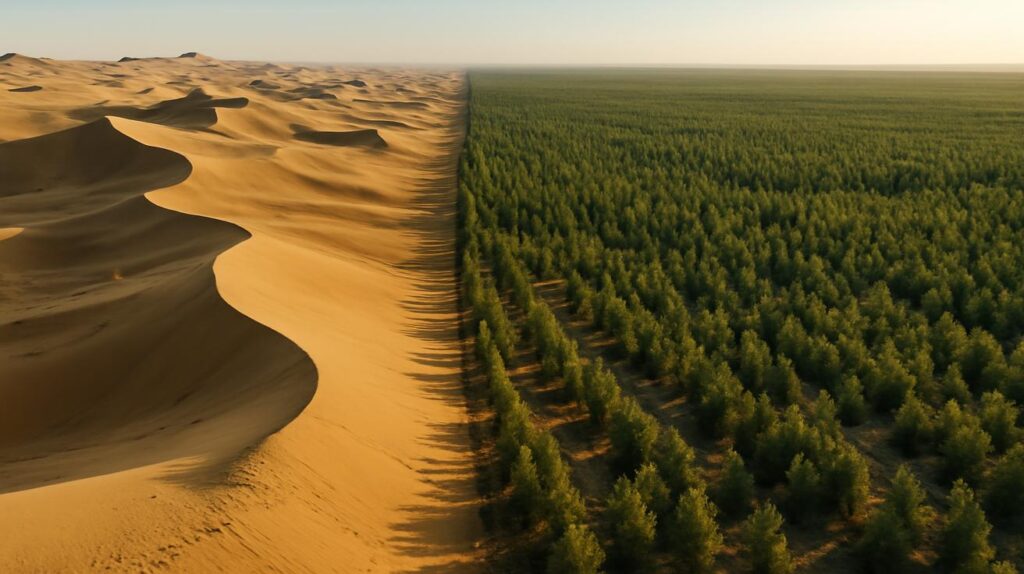
The first thing you notice is the sound. Not the roar of engines or the steady pulse of city traffic, but a soft, raspy rustle—millions of young leaves scraping against dry air. The wind that once carried only sand now tugs at branches, lifts the scent of damp soil, and drags it across a landscape that, a generation ago, was all but written off as lost. Somewhere in northern China, a farmer leans on his shovel, squints toward a thin green line on the horizon, and remembers when that same line was nothing but dust.
A Wall You Can Walk Through
Long before most of the world had heard about it, China began planting a wall—one not made of stone, steel, or concrete, but of roots and branches. Since the 1990s, the country has planted over a billion trees in an effort to hold back the deserts that were chewing steadily into farmland, villages, and cities. It is a wall you can walk through, touch, and smell, one that bends in the wind, drops its leaves, and, in many places, has quietly changed the future of the land around it.
Stand on the edge of the restored land today and the story is written in color. To one side, the desert waits in shades of dull beige and gray, the sand broken only by the skeletons of shrubs and the twisted remains of long-dead trees. To the other, young poplars and pines stretch upward, their trunks pale against the richer browns of revived soil. Between them lies a band of transition—grasses, small shrubs, and a few stubborn dunes clinging on, as if unsure which world they now belong to.
This living barrier has a formal name—the Three-North Shelterbelt Program—but on the ground, people simply call it the “Green Great Wall.” It snakes across the northern part of the country, from the arid expanses of Xinjiang to the windswept plains near the Korean border. It is not a single, flawless forest, but a patchwork of shelterbelts, reforestation plots, managed grasslands, and experimental plantings stitched together over decades.
In the 1990s, when the program gained momentum, the stakes were painfully clear. Sandstorms rolled into major cities. Farmland disappeared under drifting dunes. Lakes shrank or vanished. Herds of livestock kicked up dust from what had once been rich pasture. The question was simple and urgent: How do you keep a desert from moving?
The Slow Art of Holding Back Sand
To understand what China has done, you have to start with the desert itself. Deserts are not static. They creep. Wind lifts loose sand and dust and drives it forward, grain by grain, storm by storm. Without roots to bind the soil, even a small gust can chew away at the edges of a fragile landscape, turning dry land into dead land. And once that process begins, it feeds on itself. Sparse vegetation dies off, exposing more soil, which the wind strips away even faster.
The response was not a single masterstroke but a slow, evolving experiment in restoration. In many places, the first step was not trees at all but straw. Workers planted grid-like mats of straw into dunes, each square a small fence to trap moving sand. Within those straw squares, they tucked in hardy shrubs—the kind that can handle thirst, heat, and the occasional smothering by sand. Only when the dunes began to settle, when the wind’s sharp edge was blunted, did the trees come.
The trees themselves tell a story of trial and error. In the early years, fast-growing, water-thirsty species like poplars were planted in long, straight lines. They shot up quickly, turning bare land into visible “forest” in just a few seasons. But in some areas, they weakened over time, particularly where rainfall was too scarce. The land needed more than speed; it needed resilience. Slowly, scientists and local communities shifted toward more diverse, drought-tolerant species—locusts, pines, native shrubs and grasses that didn’t just endure the harsh climate, but belonged to it.
Every hole dug, every sapling planted, added up to a subtle change. Less wind at ground level. More shade. A bit more moisture held in the soil after a rare rain. In patches that had once been written off as degraded wasteland, birds returned. Insects colonized the new vegetation. Seeds, carried by the wind, began to germinate where once they would have dried and died.
The View from the Village Edge
If you want to measure the impact of those changes, you can look at satellite images or soil data, but you can also just talk to the people whose homes sit at the desert’s edge. For decades, residents in parts of northern China watched the sand advance like an uninvited tide. They recall roads buried overnight, the sharp sting of dust storms that turned daytime into a coppery haze, and the numbing sense that the land itself was slipping away.
Today, some of those same villages are framed by green. Trees form windbreaks around fields, their branches catching dust that once would have traveled hundreds of kilometers. Where bare soil once dominated, farmers now speak of better harvests, healthier livestock, and fewer days lost to choking storms. Children walk to school under dappled shade instead of through open, exposed stretches of dirt and sand.
The transformation is not absolute. On the windiest days, fine dust still hangs in the air—a reminder that decades of damage cannot be reversed overnight. But the character of those storms has changed. They are less frequent, less fierce, and they often meet their match in belts of trees and shrubs that stand, row after row, between the desert and the fields.
When a Billion Trees Become a System
Planting one tree is simple: dig, drop, cover, water. Planting over a billion trees across a landscape as vast and variable as northern China is another matter entirely. It is a logistical feat that blends human labor, state policy, scientific research, and local intuition in often messy, imperfect ways.
Forestry teams map out where shelterbelts will have the most impact—along the edges of cropland, across exposed slopes, tracing riverbanks that have begun to fray and collapse. Scientists test soil composition, rainfall patterns, and native vegetation to decide what should be planted where. Over time, data from satellites, drones, and on-the-ground surveys has helped refine these choices: fewer thirsty species in arid zones, more local genetic strains, mixed plantings instead of rigid monocultures.
Communities play their own vital role. In many regions, local people are paid or incentivized to plant and care for trees, protect young saplings, and adjust grazing patterns so that new vegetation has a chance to establish. Land that was once overgrazed is fenced and rested. Formerly bare slopes sprout patchworks of shrubs and shrubs beneath taller trees. The work is repetitive and physically demanding: season after season of bending, planting, watering, and hoping.
Seen from above, the impact of that patience becomes visible. In satellite images, bands of greenery cut across what was once continuous tan. Darker, denser patches of forest fan outward from older plantings. A landscape that had been losing its grip on water begins to hold it again—rivers flow longer into the dry season, and small wetlands reappear in shallow depressions.
Desert Slowed, Not Silenced
The phrase “slowed desert expansion” sounds technical, almost sterile, but out on the ground it feels like the difference between inevitability and choice. Studies using decades of imagery and climate data suggest that, since the 1990s, the advance of some desert areas in northern China has been checked, and in certain regions, actively reversed. Places once labeled as degraded or desertified now show signs of recovery—higher vegetation cover, richer organic content in the soil, more stable dunes.
This does not mean that the desert has been conquered. Climate change still looms over the region, bringing shifting rainfall patterns and rising temperatures. Some plantations have struggled—trees planted too densely or with the wrong species have wilted or died, leaving behind ghost forests of brittle trunks. Critics rightly point out that planting trees alone is not a miracle cure. Without thoughtful water management, wise species selection, and attention to local ecosystems, efforts can backfire, straining already-scarce resources.
Yet, even with these caveats, the broad trend is clear: large-scale ecological restoration, when combined with better land-use practices, can alter the trajectory of a region. In northern China, the arc has bent—perhaps not as fast or as cleanly as planners hoped, but enough that satellites see greener where there was once only dust, and farmers see possibilities where there was once only loss.
The Subtle Wealth of Restored Land
Walk into one of the older shelterbelts on a hot summer day, and the most immediate change is the temperature. Outside, the ground radiates heat, the sun unfiltered by leaves. Inside the canopy, there is a softness to the air—the shade cuts the intensity, and the soil underfoot is cooler, speckled with fallen leaves and needles. You can smell decomposition, that rich, earthy scent of organic matter breaking down and feeding the next generation of growth.
This is what restored land offers: not just trees, but a whole suite of quiet services that human life depends on. The roots knit the soil together, reducing erosion during storms. The canopy slows the wind, cutting down on the dust that can clog lungs and coat crops. The revived soil holds more carbon, taking some of the planet-warming gas out of the atmosphere. Birds use the branches as perches and nesting sites. Insects find shelter in the bark, the leaf litter, the flowers of restored shrubs and understory plants.
Over time, these subtle changes roll outward into human communities. Agricultural yields can improve when fields sit behind protective belts of trees instead of facing direct desert winds. Wells draw from aquifers that refill more easily when rain has a chance to soak slowly into healthy soil instead of running off bare, compacted ground. In some regions, people harvest fruit, nuts, or timber from planted forests, adding income streams to rural economies.
All of this is hard to capture in a single photograph or statistic. It is the slow, steady accumulation of small wins—the extra centimeter of topsoil, the slightly clearer air, the additional bird species recorded in a survey. But if you stack those small wins over millions of hectares and several decades, they begin to look a lot like a new kind of wealth: one rooted in ecological stability rather than short-term extraction.
Numbers You Can Feel Under Your Feet
In a world awash with big figures, “over one billion trees” risks sounding abstract. To bring it closer, imagine a simple, mobile-friendly snapshot of what this transformation involves:
| Aspect | What It Looks Like on the Ground |
| Trees Planted Since 1990s | Over 1,000,000,000 saplings and seedlings across northern regions |
| Key Goal | Slow desert expansion and stabilize vulnerable land |
| Main Methods | Shelterbelts, dune stabilization, reforestation, grassland restoration |
| Visible Changes | Less drifting sand, more vegetation cover, cooler microclimates |
| Benefits to People | Fewer sandstorms, more stable crops, improved local livelihoods |
Each of those billion trees represents a small act of faith in the land’s ability to recover. Many won’t survive their first five years. Those that do will keep growing long after the hands that planted them have grown old. Together, they turn policy into something you can feel under your feet—a forest floor where there was once only shifting sand.
Lessons Sprouting from the Sand
China’s vast experiment in tree planting and land restoration is still unfolding, but it already offers lessons that reach far beyond its borders. In a century defined by climate change, land degradation, and biodiversity loss, it stands as both a model and a warning.
The model is clear: large-scale, coordinated ecological restoration can make a difference. It can slow the march of deserts, revive soil, and stabilize communities living at the edge of habitability. The key lies in treating ecosystems not as blank canvases to be filled with trees, but as living, local puzzles. Matching species to climate and soil. Giving space for native vegetation to return. Integrating trees with grasslands, wetlands, and croplands rather than smothering them.
The warning is more subtle: size does not guarantee success. Monoculture plantations that rush for quick gains can falter. Planting without listening to local communities can trigger resistance or neglect. Ignoring water limits in arid zones can create new stresses even as old ones are eased. Restoration is not just about numbers—it is about relationships between people, water, soil, and the species that share the land.
Still, for anyone standing in a once-degraded valley now mottled with green, those caveats do not erase what has been gained. The desert has not vanished, but its momentum has been checked. Small forests now frame schools and roads. Grasslands, carefully managed, hold their ground against encroaching dunes. The air after a storm carries the smell of wet leaves instead of just dust.
In these places, hope has taken root in very literal ways. It stands in rows, sways with the wind, and drops its leaves each autumn, returning nutrients to soils that will feed future growth. It is a hope that can be counted in tree rings, measured in fewer days of choking haze, and heard in the soft, persistent rustle of new forests where, not long ago, there was only sand.
Frequently Asked Questions
Has China really planted over 1 billion trees since the 1990s?
Yes. Various large-scale programs, including the Three-North Shelterbelt Program and other reforestation and land restoration projects, have collectively resulted in the planting of well over a billion trees since the 1990s, particularly in northern and northwestern China.
Has desert expansion actually slowed down?
In many regions, evidence from satellite data and field studies indicates that the pace of desert expansion has slowed, and some formerly degraded or desertified areas now show increased vegetation cover and signs of recovery. The change is not uniform everywhere, but the overall trend in key project zones is toward greater stability.
Do all the planted trees survive?
No. In such harsh environments, a significant portion of saplings fail due to drought, pests, poor species choice, or planting density. However, enough survive and mature to change wind patterns, stabilize soil, and create conditions that support further natural regeneration.
Are monoculture plantations a problem in these projects?
Monocultures—large areas of a single tree species—have sometimes led to issues such as vulnerability to disease, water stress, and lower biodiversity. Over time, project managers and scientists have shifted toward more diverse plantings, using local, drought-tolerant species and mixing trees with shrubs and grasses.
What benefits do local people see from these restored areas?
Communities often experience fewer damaging sandstorms, more stable farmland, improved grazing conditions, and, in some cases, new income from forest products. The restoration can also support cleaner air, more reliable water supplies, and a generally more livable environment.
Can other countries copy China’s approach?
The core idea—large-scale, long-term ecological restoration—is widely applicable, but the methods must be tailored to local climates, soils, cultures, and economies. What works in northern China needs adaptation before being used in the Sahel, the Middle East, or other drylands.
Is tree planting alone enough to stop desertification?
No. Tree planting is only one tool. Sustainable grazing, careful water management, soil conservation, protection of native vegetation, and supportive policies are all crucial. When these elements are combined, trees become part of a broader, more effective strategy to restore degraded land and slow desert expansion.