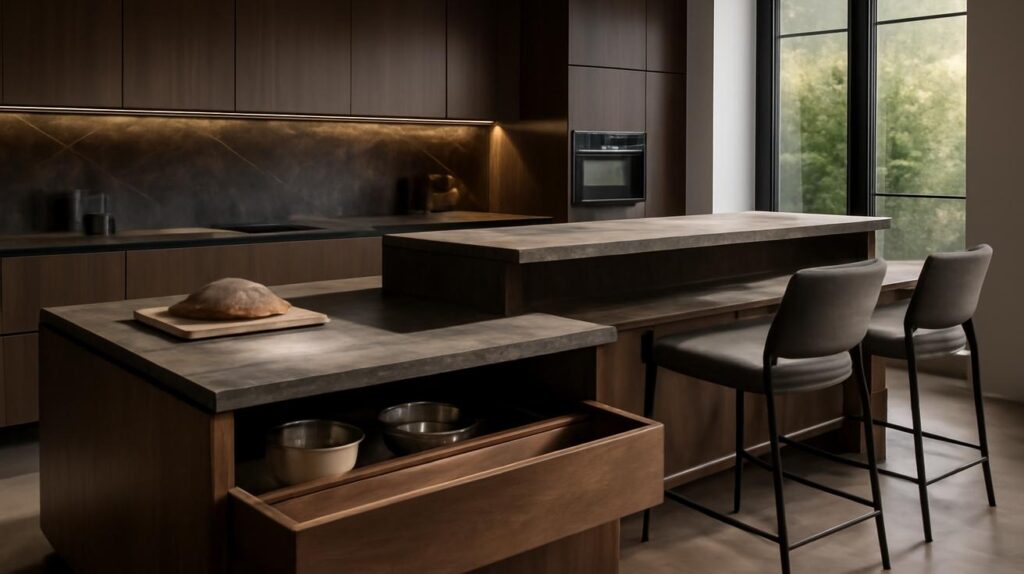
The first thing you notice is the absence of clutter. No hulking block in the middle of the room, no battlefield of half‑emptied grocery bags, no maze to navigate while carrying a sloshing pot of pasta water. Just light. Space. A smell of orange zest and toasted garlic drifting easily from stove to table. You can walk in a straight line from the window to the sink without doing that awkward side‑shuffle around a corner. Somewhere, the ghost of the kitchen island you thought you’d always need quietly slips away.
The Island Era Is Ending (And Your Knees Won’t Miss It)
For nearly three decades, the kitchen island has reigned like a big, blocky monarch. It was storage, seating, stage, and sometimes, let’s be honest, a catch‑all for mail, homework, and random tools no one knew where to put. But like most trends pushed to the extreme, the island grew larger, taller, and more crowded with gadgets until one day you realized: this thing was working against you.
Think about last week’s dinner. You probably wedged yourself between a bar stool and a cabinet, nudging someone’s knees as you reached for the fridge. Maybe you navigated around an open dishwasher that turned the island into a barricade. Maybe the “open concept” you were promised never really felt open at all.
Designers noticed it, too. Over the last few years, they’ve been quietly softening the hard lines, lowering the heights, and easing the pathways of the modern kitchen. The result is the kitchen’s new protagonist: not an “island” at all, but something looser, more gracious, and far more practical. It’s the rise of the kitchen table‑like workstation—sometimes called an “unfitted prep table,” “kitchen farm table,” or simply a “central worktable.” Whatever you call it, it’s changing how kitchens feel, look, and most importantly, how they’re lived in.
The 2026 Replacement: A Freer, Lighter Centerpiece
Imagine the familiar central surface of an island, but with legs you can see, air underneath, and nothing locked to the floor. It might be a long, narrow wooden table with a stone inset for rolling dough. It could be a sleek metal‑framed workbench with drawers that glide like a professional chef’s station. In some homes, it’s even a vintage farmhouse table pulled into the heart of the room and thoughtfully customized.
This is the 2026 replacement: a hybrid of prep station, dining table, and social hub. It takes the best of the island—the gathering point, the extra counter space—and sheds all the heaviness. It’s mobile in spirit, if not always on wheels. It respects the natural flow of a room instead of commanding it.
And in a world where our kitchens are offices, classrooms, labs, and therapy sessions, that flexibility matters. You can clear it, dress it, push stools in and actually tuck them out of the way. You can put a vase of branches in the center and still have room to chop vegetables without sidestepping someone logging into a virtual meeting.
Why Our Homes Are Ready to Let Go of the Island
Several quiet shifts in how we live are converging at once, and they’re all pointing away from fixed islands and toward lighter, more adaptable pieces:
- We’re cooking more, but also multitasking more. A big, blocky island often forces the cook to turn their back on everyone else. A central worktable lets you face the room, slide from laptop to cutting board, and move around the perimeter more smoothly.
- We crave softness and warmth. After years of sharp white quartz and hard edges, the tactile comfort of wood, rounded corners, and visible legs feels like a deep breath. A table‑like workstation looks like furniture, not equipment.
- We need our rooms to adapt. One week you’re hosting brunch; the next week you’re spreading out craft supplies, spreadsheets, or science projects. A lighter centerpiece can be rearranged, reimagined, and sometimes literally moved.
- Smaller homes are demanding better flow. Many islands made small and medium kitchens feel pinched. Replacing them with a slimmer worktable gains circulation room and restores that luxurious feeling of being able to walk without dodging corners.
In short, the new central worktable isn’t just a style, it’s a response—to modern life, to the way our bodies move, to the way our brains relax when a room doesn’t feel like an obstacle course.
From Block to Table: How the New Trend Actually Looks
Picture a late afternoon in early spring. The sun falls in angled stripes across a pale oak floor. In the middle of the room stands a table: legs tapered, edges gently rounded, top clad in a soft‑honed stone that feels cool under your palms. A colander of strawberries bleeds its red onto a linen towel. A child leans on one end with coloring pencils; you trim asparagus at the other. No one’s trapped in a corner. No one’s shouting “excuse me” just to pass by.
These new pieces wear many faces, but they share a few telling traits:
- Legs instead of full cabinetry. You can see the floor beneath them. This single detail tricks your eyes into reading the entire kitchen as larger and lighter.
- Mixed materials. Wood frames with stone tops, steel legs with butcher block, timber with a band of tile where hot pots land. They look collected, not built‑in.
- Gentler silhouettes. Soft corners, slim profiles, sometimes a slight curve that echoes old farmhouse tables or European baker’s benches.
- Modest but meaningful storage. A shelf for baskets, a few deep drawers, maybe a rail for hanging towels or colanders. Enough to be useful; not enough to become a junk bunker.
You still get the theater of cooking at the center of the room, but with a calm, open feeling that many islands never delivered. It is, in essence, a return to the oldest kitchen furniture we once had—the table—reimagined with everything we’ve learned from decades of island living.
Where the Storage Goes Now (Spoiler: It’s Smarter)
Of course, the island faithful will ask: where does all the stuff go? The answer is pleasantly unglamorous: it goes where it should have been all along.
Instead of stuffing every pan, serving platter, and gadget into the center of the room, designers are redistributing storage more intelligently:
- Deeper perimeter drawers that fully extend, so that a single drawer can replace a tangle of awkward lower cabinets.
- Full‑height pull‑outs near the stove for oils, spices, and utensils—replacing those rattling island drawers full of everything and nothing.
- Appliance garages in wall cabinetry to hide toasters, blenders, and coffee gear yet keep them within easy reach.
- Freestanding pantries that behave like furniture wardrobes, giving a tactile, old‑world charm while quietly absorbing bulk storage.
By the time all of this is in place, the central worktable doesn’t need to carry the burden of being a storage warehouse. It can be what it’s best at: an open, generous horizontal surface where life can unfold.
| Feature | Traditional Kitchen Island | 2026 Worktable‑Style Centerpiece |
|---|---|---|
| Visual Weight | Bulky, solid base; visually heavy | Lifted on legs; feels light and open |
| Movement & Flow | Can create tight, congested circulation | Improved walking paths; easier to navigate |
| Primary Identity | Built‑in cabinetry, part of “architecture” | Furniture‑like piece; flexible and adaptable |
| Use Modes | Mainly prep and casual eating | Prep, dining, work, crafts, entertaining |
| Emotional Feel | Centerpiece, but often busy and cluttered | Calmer, softer, more inviting and social |
Designing Your Post‑Island Kitchen
You don’t need to be building a new house—or even tearing your kitchen down to the studs—to join this shift. You just need to ask a different question. Instead of: “How big an island can I fit?” try: “How do I want to move, cook, and gather in this room?”
Start with the Way You Actually Live
Close your eyes and walk through your kitchen in your mind. Where do you naturally chop vegetables? Where do people gravitate when they wander in? Do you like to cook alone, or with a partner, or a crowd? Do you dream of quiet breakfasts or sprawling dinner parties?
Those answers—not square footage alone—should shape your central piece. A couple who cooks together but rarely hosts might prefer a compact, ultra‑functional worktable close to the stove. A family of five may want a longer, communal table that can handle cereal bowls at one end and a laptop at the other.
In many medium‑sized kitchens, this shift looks like removing or shrinking an existing island and replacing it with a narrower, legged piece that opens up the cross‑traffic. Suddenly, the dishwasher door can drop open without barricading the room. The trash pull‑out can be accessed even when someone is standing at the sink. No one has to perform a tight little dance just to carry plates to the table.
Think Dimensions, Not Just Aesthetics
Two numbers matter more than any Pinterest inspiration: clearance and width.
- Clearance: Aim for at least 36 inches (and ideally 42 inches or more) of open space around your central table. This is the breathing room that transforms how a kitchen feels.
- Width: Many new worktables land between 28 and 40 inches wide—leaner than the classic 48‑inch island, but just as effective for prep and seating.
Within these lines, you can play: a slab of richly grained oak, an oiled walnut top that develops a patina, a softly honed limestone that remembers every lemon and loaf. The piece can be as modern or as rustic as you like; what matters is that it supports movement, not blocks it.
The Sensory Shift: How a Room Feels Without an Island
What’s most surprising about saying goodbye to the island isn’t how the kitchen looks, but how it feels. There’s an immediate sense of exhale, like taking off a heavy coat you didn’t realize you were still wearing inside.
Sound changes first. Without bar stools jammed in a row and cabinet doors wrapping the base of a monolith, the room sounds less like a cafeteria and more like a living room with a stove. Voices soften. Conversations travel more gently across the space.
Light is next. It drifts through the gap under the table, reflecting off visible floor and chair legs, bouncing up to catch the underside of a stone top. Shadows become softer, more nuanced. A small lamp on the worktable—a quiet rebellion against the reign of recessed cans—casts a pool of warmth that makes a late‑night snack feel like a little ritual.
Then there’s touch. Instead of running your hand along a cold, vertical slab of cabinetry, you graze the rounded edge of a tabletop. Your knuckles knock on wood. Your hip leans into a leg that feels like furniture, not infrastructure. The room feels less like a showroom and more like a place someone truly lives.
And you’ll see something subtle but profound: people tend to sit around a table, but they line up against an island. One is a circle, even when it’s rectangular; the other is a counter. The new centerpieces are inviting a different kind of gathering—less transactional, more communal.
What Happens to the Old Island?
Not everyone can—or wants to—rip out an existing kitchen right away. The transition can be gentler, and sometimes more creative, than that. Think of it less as demolition and more as editing.
In some homes, the island is simply slimmed down: the heavy, full‑cabinet base replaced with an open frame and a single shelf; the overhang reduced so stools tuck completely beneath; the solid sides softened with arches or cut‑outs. A formerly immovable block quietly learns to float.
In others, the island leaves entirely, and a piece of real furniture takes its place. A refurbished antique table with a new stone inset. A workbench that once lived in a studio, now sealed and adapted for kitchen life. A custom‑built hybrid that borrows from both worlds.
And in the most adventurous kitchens, nothing takes the island’s place at all. The room becomes a dance floor of sorts—cabinets around the perimeter, a portable trolley or two, and wide open space in the middle for long cooking days, yoga mornings, or late‑night gatherings that gradually migrate from sofa to stove.
The lesson, whichever path you choose, is the same: the center of the kitchen is not obligated to be a box. It can be light, movable, human‑scaled. It can hold space for the unexpected.
FAQs: Goodbye Kitchen Islands, Hello Worktables
Are kitchen islands really going “out of style” by 2026?
Islands won’t vanish overnight, but their dominance is fading. The emerging trend favors lighter, table‑like workstations that improve flow and make kitchens feel more like living spaces. In new builds and thoughtful remodels, designers are prioritizing these more flexible pieces over large, built‑in islands.
Will I regret losing all that island storage?
If you plan carefully, you’re unlikely to miss it. The new approach relies on smarter perimeter storage—deep drawers, pull‑outs, and freestanding pantries—so the central worktable doesn’t have to be a storage bunker. Most homeowners find that better‑organized wall storage replaces bulky island cabinets surprisingly well.
Can a worktable still include seating like an island?
Yes. Many worktable‑style pieces have an overhang on one or two sides for stools or chairs. Because they read as furniture, the seating feels more like a casual dining spot and less like a row of bar stools at a counter, which can make everyday meals and conversations more comfortable.
Is this trend only for large, high‑end kitchens?
Not at all. In small and medium kitchens, replacing an island with a slimmer, legged worktable often has the biggest impact. It restores circulation space, reduces visual bulk, and can even make the room feel bigger. You can use a customized standard table, an upcycled vintage piece, or a modest custom build to achieve the look.
How do I know if my kitchen is a good candidate for ditching the island?
If you regularly bump into corners, can’t open appliances without blocking pathways, or feel like the room is smaller than it should be, your island may be the culprit. Measure the clearances around it; if you have less than about 36 inches on any side, consider a narrower, more open worktable or removing the island entirely to reclaim your kitchen’s natural flow.