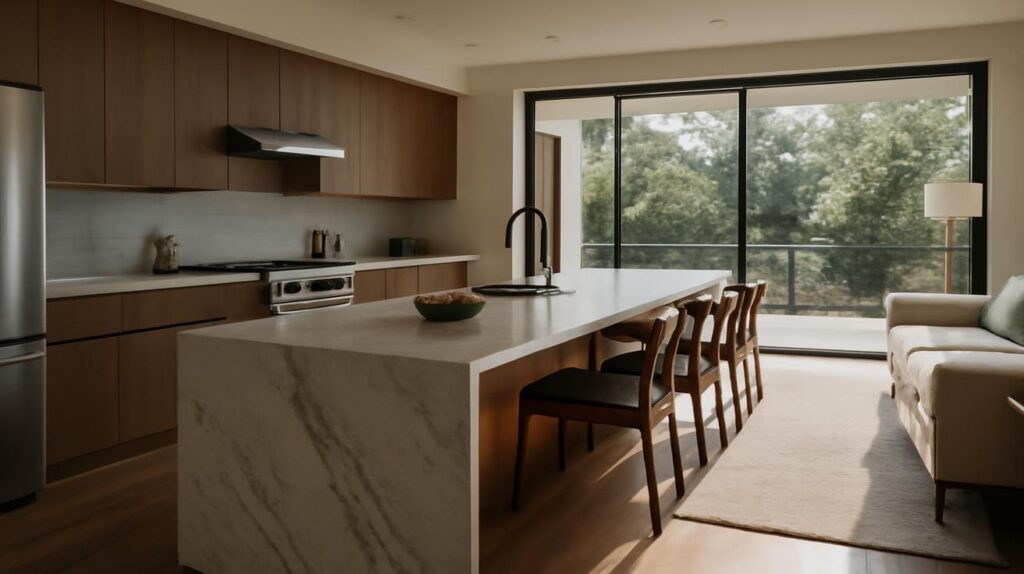
The first thing you notice when you walk into the room is the absence. That big, boxy block of cabinetry you’ve grown used to navigating around, dumping mail on, and circling like airport traffic? Gone. The space feels wider, calmer, somehow more human. Light pours across the floor instead of slamming into a dead-stop island. Your shoulders drop. You can actually hear the quiet hum of the house—air through vents, the soft clink of mugs—without bumping a hip into a hard corner.
In the middle of the room, instead of an island, there’s something else: a long, almost table-like structure, slim and elegant, open underneath, with legs that touch the floor instead of a heavy base. On one side, the surface is butcher-block warm under your palm; on the other, cool stone gleams where someone’s just set down a pot. Stools slide neatly beneath. You could work here, eat here, roll out dough here. It feels less like a barricade and more like an invitation.
This is the kitchen’s near future: goodbye, monolithic islands. Hello to their quieter, more practical 2026 replacement—a hybrid creature that behaves like furniture, performs like a workstation, and looks like something you’d be proud to put in the center of your life, not just the center of your kitchen.
The End of the Block in the Middle
For decades, the kitchen island has been the gold standard of “upgraded” design. It was how you knew a kitchen was serious: big slab of stone, heavy base, pendant lights lined up like runway markers. But as our lives changed, the island often stayed stuck in a different era—when square footage was cheaper, gatherings were bigger, and open-concept living was still novel.
Today, many people are quietly admitting something they didn’t dare say aloud when the island craze peaked: those giant rectangles are not always that practical. They gobble up floor space, force strange traffic patterns, and turn the center of the kitchen into a storage bunker rather than a place you actually want to be.
We’ve built our cooking lives dodging corners, squeezing past open dishwasher doors, and trying not to feel trapped between three solid planes of cabinetry every time we turn around with a hot pan. In small and medium-sized homes, the island often overwhelms the room. In large homes, it becomes a stage that’s hard to keep tidy enough to deserve its spotlight.
So designers, homeowners, and even builders have been asking a simple, radical question: what if the heart of the kitchen didn’t have to be a block? What if it could feel more like a piece of furniture—lighter, movable, multi-purpose—while still delivering all the function we’ve come to expect?
The 2026 Star: The Kitchen Worktable-Hub
That question is leading directly to the island’s elegant successor: the kitchen worktable-hub. Think of it as the love child of a farmhouse table, a chef’s prep station, and a sleek, modern console. It’s slimmer, often longer, sometimes on legs, sometimes on hidden casters. It might have drawers, a narrow shelf, or a rail for hanging towels and utensils, but what it doesn’t have is that heavy, wall-to-wall base that locks your layout in place for the next twenty years.
Instead of a chunk of cabinetry dropped in the middle of the room, the worktable-hub feels like it chose to be there. You can see the floor beneath it. Your eye travels across the room without crashing into a barricade. In smaller spaces, that alone can make the difference between “tight” and “breezy.” In larger spaces, it stops the kitchen from feeling like a museum exhibit of stone and wood.
It’s still very much a workhorse. The 2026 versions aren’t fragile little side tables—they’re scaled and built for chopping, rolling, and plating, but with a sculptural presence that feels more like a dining table than a boxy cabinet run. Some have integrated butcher-block strips within stone tops, carved drain grooves near a prep sink, or low-profile power outlets hidden in the underside of the surface rather than slapped on the side like an afterthought.
Why This New Trend Works Better in Real Life
You don’t need to be a design professional to understand why this shift is happening. You just need to think back to the last time you cooked with someone else and felt like you were doing a clumsy dance around the island, colliding at corners and reaching over each other’s elbows.
The new worktable-hub quietly solves that. It invites people to gather around rather than on just one side. With open leg space and slightly narrower depth, two people can stand opposite each other, working together, talking, making eye contact instead of lining up like customers at a counter.
There’s also the reality of how we actually live in our kitchens now—laptops on the counter, kids doing homework, someone scrolling recipes while another person stirs a pot. A furniture-like hub adapts to these roles more naturally than a hulking island. It can host a candlelit dinner, then a messy baking project, then a Sunday afternoon of sketching or spreadsheets.
And under all that, there’s a subtle psychological shift: when the heart of the kitchen feels like furniture, the room feels less like a production facility and more like a living space. That’s a mood change you feel every single day, not just when you have guests.
Form Meets Function: What These New Hubs Actually Look Like
Walk through the kitchens that will define 2026 and you’ll notice a few shared design choices—clues to how this trend translates from idea to reality.
| Feature | How It Differs from Classic Islands | Why It Matters in Daily Life |
|---|---|---|
| Open Leg Base | Visible legs & floor, no solid box cabinetry | Makes the room feel bigger, lighter, less cramped |
| Slimmer Depth | Often 24–30 inches deep instead of 36–48 | Easier to reach across; better flow around all sides |
| Mixed Materials | Wood + stone + metal rather than one continuous slab | Adds warmth, character, and a furniture-like feel |
| Subtle Storage | Shallow drawers, rails, or a single shelf instead of deep cabinets | Keeps essentials close without creating a clutter magnet |
| Flexible Placement | Centered, offset, or even partially rotated in the room | Layouts can respond to how you actually move, not just a grid |
Look closely and you’ll see other thoughtful touches: a shallow overhang that allows for comfortable seating without swallowing too much floor; rounded corners that prevent bruised hips and soften the silhouette; integrated rails where a hand towel, a favorite pan, or a basket of onions can live without cluttering up the top.
Some hubs incorporate a small prep sink, but unlike old-school islands, they avoid turning the whole surface into a tangle of appliances. The sink is compact, the faucet low-profile, and the surrounding area still feels like a table rather than a utility station. Even when there’s a cooktop, it’s often flush-mounted, with unobtrusive downdraft ventilation or a slender hood that doesn’t dominate the space.
How These Hubs Change the Way You Cook and Gather
Imagine you’re making dinner on a gray winter evening. Instead of standing with your back to the room at a perimeter counter, you’re at the center worktable, facing out toward the windows or into the living space. A pot of soup simmers on the stove behind you, but the real activity is here: chopping herbs, arranging bread on a board, talking.
Your partner sits on a stool on the other side, laptop open, half working, half chatting. A kid wanders in and leans against the edge, telling you about their day. No one has to wedge themselves between you and a cabinet run. There’s no sense of trespassing into “the cook’s zone.” The edge of the table becomes a shared border, not a barrier.
Later, when dinner is ready, you don’t have to migrate somewhere else. You slide plates across the same surface, blow out the prep candle and light a dining one. Maybe you add a linen runner down the center and pull over a couple more chairs from the wall. In the softer light, the hub no longer looks like a workstation at all. It looks like a long, welcoming table—the kind that remembers stories and crumbs and late-night tea.
This shift from “island as storage block” to “hub as living surface” has subtle but powerful consequences:
- You waste less time doing laps around cabinetry because movement lines are clearer and more open.
- Cooking feels less isolating; the hub faces into life rather than away from it.
- The space can pivot, hour by hour, from kitchen to coworking space to casual dining room.
- Clutter is more self-regulating. With fewer deep cabinets underneath, you’re less likely to accumulate forgotten gadgets and more likely to keep what you use and love within arm’s reach.
It’s no accident that many of the people embracing this trend are those who’ve lived with oversized islands and found themselves working around them rather than with them. Once you’ve felt the ease of circulating freely through the kitchen, it’s hard to go back to the stop-and-start choreography of last decade’s layouts.
Space, Sustainability, and the Quiet Luxury of Less
There’s another layer to this design turn that’s easy to miss at first glance: restraint. For years, the kitchen was where we showcased scale—thick countertops, massive islands, towering hoods. But as climate conversations seep deeper into everyday decision-making, the idea of building bigger just to prove we can is losing its shine.
The worktable-hub is a quieter sort of luxury. It doesn’t scream for attention; it earns it. Instead of a 10-foot slab of rare stone, you might choose a smaller piece of locally sourced material, paired with sustainably harvested wood, set on a base that can be refinished or even repurposed if your needs change. Less volume, more intention.
Because these hubs are more furniture-like, they also have a longer imaginative lifespan. If you move, it’s often possible to take the piece with you, or at least repurpose it in a different way—a craft table, a studio surface, an office meeting table. That possibility alone makes it feel less like a permanent architectural decision and more like a well-chosen object in your life.
From a cost perspective, the story is nuanced. A beautifully built hub can be every bit as expensive as a traditional island, especially if it uses custom joinery and high-end materials. But what changes is where the investment goes: less into sheer mass, more into touch, proportion, and craftsmanship. Fewer cabinets; finer details.
Imagining Your Own Kitchen without an Island
If you’re looking around your current kitchen and trying to picture it without an island, your brain might rebel at first. We’ve been conditioned to see that block in the middle as the sign of a “complete” space. But it can be useful to strip everything back in your mind and start from how you actually live.
Ask yourself: where do you naturally like to stand? Face? Gather? If you had a long table-like surface instead of a box, would you orient it toward the view, toward the living room, or down the length of the room? Would you want people seated across from you while you cook, or would you prefer the hub to be offset, leaving an open line of sight from sink to stove?
Then think about what truly needs to be inside that central surface. Do you really need a full wall of cabinets underneath, or would two or three shallow drawers for knives, cloths, and spices be enough? If heavy storage lives along the perimeter walls instead, could the center be freed up for movement and conversation?
Consider materials, too: a stone perimeter for heavy-duty tasks, a warmer wood top on the hub for touch, baking, and serving. Or a tough, honed surface for the whole thing, with soft seating and textiles doing the warming work.
The beauty of the 2026 hub trend is that it’s not one fixed style. It can be rustic or ultra-minimal, industrial or quietly traditional. What unites the best versions is not how they look in a photo, but how they make the room feel: more breathable, more adaptable, more human in its scale and behavior.
Goodbye Island, Hello Centered Living
When you remove an island from a kitchen, you’re not just creating physical space. You’re making room for a different kind of daily rhythm. You’re choosing to float the heart of the room on legs instead of anchoring it with a heavy block. You’re admitting that the center of your cooking life is not a monument to storage, but a surface where things happen—meals, projects, conversations, quiet mornings with a single cup of coffee.
The island had a good run, and in some kitchens, it will still make sense—a compact version, perhaps, thoughtfully scaled. But the shape of our days is changing, and the rooms we inhabit are starting to respond. In the next few years, the kitchens that feel the most current won’t be the ones with the bulkiest islands. They’ll be the ones where you can move easily, see clearly, gather comfortably, and feel, every time you walk in, that the space is ready to shift with you.
When that happens—when the central piece of your kitchen behaves more like a beautiful tool than a fixed monument—you stop designing around a block and start designing around a life. And that, more than any trend, is what makes these new worktable-hubs feel not just fashionable, but inevitable.
Frequently Asked Questions
Are kitchen islands really going out of style by 2026?
Islands aren’t disappearing overnight, but oversized, blocky, storage-heavy islands are steadily losing favor. They’re being replaced by lighter, more flexible worktable-style hubs that function better in real, everyday life and feel more like furniture than built-in cabinetry.
Will I lose storage if I replace my island with a worktable-hub?
You may lose some deep cabinet storage in the center of the room, but many people compensate with better-organized perimeter cabinets, tall pantry units, and smarter use of wall space. In return, you gain openness, better movement, and a central surface that’s far more enjoyable to use.
Can a worktable-hub include a sink or cooktop?
Yes. Many 2026 designs integrate a small prep sink or a low-profile cooktop. The key difference is restraint: the hub still feels like a table first, with fixtures scaled and placed to preserve openness, rather than turning the piece into a dense block of utilities.
Is this trend only for large, high-end kitchens?
No. In fact, smaller and mid-sized kitchens often benefit the most. A narrower, leggy worktable in the center can make a compact room feel larger and more comfortable than a chunky island ever could. The look can be customized to modest budgets using simple materials and smart design.
How do I know if my kitchen is a good candidate for an island replacement?
If you constantly bump into your island, struggle with tight clearances, or find the center of your kitchen feels cluttered or dark, you’re a strong candidate. Sketch the room without the island and imagine a slimmer, open-based table instead—if the mental image makes you breathe easier, you’re likely ready for the shift.