The first time I buried a banana peel in the garden, I did it like a guilty secret. It was early, the kind of damp morning when the soil smells like coffee grounds and last night’s rain. In one hand: the limp yellow skin of yesterday’s snack. In the other: a trowel. I slit the soil beside a young tomato plant, slid the peel under like I was tucking in a child, and patted the earth closed. Somewhere in my mind, I imagined the plant whispering, thank you.
Of course, nothing magical happened overnight. There were no golden leaves, no instant jungle of fruit. But over the weeks, I started noticing a pattern: some plants responded to those buried peels as if I’d given them a secret advantage, while others looked… unimpressed. It didn’t take long to learn what many gardeners eventually discover: banana peels are not a miracle cure—and they only really help when they are in the right place, in the right way.
The Myth of the Magic Peel
For years, social media has treated banana peels like fairy dust for gardens. Toss them anywhere, and—poof—your roses will blush deeper, your tomatoes will swell like balloons, your houseplants will rise up in gratitude. It’s a nice fantasy. It’s also why so many people end up disappointed.
Banana peels do contain useful nutrients: potassium, a bit of phosphorus, calcium, magnesium, and trace elements. The skin that once wrapped a sweet, soft fruit is basically a slow-release packet of minerals. But there’s a catch: plants can’t nibble on peels. They can only absorb nutrients that are broken down into forms dissolved in water and pulled into roots. Until microbes, fungi, and soil organisms decompose that peel, it’s basically a sealed package the plant can’t open.
This is where the “exact spot” comes in—not just anywhere in the garden, but in the narrow, living zone where roots and soil life are most active. Put a banana peel in the wrong place, and it’s just trash with better PR. Place it in the right place, and suddenly the whole story changes.
The Secret Zone: Where Banana Peels Actually Work
Walk out into your garden and crouch beside a plant—any plant you care about. Imagine, just under the surface, a tangle of roots stretching outward. Most of the feeder roots—the fine, threadlike ones that actually take up water and nutrients—are not at the base of the stem. They’re out a bit, usually around the drip line: the invisible circle on the ground where rain would fall from the outermost leaves.
That ring, a few inches below the soil, is the sweet spot.
This is where the soil is most alive: earthworms threading through, fungi wrapping around roots, bacteria bustling in microscopic crowds. It’s in this bustling underworld that your banana peel either becomes part of the living system—or sits there stubborn and slow, decomposing at a glacial pace.
The right spot for banana peels is not:
- On top of the soil, baking in the sun like a forgotten snack.
- Stacked in a slimy pile beside the plant’s stem.
- In a sealed pot where drainage is poor and rot turns sour.
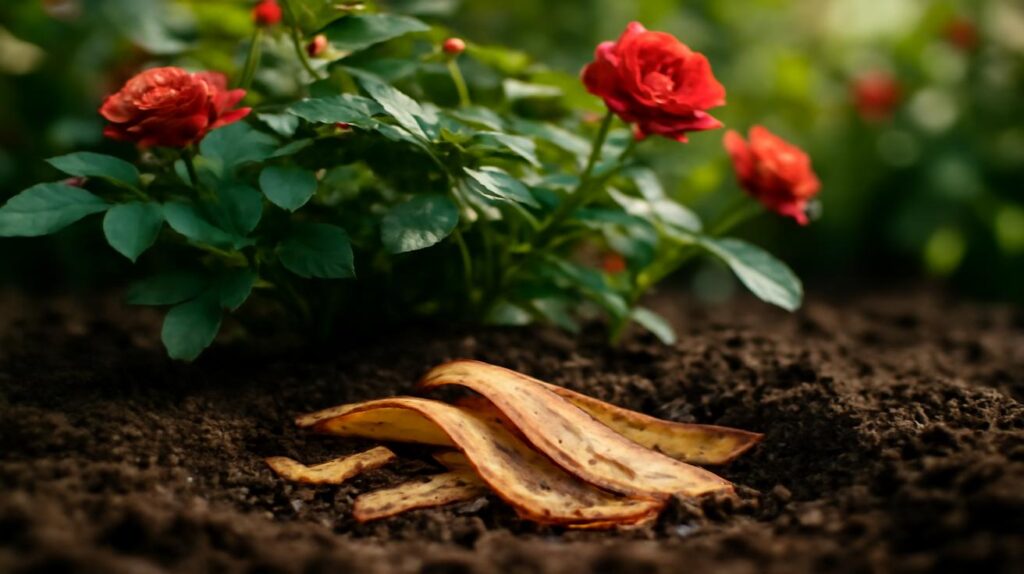
The right spot is just below the surface, near but not touching the feeder roots—usually 2–3 inches down for small plants, 4–6 inches for shrubs, and out near the drip line for trees. Bury the peel shallowly, and you give soil life easy access. That’s where the quiet alchemy begins.
The Simple Bury-and-Wait Method
Here’s how that looks in practice. You finish a banana. Instead of tossing the peel into the trash—or even straight into the compost—you turn it into a small, targeted offering to a specific plant.
- Choose a healthy plant that’s actively growing (not dormant or struggling badly).
- Stand at the plant and look at where its outer leaves end. Aim for that ring in the soil.
- With a hand trowel, dig a narrow slit or small hole 2–3 inches deep for smaller plants, 4–6 inches for larger ones.
- Cut or tear the banana peel into a few pieces. Smaller pieces decompose faster and attract fewer pests.
- Lay the pieces flat into the slit, then cover them fully with soil and gently press down.
That’s it. No dramatic transformation, no instant lushness—but over several weeks, as soil organisms feast and break down the peel, the area around that root zone becomes just a little richer, a little more alive. Do this consistently around the same plant over a season, and the cumulative effect is what you start to see.
What Really Happens to a Peel Underground
Imagine the buried peel in the dark. It cools, softens, and begins to surrender. The first visitors are bacteria, invisible and relentless, followed by fungi that send fine threads through the softening skin. Earthworms arrive like quiet tourists, tasting, digesting, leaving behind castings richer than what they consumed.
As the peel decomposes, potassium slowly seeps into the surrounding soil, along with smaller amounts of phosphorus and calcium. Potassium is famous for supporting flowering, fruiting, and overall resilience: it helps plants regulate water and build stronger cell walls. Calcium supports cell structure and root health. While banana peels are not balanced fertilizers—and they lack nitrogen, the big driver of lush, green growth—they gently support the behind-the-scenes functions of a plant.
But here’s the thing: if that peel is too far from the roots, or if the soil is compacted, waterlogged, or lifeless, those nutrients drift into a kind of no-man’s land. The plant never really benefits. Roots and microbes must be nearby, breathing, drinking, cycling, or the peel’s potential just melts away into the general background of the soil.
This is why placement matters so much. A banana peel stuck near the surface, far from roots, is like leaving groceries on your front lawn instead of bringing them to the kitchen.
Banana Peels vs. Banana Hype
You might have seen claims that banana peels will cure every plant problem: yellowing leaves, drooping stems, blossom end rot, sad roses. But a peel can’t fix poor soil, overwatering, or lack of sun. It can’t supply missing nitrogen. It can’t override basic plant needs.
There are gardeners who swear by banana peel water—soaking peels in a jar, then pouring the rusty-looking liquid on their plants. It sounds clever, but most of the nutrients in a peel are not instantly water-soluble. A short soak pulls out very little; a long soak risks a smelly, anaerobic brew that does more harm than good. In most cases, that liquid is more placebo than power.
The real, quiet benefit happens in soil, over time, in that intimate space where roots, microbes, and decomposing matter meet. You’re not making a magic potion—you’re supporting a living process.
The Exact Spot for Different Plants
Not all plants use soil in the same way, and the magic spot for a buried peel shifts slightly with their growth patterns. You don’t need a degree in botany—just a sense of where roots like to be.
| Plant Type | Where to Bury the Peel | Depth | How Often |
|---|---|---|---|
| Tomatoes & Peppers | In a ring 4–6 inches away from the stem, around the root zone | 3–4 inches | Every 3–4 weeks during active growth |
| Roses & Flowering Shrubs | At the drip line, spaced in 2–3 small holes | 4–6 inches | Once a month in growing season |
| Fruit Trees | Scattered around the drip line, not near the trunk | 4–6 inches | Every 4–6 weeks in spring and summer |
| Herbs & Small Annuals | Just beyond the plant’s small root area, not touching stems | 2–3 inches | Lightly, every 4 weeks |
| Potted Plants | In tiny pieces, tucked just under the surface at the pot edge | 1–2 inches | Very sparingly, every 1–2 months |
Notice how the trunk or stem is never the target. That central point is important, but it’s not where the real nutrient exchange happens. You’re always aiming for that living ring, the place where roots are actively gathering food.
Banana Peels in Pots: A Delicate Balance
Containers are their own little worlds. Unlike garden beds, where soil life and drainage can spread out, pots are tight, confined ecosystems. A whole banana peel wedged into a pot is like leaving half a sandwich in a shoebox: it will rot slowly, smell, attract fungus gnats, and possibly go slimy before it ever helps the plant.
If you want to use banana peels in containers, think tiny and rare:
- Cut peels into small squares or thin strips and let them dry a bit first.
- Tuck just a few pieces under the top inch of soil near the pot edge.
- Avoid using them in very wet, poorly drained pots.
Often, it’s far better to add those peels to a compost pile instead, then use finished compost in your potted plants. The composting process does the heavy lifting for you, turning kitchen scraps into something stable, rich, and less risky.
When Banana Peels Cause More Trouble Than Help
There’s a moment every gardener has: the realization that “more” is not the same as “better.” A handful of carefully buried banana peels can be a quiet boon to your soil. A bucketful tossed under a tree can become a mess.
Misplaced or overused banana peels can:
- Attract pests if left exposed—rats, raccoons, insects, and even neighborhood pets.
- Grow mold or fungus in soggy, poorly drained soils or pots.
- Create imbalances if used as the only “fertilizer,” since they lack nitrogen.
- Encourage root burn if stacked too densely right against young root systems (especially in confined spaces).
Think of banana peels as a nice side dish for your soil, not the main course. You wouldn’t live on bananas alone; plants shouldn’t either.
They work best when they support a broader soil-building approach: compost, mulch, diverse organic matter, and attention to watering and light. A peel in the right place is one thread in a tapestry, not the entire picture.
Compost First, Garden Second
If you drink smoothies every day or have a family that eats bananas like candy, you’ll quickly have more peels than your soil can gracefully absorb. That’s where compost comes in. A compost pile or bin is simply nature’s stomach, working on a larger scale.
When banana peels go into compost, they’re mixed with other scraps, browns like leaves or shredded paper, and air. Microbes chew, churn, heat, and transform. By the time that compost returns to your garden, the peels are no longer recognizable—just a dark, crumbly richness that plants can use more evenly and easily.
In a way, composting is just a bigger, slower version of that little act of burying a peel near a root. Both use the same principle: let the living soil community do the work, then let the plants tap into the results.
Listening to Your Soil
There’s something intimate about folding a banana peel into the earth, right where your plant’s roots are quietly reaching. It slows you down. You notice the moisture level of the soil, the smell, the way the trowel meets resistance or slides in easily. You see tiny lives—worms, beetles, maybe the white lace of fungal threads.
In that moment, you’re not just “fertilizing.” You’re paying attention.
Over time, you’ll notice patterns. Plants in loosened, well-mulched beds respond better to buried peels because their root zones are already active and aerated. Heavy, compacted, or constantly waterlogged soils don’t respond as well, no matter how perfectly you place the peel. The lesson isn’t that banana peels don’t work—it’s that they can’t fix a soil that can’t breathe.
So when you think about the “exact spot” to place a peel, think beyond a single hole in the ground. Think of the whole root environment. Think of worms. Think of fungi. Think of water moving in and air moving out.
And then, with that in mind, slip that yellow skin into the right ring of soil—not as a magic trick, but as a quiet, ongoing conversation with the living world beneath your feet.
FAQs About Banana Peels in the Garden
Do banana peels really help plants grow?
They can help, but not in the dramatic way many posts promise. Banana peels provide potassium and some other minerals that support flowering, fruiting, and overall plant resilience. They’re most effective when buried near active roots in healthy, living soil. They are not a complete fertilizer and won’t replace good soil, compost, or proper care.
Where exactly should I put banana peels for the best results?
Bury them just below the soil surface—2–4 inches deep for most plants—near the feeder roots. Aim for a ring a few inches away from the stem, or around the drip line for larger shrubs and trees. Do not leave them on top of the soil or piled right against the stem or trunk.
Can I just put banana peels on top of the soil as mulch?
You can, but it’s not ideal. Exposed peels decompose more slowly, can look messy, and are more likely to attract pests. They’re far more useful when cut into pieces and buried shallowly so soil organisms and roots can access them.
Are banana peel “teas” good fertilizers?
Most banana peel teas are weak and unreliable. A short soak doesn’t dissolve much of the peel’s nutrients, and a long soak can become smelly and anaerobic. For most gardeners, it’s more effective and safer to bury the peel near roots or add it to compost instead of making banana water.
Can I use banana peels in indoor pots?
Yes, but very carefully. Use only small, chopped pieces, bury them just under the surface near the pot’s edge, and use them sparingly. Whole or large peels in pots can rot, smell, and attract fungus gnats. Many indoor gardeners prefer to skip direct peels and use quality compost or balanced fertilizer instead.
Will banana peels prevent blossom end rot in tomatoes?
Not reliably. Blossom end rot is mainly caused by inconsistent watering and calcium availability, often linked to root stress. Banana peels offer only small amounts of calcium and don’t fix watering issues or root damage. They can gently support soil health, but they’re not a cure.
Is it better to compost banana peels or bury them directly?
Both methods can work, but composting is usually better if you have a lot of peels or limited garden space. Compost turns peels and other scraps into a more balanced, stable material that’s safer and easier to spread widely. Direct burying is great for small amounts used thoughtfully, placed near root zones in healthy soil.