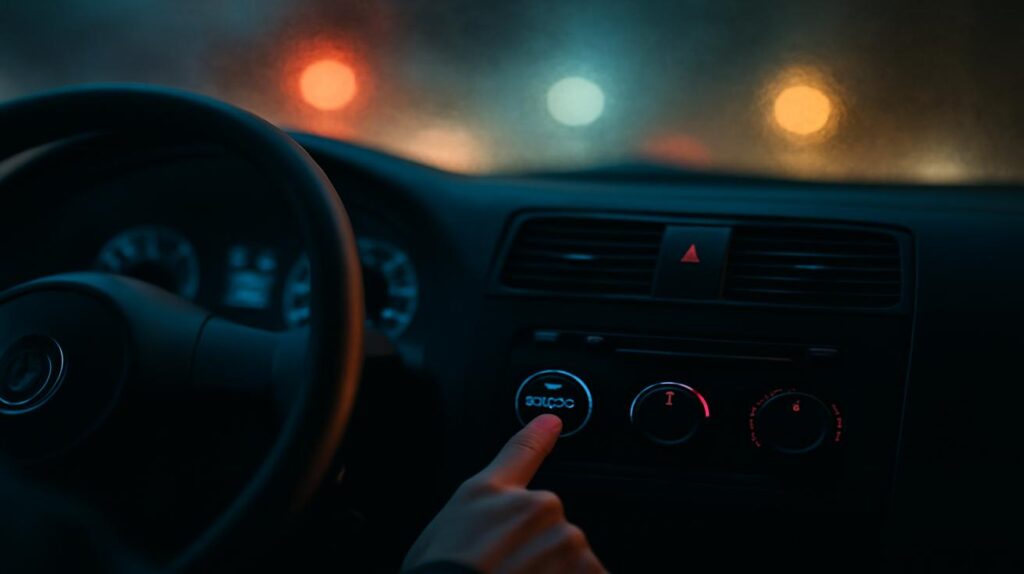
The first cold breath of morning hits the glass, and just like every other rushed weekday, your windshield turns into a milky, ghosted blur. You’re late. Coffee sloshing in the cup holder, you jab at the dashboard, twist a dial, poke a button that looks vaguely like a windshield with squiggles. The fan roars, the engine hums harder, the air smells faintly like warmed dust—and still the fog refuses to budge. So you do what half of us secretly do: swipe a sleeve across the glass, curse under your breath, and crank every setting to “max.” Somewhere under the dashboard plastic, your car quietly groans.
When Winter Meets the Dashboard
Talk to any mechanic in late autumn and they’ll tell you: as soon as the air turns chilly and damp, a strange ritual spreads across parking lots and driveways. Drivers sit hunched over steering wheels, vents roaring, rear defrosters blazing, AC lights blinking, and that mysterious “recirculate” button glowing like a tiny, misunderstood moon.
For years, the common wisdom has sounded something like this: “Turn everything on. Blast the heater. Hit the rear defogger. Slam recirculate so you’re not bringing in cold air. The faster it gets warm, the faster the fog disappears.”
Car experts, however, are watching this with a mix of horror and weary resignation. Because that routine—especially the part where you hit the wrong settings—is quietly burning extra fuel, beating up your climate system, and in a lot of cases actually making the fog worse.
And now that more experts and car techs are explaining what’s really going on, drivers are furious. Not because they don’t like being corrected, but because so many of us have been doing exactly what we were taught by parents, friends, or driving instructors… and we’ve been wrong for years.
The Button Everyone Gets Wrong
If the fog struggle had a main villain, it would be that harmless-looking icon of a car with a little circular arrow: the recirculation button. Most people treat it as a comfort switch—“keep the warm air in, keep the cold air out.” It feels logical. It even makes the cabin heat up faster. And on a bitter morning, that’s hard to resist.
But there’s a catch, and it’s a big one. The air inside your car is wet. It’s full of moisture from your breath, your damp jacket, maybe the snow that melted off your boots. When you hit recirculate, all that humid air just keeps looping through the cabin. Warm air holds more moisture than cold, so as things heat up, that moisture level climbs. The glass, on the other hand, stays relatively cool, especially the windshield facing the cold outside.
Warm, wet air + cold glass = instant fog. And once it’s there, no amount of “just heat it up more” will do what you think it will. In fact, you may be feeding the problem.
That’s why experts keep repeating the same unpopular advice: when you want to clear fog from the inside of the windshield, you should almost always turn recirculate off and let fresh, dry outside air into the cabin. It feels counterintuitive, especially when it’s freezing outside. It even feels a little wrong. But the physics don’t care how it feels.
The outside air, even if it’s ice-cold, is usually drier than the air trapped inside your car. When it gets pulled through the heater and then blown onto your windshield, the relative humidity drops, and the glass starts to clear. Add the AC compressor into the mix—yes, even in winter—and you get even drier air, which speeds everything up. That’s why so many newer cars will quietly click the AC on by themselves when you select the defrost setting.
The Quiet Fuel Leak You Never See
Here’s where the fury starts to bubble up: using the wrong defogging settings isn’t just annoying, it can cost you money every single drive.
Any time the AC compressor runs, your engine (or battery, in a hybrid/EV) has to do more work. That means more fuel burned. Used properly, the AC-for-defog trick is absolutely worth it—clear vision is non-negotiable. But when you’re blasting full fan speed, rear defrost, max heat, and recirculate at the same time, you’re running one of the most power-hungry systems in the vehicle, and often for longer than necessary because the glass doesn’t clear efficiently.
Over a winter season, or across years of daily commuting, that waste adds up. You feel it as slightly worse mileage, more frequent fill-ups, and an engine that’s been asked to do just a little more than it had to.
For many drivers, the backlash isn’t just about fuel. It’s the realization that the car’s own layout and symbols almost seem designed to confuse you. The recirculate icon is tiny and vague. The fact that the AC often turns on automatically in defrost mode is rarely explained. Owner’s manuals bury the best practices deep in dense text that most people never read.
So drivers try to improvise in real time—fogged windshield, traffic pressing behind them, kids arguing in the back—jabbing buttons until the glass clears. They don’t see the extra fuel trickling away or the compressor cycling on and off more than it needs to. What they do see is a smear of fog stubbornly clinging to the glass, and a dashboard that might as well be a cockpit.
“Nobody Told Me”: The Human Side of Dashboard Confusion
Ask around at a gas station on a frosty evening and you’ll hear the same story again and again.
“I thought recirculate meant ‘keep the cold air out,’” one driver says, glove still on the steering wheel. “Isn’t that what the button looks like?”
“My dad always told me to crank the heat and shut everything else,” another shrugs. “He drove trucks his whole life. I assumed he knew.”
“Why does my car turn the AC on when it’s freezing out?” a third complains. “That has to be wasting gas. So I always turn it off. And then the fog gets worse. I thought my car was just badly designed.”
Beneath the grumbling is a quieter frustration: this could have been so simple to teach. A 30-second explanation during a driving lesson. A short, clear card in the glove box. A brief animation on the center screen the first time defrost is used. Instead, most of us were left alone with a handful of glowing symbols and high stakes—fogged glass on real roads with real consequences.
That’s why, when experts began posting videos and articles explaining the “right” way to clear fog—fresh air on, AC on, recirculate off, moderate heat—comment sections erupted. People weren’t just surprised. They were angry that this was the first time anyone had bothered to really explain what those buttons do to both visibility and fuel use.
How to Actually Clear Fog (Without Wasting Half a Tank)
Imagine this: a cold, wet morning. You climb into your car; your breath shows in the air. The windshield is already hazed, a thin film spreading from the edges. This time, instead of guessing, you move with a kind of quiet clarity.
You twist the temperature to warm—not full blast, just comfortably hot. You press the front defrost icon so air is directed up toward the windshield. You make sure the little recirculate light is off, even if that means a few minutes of cooler air. You notice the AC light flick on automatically and, instead of stabbing it off to “save gas,” you leave it alone, knowing the compressor is pulling moisture from the air before it hits the glass.
The fan goes up to a medium or high setting. Outside, frigid but dry air slides in, gets warmed, dried further by the AC evaporator, and streams across the windshield. Within seconds, the white haze begins to shrink. Within a minute or two, the glass is clear enough to see the sharp lines of branches, street signs, and the brake lights ahead.
Once the glass is fully clear and the cabin is warm, you can dial the fan down, maybe lower the temperature a notch. The heavy work is done. The compressor won’t have to run as long. The engine won’t have to strain so much. You’ll spend less time peering through streaky glass, less money compensating for a bad habit.
It’s not magic. It’s airflow and humidity, two invisible things we rarely think about while juggling directions, speed limits, and playlists. But once you feel how different it is—how much quicker the fog clears, how much calmer the whole ritual becomes—it’s hard not to look back at your old way with a kind of begrudging embarrassment.
And then you start noticing everyone else on the road, headlights glowing faintly behind fogged windshields, rear windows still opaque with mist, their recirculate lights cheerfully shining.
Are You Overworking Your Car to Fight Fog?
A modern car’s climate system is tougher than it looks, but it isn’t invincible. When we misuse it, we often do it in the same ways, over and over, slowly adding up to real mechanical wear.
Running the fan on maximum constantly, blasting full heat and rear defrost every morning, punching recirculate any time you feel a draft—these are little acts of understandable overkill. But they mean more strain on blower motors, more cycling of the AC compressor, more current flowing to heated glass elements. None of this will break your car overnight, but over years, excessive use does what it always does: shortens component life, increases repair chances, and quietly nibbles at your wallet.
Experts like to draw a line between “necessary use” and “habitual overuse.” Clearing a dangerously fogged windshield fast? Absolutely worth every bit of energy the system can muster. Leaving full defrost and rear heat on for the entire 40-minute drive after the glass is already clear? That’s where waste creeps in—extra fuel, extra load, no added benefit.
The anger many drivers feel once they understand this is almost tender: a kind of late realization that their car has been doing its best despite being constantly told to sprint up a hill in heavy boots. It’s not guilt so much as a desire to do better by the machine that, for most of us, quietly carries our lives back and forth every day.
A Quick Look at Common Settings and What They Really Do
It can help to see the main choices you face, side by side, especially when you’re staring at a fogged windshield and a blur of icons.
| Setting | What Most People Think | What It Actually Does | Best Use for Fog |
|---|---|---|---|
| Recirculate ON | Keeps warm air inside; clears fog faster | Reuses humid cabin air, often increasing fog | Avoid when fogging; better only for very hot days |
| Recirculate OFF (Fresh Air) | Lets in cold, uncomfortable air | Brings in drier outside air that can absorb moisture | Use for fastest, most effective defogging |
| AC ON | For cooling only; wastes fuel in winter | Dries the air before it hits the windshield | Turn on (or leave on) when defogging, even in cold weather |
| Defrost Mode | Just changes where the air blows | Directs air to glass; often auto-activates AC and fresh air | First choice whenever you see interior fog |
| Max Heat, Max Fan | Always clears fog fastest | Can help, but wastes energy if left on too long | Use to start clearing, then dial back once glass is clear |
The Small Ritual That Changes Everything
Once you understand the dance between humidity, glass temperature, and airflow, the daily fog battle turns into something almost… gentle. A small ritual instead of a rushed, chaotic scramble.
On a damp evening drive, you notice the first faint softening of the world beyond the windshield: taillights bloom halos, street signs smudge. Instead of panicking, you nudge the system into action. Fresh air on. Defrost selected. AC allowed to run. Maybe the fan up one notch. You feel the dryness in the air within seconds, almost like the first breeze after rain.
You start to see how your habits shift the internal weather of the car. That hot coffee in the cup holder adds a little steam. The soaked jacket in the backseat pumps moisture into the air. Four passengers breathing in a sealed cabin can fog glass in minutes if recirculate is on. You don’t have to obsess over it, but being aware makes you faster, calmer, and more respectful of what the car is quietly trying to manage for you.
Far from being a scolding lecture, the new understanding feels oddly liberating. You’re no longer at the mercy of random buttons and half-remembered advice. You’re in partnership with the machine. And that partnership means clearer glass, less fuel burned, and a climate system that lasts longer because it isn’t being commanded to sprint full-speed at every hint of haze.
In a world where so much about driving feels bigger, louder, and more complex—traffic, insurance, road rage, technology—there is something deeply satisfying about mastering this one, simple piece: how to keep your view of the world clean and clear, without punishing the very car that carries you through it.
FAQs
Does turning on the AC in winter really help clear fog?
Yes. The AC system dries the air before it reaches the windshield. Dry, warm air removes moisture from the glass much faster than warm, humid air, so AC use in defrost mode is both intentional and effective.
Is using AC in cold weather bad for my car?
No. In fact, regularly engaging the AC system helps keep seals lubricated and reduces the chance of leaks. The extra fuel use is usually small and is worth it for better visibility.
Should I ever use recirculate when my windshield is fogged?
Generally, no. Recirculate traps humid cabin air and usually makes fogging worse. Use fresh air (recirculate off) when you’re trying to clear interior fog.
Why does my car seem to fog up more with several passengers inside?
Every person in the car is constantly adding moisture to the air through breathing and damp clothing. More people means more humidity, which fogs cool glass faster—especially if recirculate is on.
Is it okay to wipe the windshield with my hand or a cloth?
It’s better to avoid it. Wiping can leave oils and streaks that make future fogging worse and reduce clarity at night. If you must wipe, use a clean, dedicated microfiber cloth and still rely on proper ventilation and defrost settings.
Does using defrost and rear defogger really waste that much fuel?
Individually, each use doesn’t burn much extra fuel, but constant overuse—running them on high long after the glass is clear—adds unnecessary load. Use them to clear visibility, then turn them down or off when they’re no longer needed.
How can I set my controls to avoid fog from the start?
Use fresh air instead of recirculate, keep the temperature moderate, and consider leaving the AC available so it can dry the air if your car’s system decides it’s needed. If you see the first signs of fog, switch to defrost right away instead of waiting until visibility is badly reduced.