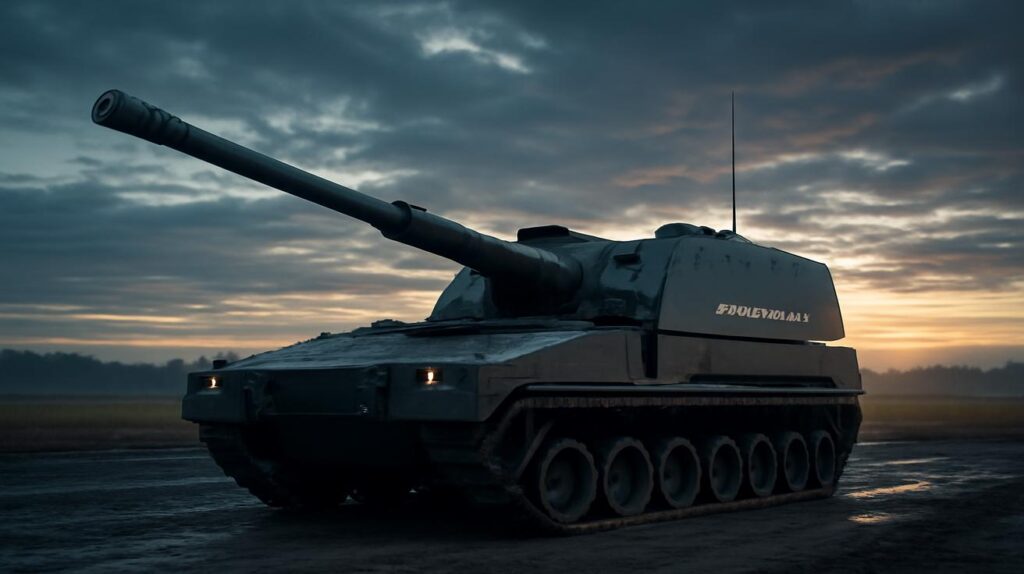
The story begins in a foggy Central European dawn, where the silhouettes on the horizon are not trees or church steeples, but cranes, gantries, and the blunt, angular outlines of armored vehicles. Somewhere on the outskirts of a Czech town, a test range echoes faintly with the sound of diesel engines, clanking tracks, and the metallic thud of artillery practice. It smells of cold air, machine oil, and earth. This doesn’t feel like the stage for a global financial story. And yet, from these unassuming facilities, a new European defence giant is quietly, methodically taking shape—far from the familiar power centers of Berlin and Paris.
A Giant in the Making, Born in the “Small” Country
Central Europe is used to being described with diminutives: small economies, small languages, small players between larger powers. But in the folds of this so-called “smallness,” the Czech-based Czechoslovak Group—better known as CSG—has spent the last decade building something surprisingly large.
Think of the company’s growth as rings in an old oak tree. In the early years, CSG was a regional industrial group dabbling in defence, rail, automotive, and heavy engineering. Each new acquisition added a ring: a struggling ammunition manufacturer here, an armored vehicle plant there, a radar company further down the road. Layer by layer, the trunk thickened, the roots deepened, and the canopy spread above the Central European landscape.
What makes this story different is where it’s happening. When we talk about European defence, our minds instinctively leap to Germany’s Rheinmetall or France’s Nexter and Dassault. The powerhouses, the familiar brands, the legacy giants. But the continent’s security architecture is shifting, and gaps are opening between what European governments say they need and what the old guard can promptly deliver.
Into that gap steps CSG: pragmatic, opportunistic, and surprisingly nimble. It is not burdened by a century of bureaucracy or by the intense political scrutiny that hovers around big French or German primes. Instead, it moves more like a fast, low-flying bird between the branches, securing contracts where production speed and flexibility matter as much as tradition and prestige.
Now, with a landmark IPO on the horizon, CSG is preparing to molt once more—this time into a fully-fledged, publicly traded European defence giant, headquartered not in a traditional capital of empires, but in the Czech Republic, a country whose recent history is marked by occupation, transition, and quiet resilience.
From Workshops to War Rooms: How the Czech Defence Machine Grew
Drive through certain parts of the Czech Republic and you’ll see traces of industrial history everywhere: old brick factories with tall chimneys, rusted rail sidings, workshops set back from the road behind simple iron gates. This is the landscape from which CSG emerged. Rather than chasing glossy new-build campuses, it moved into old sites and retooled them for a new era.
There is a certain sensory intimacy to that transformation. Step inside a modernized CSG plant and the smell of decades-old oil coexists with the crisp tang of newly cut metal. An aging overhead crane might rumble quietly above a row of CNC machines glowing with cool blue light. The past hasn’t been erased; it’s been rewired.
CSG’s business model has been, in many ways, a salvage operation turned strategic master plan. Where post-communist defence and heavy industry had once lain dormant or fragmented, the group stepped in to consolidate and invest. Ammunition factories were modernized and reconnected to global supply chains. Vehicle plants that once built armored personnel carriers for the Warsaw Pact began developing and upgrading platforms for NATO armies. Radar and electronic systems, once niche side-lines, became part of an integrated defence offerings portfolio.
As geopolitical tensions ramped up—first with Russia’s annexation of Crimea in 2014, and then with the full-scale invasion of Ukraine in 2022—the demand curve bent sharply upward. Countries that had quietly underfunded defence for decades suddenly rushed to replenish stockpiles of ammunition, vehicles, and support systems. In this scramble, CSG’s ability to respond quickly, produce at scale, and adapt existing industrial capacity turned it into something more than just another supplier. It began to look like an indispensable node in Europe’s defence network.
A Table of Scale: CSG’s Emergence in Context
To grasp the magnitude of what is unfolding, it helps to set CSG beside some of its more established peers. The numbers are estimates, the picture still in motion—but a contour emerges.
| Company | Headquarters | Main Focus | Position in Europe |
|---|---|---|---|
| Rheinmetall | Germany | Armored vehicles, artillery, ammunition | Established German heavyweight |
| Nexter (KNDS) | France | Tanks, artillery, land systems | French pillar of European land defence |
| Leonardo | Italy | Aerospace, electronics, helicopters | Diverse, aerospace-leaning giant |
| Czechoslovak Group (CSG) | Czech Republic | Ammunition, land systems, radar, mobility | Fast-rising Central European defence hub |
CSG’s impending IPO doesn’t just add another line to this table; it shifts the balance of where Europe’s industrial defence muscle is located. For the first time in decades, a major new player is emerging from outside the Franco-German axis, with the scale and ambition to shape procurement choices, industrial cooperation, and long-term capability planning.
The IPO as Coming-of-Age Ritual
There’s something almost ceremonial about a company going public. It is part financial transaction, part public performance, part rite of passage. For CSG, this IPO is not merely about raising capital; it is about stepping onto a stage that has, until recently, not been reserved for companies with “Czechoslovak” in their name.
Imagine the scene on listing day. Screens glow in a stock exchange far from the smoky workshops of Central Europe. Tickers scroll with unfamiliar consonant-heavy names; traders and analysts eye the order book. But thousands of kilometers away, in factories humming along Czech rivers and valleys, the sound of the IPO is not bells or applause. It is the rhythmic hiss of hydraulics, the rasp of welding torches, the steady, measured beat of production.
Going public forces a certain kind of openness. Balance sheets, strategy, risk, governance—all become a matter of public record, scrutinized not just by defence specialists but by pension funds, journalists, activists, and policymakers. For a defence group, that visibility is double-edged. On the one hand, it builds credibility and access to capital, allowing the company to expand capacity, invest in new technologies, and pursue international acquisitions. On the other hand, it invites questions: about ethics, export destinations, environmental impact, and the role of private industry in matters of war and peace.
CSG’s owners, long used to steering the ship from a relatively sheltered harbor, will have to learn to navigate the restless seas of public markets. Quarterly earnings calls will sit alongside long-term industrial investments that only bear fruit over years. Market sentiment, driven by everything from geopolitical shocks to shifting ESG expectations, will be an invisible but ever-present wind at the company’s back—or in its face.
Yet there is also something undeniably symbolic about a Czech-based defence group taking this leap now. It marks the maturation not only of one company but of an entire region’s industrial renaissance. The IPO is a signal that Central European industry is done being seen merely as “workshop for the West,” content to provide low-cost labor and subcontracting. It is claiming a place at the strategic table.
Between Old Frontiers and New Threats
Walk through Prague on a quiet evening and the city’s layered history is almost audible. Cobblestones worn by Habsburg boots, walls scarred by wars and revolutions, memorials to uprisings and invasions. The Czech Republic’s relationship with security and sovereignty is not theoretical; it is written into its streets and its collective memory.
That history shapes how a defence company like CSG is perceived at home. For many Czechs, the idea that their country is becoming a key supplier of the tools of defence to NATO allies is not just a business achievement but a narrative reversal—an evolution from a place once occupied and disarmed to one that produces capability, deterrence, and resilience for others. There is pride in that, but also introspection.
The wars and tensions that drive today’s defence spending feel close in Central Europe. Ukraine is not a distant theater; it is a neighbor reached in a day’s drive. Russian missiles and artillery are not abstract hardware items but things that have torn through real cities, homes, and lives. When CSG manufactures ammunition or armored vehicles destined for Ukraine’s defenders, the work on the factory floor is freighted with a human immediacy that is difficult to ignore.
This closeness sharpens difficult questions. How should a company grow responsibly in a world where demand for its products is driven by conflict? How does a region that knows occupation and dictatorship ensure that its industrial strength does not feed the wrong hands? And how do European governments balance the need to rearm with commitments to human rights and international law?
In these questions, the IPO is again a hinge. Public ownership means public accountability. Investors will query export policies; NGOs will dig into end-use controls; journalists will follow the trail from Czech factories to front lines across the world. This scrutiny can be uncomfortable, but it can also be a powerful mechanism for aligning growth with values. A European defence giant born outside the traditional core will be judged, in part, on how it uses its new power and visibility.
Shifting the Geography of European Power
Look at a satellite map of Europe at night and you’ll see the luminous clusters of old industrial power: the Ruhr valley in Germany, the Paris basin, northern Italy’s manufacturing belt. Those bright knots have long shaped where big decisions and big factories sit. The emergence of CSG, centered in the Czech Republic and connected to networks across Slovakia, Poland, and beyond, subtly redraws that map.
For the European Union, this geographic shift matters. Defence is becoming not just a military question but an industrial one: who has the capacity, the supply chains, the engineering talent to manufacture at the scale and speed that current threats demand? As countries pledge to raise defence spending, they increasingly want to keep that money circulating within Europe rather than flowing to suppliers overseas. But to do that, they need more than two or three giants. They need a dense, resilient web of producers.
CSG slots squarely into that emerging picture. From ammunition lines that can replenish NATO stockpiles, to mobile radars and vehicles that support both national armies and humanitarian operations, the group offers something that is both pragmatic and politically palatable: a European supplier, firmly inside the EU and NATO, yet located in a part of the continent that has been economically underweighted for decades.
The symbolism is powerful. A major defence group, headquartered in a country that once lived behind the Iron Curtain, now helping defend the enlarged European project that rose from that division. The IPO simply amplifies that story and broadcasts it to global investors, asking them to place a bet not just on a company, but on Central Europe’s role in the continent’s future security.
Factories, Forests, and the Quiet Weight of Responsibility
It is easy, in all this talk of markets and geopolitics, to forget the places where these changes actually take physical form. Somewhere, near a river lined with willows, stands a factory that has seen three political regimes and countless technological revolutions. Behind its fence, forklifts hum across concrete, carrying crates of components. Outside, a flock of birds lifts suddenly from a line of poplars as a vehicle roars to life for testing.
Nature and industry are not as separate as we sometimes imagine. The steel in a tank once lay quiet in an ore vein beneath a forest. The energy that drives a radar came from wind, water, or fossil fuels scraped from ancient seabeds. Around CSG’s plants, seasons still change: snow piles against blast walls in winter, wildflowers push up along rail tracks in spring, heat shimmers over parking lots in summer. Workers step out during their breaks and feel the same sun and wind that fall on empty fields further away.
This proximity gently insists on a broader perspective. Building a defence giant is not just about securing contracts and pleasing shareholders. It is about deciding what kind of footprint—environmental, social, ethical—a company will leave in the landscapes and communities it inhabits. How noisy are the test ranges? How clean are the effluents? What happens to local economies when production surges—or falls? How are employees trained, protected, and listened to?
The modern language for such questions is ESG: environmental, social, governance. But behind the acronym lies something older and more elemental: responsibility. As CSG’s IPO brings a new influx of capital and a sharpened growth trajectory, that responsibility grows heavier. The forests and towns that watch the company’s rise from their edges will bear witness not only to its profits but to its choices.
In a Europe that is simultaneously rearming and trying to decarbonize, the intersection between defence and sustainability will be a contested, evolving space. Public investors and policymakers will increasingly demand cleaner processes, lower emissions, and smarter resource use from defence manufacturers. The companies that thrive will be those that learn to reconcile the hard steel of security with the soft but unyielding constraints of the natural world that ultimately sustains it.
Looking Ahead: A New Center of Gravity
So where does this story go from here? An IPO is a beginning disguised as a culmination. The real narrative will unfold over the coming years and decades, written in the language of orders booked, partnerships signed, plants expanded, and perhaps technologies invented that we can barely imagine today.
What seems certain is that the idea of European defence will feel less and less like a conversation between Paris and Berlin alone. The map is decentralizing, the voices multiplying. In that more polyphonic landscape, CSG’s rise stands out as a vivid example of how history, geography, and opportunity can combine to create something structurally new.
Somewhere on that Czech test range, another vehicle is rolling out under a lowering sky, its engine note blending with distant highway traffic and the rustle of wind through fields. For the workers watching, it may be just another day’s output. For a portfolio manager in London or Amsterdam, it may be a line item in a prospectus. For a policymaker in Brussels or Warsaw, a component of a reshaped European capability. For a villager walking a dog along a nearby lane, simply a familiar rumble beyond the trees.
But look closely, and you can sense the scale of what is quietly being built. A new European defence giant—rooted not in the traditional bastions of power but in a country that once stood at the fault line of empires—is about to step fully into the light of global markets. The cranes and gantries on that misty horizon are more than metal and cables. They are the scaffolding of a new center of gravity in Europe’s industrial and strategic story.
Frequently Asked Questions
What is Czechoslovak Group (CSG)?
CSG is a Czech-based industrial and defence group that brings together companies active in ammunition production, land systems, radar and electronics, mobility solutions, and other heavy industries. Over the past decade, it has grown from a regional player into one of Europe’s significant defence manufacturers.
Why is CSG’s IPO considered a landmark event?
The IPO is seen as landmark because it marks the emergence of a large, publicly traded European defence company based outside the traditional power centers of Germany and France. It signals the growing strategic and industrial importance of Central Europe in Europe’s defence architecture.
How does CSG differ from established European defence giants?
Unlike long-established giants such as Rheinmetall or Nexter, CSG has grown rapidly through consolidating and modernizing post-communist industrial assets. It is often more nimble, with a strong focus on ammunition, land systems, and adaptable production capacity, and it is headquartered in the Czech Republic rather than in Western Europe’s traditional defence hubs.
What impact could the IPO have on European defence capabilities?
The IPO can provide CSG with additional capital to expand capacity, invest in new technologies, and pursue international partnerships or acquisitions. This can help increase Europe’s ability to produce ammunition, vehicles, and other systems at scale—crucial for replenishing stockpiles and strengthening deterrence.
Are there ethical concerns around investing in a defence company like CSG?
Yes, defence investments naturally raise ethical questions. Some investors avoid the sector entirely, while others see it as essential for legitimate defence and deterrence. With CSG going public, its export policies, governance, and environmental impact will come under closer public and investor scrutiny, shaping how responsibly it can grow.
Why is Central Europe becoming more important in the defence industry?
Central European countries, including the Czech Republic, have inherited substantial industrial infrastructure and engineering talent. As Europe re-arms and seeks to keep more procurement within the EU, these countries are well-positioned to expand production capacity. Their proximity to current security tensions also makes their role particularly relevant.
How might CSG’s growth affect local communities and environments?
CSG’s expansion can bring jobs, investment, and technological upgrades to local communities. At the same time, it increases responsibility around environmental management, noise, resource use, and long-term economic resilience. Balancing industrial growth with sustainability and community well-being will be a key test for the company after its IPO.