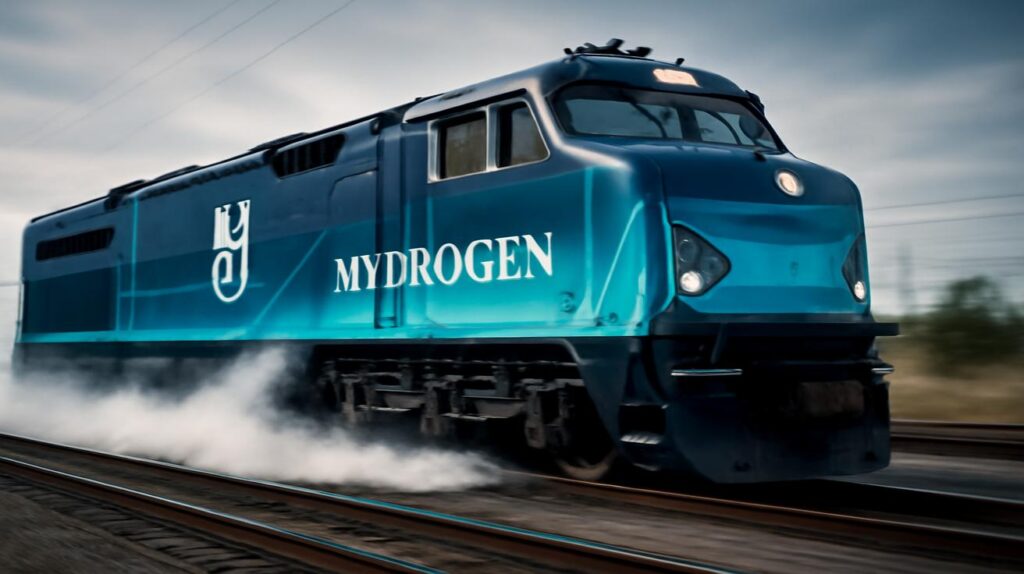
The first thing you notice is the silence. Not the absolute quiet of a forest after snowfall, but a new kind of hush: a 20,000-ton freight train easing forward without the growl of diesel, its movement announced only by the faint hum of electric motors and the soft crunch of steel on steel. Somewhere on a rail line in Inner Mongolia, a locomotive the color of fresh-cut steel rolls beneath a winter sky, dragging a chain of cars that seems to run all the way to the horizon. To an untrained eye, it’s just another train. To engineers, policy makers, and rival nations watching closely, it’s something else entirely—a signal flare from the future.
A Cold Morning, a Warm Engine
It’s still dark when the technicians arrive at the depot. Frost clings to the tracks, ghostly vapors rising as their headlamps sweep across the yard. The air smells of metal and coal dust, a reminder that for more than a century, this region’s lifeblood has moved by rail. But today the coal, if it moves, will be pulled by a machine designed to leave very little trace of its passing.
The locomotive stands waiting, hulking and self-contained. Instead of a familiar diesel roar, there’s only a faint whispering of pumps and electronics, like a distant ventilation system in a sleeping building. Inside its frame, stacks of fuel cells quietly convert hydrogen into electricity and water vapor. No smoke. No oily exhaust hanging in the air. Just the crisp bite of winter and the faint, slightly lab-like scent of hydrogen infrastructure—sterile metal, clean pipes, new paint.
Engineers move around it with a mix of pride and tension. They know the numbers by heart: up to 2,600 kilowatts of power, designed to haul 20,000 tons, able to run long stretches on hydrogen without refueling. On paper, it is the most powerful hydrogen fuel cell locomotive ever built. In practice, today will test whether tomorrow’s promises can survive the unromantic reality of freight logistics, crosswinds, and frozen switches.
Rivalry on the Rails
When people talk about modern rail innovation, one country’s name arrives faster than a bullet train: China. It runs the world’s largest high-speed rail network, lays tracks through deserts and mountains at astonishing speed, and exports rail technology to dozens of nations. Its rival—sometimes framed as its mirror image on the world stage—is not a single country, but a loose constellation: the United States, the European Union, Japan, South Korea, and a handful of others, all wrestling with how to keep pace without copying the same playbook.
In this quiet race, the battlefield isn’t always spectacular stations or glamorous passenger trains streaking between megacities. It’s also in the strange niches: ore-hauled across steppe, timber dragged out of remote forests, freight crawling along lines far from headlines and political speeches. It’s here that hydrogen trains become more than a technological curiosity. They become a strategic statement.
Every major industrial power knows the problem: freight rail is hard to decarbonize. Electrified lines are clean in operation, but incredibly expensive to string across thousands of kilometers of sparsely used track. Diesel is cheap, dirty, and maddeningly effective. Hydrogen, for all its challenges, offers an alluring middle ground—a way to keep the flexibility of diesel while trading soot for water vapor.
So when China’s biggest rivals—especially in Europe and North America—look at this record-setting hydrogen locomotive, they see more than horsepower. They see a benchmark, a gauntlet thrown down. Who will build the cleanest, most capable workhorses for the world’s freight lines? Who will define the railway of the next fifty years?
The Sound of a Turning Point
On the test track, the driver eases the throttle forward. Inside the cab, the noise profile is uncanny: the muted click of relay switches, the rise of electric traction motors, the almost spaceship-like hum that replaces the belch and bellow of diesel. Outside, the locomotive gathers itself and begins to pull.
The first few meters are always the most nerve-wracking. Freight trains are like stubborn animals; they resist motion with a kind of physical grudge. Yet the hydrogen locomotive leans into the load with confidence, the power curve rising cleanly on the cabin’s displays. Behind it, couplers stretch, creak, and then settle as the entire chain begins to roll. The air thickens with the metallic scent of friction, but not with exhaust.
Watching from the lineside, an engineer captures it on a tablet. Not just the train, but the numbers: torque, current, fuel consumption, cell temperature, ambient wind. These data points will migrate later into white papers, export pitches, and—inevitably—into intelligence briefings in other capitals. Because in an era where supply chains are national security, even a locomotive’s data stream is of geopolitical interest.
How Hydrogen Locomotives Rewrite the Old Rules
To understand why this particular locomotive matters, you have to step back from the frost and the noise and look at the larger diagram sketched across the map.
Conventional freight rail runs on two main systems: fully electrified corridors with overhead lines or third rail, and diesel-operated lines that need only steel, sleepers, and fuel. Each has its domain. Electrified corridors are efficient and clean in operation, but costly to build and maintain. Diesel goes where wires don’t—remote lines, industrial sidings, lightly used branches choked with vegetation in summer and snowdrifts in winter.
Hydrogen-powered trains slip between these two worlds. They are, in essence, electric trains that carry their own power stations. Hydrogen is fed into fuel cells that generate electricity, which then drives traction motors. The only direct by-products are heat and water. Done right, it’s like having the advantages of a wired line without stringing a single new cable.
But the appeal is not just theoretical. It’s logistical, economic, and strategic:
| Aspect | Diesel Freight | Hydrogen Freight |
|---|---|---|
| Local Emissions | CO₂, NOx, particulates, soot | Water vapor, heat only (at point of use) |
| Infrastructure Needs | Fuel depots, minimal track upgrades | Hydrogen production, storage, and refueling depots |
| Decarbonization Potential | Limited; dependent on biofuels or offsets | High, if hydrogen is produced from low-carbon sources |
| Noise Levels | High engine noise and vibration | Lower, dominated by motor hum and wheel noise |
| Operational Flexibility | Very high, established global supply chains | Growing, depends on hydrogen network rollout |
The record-breaking locomotive slots itself into this matrix as a proof of concept at industrial scale. This isn’t a light commuter shuttle or a pilot project pulling a few cars through a scenic valley. It’s meant to move heavy freight, day after day, in a landscape of mines, ports, and heavy industry. If hydrogen can work here, its advocates say, it can work almost anywhere.
Tomorrow’s Trains, Today’s Politics
In conference rooms far from the raw chill of the rail yard, the story of this locomotive takes on a different tone. PowerPoint decks appear, filled with maps streaked in color: potential hydrogen corridors, export routes, long-distance freight lines that might be converted in the next decade. The voices around the table talk of megatons of CO₂ avoided, job creation in green industry, energy security, and national prestige.
China’s biggest rivals see hydrogen rail as a multi-layered opportunity. For Europe, it’s one more lever to hit ambitious climate targets, especially in regions where electrification is physically difficult, like mountainous lines or low-traffic rural stretches. For Japan and South Korea, which lack domestic fossil fuel resources, hydrogen offers a way to diversify away from imported hydrocarbons while exporting engineering expertise. For the United States, it’s a possible bridge between vast freight networks and a renewable-heavy power grid that increasingly needs new forms of energy storage and consumption.
And for all of them, there’s the same lingering question: will they lead, or will they buy?
China’s move to build the world’s most powerful hydrogen locomotive is not just a technical feat; it’s an industrial strategy. It signals to potential customers in Central Asia, Africa, Latin America, and beyond: when you’re ready to decarbonize your freight lines, we have a turnkey solution. Locomotives, hydrogen production plants, storage tanks, maintenance depots—packaged, financed, and delivered.
That offer makes others nervous. In Berlin, Washington, Tokyo, and Brussels, policymakers are increasingly determined not to let another strategic technology slip away. They are determined to dream of their own tomorrow’s trains—for reasons that are as much about geopolitics as about clean air.
The Human Side of a Hydrogen Future
Amid all the talk of gigawatts, megatons, and export markets, it’s easy to forget that trains are intimate pieces of technology. They shape the lives of the people who run them and the communities they pass through.
Stand trackside as the hydrogen locomotive rolls past, and you feel that subtle shift. The roar that would send conversation scattering to the wind is gone. It’s still loud—40 axles grinding over joints will never be gentle—but the sound is thinner, cleaner, somehow less aggressive. Villages along the line may not notice at first, but they’ll notice over time: less diesel tang in the air, less soot collecting on windowsills, fewer nights shaken by idling engines in nearby yards.
For the crew inside the cab, the difference is tactile. Fewer vibrations, less constant thrumming underfoot, more of a sensation of gliding than rattling. Drivers used to reading the “feel” of a diesel engine—listening for the pitch of the motor, sensing subtle changes in vibration—now watch readouts and flow charts, learning to trust the invisible chemistry beneath their feet.
Maintenance crews, too, have to rewrite their muscle memory. No more oil-blackened hands from engine overhauls; instead they deal with high-pressure tanks, membrane stacks, and power electronics. Safety training shifts from fire and fuel spills to the unique behavior of hydrogen—its eagerness to escape confinement, its invisible flame, its insistence on respect.
That human transition might be the hardest part. Not because hydrogen is inherently more dangerous or difficult than diesel, but because entire cultures of work must be updated: new certifications, new suppliers, new emergency procedures, new stories passed from old hands to new recruits. Every industrial revolution is also a story of people learning to trust strange new machines.
Challenges on the Track Ahead
If the morning’s test run is a kind of quiet triumph, the engineers know better than to celebrate too soon. Records, after all, are snapshots. The real measure of this locomotive will be the years and millions of kilometers ahead.
Hydrogen’s critics have plenty of arguments:
- Producing truly green hydrogen—using renewable electricity and water—is still expensive and limited in scale.
- Transporting and storing hydrogen safely requires infrastructure that does not yet exist in most rail networks.
- Energy efficiency losses, from electricity to hydrogen and back again, can be higher than simply electrifying lines where practical.
Supporters counter that no single solution will decarbonize global freight. The future will be messy and plural: overhead wires in dense corridors, hydrogen where wires don’t make sense, battery trains on shorter routes, and biodiesel or synthetic fuels where nothing else fits yet. In that patchwork, a world-leading hydrogen locomotive is less a silver bullet and more a powerful proof that one piece of the puzzle is ready to be scaled.
China’s rivals are responding in kind. European firms are refining their own hydrogen and hybrid freight concepts, testing them quietly on secondary lines. North American railroads, historically conservative, are experimenting with pilot locomotives in switching yards and short-haul routes. The competition is no longer about who can build a fast train—that race was settled long ago—but about who can build a clean, hard-working one that makes business sense.
The Dream in the Distance
As the day wears on, the new locomotive returns again and again along the test stretch, hauling, braking, idling, refueling. Each run adds a thin layer of confidence. The hydrogen tanks behave. The cells stay within safe temperatures. The power electronics shrug off the bitter air. Over time, the extraordinary becomes routine—the surest sign that a technology is maturing.
In the afternoon, the light slants low, turning the rails into silver bands. From a distance, the train is just a dark line moving across a pale plain, one more industrial animal at work. Children watching from a nearby road embankment would never guess they’re seeing a record-setter, an exhibit in a silent contest between nations, a machine wrapped in dreams about decarbonization and power.
Yet in quiet ways, the significance accumulates. Every ton of freight pulled without burning diesel is a small subtraction from the atmosphere’s burden. Every engineer trained to work with hydrogen is a seed of future expertise. Every rival studying this locomotive’s specifications is a nudge toward their own innovation.
Tomorrow’s trains are rarely born with fireworks. They arrive like this: on frosty mornings, with checklists and radio calls, with coffee in disposable cups and pencil notes in worn notebooks. They arrive as prototypes that slowly become products, as ambitious projects that gradually turn into the new normal.
Somewhere in research labs in North America and Europe, engineers are already sketching their response on whiteboards. More power. Longer range. Cheaper fuel cells. Smarter controls. Their governments talk of hydrogen valleys and green corridors, their companies of export markets and strategic autonomy. Everyone, it seems, is dreaming of the same future: steel wheels, clean energy, deep-cut tracks leading out into a world that must move goods without overheating the sky.
For now, though, the most powerful hydrogen locomotive in the world belongs to one ambitious player. It glides through its winter trials beneath a wide northern sky, carrying with it not just freight, but a message: the race for tomorrow’s trains has already left the station.
FAQ
What makes this hydrogen locomotive a world record holder?
Its claim to the record rests on power and capability. With fuel cells delivering up to around 2,600 kilowatts and the ability to haul roughly 20,000 tons of freight, it surpasses earlier hydrogen locomotives, which were typically designed for lighter passenger services or short-haul duties.
How does a hydrogen locomotive actually work?
Hydrogen stored in high-pressure tanks is fed into fuel cells, where it reacts with oxygen from the air. This electrochemical process produces electricity, water, and heat. The electricity powers traction motors that drive the wheels, just like in an electric or diesel-electric locomotive, but without exhaust emissions at the point of use.
Is hydrogen rail really better for the environment?
It depends on how the hydrogen is produced. If hydrogen comes from renewable-powered electrolysis, overall emissions can be very low. If it’s produced from fossil fuels without carbon capture, the climate benefits are much smaller. At the train itself, however, local pollution is dramatically reduced compared with diesel.
Why not just electrify all freight lines instead?
Full electrification is efficient, but it’s costly and complex, especially on low-traffic or remote routes. Installing and maintaining overhead wires across thousands of kilometers isn’t always economical. Hydrogen locomotives offer a way to “electrify” trains on these lines without building new electrical infrastructure along the track.
Will hydrogen locomotives replace diesel everywhere?
Unlikely. The future of rail is expected to be a mix: classic electrification on dense corridors, hydrogen and hybrid systems on non-electrified stretches, batteries on shorter routes, and cleaner liquid fuels where necessary. Hydrogen locomotives are poised to take a significant share of the non-electrified, heavy-duty segment, especially as infrastructure and green hydrogen production expand.