The first thing you notice is the color of the water. It isn’t the deep, unbroken blue you expect from the open South China Sea. Instead, it’s a muddied turquoise, streaked with beige swirls that curl and twist like smoke. Beneath the belly of a dredging ship, a slurry of sand and silt gushes out, turning the sea into something halfway between liquid and land. Engines roar. Steel groans. And very slowly, almost imperceptibly, a shape begins to rise from the waves—a pale, artificial shoal where yesterday there was nothing but water.
From Reef to Runway: The Slow Birth of New Land
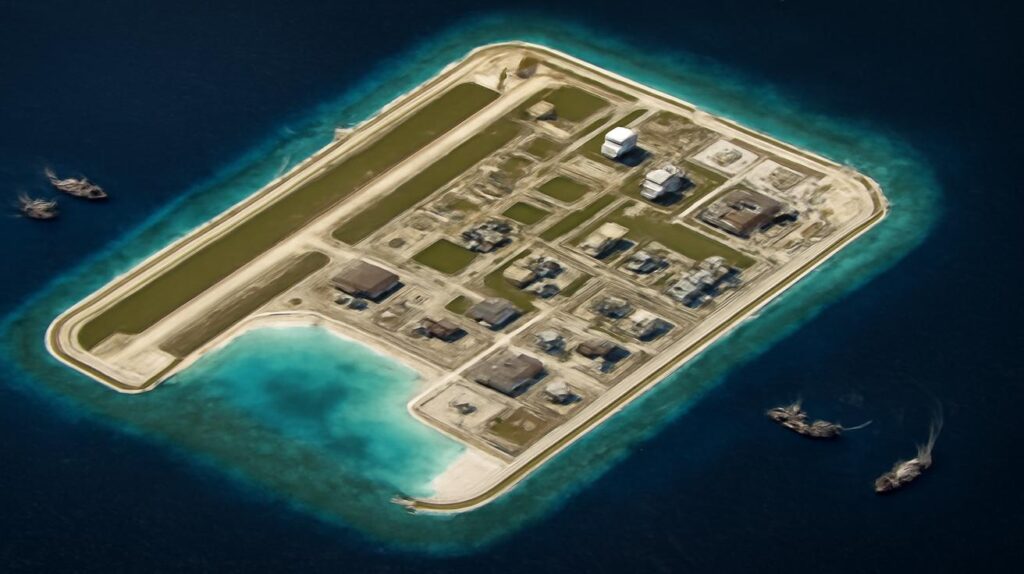
On satellite images, the transformation looks almost like stop-motion animation. Click through the years and you see it: coral reefs that were once pale freckles in a vast blue expanse swelling into solid, geometric forms. What began as scattered maritime features—submerged reefs, lonely rocks barely peeking above the surface at low tide—are now unmistakable islands, complete with airstrips, harbors, and straight-edged shorelines that nature would never design on her own.
For more than a decade, China has been pouring sand into the sea, literally manufacturing land in one of the most contested corners of the planet. The technology is not new; land reclamation has reshaped coasts from Dubai to Singapore. But the speed, scale, and geopolitical implications of what’s happened in the South China Sea are something else entirely.
Imagine standing on the deck of a dredging vessel in the early morning gloom. The air smells metallic and faintly rotten, like wet rust and disturbed seafloor. Giant hoses snake from the ship down into the depths, sucking up sand, crushed shell, and bits of coral. The slurry is then blasted onto shallow reefs, where bulldozers crawl like insects over the growing surface, pushing the new material into shape. Day after day, month after month, the sea is persuaded to harden into something you can stand on.
There’s a strange, disorienting feeling to walking along these newborn shores. The sand is coarse, raw, almost too bright under the glare of the sun. There are no seashells, no driftwood, no tide-carved patterns that speak of seasons and storms. The line where surf meets land feels temporary, as if the ocean is still considering whether to accept this intruder.
The Engine Behind the Islands
Behind this transformation is a flotilla of some of the world’s most powerful dredging ships. These vessels are like floating factories, equipped with monstrous mechanical mouths that scrape and suck the seafloor. They operate relentlessly, often around the clock, guided by GPS, sonar, and digital mapping systems that turn seascapes into grids of depth and volume.
Inside the control rooms, the atmosphere is less ocean adventure and more quiet, humming data center. Screens glow with coordinates and bathymetric charts. Operators track the density of the sand mixture, the rate of pumping, the exact contours of the growing island. Outside, the process looks almost chaotic—turbid water, roaring pumps, spray arcing through the air—but in truth it’s carefully choreographed engineering.
Once a sufficient mound has risen from the reef, nature’s oldest enemy—gravity—becomes the next challenge. Sand alone is fickle. It slumps, shifts, and erodes with every wave and storm. So engineers reinforce the edges with rock, concrete, and steel. They drive piles deep into the seabed. They lay down geotextiles and armor the perimeter with long lines of boulders or prefabricated seawalls, trying to convince the island to stay put.
Then comes the unmistakable human fingerprint: straight roads etched across the pale surface, a grid of foundations, radar domes gleaming in the sun, hangars, fuel storage tanks, and the long, flat strips of runway that can handle military aircraft. What began as a ghostly smear of sand becomes, in a few short years, something that looks permanent, purposeful, and strategically placed.
The Geography of Power
To understand why all this sand matters, you have to zoom out—far out. At altitude, the South China Sea is a restless triangle of blues and grays framed by China to the north, Vietnam to the west, the Philippines to the east, and Malaysia and Brunei to the south. It’s a maritime crossroads, a body of water that carries a sizeable portion of global trade, from crude oil to smartphones.
But beneath that busy surface lies a patchwork of claims and counterclaims, dotted with features that, until recently, were barely more than lines on nautical charts: Fiery Cross Reef, Subi Reef, Mischief Reef, and others whose names sound like they belong in some old mariner’s tale rather than a modern diplomatic standoff.
For decades, these reefs were little more than symbols—awkward, contested markers in disputes over maritime boundaries and resource rights. They were shallow, fragile, and largely inaccessible, especially during bad weather. But when you turn a reef into an island, you change the calculus. An artificial island can hold people, planes, radar systems, ships, and weapons. It can host harbors deep enough for large vessels. It becomes a permanent, physical presence in a place that used to be mostly abstract, a line on a map.
And so, over the years, as sand piled up and concrete was poured, a new geography of power emerged. China’s artificial islands are not just engineering projects; they’re signals in stone and steel, messages broadcast not by radio but by the blunt reality of new land where water used to be.
What the Ocean Loses
From space, these islands look neat and contained—thin outlines of white and gray within the blue. But from the perspective of a coral polyp or a parrotfish, the story is closer to catastrophe.
Before the dredgers arrived, many of these sites were rich coral reef ecosystems: latticed structures built over centuries, nurseries for fish, feeding grounds for sea turtles, hunting grounds for sharks, resting places for seabirds. Reefs are living architecture, complex and crowded, humming with color and movement. The moment a dredging hose begins to roar to life above them, that delicate architecture is in danger.
The process of vacuuming up sand and crushed coral doesn’t just scrape the seafloor; it smothers nearby reefs in clouds of fine sediment. Coral, which depends on clear water and sunlight, begins to suffocate. Fish scatter. Sea cucumbers, clams, and crabs are buried alive. The reef’s beautiful complexity collapses into a monotone sludge of broken fragments.
Even after the new island is built, the wound continues to bleed. Construction means more runoff, more pollution, more disruption. The sheer change in shape of the seafloor changes how currents move, which in turn affects how larvae disperse, where nutrients flow, and how nearby ecosystems breathe and feed.
Scientists who study the region talk about these changes in careful, measured language: “habitat loss,” “biodiversity decline,” “altered sediment regimes.” But beneath those neutral terms lies something more visceral—the quiet dying of places that took millennia to grow.
Numbers in Sand: Scale, Time, and Impact
It helps to see the islands not just as shapes, but as quantities. Imagine trying to weigh the sand lifted from the seabed, to count the individual grains forcibly rearranged. While precise figures vary depending on the source and method, what’s clear is that this is transformation on a massive scale.
| Aspect | Approximate Scale | What It Means in Practice |
|---|---|---|
| Years of major island building | Roughly a decade+ | From scattered reefs to a network of artificial islands within a human working lifetime. |
| Number of major features transformed | Several key reefs and shoals | Multiple once-submerged reefs now host airstrips, docks, and buildings. |
| Reclaimed land area | Hundreds of hectares | Equivalent to turning scattered reef tops into small human-made islands and mini-bases. |
| Ecological footprint | From local reef loss to regional effects | Damage extends beyond the exact footprint due to sediment plumes and altered currents. |
These numbers, while approximate, hint at the enormity of what has happened. You could think of it as a slow-motion earthquake—except instead of tectonic plates grinding over eons, this is human intent, expressed in steel and diesel and sand, reshaping the seafloor at industrial speed.
Life on a Manufactured Horizon
What does it feel like to actually live and work on one of these artificial islands? The reality is far from the glamorous, futuristic visions of floating cities some architects like to sketch. Life here is contained, controlled, and deeply dependent on supply lines and machinery.
Step outside on a clear day and you’re immediately aware of how exposed you are. There are no hills, no trees, no natural shelter. The wind moves unimpeded across the flat expanse, carrying with it fine grains of sand that sting your eyes and collect in the corners of windows and doors. The horizon is a ring of water in every direction, the sky a vast, receding dome.
At night, the islands glow like isolated circuits etched into the dark—runway lights, floodlights, the soft rectangular glare of windows in barracks and control towers. The soundscape is a mix of distant waves and the constant thrum of generators, air-conditioning units, and machinery. The island feels both utterly remote and strangely artificial, as though you are living on a film set assembled in the middle of an empty ocean.
There is a psychological weight to such a place. For the people stationed there, the island is at once a home, a workplace, and a strategic outpost. Every crate of food, every drop of fuel, every medical supply arrives by ship or plane. Freshwater must be carefully managed. Waste must be processed or carried away. The line between self-sufficiency and vulnerability is thin, always humming just beneath daily routines.
The Ocean Remembers
For all the engineering prowess on display, the sea is not a passive backdrop. It presses back—constantly, patiently. Typhoons slam into the islands, testing the strength of seawalls. Storm surges claw at shorelines. Salt eats at metal. The very sand that was pumped up and shaped into land wants to move, to slump, to slide back toward the depths from which it came.
Standing on one of these islands during bad weather, you can feel this contest in your bones. Waves strike the reinforced perimeter with a low, percussive boom that you feel under your feet. Wind drives sheets of rain across the barren ground. Even with shelter walls around you, there is a sense of precariousness, of borrowed time.
Global seas are rising too, slowly but steadily. The irony is stark: nations build artificial islands to cement claims and project influence, just as the old lines between land and water begin to blur under a changing climate. Engineers can raise and fortify these structures, but the long-term conversation between sea level and sand is far from settled.
Nature is not vengeful in any human sense, but it is persistent. Every grain of sand placed by a dredging pipe is now part of that larger, planetary conversation about coasts, storms, and the fluid boundary between solid ground and moving water.
What It Says About Us
Pull back even further, beyond the politics and the maps, and these islands start to look like something else: a mirror. They reflect not just national ambitions but a distinctly human impulse—to occupy, to redraw, to extend our reach onto spaces that once resisted us.
We have been doing this for centuries: draining wetlands, taming rivers, building dikes and polders, pushing cities into the sea on foundations of rubble and fill. The artificial islands in the South China Sea are simply a sharper, more visible expression of that same drive, carried out with modern tools in a highly sensitive space.
There’s a friction here between awe and unease. On one hand, it is astonishing that we can, with enough machinery and fuel, call into existence new pieces of geography. On the other, there’s the unsettling realization that such power is being wielded in places of incredible ecological fragility and political tension.
When coral reef becomes runway, when sea becomes borderland, the costs are not only measured in diplomatic communiqués and strategic advantages. They are also counted in lost habitats, altered tides, and the slow, quiet rearrangement of how life—human and non-human alike—inhabits this shared ocean.
In the end, the story of China dumping sand into the South China Sea to build islands is not just about one nation or one region. It is part of a larger human narrative about how we treat the boundaries of our world: as limits to respect, or as invitations to override.
Frequently Asked Questions
Why is China building artificial islands by dumping sand into the ocean?
China’s artificial island building serves multiple purposes: it strengthens territorial claims in disputed waters, provides bases for military and coast guard operations, supports surveillance and logistical activities, and helps project influence over busy sea lanes and potential offshore resources. Turning reefs into islands effectively turns abstract map claims into concrete, inhabitable outposts.
How are these islands actually constructed?
The process typically involves large dredging ships that suck up sand and sediment from the seafloor and pump it onto shallow reefs or shoals. Bulldozers and excavators then spread and compact this material, raising it above sea level. Once a basic landform is created, engineers reinforce it with seawalls, concrete, and rock, before building infrastructure such as runways, docks, housing, and radar installations.
Are these new islands stable in the long term?
Artificial islands built mainly from sand require constant maintenance. They are vulnerable to erosion, storms, and sea-level rise. Reinforced seawalls, buried rock cores, and engineered drainage systems help, but the islands are in a dynamic, high-energy marine environment. Long-term stability depends on ongoing engineering work and adaptation to changing ocean conditions.
What is the environmental impact of dumping sand to create islands?
The environmental impact is significant. Dredging destroys seafloor habitats and smothers coral reefs under sediment plumes. Sensitive species lose feeding and breeding grounds. The altered seafloor and new coastal shape can change local currents, affect water quality, and disrupt broader reef ecosystems. Much of the damage is difficult or impossible to fully repair in the short term.
Do these artificial islands change international law or maritime boundaries?
Under international law, artificial islands generally do not generate the same maritime zones as naturally formed land. While they can serve as bases or installations, they do not typically create new territorial seas or exclusive economic zones. However, in practice, their presence on the water complicates disputes, alters behavior at sea, and can influence how power and access are negotiated, even if the legal status remains contested.