The wind came in sideways across the pack ice, sanding my cheeks with snow as fine as powdered glass. Overhead, the sky was the color of steel, the kind of heavy Arctic gray that swallows distances and sound. The boat’s engine muttered beneath my boots, and everyone on deck had fallen silent at the same moment, our binoculars raised in a synchronized, almost reverent motion. Out on the ice, a creamy shape moved with lazy purpose. Another shape appeared behind it. Then another.
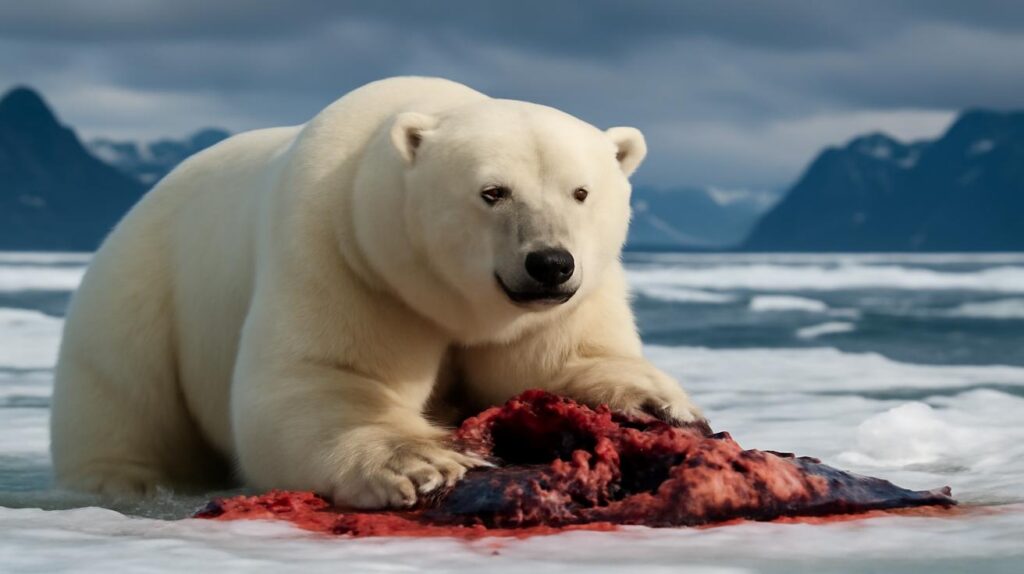
Three polar bears—mother and two nearly grown cubs—ambled across the frozen surface as if they owned every last snowflake. And in a way, they do. But there was something else about them that caught the eye before the awe had even settled: they were big. Not just “large animal” big. They were heavy, thick through the neck and shoulders, with a layer of fat that made their movements look unhurried and confident. In other corners of the Arctic, polar bears are thinning, starving, searching longer each year for the seals they rely on. Yet here, off the coast of Norway’s Svalbard archipelago, these bears looked almost…prosperous.
This is the paradox of Norway’s polar bears: in a world warming at frightening speed, where sea ice retreats earlier each spring and returns later each autumn, the very animals most dependent on that ice are—at least in this part of their range—getting fatter and healthier. It sounds like a contradiction, maybe even a cruel joke played by statistics. But out on the ice, with the low sun catching on their thick fur and the dark water breathing at the edge of the floe, the evidence is surprisingly round and very much alive.
The Arctic that isn’t supposed to exist anymore
From the deck, the Arctic looks timeless. The ice fields stretch away into a white infinity, the mountains of Spitsbergen rise in blue-gray tiers on the horizon, and the water between floes laps gently against their undersides in a sound like slow applause. But the Arctic of our imagination—frozen, stable, untouched—is no longer real. The change is obvious even here, to those who know where to look.
The sea ice around Svalbard forms later now. Winter arrives hesitantly, like someone unsure whether they’re welcome. Satellite records show that the Barents Sea, on the doorstep of these islands, is warming faster than almost any other ocean region on Earth. The ice-free season is getting longer. The old, multiyear ice that stayed stubbornly through summer is mostly gone, replaced by thin, fragile skins that come and go with each season.
On paper, this is terrible news for polar bears. They hunt seals from the ice, waiting by breathing holes or ambushing them as they haul out to rest. Less ice should mean fewer hunting platforms and more swimming, which drains energy and can even drown cubs. And indeed, in places like Western Hudson Bay in Canada, the story has been grim: shorter hunting seasons, thinner bears, declining reproduction.
Yet in Svalbard and the surrounding Barents Sea region, researchers are reporting something very different. When they capture and assess bears for long-term monitoring—measuring fat reserves, taking blood samples, checking teeth and body condition—they’re finding that, on average, the bears are actually heavier than they were a few decades ago. Adult females, especially, are carrying more fat. Cubs are growing faster. The bears here look, by several measures, healthier than in the past.
Out on the ice, you can see it in the casual way a well-fed bear moves. There’s no frantic zigzagging, no desperate testing of every hole and shadow. Instead, there’s the calm, almost arrogant stroll of an apex predator that knows dinner is coming, sooner or later.
The hidden menu beneath the ice
To understand why these Norwegian Arctic bears are thriving, you have to go below the ice—into the cold, dark water where the food chain begins with invisible drifters and ends with a bellyful of seal fat. Warming oceans don’t just melt ice; they rearrange the entire pantry of a marine ecosystem.
As Atlantic waters push farther north, the Barents Sea is becoming what scientists call “Atlantified.” Warmer, nutrient-rich currents bring new species into contact with the old Arctic residents. The result is a complicated, shifting food web. Some species suffer. Others boom. And a handful of top predators, like the polar bears, find unexpected opportunity in the chaos.
For polar bears, the primary currency is fat. A ringed seal pup is a dense package of calories wrapped in soft fur and innocence. An adult bearded seal is even richer—a box of butter with whiskers. In much of the Arctic, retreating ice has made these seals harder to reach. But in Svalbard’s waters, something different is happening: the food available to seals themselves has changed, and in some cases, improved.
Warmer, open waters support more fish, particularly species like capelin and polar cod, which flourish in the mixing zones between cold and warm currents. More fish can mean more, and sometimes fatter, seals. And what’s good for seals is, by grim extension, excellent for polar bears.
There’s also another twist: as glaciers around Svalbard retreat, they leave behind new fjords and shallow bays that become productive hotspots. Meltwater carries nutrients; sunlight penetrates farther into newly ice-free areas; plankton blooms light up the water column. These fertile pockets attract fish, which attract seals—which, inevitably, attract bears. In this scrambled Arctic, some hunting grounds are actually becoming richer, even as the broader region loses its old rhythms.
| Region | Sea Ice Trend | Polar Bear Condition | Main Food Changes |
|---|---|---|---|
| Western Hudson Bay (Canada) | Earlier melt, later freeze | Thinner, declining | Shorter seal hunting season |
| Southern Beaufort Sea (Alaska) | Rapid loss of summer ice | Poor condition, lower cub survival | Fewer ice-based hunts, more swimming |
| Barents Sea (Norway’s Arctic) | Strong warming, less stable ice | Heavier, generally healthier | Richer seal prey in some areas |
The table could never tell the whole story—the hush on the water when a bearded seal surfaces for air, the sudden explosion of white fur as a bear lunges from the edge of a floe—but it hints at the underlying contradiction. The same warming that pushes some populations toward starvation appears to be stocking the larder here, at least for now.
Protection, peace, and the long shadow of hunting
There’s another reason Norway’s polar bears are doing well, and it doesn’t come from currents or climate graphs. It comes from people choosing, for once, to pull back.
Once upon a not-so-distant Arctic, polar bears were shot on sight. They were seen as competition, as danger, as trophies. In Svalbard, a visiting ship might leave with a deck lined in limp, white bodies, yellow fur matted with blood and salt. It feels unthinkable now, watching a bear sniff the air delicately or roll on its back in the snow, but for decades this was the norm. Populations fell hard.
Then, in the 1970s, something shifted. Concern over declining numbers grew loud enough that even distant capitals heard it. In 1973, Norway joined other Arctic nations in signing the International Agreement on the Conservation of Polar Bears. Shortly after, Svalbard’s polar bears received full protection from hunting. Bear by bear, year by year, the guns went silent.
Today, Norway enforces some of the strictest polar bear protections in the world. It is illegal to kill them except in very rare, immediate self-defense. Large swaths of Svalbard are nature reserves where human activity is tightly controlled. Tour operators are required to follow strict guidelines, keeping respectful distances and avoiding disturbance during sensitive times like denning season.
The result of that long truce is visible in the bears’ bodies. Without the constant pressure of hunting, populations have had time to rebuild. Bears that might have been shot decades ago as “problem animals” now live long enough to raise multiple litters. Cubs grow up watching their mothers navigate hunting grounds free of gunfire. All of this gives the population a kind of resilience—a stored memory of abundance—that can buffer, at least temporarily, the shocks of a changing climate.
When you see a fat polar bear in Svalbard, you’re not just seeing calories. You’re seeing fifty years of policy, restraint, and the simple act of letting a top predator exist without a price on its head.
Adapting in real time: bears on the move
Stand on the ice for long enough and you realize nothing in the Arctic is truly still. The floes shift and rotate beneath your boots, the clouds drag low across the peaks, and somewhere out there, every polar bear is following an invisible map drawn by instinct, scent, and memory.
As the climate pushes and pulls on that map, the bears of Norway’s Arctic are adjusting. Some of those adjustments are subtle: timing their hunts differently, lingering longer in places where ice clings to the coast, learning the new travel corridors between floes. Others are more dramatic, painted in the tracks they leave on snow and shoreline.
Scientific surveys and satellite collars show that many Svalbard bears are spending more time out on the drifting pack ice away from land, where sea ice still persists longer. Some are shifting their range farther north, tracking the edge of the ice like a slow-moving border. A few have even been spotted scavenging whale carcasses or exploring newly exposed beaches where seabirds nest—signs of flexible, opportunistic behavior in a landscape whose rules are being rewritten.
For now, these shifts seem to be working in their favor. Access to productive offshore hunting grounds means more seals. More seals mean more fat stored under that thicker fur, more energy for females to carry pregnancies and nurse cubs through the long dark months of denning.
But adaptation is not the same as invincibility. The bears are, in a sense, sprinting on a treadmill that someone keeps speeding up. The fact that they are keeping pace now does not guarantee they will do so ten, twenty, or fifty years from today.
The uneasy comfort of a good news story
It is tempting, on a cold day with the clean scent of sea ice in your lungs, to let the sight of a fat polar bear feel like absolution. See? you might think. Nature is clever. It bends. It finds a way. Maybe things aren’t so bad after all.
But step back, and the picture blurs into something more complex, and less comforting.
Norway’s thriving polar bears are not a sign that the climate crisis has been exaggerated or that wildlife will simply adapt its way through our excess. They are more like an outlier on a chart—not a refutation of the trend, but a reminder that change hits unevenly. One region’s short-term gain can exist right alongside another’s slow collapse.
Across the Arctic, many polar bear populations are already in trouble. In some areas, the breeding rates are falling. Bears are appearing on shore more often in summer, lean and restless, scavenging in dump sites or wandering near communities in search of food. Scientists project that if greenhouse gas emissions continue on a high path, large swaths of polar bear habitat could become functionally ice-free in summer within this century, undermining the very foundation of their hunting strategy.
The Barents Sea bears may be on a brief plateau of advantage—a moment when the combination of richer seal prey, strong legal protection, and lingering seasonal ice tilts the balance in their favor. That moment could last decades. Or it could close faster than we expect as warming accelerates and ice-dependent seals themselves struggle to cope.
So this is a good news story, but one we should hold gently, without squeezing it into something it’s not. The fat Norwegian polar bear is a sign of what can happen when climate impacts intersect, for a time, with strong conservation and an ecosystem temporarily flushed with new productivity. It is not a guarantee. It is a window.
What the bears are really telling us
On the ride back toward Longyearbyen, the small town that clings to a valley on the edge of the ice, the wind died down and the world softened. Mountains reflected in the dark water with a painter’s precision. A kittiwake floated by on a tiny iceberg, as if it had ordered a personal island for the afternoon.
Somewhere behind us, the polar bears we had watched earlier were likely curled up in the lee of an ice ridge, bellies round, paws crossed under their chins. Their breathing would be slow and deep, each exhalation forming a brief, private cloud. They were, by every metric the biologists use, doing well.
Yet their story, like the Arctic itself, exists on two time scales at once. In the short term, it is a tale of resilience and surprising abundance. In the long term, it is an open question written in melting ice and rising CO₂ charts. The bears’ bodies carry the history of both: the scars of old bullets in a healed shoulder, the thick fat layer of recent seal feasts, the genetic memory of countless generations that lived atop an ice world we are rapidly unmaking.
If there is a lesson in their good health, it might be less about comfort and more about possibility. We can see, in Norway’s Arctic, the power of giving wildlife space and time to recover from our direct pressures. We can see how quickly ecosystems can respond when we stop actively harming them—even when, in the background, a larger, slower harm like global warming continues to grind forward.
And we can see, if we choose, the urgency shimmering around the edges of this apparent success. These bears thrive not in spite of us, but partly because of decisions we made—bans on hunting, protected areas, rules on shipping and tourism. It suggests that the bigger decision, the one about how quickly we untangle our economies from fossil fuels, could likewise tilt their fate, and ours, far more sharply than fatalism would have us believe.
For now, the fat polar bears of Norway’s Arctic walk the ice like small miracles—soft-footed, heavy-shouldered reminders that the living world is still capable of surprise. They are not proof that everything is fine. They are proof that, in places where we give it half a chance, life can still surge forward with startling vigor.
Watching them vanish into the pale horizon, you’re left with a strange, stubborn feeling: not hope, exactly, but a kind of responsibility wrapped in awe. The knowledge that this abundance is both fragile and real, that it belongs to the bears—and, uncomfortably, to us too.
Frequently Asked Questions
Are polar bears in Norway really getting fatter?
Yes. Long-term monitoring in the Barents Sea and Svalbard region shows that many polar bears, especially adult females, are on average heavier and in better body condition today than several decades ago. Researchers measure this through capture-and-release programs, where they weigh bears, assess fat reserves, and collect health data.
How can polar bears be healthier if the Arctic is warming so fast?
In this particular region, several factors overlap in the bears’ favor: strong legal protection from hunting, relatively rich seal populations fueled by changing ocean conditions, and access to productive hunting areas offshore. Together, these have so far offset some of the negative effects of sea ice loss—at least temporarily.
Does this mean climate change is good for polar bears in Norway?
No. The current benefits are likely short-term and uneven. While some bears are thriving now, continued warming and further loss of sea ice will eventually threaten both seals and bears. The present “fat and healthy” phase may be a brief window of advantage during a rapid ecological upheaval.
Are polar bears thriving everywhere in the Arctic?
Not at all. In several regions, such as Western Hudson Bay in Canada and parts of Alaska’s Beaufort Sea, polar bears are already in poorer condition, with lower cub survival and shorter hunting seasons. The situation varies by population, depending on local sea ice trends, prey availability, and human pressures.
What role has Norway’s conservation policy played?
Norway banned polar bear hunting in Svalbard in the 1970s and has since implemented strict protections and large nature reserves. These policies allowed heavily hunted populations to recover and build resilience. The reduced human pressure has been crucial in helping the bears cope, so far, with the added stress of climate change.