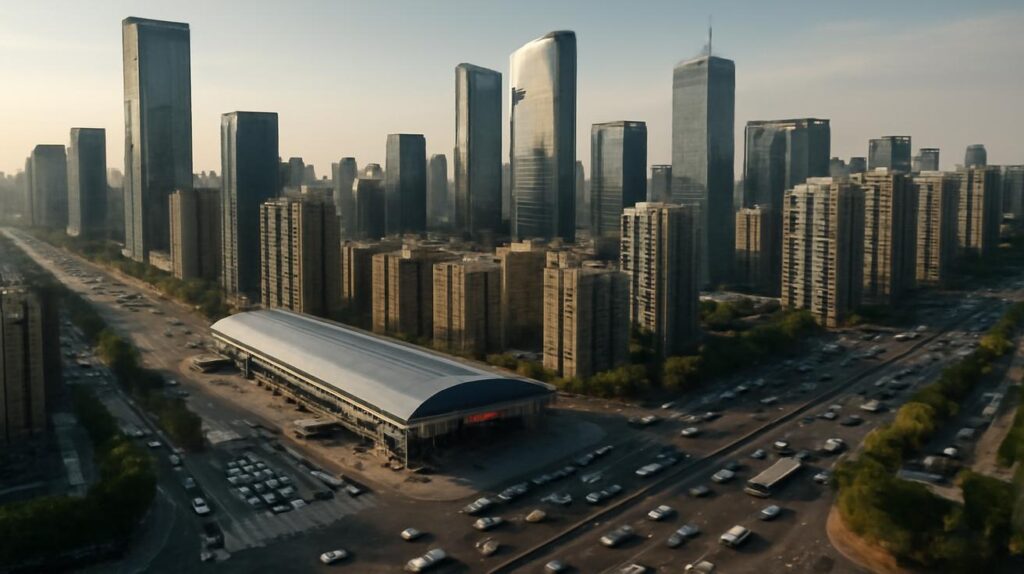
The train doors slid open to a station that looked like a mirage: spotless tiles, soft yellow lighting, gleaming escalators humming quietly—and outside, through the glass barriers, only empty fields stretching toward a hazy horizon. No crowds, no honking taxis, no swarms of commuters. Just wind, dust, and the strange feeling of having arrived somewhere that hadn’t been built yet.
The Ghost Stations Everyone Laughed At
In 2008, photos from China began circulating in newspapers and online forums around the world. They showed subway stations—shiny, futuristic, and almost clinically clean—sitting in the middle of nowhere. No dense city blocks above them, no shopping malls, no buzzing neighborhoods. Just patchy farmland, construction cranes in the distance, and long strips of elevated track slicing through open space.
Commentators called them “ghost stations.” Critics shook their heads and said it was proof of runaway planning, wasteful spending, and a kind of techno-optimism gone off the rails. Why, they asked, would any country build metro stops where there were barely any passengers? Who were these trains for—cows and construction workers?
It was easy to laugh at a platform where only a handful of people got off each day. It fit neatly into a familiar story: the one where ambition outpaces reality, where governments chase prestige projects and forget the simple rule that infrastructure should follow demand, not fantasy.
But the story we told ourselves back then was only half-formed, like judging a photograph halfway through printing. From where we stood in 2008, those empty platforms looked like overreach. From where we stand now, they look like something else entirely.
“We Build First, People Come Later”
If you rode one of those almost-empty lines in the late 2000s, the emptiness had its own soundscape. The light ring of your footsteps on polished floors. The distant clank of a maintenance worker’s tools. A PA system announcing the next train to a platform occupied by three commuters and a bored security guard scrolling on his phone.
Ask the planners in charge back then, and they would have answered with a very different logic from the one Western analysts tended to use. In many Chinese cities, officials were blunt: “We build first, people come later.” It wasn’t a slogan—it was a strategy.
Instead of chasing existing demand, they were laying down the skeleton of the future city. They saw rapid urbanization coming like a tidal wave. Between 2000 and 2020, hundreds of millions of people would move from countryside to city. Waiting until the wave crashed, then scrambling to lay rails beneath those moving feet, would be too late. Better, they argued, to have the bone structure in place and let the flesh grow around it.
The numbers looked absurd to many outsiders. Stations with only a few thousand riders per day. Whole lines that seemed to glide through sparsely populated districts. Critics pointed to the empty concourses as evidence of a bubble ready to burst.
Yet on the ground, an odd thing started to happen. Every year, if you rode the same line, the landscape outside your train window shifted. The once-bare fields sprouted blue construction fences, then concrete shells, then entire new neighborhoods. The stations, once isolated islands, began to feel less alone.
The Slow Filling of an Empty Map
Imagine a mental time-lapse. The year is 2008: a solitary station is dropped into farmland, a bright white square on a mostly gray, unmarked map. The elevators gleam unused. The ticket machines blink in the quiet.
Fast-forward to 2012. Now there are roads leading to the station, thin at first, then gradually thickening. Residential towers rise like exclamation marks around it. A small convenience store appears at one station entrance, then another. Electric scooters begin to gather outside the exit at rush hour.
By 2018, the map is crowded. The “middle of nowhere” has acquired a name, a pulse, a skyline. Children in uniforms shoulder their backpacks as they hurry down into the metro on their way to school. Office workers clutch takeout coffee, glancing at their phones as the next train rolls in. During the evening peak, trains are full enough that you have to angle your way into the car.
Some of the very stations once featured in mocking headlines now sit in the heart of districts that didn’t exist on any commuter’s mental map in 2008. The joke, it turns out, ages quickly when the city refuses to stay still.
When Naïve Assumptions Collide with Fast Cities
Looking back now, the naivety wasn’t in the empty stations themselves. It was in how confidently the rest of the world misread them.
We assumed that quiet platforms meant failure. That “no riders yet” meant “there will never be enough riders.” We were measuring success with the ruler of the present and forgetting that infrastructure, by definition, lives in the future.
In much of the world, the pattern is clear and predictable: first the city sprawls, then traffic worsens, and only once gridlock becomes unbearable do we finally build a train line. Then we declare it a smart, responsive solution—as if we had no way of seeing the problem decades in advance.
In China, the script was flipped. City after city raced to build subways far ahead of demand. In 2008, several of those systems were in their infancy; by the early 2020s, they were dense metro webs rivaling century-old networks elsewhere. What looked like overbuilding morphed into something closer to preemptive adaptation.
Of course, it wasn’t perfect. Some stations remained underutilized longer than expected. Some “new towns” struggled to attract enough people. Not every line was a triumph of foresight. But step back and the pattern is unmistakable: those ghost stations did not stay ghostly for long.
A Quiet Experiment in Time
What we witnessed in 2008 was less a folly and more a time experiment: what happens if you gamble that people will follow rails, instead of rails following people?
In many new districts, property ads proudly highlighted proximity to a subway stop, even when those trains weren’t yet full. Schools, hospitals, office parks, and shopping centers began clustering around the stations. The existence of a metro line acted like an invisible magnet, pulling life toward it.
Meanwhile, cities that delayed transit investment often found themselves trapped in a familiar bind—a tangle of highways and widening roads that never quite solved congestion, stretching budgets further while locking in car dependency.
In this light, the “naive” assumption was not China’s belief that people would come. It was the rest of the world’s belief that building ahead of demand was inherently reckless.
What the Numbers Whispered While We Weren’t Listening
By the early 2020s, ridership data on many of those once-empty lines told a very different story than the headlines from 2008. Annual passenger volumes climbed year by year as urban populations swelled and development densified around transit hubs.
| Aspect | 2008 Perspective | 2020s Reality |
|---|---|---|
| Station Usage | Low ridership, “ghost stations” | Steadily increasing daily traffic, peak-hour crowding in many corridors |
| Urban Development | Surrounded by fields, sparse housing, construction sites | Dense residential blocks, malls, schools, and offices clustered around stations |
| Public Perception | “Overbuilt”, “wasteful”, “vanity projects” | Seen as essential infrastructure, often taken for granted by daily commuters |
| Planning Logic | Judged against present-day population and demand | Better understood as shaping future growth and guiding where people live and work |
The contrast between how these stations looked in photographs and how they functioned in spreadsheets is a reminder of how misleading snapshots can be. A still image captures emptiness; a data series captures motion.
And beneath those numbers lies something quieter but more profound: the lived experience of millions of people whose daily routes now assume the presence of those once-derided lines. A child born the year a “ghost station” opened might have grown up never knowing a version of their city without that train. To them, the station is not a monument to overreach—it’s simply how you get to school, to friends, to the rest of your life.
The Smell of Dust, the Sound of Arrival
Return, in your imagination, to one of those stations you might have visited in 2008. Back then, the air outside smelled of concrete dust and wet earth. The climb down the escalator felt slightly surreal, as if you’d stumbled into an airport terminal built on the edge of a village.
Come back today. The dust has given way to the smell of fried dumplings from a food stall near Exit B. Above ground, neon signs crowd for attention, and delivery riders weave between pedestrians. Down below, the platforms echo with that familiar urban hum: the shuffle and murmur of people, the rising wind of a train pulling in, the ding of closing doors.
The station hasn’t moved an inch. But everything around it has shifted. In a way, the station was a promise laid into the ground—a statement that this place, which once seemed like nowhere, would one day be somewhere.
The Lesson Hidden in Plain Sight
When we say, “In 2008, China built subway stations in the middle of nowhere. In the 2020s we finally see how naive we were,” we’re talking less about steel and concrete and more about our own blind spots.
We were naive about how quickly cities can change when a billion people are on the move. We were naive about the power of transit to not just serve a city but to actually script where the city will grow. And we were naive about time—about how unfair it is to judge long-term infrastructure with short-term patience.
None of this means every ambitious project should be applauded. Building ahead of demand can still go wrong, especially if it ignores social needs or environmental limits. But those once-empty stations invite a different kind of humility: the humility to admit that sometimes, what looks like overbuilding is actually pre-building.
As other countries wrestle with questions of how to cope with climate change, sprawl, and population shifts, these ghost-station-turned-hubs offer a quiet, steel-and-glass reminder: the most important infrastructure for the 2040s probably looks a little excessive in the 2020s.
Seeing the Future in the Present
Maybe the most striking shift is psychological. In 2008, pointing at an empty station felt like proof that the planners had miscalculated. Today, pointing at a newly built, half-empty transit line might instead spark a different question: what future is being prepared here that I can’t yet see?
Our everyday instincts are tuned to the visible present. We judge a restaurant by tonight’s crowd, a neighborhood by this year’s prices, a train line by this morning’s passengers. Yet the most consequential choices cities make often concern people who haven’t arrived yet, trips that haven’t been taken, lives that haven’t unfolded.
Standing on a once-empty platform at rush hour now, squeezed between office workers and students, it’s hard to remember that this place was ever considered a punchline. The turnstiles click steadily. The ventilation fans hum. The arrival board glows. Somewhere above, a child tugs a parent’s sleeve and asks, “When’s the train coming?”
For them, the answer is simple: “Soon.” For us, the better question might be, “What else might we be misreading today, just because we’re looking at it too early?”
FAQs
Why did China build subway stations in areas with so few people back in 2008?
The stations were part of a deliberate strategy to build infrastructure ahead of demand. Planners anticipated rapid urbanization and wanted transit in place before neighborhoods grew, rather than trying to retrofit subways into already congested, built-up areas.
Weren’t these “ghost stations” considered a waste of money at the time?
Many outside observers saw them as wasteful because early ridership was low. Over time, however, as development clustered around the stations and passenger numbers rose, many of those same projects came to be seen as essential foundations for new urban districts.
Did all of the early, underused stations eventually become busy?
Not all at the same pace. Some lines and stations filled up quickly, others took longer, and a few still underperform. But overall, a significant number of the once-criticized stations are now embedded in dense, active neighborhoods with heavy daily use.
What can other countries learn from this experience?
One key lesson is that transit can shape urban growth, not just respond to it. Building ahead of demand, when done thoughtfully, can guide where people live and work, reduce future congestion, and make cities less dependent on cars.
Does this mean every ambitious infrastructure project is a good idea?
No. The success of such projects depends on broader planning: housing policy, job distribution, environmental considerations, and financial sustainability. The Chinese example shows what’s possible, but it doesn’t turn all large, speculative projects into wise investments by default.