The wind along Hadrian’s Wall has a way of carrying stories. It combs through heather and grass, whispers between broken stones, and skims over the low, moss-darkened remains of a Roman latrine. To stand here, on a raw, gray afternoon in northern England, is to feel time sliding in two directions at once. Tourists nearby are pulling up hoods and zipping jackets; someone complains about the chill. Eighteen centuries ago, a soldier, wrapped in a damp wool cloak, likely shivered in this very spot—tired, hungry, stomach roiling with cramps he could not explain.
When History Turns to Dust—and Then to Data
For a long time, Hadrian’s Wall was cast in a familiar narrative: a mighty stone barrier, Roman discipline at the edge of empire, soldiers holding the line against the unknown tribes of the north. Yet in the last few years, a different story has emerged from the most unglamorous of places—latrines and the soil around them.
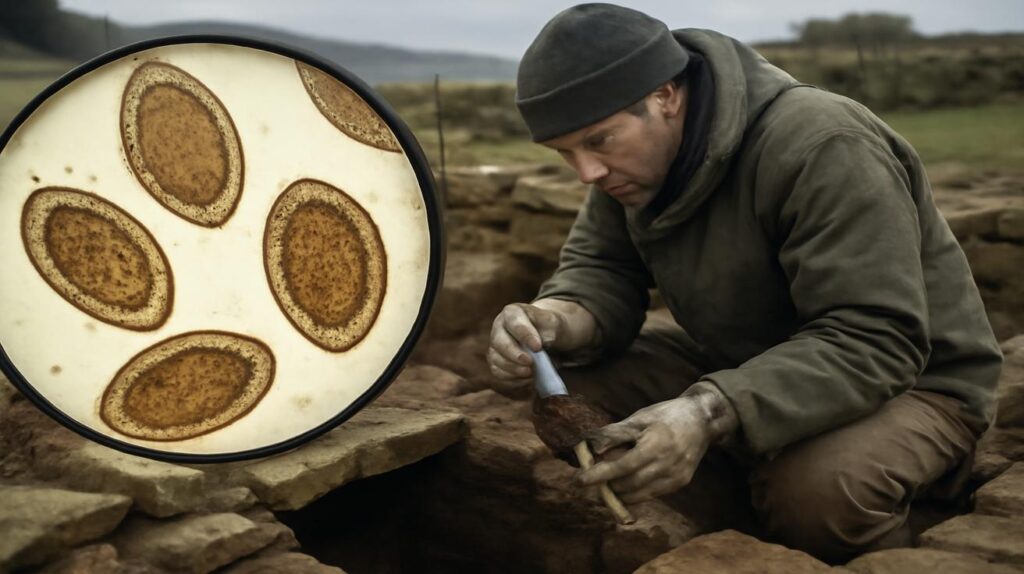
Archaeologists and paleoparasitologists (yes, there is such a specialty) have been quietly collecting samples from ancient drains, cesspits, and compacted soils in and around forts along the Wall. Under the microscope, those samples crackle with microscopic life—though the life is long dead. Tiny eggs of whipworm, roundworm, and other intestinal parasites lie preserved in the same muck where Roman sandals once squelched.
In a new, detailed analysis of these latrine deposits, researchers have found that Roman soldiers along Hadrian’s Wall were living with widespread and often severe gut parasite infections about 1,800 years ago. The findings don’t just add a disgusting detail to Roman daily life; they complicate our image of power, health, and empire. These weren’t invincible legionaries striding the frontier in gleaming armor—they were men whose intestines were a battlefield of their own.
Imagine their mornings: the clang of the fort’s gate, the shout of orders, the clatter of hobnailed boots on stone. Underneath it all, for many, there would have been a low, constant ache in the belly, an urgency at the wrong moment, a fatigue that no amount of barley porridge or salted pork could cure. The Wall might have held firm, but their guts were under siege.
The Latrine as Time Capsule
To understand how we know this, you have to picture a Roman latrine. Not a lonely wooden shack in the woods, but a communal stone bench lined up over a drainage channel, sometimes with running water beneath. At a fort along Hadrian’s Wall, latrines were social places. Men sat shoulder-to-shoulder, no cubicles, no privacy, trading gossip, cursing the rain, talking about home, about pay, about commanders. The smell would have been thick—human waste, damp wool, oil from lamps, maybe the sour tang of wine.
Now imagine those same benches long gone, the stone channel silted up, layer on layer of soil pressing down. Organic matter decays, but some things are stubborn. Parasite eggs, tough little capsules smaller than a grain of sand, can survive for centuries if conditions are right—cool, damp, low in oxygen. Along Hadrian’s Wall, the cool British climate and waterlogged deposits created something close to perfect preservation.
In the lab, soil from these latrines is carefully broken down, sieved, and scanned under a microscope. To the trained eye, the shapes are unmistakable: barrel-shaped whipworm eggs with their characteristic polar plugs; oval roundworm eggs with thick, sculpted shells. Sometimes there are eggs from liver flukes or tapeworms, each with its own microscopic signature.
The new analysis pooled dozens of such samples from multiple forts along the Wall—places like Housesteads, Vindolanda, and others that once buzzed with military life. The result was striking: parasite eggs were everywhere, in numbers high enough to indicate that these were not rare or mild infections but a routine, often heavy burden that the garrison lived with daily.
Meet the Unseen Garrison in Their Guts
To grasp what these soldiers faced, it helps to know the cast of microscopic characters sharing their intestines.
Whipworm (Trichuris trichiura) is aptly named. The worm’s slender front end embeds in the intestinal wall, while the thicker rear end dangles into the gut. It feeds on blood and tissue fluids, causing chronic abdominal pain, diarrhea, and, in heavy infections, anemia and growth problems. Roundworm (Ascaris lumbricoides) can grow to startling sizes—up to the length of a forearm—and live in swirling knots inside the small intestine. People heavily infected may feel constant hunger yet remain thin, fatigued, and frail.
The egg counts and variety along Hadrian’s Wall indicate that many soldiers suffered from multiple infections at once. Picture trying to heft a shield, drill in armor, march miles along the frontier, or man a windswept watchtower with the constant discomfort of bloating, cramps, and urgent trips to the latrine. These were not minor nuisances; they likely shaped productivity, morale, and maybe even strategy.
Then there are liver flukes, parasites that usually reach humans through contaminated water plants or undercooked freshwater fish. Evidence of liver fluke eggs hints at complicated supply lines: food imported from across the empire, including delicacies from marshy or riverine regions far to the south. Each bite of something exotic carried invisible hitchhikers north, all the way to Britain’s edge.
Every latrine sample is, in a way, a health survey frozen in time. And in survey after survey, the message is the same: the soldier’s body was a shared space, part Roman, part parasite.
The Paradox of Roman Engineering
On paper, Romans knew something about cleanliness. They embraced baths, built aqueducts, piped water into forts, and drained waste away with sophisticated sewage systems. It is tempting to assume that such engineering prowess meant superior health. But the parasites in the soldiers’ guts tell a more tangled story.
Take the latrines themselves. Communal toilets with running water sound like a step toward modern sanitation. However, reused water flowing through stone channels could easily spread microscopic eggs from one man to another. Shared sponges on sticks—yes, that famous Roman “toilet paper”—were sometimes rinsed in communal basins. If one infected soldier used the sponge, the eggs could smear across the tool and then be introduced to the next user.
Even the baths, pride of Roman culture, could become mixing bowls of contagion. Water was rarely chlorinated or filtered the way it is today. If wastewater and clean water systems crossed, even slightly, it might bring parasite eggs back into contact with food and hands.
The more you look, the more you see the irony: the same dense, engineered, water-rich environments that made Roman forts efficient could also create ideal conditions for parasites to circulate. Roman soldiers were better supplied, better housed, and better organized than many of the local Britons they guarded against—but they were not necessarily healthier on the inside.
What the Table Doesn’t Show: The Feeling of Being Sick
Numbers and egg counts can feel dry, so it helps to translate them into something human. Below is a simplified snapshot—based on the types of findings researchers commonly report from Hadrian’s Wall and similar Roman sites—of how prevalent and disruptive these infections likely were.
| Parasite Type | Where Eggs Were Found | Likely Impact on Soldiers |
|---|---|---|
| Whipworm | Multiple fort latrines and drains along the Wall | Chronic gut pain, diarrhea, anemia, reduced stamina |
| Roundworm | Latrine pits, cess deposits in barracks areas | Bloating, malnutrition, fatigue, risk of gut blockages |
| Liver fluke | Select latrine samples with food waste traces | Liver damage, fever, long-term weakness |
| Tapeworm | Occasional finds in drains near kitchens | Weight loss, nutrient theft, vague abdominal discomfort |
Behind each cell in that table is a real, lived experience. A soldier—let’s call him Marcus—might have been stationed at Housesteads, the wind off the North Sea cutting through his cloak. He wakes before dawn, stomach churning, the familiar heaviness behind his eyes. The fort’s schedule doesn’t care that his gut feels like a tightening fist.
He eats anyway: coarse bread, a ladle of barley stew, maybe a scrap of pickled fish. Minutes later he feels the pressure build, the knot of anxiety. He knows the latrine is a short walk away along the wall, but he also knows the centurion is counting heads on the training ground. He weighs the risk of humiliation against the risk of reprimand. The parasites inside him do not care which choice he makes.
Cruel as it sounds, this was normal. Many men around him would have been going through the same thing. In some ways, the shared suffering might even have been a bond, an unspoken understanding that the glamorous marble of Rome was far away, and here, on the edge of the world, everyone’s insides were rebelling.
How Did It Get This Bad?
The question that lingers over all this is simple: Why were parasite infections so rampant? The answer sits at the intersection of hygiene, diet, movement, and sheer bad luck.
Food supplies for Hadrian’s Wall had to travel long distances. Grain, oil, wine, preserved meats, and sometimes fresh fruit and fish were brought north by road and ship. Any step in that journey—harvesting in damp fields contaminated by human or animal waste, washing produce in polluted water, storing food in vermin-infested warehouses—could introduce parasite eggs. Once the eggs were on food or hands, they were effectively invisible and unstoppable.
Inside the forts, dense barrack living meant dozens of men sleeping in tight quarters, their possessions crowded together. Handwashing with soap was not a reliable habit, and water sources were often shared between humans and animals. Latrines, while more advanced than open pits, were not designed with a modern understanding of microbial disease. If the drainage system backed up or overflowed during heavy rain, contamination could spread quickly.
There is also the factor of movement. Soldiers were transferred between provinces, bringing their gut fauna with them. A man who had grown up in a Mediterranean town, already infected with certain parasites, could easily seed those into the water and soil of northern Britain, just by living and defecating as usual within the fort’s system. Conversely, local parasites could spread south as units rotated out.
Layered on top of this was a worldview that had no concept of parasites as we understand them. Romans might attribute stomach ailments to diet, to cold weather, to the will of the gods, or to imbalances in bodily humors. They had herbal remedies and ritual cures, but no targeted way to kill worms in the intestines. So the infections smoldered on, season after season, winter after winter.
Rewriting the Story of Power and Vulnerability
When we picture Hadrian’s Wall today, we tend to see it from a distance: a stone line snaking across hills, an architectural statement of control. Yet parasites introduce a humbling counter-narrative. They remind us that power on a map does not translate to power in the body.
The Roman Empire could project force across continents, build roads and amphitheaters, shift taxes and laws from one city to another. But in the intimate space of the gut, tiny organisms with no concept of Rome or barbarians or borders dictated daily comfort and suffering. The soldiers along the Wall, armed with iron and discipline, were—at a cellular level—unarmed.
This does not make them weak; in some ways, it makes them more human. It’s easy to glamorize the past, to imagine soldiers as rugged superhumans hardened beyond our understanding. The parasite evidence pulls them closer. They got sick. They struggled through their shifts. They worried about sudden cramps in moments when they needed to stand firm. Their heroism, if we choose to call it that, existed alongside very ordinary bodily discomforts.
It also reshapes how we think about ancient “health.” A well-fed, well-sheltered soldier might still be carrying a burden of worms so large it quietly shaved years off his life. Strength on the outside did not mean resilience on the inside. The Wall may have stood for centuries, but the bodies that guarded it were constantly under internal attack.
From Latrines to Lessons for Today
All of this might feel—quite literally—like ancient history. After all, we have modern plumbing, sewage treatment, antibiotics, and anti-parasitic medications. Yet the story emerging from Hadrian’s Wall’s latrines carries resonant lessons for us.
First, it reminds us how invisible threats exploit the very systems we build for comfort and efficiency. Roman latrines and baths were cutting-edge for their time, yet they created pathways for disease because people didn’t understand the unseen world moving with water and waste. Today we face our own invisible passengers—bacteria resistant to antibiotics, viruses that leap continents in days, pollutants that travel air and ocean currents. Technological sophistication does not automatically equal safety; it requires an evolving understanding of the risks it creates.
Second, the parasites along the Wall highlight how deeply health is tied to infrastructure and inequality. Access to clean water, safe food, and effective sanitation remains uneven around the globe. For millions today, whipworm and roundworm are not relics but routine, just as they were for Roman soldiers. The difference is that we now know exactly how to break those cycles—and often fail to do so for political or economic reasons, not scientific ones.
Finally, there is something strangely grounding about the idea that even the might of Rome was undermined by something as small as a worm egg. It’s a reminder of common vulnerability. The soldiers at Hadrian’s Wall were separated from us by time, language, and empire, but not by biology. Their intestines functioned like ours, their immune systems fought like ours, and their discomfort would be instantly recognizable to anyone who has ever hunched over with food poisoning.
Next time you see a photograph of the Wall, or if you are lucky enough to walk beside it on a cold, windy day, you might find your imagination drifting beyond stone and sky. Picture the unseen history, preserved grain by grain under your feet: the microscopic ghosts of parasites, the men who carried them, the long, unrecorded story of how it felt to live and work at the edge of the world with an internal enemy you never knew you had.
FAQ
What exactly did the new analysis of Hadrian’s Wall latrines find?
Researchers examined soil from Roman latrines, drains, and cess deposits along Hadrian’s Wall and found abundant eggs of intestinal parasites such as whipworm, roundworm, and other species. The high numbers and distribution suggest that gut infections were widespread and often heavy among soldiers stationed there about 1,800 years ago.
How can parasite eggs survive for nearly 2,000 years?
Parasite eggs have tough outer shells designed to survive in soil and water until they are ingested by a new host. In cool, damp, low-oxygen conditions—like those found in waterlogged latrine sediments—the eggs can remain intact for centuries. Archaeologists recover them by carefully sieving and analyzing soil under a microscope.
What symptoms would Roman soldiers have experienced?
Depending on the mix and intensity of parasites, soldiers likely suffered from abdominal pain, diarrhea, bloating, anemia, weight loss, and fatigue. Heavy infections could cause malnutrition and, in some cases, dangerous complications such as intestinal blockages or long-term organ damage.
Didn’t Romans have good sanitation with baths and latrines?
Romans were advanced in engineering, with aqueducts, baths, and latrines, but they lacked knowledge of microscopic pathogens and parasites. Communal toilets, shared cleaning tools, reused water, and dense living conditions could all help spread parasite eggs, even in systems that looked sophisticated by ancient standards.
Could the parasites have affected the Roman army’s effectiveness?
Chronic gut infections would have reduced stamina, concentration, and overall health, potentially impacting training, marching, and combat readiness. While it is hard to measure precisely, the cumulative effect of widespread parasitic disease almost certainly affected productivity and resilience among troops.
Are these same parasites still a problem today?
Yes. Whipworm, roundworm, and other intestinal parasites still infect hundreds of millions of people worldwide, especially where sanitation is poor and clean water is scarce. The difference today is that we understand their life cycles and have effective treatments, though access remains uneven.
What can this research teach us about modern public health?
The findings underscore how crucial sanitation, clean water, and food safety are—and how invisible threats can travel through the very systems we build for comfort. They highlight that infrastructure alone is not enough; it must be designed and maintained with a deep understanding of how disease spreads, and it must be accessible to everyone to truly protect public health.