The first sign is not the cold. It’s the silence. That odd, cotton-thick quiet that settles over a town when the air is turning heavy and the sky has made up its mind. By midafternoon, the clouds lower like a lid, and the light fades to a bruise-colored dim. Somewhere, a dog barks once and then thinks better of it. The weather alert buzzes on your phone with the kind of insistence you can’t ignore: “A winter storm warning has been issued. Up to 55 inches of snow possible. Travel may become impossible.” You read it twice, as if the numbers might shrink the second time around. They don’t.
The Sky That Keeps Its Promises
It starts with a flake that doesn’t melt on contact. Then another. Then a curtain. Within minutes, the familiar shapes of the neighborhood soften, sharpening only at the edges where porch lights catch and crystallize the falling snow. The air smells suddenly clean, edged with that metallic hint of coming ice. Somewhere beyond the houses, the highway hum turns into a muffled sigh, swallowed by the thickening storm.
The meteorologists had warned about this one differently. Their voices on the evening news carried the subdued tension reserved for events that can still surprise even professionals: a slow-moving, moisture-rich system colliding with bitter Arctic air, stalled in just the wrong way over heavily populated corridors. Not a dusting. Not a “stay home if you can” storm. This is the kind of forecast that drops words like “crippling,” “historic,” and somewhere near the bottom of the screen, the figure that makes people swallow hard: 55 inches. Four and a half feet. Nearly the height of a small child, stacked in white against the door.
In living rooms and kitchens, people scrolled the radar maps, eyes tracing the swirling bands of color inching closer. Dark blues and purples like bruises blooming across the digital country. The math in everyone’s head was the same: How much food do we have? Do we have batteries? Is the snowblower working? Can the old sedan handle this, or is it time to surrender to the idea of being snowed in?
The Slow Disappearance of the Everyday World
By early evening, the familiar landmarks begin to blur. Street signs grow little white hats. Parked cars turn into soft mounds, their sharp outlines dissolving under a steady accumulation. The storm warning had predicted snowfall rates of two to four inches per hour, with bursts higher than that. Numbers that don’t mean much until you watch the world vanish outside your own windowpane.
You can see it happen in layers. The sidewalks go first, erased into a single smooth sheet. Then the curb vanishes, the road edges lost under a leveling white. Tires passing by no longer sound like rubber on asphalt but like a slow hiss, an audible argument between treads and slush. After a while, there are no more cars at all. The decision has been made: the roads are giving up, and so is everyone else.
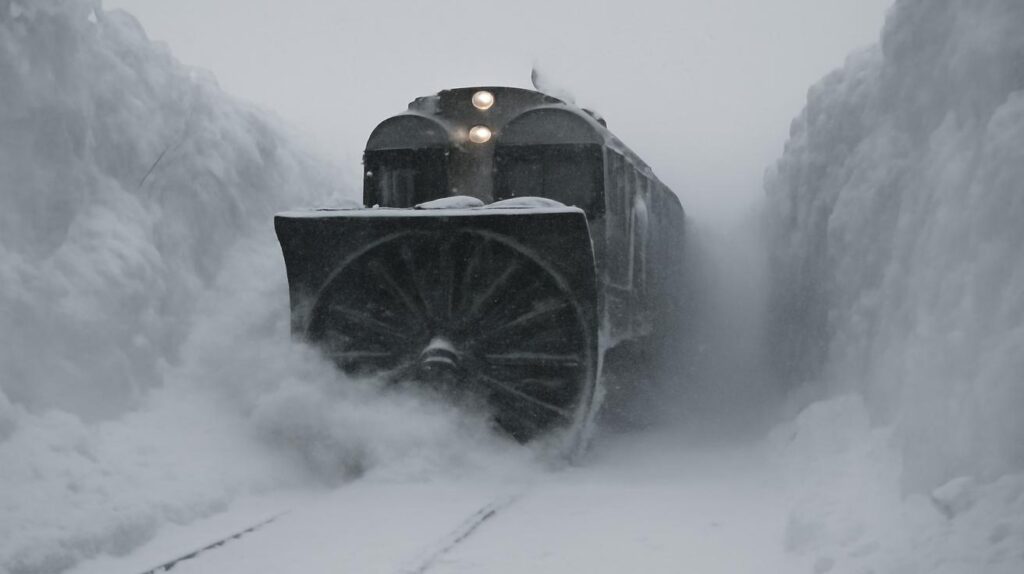
On the rail lines, the change is even more dramatic. Tracks that normally gleam like twin scars through the landscape begin to ridge with snow, ties filling with white. Commuter trains that would usually barrel through the darkness with a dependable rhythm now move like cautious animals, feeling for safe footing. Platforms transform into treacherous ledges, the gap between the train and the concrete a quiet, accumulating trap of drifting snow. Messages flash: “Delays due to weather.” Then: “Service suspended.” The steel arteries of the region, so often taken for granted, are slowly being bandaged in ice.
When the Warnings Become Real
All day, forecasters had been updating the bulletins, their language turning more urgent as the computer models converged. Heavy snowfall, damaging winds, life-threatening travel conditions. The phrase “overwhelm roads and rail networks” became a kind of refrain—repeated on TV, in push notifications, on the scrolling banners in stations and terminals.
It’s a sterile phrase, on its face. “Overwhelm networks.” But in practice, it’s deeply human. It means plow drivers clocking in for 16-hour shifts and knowing it still won’t be enough. It means dispatchers watching their maps fill with stalled icons that represent not just vehicles but people: anxious, stranded, tired. It means rail operators confronting the limits of machines built for winter but not necessarily for this winter—the kind of storm that shrugs at engineering margins.
By midnight, the storm has dug in. Snow is no longer just falling; it is insisting. Wind gusts claw around corners, rattling windows and driving the powder into every possible crevice. The sound outside is a strange mixture of howl and hush: the wind’s rage softened by the thick, sound-absorbing blanket it’s busy laying down on the world.
The Long Night of White
Inside, normal routines warp around the storm. People who meant to go to bed early stay up refreshing radar images, captivated by the slow ballet of the swirling blues across the screen. They trade messages with friends and family: “How bad is it by you?” “Can you still see your car?” There is comfort in the shared astonishment, in the knowledge that an entire region is collectively watching the same sky and the same endless, drifting descent.
As the hours stack, so do the inches. At two in the morning, someone steps out onto a porch and sinks halfway up their shins. The snow squeaks underfoot with that high, dry-powder sound unique to deep winter. Breath explodes in little plumes. The space between house and street—ordinarily a quick, thoughtless stroll—becomes a short expedition. You lift your knees higher. You test each step like a hiker in an unfamiliar landscape. Out by the main road, a plow passes with a roar and a blast of light, towering wave of snow curling off its blade like surf thrown sideways.
Across town, rail yards lie in a kind of deep freeze limbo. Locomotives idle with low, rumbling heartbeats, their warmth fighting the encroaching snow that packs into vents, stiffens couplings, clogs switches. Crews move like bundled silhouettes in the glow of high-mounted lamps, shovels and brooms and de-icing gear their only real tools against a storm that does not care how essential the timetable looked yesterday. Lines are checked, and then checked again, and still the snow sneaks back into the places it’s not meant to be.
| Element | What Happens in a 55-Inch Storm |
|---|---|
| Major Roads | Plows struggle to keep up; cleared lanes re-cover within 30–60 minutes during peak snowfall. |
| Residential Streets | Often become impassable; may wait many hours, even days, for full clearing. |
| Rail Lines | Switches freeze, tracks drift in; high risk of service suspensions and significant delays. |
| Emergency Services | Response times increase; some areas reachable only by specialized vehicles or on foot. |
| Power Infrastructure | Heavy, wind-driven snow and ice can bring down lines; outages may last longer due to access issues. |
Morning After, With the Storm Still Here
The weirdest part is waking up and realizing the storm hasn’t actually finished. Morning brings only a slightly lighter shade of gray, and the snow is still coming—slower now, more thoughtful, as if placing its final strokes carefully. You open your door to a wall. The snow has banked itself halfway up the screen, a cool white presence pressing in. For a moment, you register the childhood thrill of a snow day multiplied by ten. Then the adult logistics move in: How do I get out? Do I even need to?
The world outside is almost unrecognizable. Cars have become rounded sculptures, their make and model erased by the uniformity of depth. Fences are faint ridges. Bushes are buried to the point of anonymity. Somewhere under a smooth drift, a front walkway exists, but it might as well be memory. Even sound is altered: no engines, barely any voices. The plows are still out there, but they’re working elsewhere for now—on the biggest arteries, the main routes, the life-support lines of a snow-laden region.
On the mainline tracks, the battle between storm and schedule continues. Rail operators have had to make stark choices. Some trains are canceled outright, sparing passengers the ordeal of being stuck between stations. Others creep along at reduced speeds through corridors narrowed by drifting snow, the trains turned into cautious explorers in a suddenly hostile landscape. Overhead wires sag under the weight; signals accumulate frosty halos. The system that usually pulses with predictable precision limps, strained by a storm that refused to stay within the tidy bounds of planning charts.
The Human Choreography of Digging Out
For residents, the digging begins as a strangely social ritual. Doors open up and down the street; heads pop out, hoods pulled tight, scarves wrapped high. Neighbors who usually just exchange nods now share snow depth estimates and unvarnished astonishment. “Can you believe this?” someone says, even though everyone can see it right there, piled against their knees and, in some places, their hips.
Shovels bite into the snow with a satisfying, rhythmic crunch. Breath clouds the air. The work is slow, methodical, and surprisingly intimate—you are literally re-carving your way back into the world. Clearing a path to the street feels like forging a treaty with the storm, an agreement that you will respect its power but still insist on your passage. For those with driveways, each scoop is a negotiation with physics: where to throw the new snow when all the obvious places are already full.
At intersections, small mountains rise—plow piles that tower over children and, in some cases, even adults. Kids scramble up them, kings and queens of temporary kingdoms made of compressed powder and exhaust-streaked ice. Parents watch from below, hands stuffed deep into pockets, part of them anxious about the slickness and hidden dangers, part of them remembering their own childhood climbs on winter’s fragile architecture.
Somewhere a few blocks away, an ambulance inches its way down an only-partially-cleared street, chains rattling, red lights washing the white world in urgent color. The storm has not canceled ordinary life: people still fall, still get sick, still need help. But every response now takes longer. Every turn of a wheel is an effort. This is what “overwhelmed networks” looks like in lived experience: not chaos, exactly, but a pervasive, grinding slowness.
Fragility Revealed in White
It’s tempting to frame a 55-inch storm as pure spectacle—and visually, it is. Thick drifts sculpted by wind into ripples like frozen dunes. Trees stuck with glamorous coats of snow so heavy that branches bend in surrender. Streets transformed into corridors of whiteness, the usual clutter of human life tucked away under a uniform sheet.
But beneath the beauty is a quiet revelation about how delicately balanced our daily systems are. Roads and rails are built with winter in mind, yet there is always a threshold beyond which design assumptions fail. A snowstorm of this magnitude tests every seam.
Highways bank with stranded vehicles, some abandoned when drivers could go no further. The lucky ones made it off an exit ramp and into a parking lot, where cars are now parked at odd, diagonal angles—half-maneuvers frozen in place overnight as the snow filled in around them. Tow trucks cringe at the thought of what awaits them once visibility improves and the plows have carved a lane or two back into existence.
On the rail side, switches freeze solid despite heaters; snow clogs signal housings; drifts bury platforms. Crews who know their lines by heart find themselves confronted with alien topography, everything leveled and smoothed. Commuters who have relied on the predictability of the schedule discover its limit. The phrase “essential travel only” becomes a reality: travel is not just inconvenient; it is a question of whether the network can physically carry you where you need to go.
The Strange Tenderness of a Stopped World
Yet in the middle of this disruption, something else stirs—something slower and unexpectedly gentle. With roads and rails subdued, the frantic pace that usually hums beneath daily life quiets down. The world, forcibly paused, reveals small details that habit normally edits out.
You notice, for instance, how sound travels in a snow-muffled neighborhood: the distant scrape of a shovel, the soft clink of somebody’s wind chime, the far-off rumble of a plow that you can’t see but can hear approaching like a storm within the storm. You notice the warmth inside more acutely too—the way lamplight spills onto piles of boots by the door, the way wet mittens steam ever so slightly over heater vents.
Neighbors help push a stuck car free, their boots sliding, their laughter rising in quick bursts that steam into the cold air. Someone you’ve only waved to in passing for months now stands shoulder to shoulder with you, braced against a bumper, the shared effort like a temporary truce with the weather and with each other. A teenager with a snow shovel and an entrepreneurial grin works the block, offering help to those who eye their buried cars with a kind of quiet despair.
Inside homes, conversations that usually wait for “when things slow down” are happening now, simply because they can. The storm, indifferent and impersonal in its meteorology, has created a personal pocket of time. No train to catch. No road safe enough to justify a long drive. The calendar’s usual tyranny has been replaced by something far older: the sky, the temperature, the volume of snow at your doorstep.
Learning From a 55-Inch Lesson
Eventually—always, inevitably—the snow stops. The clouds lift. The sky, suddenly sharp and blue, appears almost arrogant in its clarity. Sunlight bounces off every surface, a blinding brilliance that makes you squint and raises sparkling points of light from the field of white. In the days that follow, the region will measure and compare. Records will be checked. Maps will be updated with new bands of color. The storm of so many inches—maybe the biggest in decades—will acquire a name in local memory.
But long after the piles recede and the roads and rails grind back to their usual rhythms, this kind of storm leaves questions behind. How prepared were we, really? How quickly did the warnings translate into meaningful action, both personally and collectively? Where did the system bend, and where did it nearly break?
Transportation agencies will pore over data, calculating where plow fleets were stretched too thin, which stretches of track needed more winterization, how to better predict and prioritize. City planners will debate snow storage, emergency routing, the wisdom of building so densely in places where winter still has teeth sharp enough to bite through infrastructure. Households, too, will quietly adjust: an extra flashlight purchased, a snow shovel replaced, maybe a forgotten neighbor added to the mental list of people to check on next time.
Because there will be a next time. Weather has always been a storyteller, and lately its stories have turned more intense, its plot twists more frequent. Warmer air holds more moisture; storms that once would have been merely inconvenient now have the potential to become overwhelming. A 55-inch event might still be rare, but it no longer feels unthinkable.
And yet, in the fragile choreography between human systems and natural forces, there is resilience too. The same people who watched their roads and rail networks buckle under the weight of extraordinary snow also found ways to adapt in real time: opening warming centers, checking on the vulnerable, sharing rides in the brief windows when travel was possible. The storm exposed weaknesses, but it also illuminated the quiet, everyday strengths that rarely make their way into forecasts.
When you think back on this winter storm warning—a line of text on a glowing screen that became a landscape-sculpting reality—you might remember the disruption first: the canceled plans, the lost workdays, the exhausting shoveling. But with time, you may also remember the silence, the brightness of the snow under a sudden sun, the way your street turned into something both harsh and strangely tender. How the world, for a moment, was forced to move at the slower, older pace of weather, and how, within that pause, you learned again just how thin the line is between the everyday and the extraordinary.
Frequently Asked Questions
How dangerous is a storm that drops up to 55 inches of snow?
Extremely dangerous. At this depth, roads can become impassable, emergency services are delayed, and roofs, trees, and power lines can experience significant stress. Travel can quickly shift from risky to life-threatening, especially when heavy snow is paired with strong winds and low visibility.
Why do roads and rail networks struggle so much in these conditions?
Most transportation systems are designed for typical winter events, not extreme outliers. When snow falls faster than it can be cleared, plows and maintenance crews are overwhelmed. For rail, snow and ice clog switches, bury tracks, freeze equipment, and reduce visibility, forcing slowdowns and shutdowns to protect passengers and crews.
What should people do to prepare for such a major winter storm?
Preparation usually includes stocking food and water for several days, having medications, flashlights, and batteries on hand, charging devices, fueling vehicles, and ensuring you have warm clothing and blankets. It’s also wise to avoid non-essential travel once warnings predict severe impacts on roads and rail.
Can public transit be relied on during a storm like this?
Public transit is often more resilient than individual driving in moderate storms, but in a 55-inch event, even well-prepared systems may reduce or suspend service. It’s important to monitor real-time updates and have a backup plan in case buses or trains are delayed or canceled.
Are storms of this magnitude becoming more common?
While any single storm can’t be blamed on a single cause, a warming climate can increase the likelihood of intense precipitation events, including heavy snow where temperatures remain cold enough. That means extremely heavy snowstorms, though still rare, may become somewhat more frequent or more intense over time.