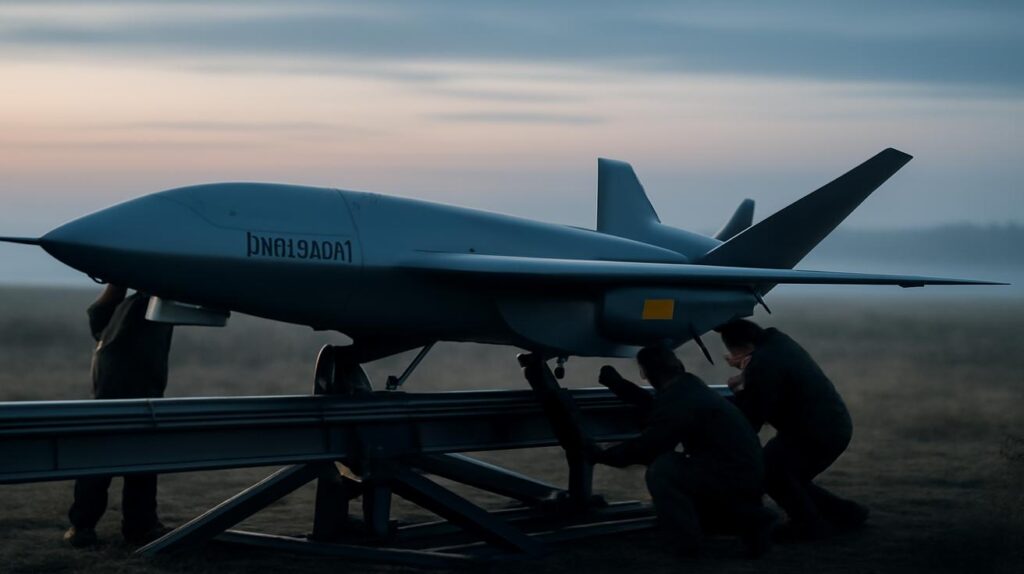
The night it first slipped across the border, no one on the ground even knew it was there. The artillery crews heard nothing. The air-defense operators watched empty radar screens, sipping burned coffee, confident they would see trouble long before it arrived. Overhead, the clouds moved like a slow gray tide, hiding a thin crescent moon. And high within that darkness, where the air turned sharp and thin, a new kind of machine rode the wind—quiet as breath, cold as the hydrogen that powered its heart.
The Quiet Arrival of a New Era
Long before anyone outside a few secure rooms in Kyiv had heard the phrase “hydrogen-hybrid combat drone,” the idea lived as sketches on whiteboards and coffee-stained notebooks. Engineers drew rough silhouettes. Officers drew arrows across maps. Someone scrawled three words in the corner of a planning slide: “silent, patient, persistent.”
Ukraine’s war had already turned the sky into a restless laboratory. Quadcopters scavenged from hobby shops hovered over trenches. Fixed-wing drones, held together with tape and hope, crossed minefields that no human wanted to touch. Larger, more lethal systems followed railway lines and river valleys, hunting supply columns with the cold logic of coordinates. It was a war where the whine of rotors and the buzz of electric motors had become as familiar as the rumble of tanks.
But familiar sounds are exactly what air defenses listen for. Batteries of guns and missiles are tuned to the signature of propellers, the heat of engines, the predictable arcs of cruise missiles. Noise, heat, repetition—that’s what gets you shot down. The hydrogen-hybrid drone was born from the uncomfortable realization that Ukraine needed a machine that could unhook itself from those expectations, that could fly further, stay longer, and be sensed less.
The concept: take the best of electric propulsion—its near-silence, its responsiveness—and marry it with the enormous energy density of hydrogen. Wrap it in a body tuned for long, high-altitude flight. Add a mind of algorithms and human operators controlling it from containerized shelters. Then send it where other aircraft could not afford to go, and keep it there for as long as the war demanded.
Inside the Hydrogen Heart
On the ground, inside a warehouse complex not far from the Dnipro River, the drone looks almost unremarkable. Its wings are long, thin, and slightly bowed, like a predatory bird caught mid-glide. The fuselage is modest, all matte composites and clipped angles. No shining metal, no grand theatrical design—just a practical skin stretched over ruthless purpose.
What sets it apart is what you cannot see. Beneath the composite shell sit slender hydrogen tanks, their pale surfaces tucked along the fuselage spine and within the wing roots. They feed a fuel cell system that hums at a pitch too high for human ears, converting hydrogen and oxygen into electricity and a thin sigh of water vapor. There is no combustion roar. No hot exhaust plume visible to infrared seekers. Just a faint thermal whisper, lost quickly to the night.
Hybrid is the key word. Alongside the fuel cell, there is a compact battery pack—lighter than most electric cars would dream of, but dense with power. When the drone climbs hard or needs a burst of speed to outrun a threat, the batteries surge forward, handing extra current to the motors. When it glides or loiters in thin air, the fuel cell takes over, sipping hydrogen and gently refilling the battery buffer. The result is a strangely organic pattern of energy use, like a heart and lungs working together under stress.
To its designers, this wasn’t just an engineering problem. It was an endurance race. Could they keep the drone in the air not for a handful of hours, but a day? Two days? Could it circle a distant logistics hub for so long that the enemy forgot to be afraid of the sky, then strike when vigilance had finally worn thin?
In one early test flight, conducted over central Ukraine long before the drone ventured into contested airspace, operators watched its flight path on their screens with a mixture of disbelief and exhaustion. The sun rose once, then set, then rose again. Ground crews rotated in shifts, sipping tea, leaning back in plastic chairs. Outside, the fields changed color from blue to gold to gray beneath an aircraft that simply refused to land.
Technical Thresholds at a Glance
When the system finally entered active operations, the data that trickled back from missions told a story in numbers as well as in sensations. Stripped of classified specifics but still revealing in their proportions, those numbers looked something like this:
| Capability | Conventional Electric Drone | Hydrogen-Hybrid Combat Drone |
|---|---|---|
| Typical endurance | 2–6 hours | 20–40+ hours (mission dependent) |
| Acoustic signature at altitude | Audible buzz in quiet conditions | Near inaudible beyond very short range |
| Thermal visibility | Distinct exhaust plume | Low-signature fuel cell heat pattern |
| Operational radius | Tactical (tens of km) | Operational–strategic (hundreds of km) |
| Primary roles | Reconnaissance, short-range strike | Deep reconnaissance, long-range precision strike, electronic overwatch |
Each row told the same story in a different dialect: this wasn’t just another drone. It was a different category of presence in the sky. A machine that blurred the line between “sortie” and “occupation”—less a visitor above the battlefield, more a lingering shadow.
The First Mission No One Heard
The order for its first real mission came on a rainy evening. In a dimly lit operations room, the map screens glowed with the familiar geometry of war: front lines, artillery arcs, suspected depots, radar sites dotted like malignant freckles across occupied territory. The target that night was not the most spectacular. No command bunker or dramatic bridge—just a logistics hub tucked between warehouses and rail spurs, the quiet heart of a supply network that kept shells and fuel moving toward the front.
In older wars, this would have been a job for bombers and flares, for squadrons and risk. In this one, a handful of operators in headsets leaned forward over consoles, and a ground crew rolled the drone out into the drizzle.
The hydrogen tanks hissed softly as they were topped up, a ghostly sound beneath the metallic clatter of tools. Somewhere forward, a compact warhead nestled in its bay, wired not just for destruction but for control—able to be armed, safed, rerouted, or withheld, right up to the last seconds of flight.
Takeoff was anticlimactic. No afterburner thunder, no stuttering propeller. The motors rose from a faint murmur to a thin, high whine, then folded into the wind as the drone lifted off and angled toward the front. Within minutes, its sound faded into the background of the storm. Within an hour, it was just another notch in the clouds.
On Ukrainian radar, it was a friendly blip with a transponder code and a long, looping path. On Russian screens—at least to begin with—it was nothing at all. Hydrogen leaves no convenient trail. Its small radar cross-section blended with background clutter. The drone climbed to where even the rain below looked like static, and then, for long stretches, it coasted, the fuel cell ticking gently, batteries topped off, motors idling at a level so low they barely registered.
As it neared the target area, its role shifted from wandering scout to patient witness. Cameras rotated, lenses peered through gaps in the clouds, and the operators watched a quiet cityscape slide slowly beneath them. Streetlights smeared gold across wet asphalt. Trains crawled along dark rails. Trucks came and went through what appeared, on the surface, to be just another industrial yard.
Only after hours of watching—after counting vehicles, logging schedules, noting which buildings stayed lit and which did not—did the logistics hub fully reveal itself. The pattern was unmistakable: timed convoys, guarded gates, covered loading bays large enough to swallow entire armored columns one truck at a time.
The strike, when it came, did not roar in from high altitude. The drone dipped and began a long, controlled descent, choosing a path that threaded through the soft gaps in radar coverage it had mapped on a previous loop. Air-defense operators, fatigued by a night of chasing cheaper, noisier threats, saw nothing new enough to alarm them. A distant radar sweep flickered briefly as the drone feathered its profile, then moved on.
In the seconds before impact, the operators back in Ukraine had options. Abort. Divert to a secondary target. Shift the aim point by meters. They watched one more truck reverse up to a bay door, saw the brief wash of interior light as the loading bay opened, and committed.
The explosion was bright but oddly intimate, less like a random strike and more like a scalpel finding the artery. One warehouse folded inward, then belched flame. Secondary detonations rumbled through the complex as stored ammunition and fuel caught fire. By the time air defenses woke fully and began painting the sky with search beams and hurried missiles, there was nothing left to shoot at. The hydrogen-hybrid drone had already paid for itself in disruption—and in lessons.
Engineering on the Edge of Necessity
The path to that night was anything but smooth. Hydrogen, as any engineer will tell you, is a restless companion. It is light, prone to seepage, and demands respect in storage and handling. Early prototypes had lines of sensors tracing every valve and coupling, alert for even the faintest leak. Ground crews trained in new rituals: grounding, venting, the careful choreography of fueling in forward locations that were themselves under threat.
The decision to press ahead anyway was less about glamour and more about math. Traditional fuel and battery systems could not easily break the ceiling that endurance demanded. Every extra minute in the air bought a little more freedom from enemy patterns, a little more time to confirm a target was real, a little more flexibility to wait for civilian traffic to clear or for electronic warfare units to power down.
Hydrogen’s energy density changed those margins. A liter of compressed hydrogen stores vastly more usable energy than a liter of typical lithium battery pack, and with the right fuel cells, it can deliver that energy with impressive efficiency. It was, in many ways, a war-driven echo of climate technology—the same chemistries being explored to green transportation and stabilize grids now repurposed to make a weapon that could wander for a day above hostile territory.
Ukrainian engineers worked quickly, but not alone. The war had blurred the boundaries between military labs, civilian startups, and universities. Some brought fuel cell expertise from clean-energy projects. Others specialized in composites, avionics, or the tangled art of integrating artificial intelligence into mission planning without surrendering human judgment.
Inside a small workshop miles from the front, a young engineer ran her fingertips along a newly finished wing panel, feeling for imperfections in the smooth carbon fiber. On another table, a fuel cell stack sat open like a dissected organ, its layers of membranes and plates arrayed in careful order. War or no war, the work still had the quiet, obsessive feel of a research lab. The stakes, though, could not have been clearer.
Why a Hydrogen-Hybrid Drone Matters
For all its technical nuance, the significance of this drone can be understood in simple terms. It marks a threshold: the moment when hydrogen-fueled aviation moved from demonstration flights and glossy concept videos into the grime of real combat operations.
Several things converge in that threshold:
- Persistence: Long endurance means drones can become semi-permanent observers, shaping battles not in minutes but over full days and nights.
- Stealth through subtlety: Reduced acoustic and thermal signatures don’t make them invisible—but they do make them far harder, and more expensive, to hunt.
- Precision: More time over target equals better intelligence and fewer rushed decisions, reducing the risk of hitting the wrong thing at the wrong time.
- Resource leverage: One multi-day mission can replace a series of shorter sorties, easing pressure on overworked crews and limited airframes.
Against the backdrop of a grinding, attritional war, those advantages are not abstractions. They mean a little less ammunition reaching frontline batteries, a few fewer missile launchers surviving long enough to fire, a little more doubt in the mind of an enemy commander who suddenly cannot be sure when the sky is watching.
A Sky That Learns
By the time the hydrogen-hybrid drone flew its second and third combat missions, it was no longer a novelty within Ukraine’s command structure. It was a tool, being sharpened with every flight. Operators adjusted tactics: sometimes flying high and detached, sometimes skimming lower to map air defenses or listen for enemy communications. Data flowed back not just in the form of video feeds, but in dense telemetry on air currents, radar exposures, jamming attempts.
In a conflict where both sides adapted quickly, the drone’s greatest strength might have been its flexibility. On one mission, it started as a reconnaissance platform, mapping convoys across a wide swath of territory. Midway through, as a high-value mobile launcher was spotted moving along an unexpected route, its role shifted. It trailed the convoy at a distance, updating coordinates for longer-range systems. Only when weather closed in and those systems could not get a clean shot did the drone’s hybrid nature show a different face: loiter, wait out the storm, and then move in closer, finishing the job itself.
Every hour it flew taught Ukrainian planners something not just about their enemy, but about their own future. If hydrogen could make a combat drone this persistent, what would happen when similar systems were scaled for unarmed surveillance across entire borders? Or for search and rescue in peacetime? If fuel cells survived the dust, cold, and improvisation of a front-line war, what might they do for remote airstrips in mountain villages or disaster zones?
The answers will come later. For now, the reality is simpler: somewhere in the darkness above Eastern Europe, a drone glides on wings that hum with hydrogen and electrons, rewriting expectations in real time. Its presence is not cinematic. It is subtle, incremental, a series of small advantages multiplied over long, sleepless nights.
What This Means Beyond the Battlefield
It is easy, staring at the wreckage left by a precision strike, to see only destruction. Harder, but just as important, is seeing the infrastructure that made that blow possible—the fueling rigs, the portable compressors, the quiet advance of hydrogen-supply know-how as it inches from lab to field. War has always been an accelerant for technology, for better and for worse.
In Ukraine’s hydrogen-hybrid drone, there is both: a machine designed to disable, disrupt, and destroy; and an accidental proof-of-concept for what long-range, low-emission flight can look like when pushed to its limits. When the war ends—and it will, though no one knows how or when—the people who designed, fueled, and flew this aircraft will carry their experience into a world still grappling with energy transition and security in equal measure.
They will remember hydrogen not as an abstract climate solution, but as a gas they handled at two in the morning on a half-frozen airstrip, with artillery rumbling somewhere over the horizon. They will remember calibrating fuel cells under generator light, checking sensor logs for leaks while sirens wailed in the distance. They will bring back a hard, unromantic confidence in what works when failure is not a research setback but a life-and-death variable.
Standing on that airstrip today, you might see the ghostly cloud of vapor that hangs briefly in the cold air as the fuel system vents. You might hear the faint whir of composite blades as the drone lifts away, angling east. Then there would be only the wind again, the smell of wet earth and exhaust, and a monitor in a nearby shelter painting a pale line across a dark map: a new kind of endurance, a new kind of presence, carrying a new kind of promise and peril into the uncertain sky.
FAQ
What is a hydrogen-hybrid combat drone?
A hydrogen-hybrid combat drone uses hydrogen fuel cells together with batteries to power its electric motors. The fuel cells provide long-duration, efficient energy, while the batteries handle peak power demands like rapid climbs or evasive maneuvers. This combination allows much longer flight times and quieter operation than traditional drones using only batteries or combustion engines.
Why is Ukraine’s deployment considered a “technological threshold”?
It is the first known instance of a hydrogen-hybrid drone being used in active combat operations rather than for testing or demonstration. That step proves the technology can survive real battlefield conditions—weather, electronic warfare, logistical stress—and still deliver meaningful military effects. Once a system crosses that line, rapid iteration and broader adoption usually follow.
How does hydrogen make the drone harder to detect?
Hydrogen fuel cells generate electricity with very low heat output and almost no noisy mechanical parts. There is no hot exhaust plume like in a combustion engine, and the electric motors can be extremely quiet. Together, this reduces both thermal and acoustic signatures, making the drone more difficult for infrared sensors and human ears to pick up, especially at higher altitudes.
Isn’t hydrogen dangerous to store and use in combat?
Hydrogen must be handled carefully, but modern tanks and safety systems significantly reduce the risk. The gas disperses quickly if released, which can actually be safer than liquid fuels that pool and burn. In Ukraine’s case, extensive sensor networks, careful fueling protocols, and hardened tank designs are used to manage the risks, even in forward-deployed locations.
Could this technology be used for civilian purposes after the war?
Yes. The same traits that make hydrogen-hybrid drones valuable in combat—long endurance, low emissions, quiet operation—are attractive for civilian roles. Potential applications include border surveillance, environmental monitoring, disaster response, search and rescue, and long-range cargo delivery to remote areas. Wartime experience will likely speed up the adoption and refinement of such systems in peacetime.
Does this give Ukraine a permanent advantage?
It gives Ukraine an important, if evolving, edge in certain mission profiles: deep reconnaissance, long-duration overwatch, and precise strikes against critical targets. However, military advantages are rarely permanent. Other countries and actors will study, copy, and adapt similar technologies. The lasting impact is less about a single system and more about having opened a new chapter in how hydrogen and drones intersect on future battlefields.