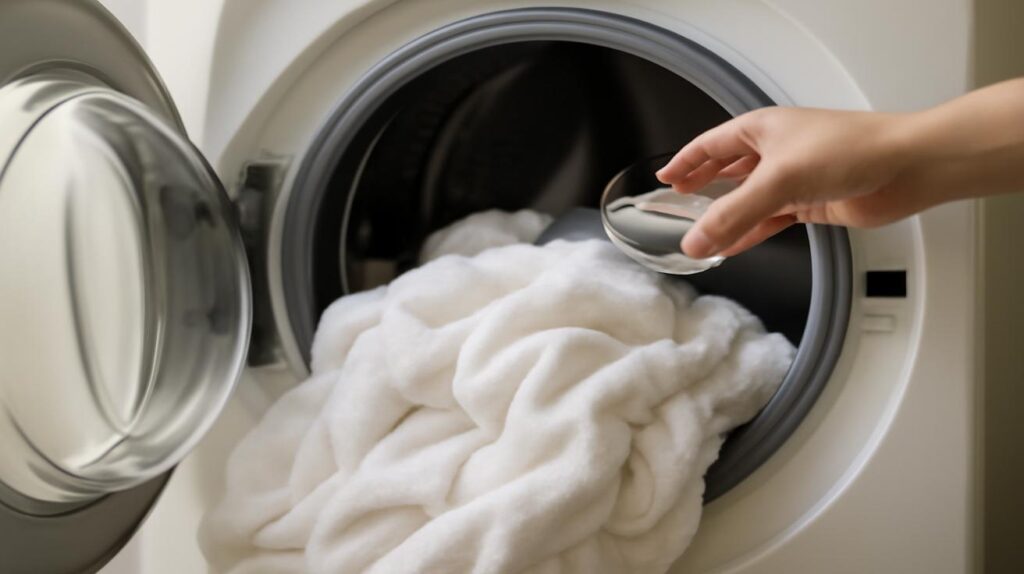
The trick first came to our street in late spring, on a Tuesday when the wind blew from the east and carried other people’s lives straight through our open windows. I was standing in my kitchen, hands in a sink of soapy water, when it drifted in—this dense, sugary-cloud smell that didn’t belong to any flower I knew. It curled through the curtains, pressed itself into the tea towel on the oven door, and sat heavily on my tongue. Somewhere nearby, a washing machine had just finished a cycle, and whatever had gone into that drum came out smelling like a candy shop collided with a field of neon-blue lilies.
The day the air smelled like laundry
I stepped out onto the small balcony, and it hit me harder. The whole courtyard was fogged with perfume. Not the light, fleeting whiff of clean cotton or soap, but a wall of scent so thick you could nearly see it—a glossy, swirling cloud of “fresh linen,” “midnight orchid,” “ocean sunrise,” whatever they call that bottled fantasy these days. A neighbour two floors below had opened their balcony door and was shaking out a bedsheet that gleamed impossibly white in the sun. Every flap sent up another gust of fragrance, like someone hitting repeat on a song that’s already too loud.
“New softener,” a voice called from the balcony opposite mine. It was Marta, with her hair in a messy knot, coffee in hand, grinning at the spectacle. “The pink bottle. They say two caps, but I use three. Clothes smell amazing for a week.”
The sheet billowed, the smell intensified, and somewhere behind me, my old houseplant gave up and quietly dropped two leaves.
There it was: the neighbourhood’s latest washing machine trick. Use a little more of everything. The thick softener. The perfumed scent boosters that look like pastel aquarium gravel. The detergent that promises 48 hours, 72 hours, 100 days of freshness, as if our T-shirts are planning to survive an apocalypse sealed in a drawer. The trick that, depending on your nose and your lungs, either makes your clothes smell divine or your neighbours furious about chemical pollution.
The secret life of a laundry room
Step into any supermarket and wander down the cleaning aisle. It’s a quiet little war zone of fragrance. Bottles shout from the shelves: “Luxury,” “Pure,” “Paradise,” “Spring,” “Mountain Air.” The colours get brighter every year. The caps get bigger. The promises more dramatic. Somewhere along the way, “clean” stopped meaning “no smell” and started meaning “smells like a lifestyle commercial.”
In my building, the laundry room is on the ground floor, next to the bike storage and a bulletin board where arguments play out in passive-aggressive notes. If you stand in there while a few machines are going at once, you can feel your skin turning into an air freshener. The air hangs heavy, humid and perfumed. Nobody talks about it, but everyone notices.
There’s the lemon-fresh socks, the vanilla-musk baby clothes, the eucalyptus-scented gym wear. You open a machine door and lean back slightly so the steam doesn’t slap you in the face, carrying that mass-produced idea of comfort. Someone figured out that if your clothes smell like a spa or a candy store or an alpine cottage, you’re more likely to buy that brand again. The story is simple: your laundry can’t just be clean; it has to perform.
So the trick spreads. One person on the floor above decides the standard scent isn’t enough and adds a glug more softener. Another neighbour learns about scent beads from a friend. The woman at the end of the hall starts pre-soaking everything in fragranced laundry disinfectant “just to be safe.” And slowly, invisibly, the building’s laundry room stops smelling like fabric and soap and starts smelling like an advertisement.
The quiet rebellion next door
In apartment 3B, this does not go down well.
3B belongs to Liora, who grows herbs on her window ledge and hangs her laundry on a small wooden rack instead of using the dryer in the basement. From her door, the hallway always smells faintly of rosemary and line-dried cotton. She doesn’t own scented candles. She doesn’t use fabric softener. She washes with the sort of plain, unperfumed detergent that hides on the lowest supermarket shelf with a label making zero promises about orchids or sunsets.
“It’s not that I hate nice smells,” she says one afternoon, when we meet in the stairwell. “It’s that these ones don’t stop at the clothes. They come right into my lungs.”
She tells me about the night she woke up wheezing because someone in the building had run a late load of laundry with a heavy dose of softener. The air system moved the scent from the basement right up the stairwell, under her door. “It’s like someone turned my home into their diffuser without asking.”
For Liora, and for more people than you might think, that trick in the washing machine isn’t just annoying; it feels like an invasion. The fragrances in detergents and softeners are often cocktails of volatile organic compounds—VOCs—that don’t politely stay on the clothes. They evaporate into the air, bind to dust, linger on surfaces. Open windows can’t always push them away. And when your lungs or skin are sensitive, you don’t need to read a scientific paper to know something’s off. Your body delivers the data directly: headaches, tight chest, itchy eyes, rashes appearing like disgruntled punctuation across your arms.
What breathes out of your washing machine
We like to imagine that what happens inside a washing machine is a closed, domestic little drama. Clothes go in dirty; they come out clean. End of story. But in the real script, what leaves the machine doesn’t stop with your laundry.
Your detergent and softener are made to cling. They’re designed to survive being rinsed, wrung, spun, dried, worn and tossed in a pile. Those long-lasting scents don’t just vanish after a day; that’s literally the point. The molecules that create that “divine” smell are formulated to hang around, to slowly evaporate from textiles into the air over time, giving you that constant hint of perfume as you move.
Now imagine an entire street of washing machines all telling the same story. Scented sheets exhale on balconies. T-shirts off-gas in wardrobes. Towels, fresh from the dryer, pump their fragrances into stairwells and small bathrooms. Air currents do the rest, knitting together an invisible fog of synthetic springtime.
For some noses, this is heaven. You open your drawer and breathe deeply, feeling a small, domestic luxury every time you pull out a T-shirt that still smells like the ad on TV. For others, it’s like living inside a chemical experiment you never agreed to take part in.
Scientists will tell you that “fragrance” on an ingredient list can hide dozens, even hundreds, of compounds, many of them petroleum-derived. Regulators allow it, partly because we’ve decided as a culture that smell is private, intimate, part of identity and comfort. But air doesn’t respect apartment walls. The story you tell in your washing machine doesn’t end at your socks; it becomes part of the shared atmosphere of your building, your street, your city.
| Laundry Choice | What You Notice | What Others Might Notice |
|---|---|---|
| Extra fabric softener | Ultra-soft feel, strong scent that lasts for days | Lingering fragrance in hallways, stairwells, shared air |
| Scent booster beads | “Luxury” smell, especially on bedding and towels | Headaches or irritation for sensitive neighbours |
| Unscented detergent | Clothes smell like…nothing much. Just clean. | Neutral air in shared spaces, fewer complaints |
| Overdosing detergent | Stronger “clean” smell, sometimes residue on fabric | More chemicals rinsed out with water into the environment |
The river, the pipe, and the T-shirt
Follow the water from that laundry room on the ground floor. After the spin cycle sighs to a stop, soapy water leaves through a pipe you never see, carrying away what’s no longer needed: dirt, skin cells, bits of fabric—and the part of your detergent and softener that didn’t stick to your clothes. It slides into bigger pipes beneath the street, joins other pipes, and eventually reaches a treatment plant where people in high-visibility jackets try to scrub our lives clean before sending the water back out into the world.
They do a lot. They filter and settle and aerate and disinfect. But not everything is simple to catch. Some fragrance chemicals slip through, too stubborn or too tiny or too complex to be neatly plucked from the stream. Some cling to microfibres shed from synthetic shirts and leggings. Those tiny threads drift onward into rivers and lakes, carrying invisible passengers of perfume and softening agents.
Meanwhile, on land, your divine-smelling laundry is shedding. With every wear and wash, minute pieces of fabric and the chemicals bound to them flake off, enter the air, the dust, the wash water. We created these scented molecules to be durable and tenacious; we shouldn’t be surprised when they are exactly that, out in the world where no one invited them.
There’s a quiet irony in how harshly we talk about visible litter—plastic bags in trees, bottles in parks—while ignoring the invisible trail from our laundry. A shirt that smells like tropical flowers even after a week in the drawer might feel like a small miracle, but that miracle has to go somewhere when we’re done marvelling at it. Often, that “somewhere” is into the noses and lungs of people around us, and eventually, into the bodies of creatures downstream who never signed up for rose-scented algae.
The middle path to clothes that truly smell good
But we’re not doomed to choose between smelling like a detergent commercial or like a damp cellar. There’s a quieter middle path—a way to have laundry that feels and smells good without turning every load into a chemical broadcast.
It starts with a gentle reset of what “clean” means. The natural smell of clean cotton after it’s dried in moving air is faint, almost shy. Wool, washed well and dried properly, carries a soft, warm scent like sun on an animal’s fur. Linen smells of dust and clouds. These aren’t the shouting smells of bottled fragrance; they’re the whispering smells of reality. But we’ve grown so used to loudness that silence now feels wrong.
Try this: once, just once, wash a load with an unscented detergent, no softener, no beads, no extra magic. Dry it where air can move—a line, a rack by a window, even the back of a chair if that’s all you have. The first time you lift a shirt to your face, you might be disappointed. It will smell like…almost nothing. But wear it. Let your skin and nose recalibrate. Notice how, by the end of the day, you smell faintly of yourself, of where you’ve been, not of a factory blend invented to please as many noses as possible.
If you still miss something extra, it doesn’t have to come from a neon bottle. A splash of simple vinegar in the rinse cycle can help remove residues that cause musty odours. A cloth bag with a handful of dried lavender in your wardrobe can gently scent fabrics without riding every air current through the building. The trick isn’t to strip your life of scent; it’s to choose scents that know how to mind their own business.
The neighbours, the note, and the next load
In my building, the laundry war never quite exploded, but it did start to simmer. A new note appeared on the bulletin board by the machines, written in the measured handwriting of someone trying very hard to be reasonable: “Please consider those with allergies and sensitivities when using heavily fragranced products. Strong scents linger in shared spaces and can cause real health issues. Thank you for your understanding.”
Some people rolled their eyes and kept their caps of softener wide open. Some quietly dialled theirs back to the recommended line on the bottle instead of pouring “until it looks right.” A couple of us started swapping tips about unscented detergents that still get out tomato sauce and city grime. Nobody became perfect. But the air in the basement began, slowly, almost imperceptibly, to thin.
One evening, as the light slanted low through the front windows, I passed the open door of the laundry room and smelled something I hadn’t noticed there in a long time: damp cotton, warm metal, a faint trace of soap that didn’t try to be anything more than itself. Behind that, yes, a plume of something tropical from a spinning machine. Coexistence, imperfect but real.
Upstairs, on my balcony, I hung out a small load of clothes. The wind lifted them gently, offered them to the city, then brought them back unperfumed, just a little cooler, a little crisper. Somewhere not far away, someone else’s dryer coughed out a blast of perfumed air that dissolved before it reached me.
There’s no single right answer for how your laundry should smell. Comfort is personal. Memory is tangled up with fragrance: a grandparent’s linen cupboard, the T-shirt you borrowed from someone you once loved, the towel that always smelled faintly of sunscreen and sea salt at the end of summer. The question is less “What do you want your clothes to smell like?” and more “Who else has to share that smell with you?”
Because in the end, that washing machine trick—one extra cap, one more scoop, a handful of beads—really does work. It makes your clothes smell divine, like a promise you can wear. It also seeps, climbs, rides, and follows, turning private comfort into public weather. The trick, perhaps, is not learning how to squeeze more scent out of a bottle, but how to draw an invisible line between the air that belongs just to you and the air we all breathe together.
Frequently Asked Questions
Why do some laundry products smell so strong?
Many modern detergents and softeners are formulated with long-lasting fragrance molecules and high concentrations of scent to make the product feel more luxurious and memorable. Strong smells encourage brand loyalty and help companies stand out on crowded shelves.
Can fragranced laundry really affect my neighbours?
Yes. Scented molecules evaporate from fabrics into the air, travel through shared ventilation, stairwells, open windows and balconies, and can be noticeable far beyond your own apartment or house—especially in dense buildings.
Are unscented detergents as effective at cleaning?
They can be. The cleaning power comes mainly from surfactants and enzymes, not fragrance. A good unscented detergent will remove dirt and stains just as well as a perfumed one; it simply doesn’t leave a strong smell behind.
What can I use instead of fabric softener?
You can try using a small amount of white vinegar in the rinse cycle to help remove detergent residue, dry clothes on a line or rack to reduce stiffness, or use dryer balls to soften fabrics mechanically instead of chemically.
How can I ask neighbours to tone down their laundry scents without causing conflict?
Be specific and kind. Explain that strong fragrances trigger headaches, breathing issues or allergies for you, and ask if they’d consider using the recommended dose or milder products. In shared buildings, a polite note in common areas or speaking to building management can also help open the conversation.