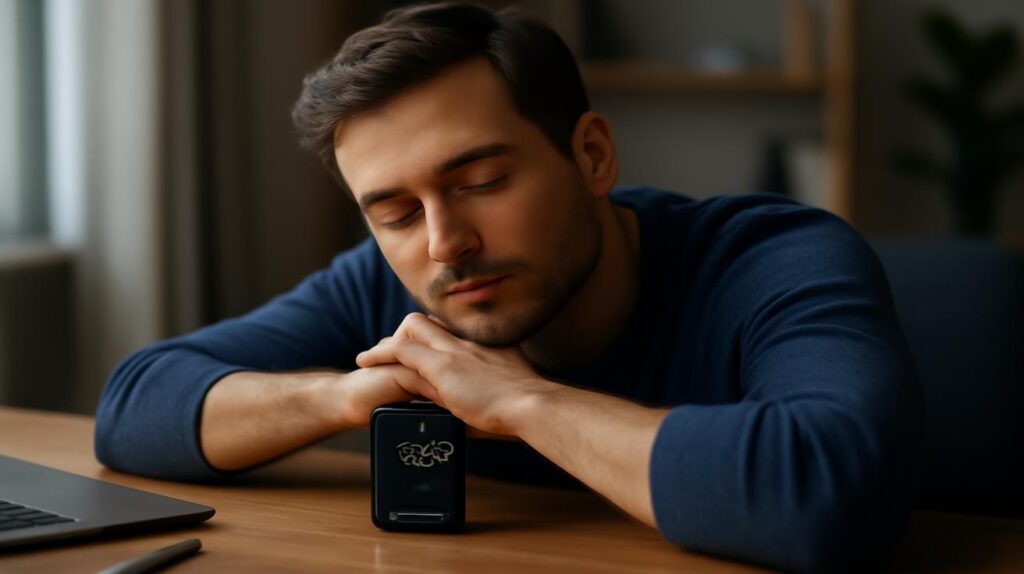
The first time I tried a micro-nap, I was sitting in my parked car, rain ticking softly against the windshield, phone set to a five-minute timer. My eyelids felt heavy in that warm, syrupy way only midafternoon can summon. I leaned the seat back a notch, crossed my arms, and let myself sink into the darkness behind my eyes. It felt silly, almost like playing pretend—who actually falls asleep in five minutes on purpose? But when the timer went off, I opened my eyes to find the world somehow sharper, the rain brighter on the glass, the traffic sounds clearer, my brain…lighter. Not fully rested, not like a long luxurious sleep—but as if someone had quietly untied a knot inside my skull.
Why Micro-Naps Feel Like Cheating the System
There’s a certain subversive thrill to sliding a tiny nap into the cracks of your day. It’s like discovering a secret passageway inside a house you thought you knew completely. Everyone else is grinding through their 3 p.m. slump, drinking burnt coffee and doom-scrolling, while you are off in a corner, eyes closed, borrowing five or ten minutes from the world.
Micro-naps are usually defined as very brief periods of intentional rest, often between 2 and 15 minutes, where you flirt with sleep more than you fully surrender to it. You don’t dive deep into dream-filled REM; you skim the surface, letting your nervous system loosen its grip just enough to reset.
You know that fog that settles in after lunch, when your screen brightness feels like an interrogation light and your brain keeps misplacing simple words? That’s your body running low on alertness fuel. Blood sugar is wobbling, circadian rhythms dip, and all the little demands of the day begin to pile up like leaves at a storm drain. A micro-nap is like quickly clearing that drain before the street floods.
The world trains us to think rest has to be long to be real. Eight hours of night sleep or nothing. But biology is more flexible than that. Your nervous system doesn’t care about round numbers; it responds to short bursts of recovery just as eagerly as to long stretches. Muscle fibers repair themselves between sets at the gym. Your lungs reset between breaths. Your brain, too, is wired for small, rhythmic pauses. A micro-nap is simply you choosing to honor that rhythm instead of bulldozing through it.
The Science Hiding Inside a Five-Minute Pause
Close your eyes for a moment—even now, as you read this. Notice what happens. Your inner world gets louder: the faint hum of a refrigerator, distant traffic, a neighbor walking overhead. Visual chatter drops away, and suddenly your brain has a little extra bandwidth to sort, file, and tidy up. That tiny shift is the starting line of a micro-nap.
When you deliberately shut your eyes and relax your muscles, your brain begins moving from fast, focused beta waves into slower, more relaxed alpha and early-theta waves. You may not fully “fall asleep,” but you dip into a lighter state of consciousness where:
- Your sensory input is reduced, giving your brain fewer things to juggle.
- Your sympathetic nervous system (the fight-or-flight branch) cools down.
- Your parasympathetic system (rest-and-digest) steps forward, lowering heart rate and easing muscle tension.
Even a few minutes in this lighter state can improve reaction time, mood, and perception of fatigue. Think of it as sweeping the mental crumbs off your workbench so your next task has a clean surface.
Interestingly, you don’t have to fully slip into deep sleep to reap benefits. In fact, with power micro-naps, you often don’t want to. You’re courting the edge—enough relaxation to reset, not so much that you wake up groggy. That grogginess, often called sleep inertia, can come from longer naps where you drift into slow-wave sleep and get yanked out before your brain is ready.
Power micro-naps stay short on purpose. They’re like rinsing your face at the sink instead of taking a long bath. Just enough to feel refreshed, not enough to need a towel and a whole new outfit afterward.
Crafting Your Daily Micro-Nap Ritual
To unlock the real magic of micro-naps, they have to move from “occasional emergency fix” to “quiet daily ritual.” Not dramatic, not indulgent—just a normal part of how you care for your brain and body. It helps to think of a micro-nap less like sleep and more like brushing your teeth: a small but non-negotiable hygiene routine for your mind.
The first step is choosing your window. Your body’s natural energy tends to dip in the early to midafternoon, often between 1 and 4 p.m. That’s your easiest opening. If your schedule allows, guard a 10–20 minute block during this time, even if your micro-nap itself is only 5 minutes. The extra buffer makes space to slow down.
Next, find your “nest”—a place where your body feels safe enough to release a little. It doesn’t need to be fancy:
- A parked car with the seat slightly reclined, doors locked, and your phone on airplane mode.
- A quiet conference room with the lights dimmed for a few minutes.
- A park bench, cap pulled low over your eyes, back supported by a tree or wall.
- Your own bed or couch if you work from home—just commit to the timer so it stays brief.
Then, build a tiny ritual around it. Ritual signals to your nervous system: “This is the part where we let go a little.” It might look like this:
- Silence notifications and set a timer for 5–12 minutes.
- Remove or loosen anything tight—shoes, belt, watch.
- Place one hand on your chest and one on your belly, feeling them rise and fall.
- Take 5 slow breaths, exhaling slightly longer than you inhale.
- Let your eyes soften behind the closed lids, jaw unclench, tongue rest heavy in your mouth.
At first, your mind may race. You’ll think about unread emails, the text you forgot to answer, what to make for dinner. That’s fine. You’re not failing. Micro-naps aren’t neat, cinematic knockouts where you instantly black out and awaken perfected. They’re messy, human, and sometimes they just feel like lying still and being bad at relaxing. That, too, is practice.
How Long Should a Power Micro-Nap Actually Last?
You’ll hear different numbers tossed around: 8 minutes, 10 minutes, 20 minutes. Those can all work, but the sweet spot for a power micro-nap—especially if you’re just flirting with sleep—is often between 5 and 12 minutes.
Within that range, something quiet happens. Your body notices you’ve stopped demanding constant output. Your brain slips down one notch in intensity. You may have tiny flickers of dreamlike images, or feel your limbs grow pleasantly heavy. Sometimes you’ll dip under and lose track of a minute or two. That’s usually enough.
Micro-naps aren’t trying to replace nighttime sleep. If your sleep tank is bone-dry, a short nap won’t fill it. But it can top it up enough to get you through the afternoon without snapping at your coworkers or rereading the same sentence five times.
A good way to experiment is to treat your nap duration like a recipe you’re adjusting by taste. Start with 8 minutes for a week. Notice: do you wake up clear or foggy? Still tired or slightly renewed? If you feel like you’re barely touching the edge, go up to 10 or 12 minutes. If you tend to plunge deep and wake groggy, try 5–7 minutes instead. Your personal sweet spot may not match anyone else’s, and that’s exactly the point.
Techniques That Make Micro-Naps Easier (Even If You “Can’t Nap”)
Some people proudly declare, “I just can’t nap.” Often what they mean is: “I can’t instantly fall asleep on command in the middle of the day like a cat.” The good news is, micro-naps don’t require that. They’re less about sleep and more about deliberate off-time for your nervous system.
Here are techniques that make slipping into a micro-nap more natural—even if you think you’re nap-proof:
- The 4–7–8 Breath: Inhale quietly through your nose for 4 seconds, hold for 7, exhale audibly for 8. Repeat 3–4 times. This pattern encourages your body toward a calmer state quickly.
- Progressive Softening: Start with your forehead. Imagine it melting like wax in warm sunlight. Then your jaw, shoulders, hands, belly, thighs, feet. By the time you reach your feet, your mind is already quieter.
- Counting Backward: Start at 50 and count backward slowly. Let every third number be a long exhale where you imagine tension leaving your body.
- Anchor Object: Imagine a tree you know well, or the texture of your favorite blanket, or the sound of ocean waves. Keep bringing your mind back to that anchor whenever it wanders.
Remember: “Success” is not measured by whether you fall fully asleep. It’s whether you genuinely stop demanding performance from yourself for a few minutes. If you emerge feeling even 5% more spacious inside, the nap did its job.
Fitting Micro-Naps into Real Life Without Looking Like You’ve Given Up
You might love the idea of micro-naps but wonder: How does this work in an office, on a job site, at school, or with kids underfoot?
The trick is subtlety and consistency. Micro-naps can be disguised as “stepping away for a moment” because that’s literally all they are. You’re not checking out for an hour; you’re bending time for a handful of minutes:
- At work: Book a “focus block” on your calendar and spend the first 8 minutes of it eyes closed at your desk or in a quiet corner. Noise-canceling headphones and a neutral face can look exactly like deep concentration.
- On breaks: Instead of scrolling through your phone in the break room, slip out to your car or a quiet stairwell landing. Lean against a wall, set a timer, close your eyes, and let yourself drift at the surface.
- At home with kids: Trade micro-naps with a partner or use screen time strategically. Five minutes of a cartoon for them can mean five minutes of eyes-closed stillness for you.
- Between errands: Waiting in a parking lot or outside a school pickup line is prime micro-nap territory. You’re just the person in the car with their eyes closed for a moment. No one needs to know it’s a secret energy ritual.
What matters most is that you protect the boundary around these few minutes. Treat them as non-negotiable rather than optional. When someone asks, “Can we talk right now?” you’re allowed to say, “In ten minutes.” Your nervous system is not a bottomless well. Every micro-nap is a way of quietly respecting that.
| Nap Length | Best Use | How You’ll Likely Feel After |
|---|---|---|
| 2–5 minutes | Quick reset between tasks, before a meeting, in a car or hallway | Slightly clearer, more alert, subtle lift without feeling like you slept |
| 6–10 minutes | Power micro-nap during afternoon dip, pre-commute reboot | Noticeably refreshed, more focused, usually no grogginess |
| 11–15 minutes | Deeper reset on heavy days, when concentration has dropped | More rested, mild drowsiness possible for a few minutes |
What Micro-Naps Actually Change Over Time
After a week of daily micro-naps, the effect is subtle but real. The late-afternoon meltdown you usually feel might soften into a manageable low tide. You snap less at colleagues and family. Your brain doesn’t skid out on small frustrations quite as easily. You begin to notice urges to reach for sugar or coffee and realize that sometimes, what you’re really craving is a pause.
Over a month or more, the compound interest kicks in. You may find:
- More consistent focus: Instead of a day that ramps up and then plummets after lunch, micro-naps create softer dips and steadier climbs.
- Better emotional regulation: That tiny daily window of off-time teaches your body it has options besides powering through or melting down.
- More creativity: Letting your mind drift for a few minutes a day is like gently stirring the sediments in a river; old ideas unstick and new ones float to the surface.
- Increased body awareness: You start noticing when your shoulders live near your ears or your jaw is permanently clenched—and you remember that a five-minute reset is available.
There’s also a quieter shift: the story you tell yourself about rest. Instead of believing rest is a rare, extravagant reward, you begin to see it as a basic ingredient in good work and a livable life. That’s not a productivity hack; that’s a worldview change.
The real benefit of power micro-naps isn’t just what they do to your reaction times or concentration scores. It’s the way they whisper, over and over, “You’re allowed to stop for a moment.” In a world that profits from your constant attention, claiming those moments is a small, quiet act of power.
Making Micro-Naps a Habit You Actually Keep
Habits don’t stick because we decide they’re important. They stick because we make them easy, obvious, and a little bit satisfying. Power micro-naps are no different.
To weave them into your days, try this:
- Attach them to something you already do. Right after lunch. After your second coffee. When you park the car before going into the house.
- Use gentle reminders. Set a recurring daily alarm with a name like “Reset, not scroll” or “Five-minute nest.”
- Make the first week a playful experiment. You’re not testing your discipline; you’re just noticing how different durations and times feel.
- Track the difference. At the end of each day, ask, “On a scale of 1–10, how fried was my brain?” Over time, you’ll see patterns.
- Lower the bar. If you’re exhausted or busy, tell yourself, “I’ll just close my eyes for 2 minutes.” Tiny is allowed.
The goal isn’t to become “good at napping.” It’s to renegotiate your relationship with stillness and effort. Power micro-naps are simply structured invitations to step out of the stream for a breath, then step back in with just a little more of yourself intact.
On some days, you’ll slide into that soft edge of sleep like a stone into a lake. On others, you’ll lie there with a noisy mind and a stubborn spine and feel like nothing’s happening. But if you listen carefully, even on those days, something is. You are practicing the rare art of not pushing, not fixing, not scrolling—just resting inside your own life for a handful of minutes.
And when the timer gently pulls you back, you may open your eyes to find, as I did in that rain-dimmed car, that the world has been lightly rearranged: a little clearer at the edges, a little kinder in the middle. Not because the world changed, but because, for five minutes, you let yourself soften—and brought that softness back with you.
FAQ: Power Micro-Naps
Are micro-naps safe to do every day?
For most healthy adults, yes. Micro-naps are short enough that they typically won’t interfere with nighttime sleep and can be safely practiced daily. If you have a diagnosed sleep disorder or a medical condition, it’s wise to check in with a healthcare professional.
Will micro-naps make it harder to sleep at night?
Because they are so short, micro-naps usually don’t disrupt nighttime sleep. If you notice it becoming harder to fall asleep, try moving your micro-nap earlier in the day or shortening it to 5–8 minutes.
What if I never actually fall asleep?
That’s okay. The benefits of micro-naps come from deliberate rest, not necessarily full sleep. If you spend 5–10 minutes with your eyes closed, breathing slowly, and letting your muscles soften, your nervous system still gets a reset.
Can I use coffee with micro-naps?
Some people enjoy a “coffee nap”: drink a small cup of coffee, then immediately lie down for a 10–15 minute nap. By the time the caffeine kicks in, you’re waking up from light rest, feeling doubly alert. Just avoid this too late in the day if caffeine affects your nighttime sleep.
Is there anyone who should avoid micro-naps?
If you have conditions like insomnia, severe sleep apnea, or other sleep disorders, or if you find that even very short naps make you significantly more tired or disoriented, talk to a healthcare provider before making micro-naps a daily habit.
How many micro-naps a day is too many?
Most people do well with 1–2 micro-naps spaced apart, usually during natural energy dips. If you feel the urge to nap repeatedly throughout the day, it may be a sign that you’re not getting enough quality nighttime sleep or that something else needs attention.
Do I need a special app or device to do this right?
No. A simple timer on your phone is more than enough. Comfort, consistency, and a willingness to pause matter far more than any technology. If an app helps you remember or relax, use it—but it isn’t required to unlock the benefits of power micro-naps.