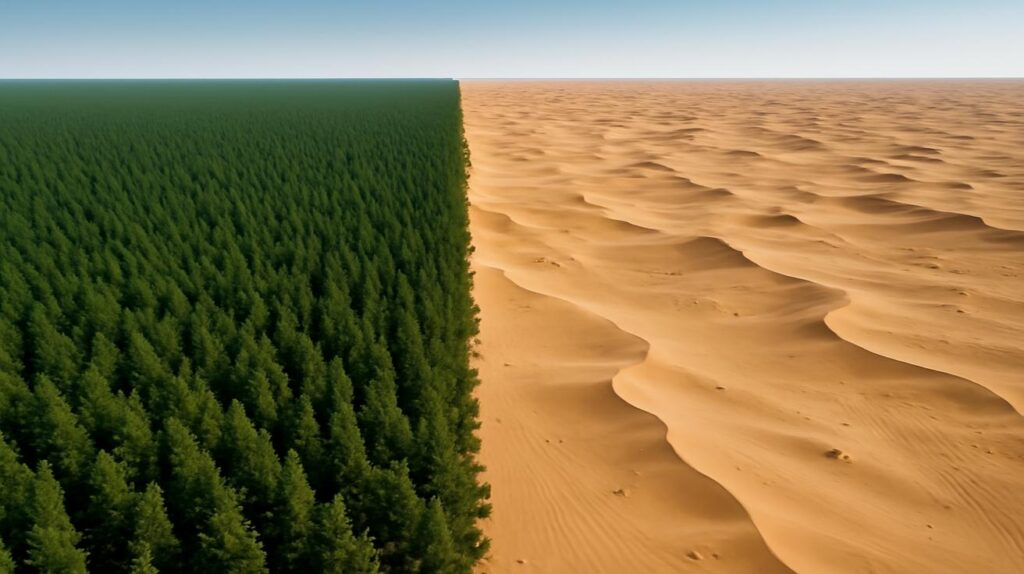
The wind over the Kubuqi Desert used to sound like a warning. It scraped over bare dunes and abandoned homes, rattling against doors that no one bothered to lock anymore. Sand swallowed fields, choked roads, and crept into bedrooms through the smallest cracks. People spoke of the dunes not as scenery, but as a slow, patient predator. Today, in many of those same places, the wind sounds different. It rustles in willow leaves, brushes across rows of poplars, pushes through sea-buckthorn shrubs thick with orange berries. The air smells of sap and damp soil instead of dust. Children who once watched their families flee the sand now walk to school under tree shade. This is the story of how a country decided to push back a desert with roots and patience—one billion trees at a time.
From Dust Storms to Green Dreams
If you lived in northern China in the 1980s or 1990s, you didn’t need a weather forecast to tell you when spring had arrived. You could see it in the sky turning the color of old parchment, taste it in the grit between your teeth. Dust storms rolled in from the expanding deserts of Inner Mongolia and beyond, blanketing Beijing and other cities in a fine, suffocating powder. Windows were sealed with tape. Streets disappeared behind a brown veil. The deserts, long considered distant and remote, suddenly felt like an invading army at the city gates.
For farmers and herders near the desert’s edges, the crisis hit much earlier. Land that had fed families for generations turned dry and brittle, then simply blew away. Overgrazing, deforestation, and poor land management had stripped many areas of their natural defenses. Once the vegetation disappeared, the topsoil loosened and the wind went to work. In some villages, people woke up to find sand piled against their doors like snowdrifts, fields buried, wells clogged. Homes were abandoned. Livelihoods vanished.
These scenes sparked a question that, at the time, sounded almost naïve in its scale: could a line of trees hold back a desert? China’s answer was not a cautious experiment but a sweeping commitment. Starting in the late 1970s and accelerating through the 1990s and beyond, the government launched an unprecedented reforestation campaign, often called the “Great Green Wall.” The idea was as simple as it was ambitious—plant vast belts of trees and shrubs across the north to stabilize soils, shield farmland, and eventually turn bare ground back into living landscapes.
By the 1990s, this was no longer just an aspiration. On plains and plateaus once written off as doomed to desertification, the shovels came out. Schoolchildren lined up to plant saplings on the edges of their playgrounds. Retired workers took part in community planting drives. Local governments experimented with drought-tolerant species. And slowly, something nearly invisible at first began to change: the land stopped vanishing quite so fast.
A Billion Trees and the Quiet Work of Roots
It is tempting to picture the planting of more than one billion trees as a single, heroic act—a few iconic photos of saplings lined up against a vast sand sea. The real story is messier, slower, and more human. It is written in calloused hands, in small arguments about which species survive best, in the fatigue of long bus rides to remote hillsides. It is also written in numbers, the kind that reveal how many incremental efforts can add up to a transformation.
| Aspect | Details (Approximate) |
|---|---|
| Trees planted since 1990s | More than 1 billion individual trees across northern and western China |
| Key project zones | Inner Mongolia, Gansu, Ningxia, Shaanxi, Hebei, and other arid provinces |
| Main goals | Slow desert expansion, reduce dust storms, restore degraded land, protect farmland and settlements |
| Notable outcomes | Desert expansion slowed or reversed in several regions; increase in vegetation cover; reduced frequency and intensity of some dust storms |
| Methods used | Tree belts, shrub planting, grass seeding, controlled grazing, sand barriers, water-saving irrigation |
Walk through one of these transformed zones on a cool spring morning and the difference is visceral. Underfoot, the soil no longer drifts and crunches like dry sugar. It holds together, stitched by roots, darkened by decaying leaves. In the early light, lines of poplar and pine throw long, crisp shadows over fields that were once bare. This is the quiet work of roots: gripping the earth, catching drifting sand, sheltering seedlings from wind that used to tear them out of the ground.
In Inner Mongolia’s Kubuqi Desert, once nicknamed a “sea of death,” the soundscape has rewritten itself. Where there was only the hiss of sand, you now hear the drone of bees navigating rows of shrubs and the low hum of irrigation pumps. Herbs and grasses hide between the planted trees, seizing the newfound shade and moisture. The transformation is not a lush rainforest—these are still fragile, water-limited ecosystems—but they are living, resilient, and productive in ways that once seemed impossible.
The magic is not in a single tree but in their combined presence. One shrub breaks the wind for its neighbor; one line of willows slows the sand long enough for grasses to root. Over time, organic matter accumulates. The land, battered for decades, begins to heal.
The Human Stories Behind the Green
Every line of trees tells a human story. In the early days of the campaign, villagers in some regions were skeptical. Why plant trees on land that seemed beyond saving? Water was scarce, and planting meant time away from crops and herds. Yet subsidies, training programs, and, in some areas, a sense of shared jeopardy turned doubt into participation.
In one village near the Tengger Desert, older residents still remember tying saplings to stakes with strips of cloth cut from worn-out shirts, praying they would survive the first brutal summer. They recall carrying buckets by hand to water newly planted rows when irrigation pipes didn’t reach that far. Some of those saplings died. Many did. But enough survived that, thirty years later, their grandchildren can stand in the shade of full-grown trees and listen to their grandparents’ stories as if hearing tales from another continent.
The work also shifted livelihoods. Former herders, whose animals had overgrazed already-normal pastures, were trained as forest rangers and tree-care workers. Local cooperatives formed to manage plantations and share profits from timber, fruit, and medicinal plants grown in the newly stabilized soils. Where sand once blew into houses, rows of poplar now act as living windbreaks, protecting crops, roads, and towns. The shift from “we can’t stop the desert” to “we are shaping our own landscape” changed not only the skyline, but also how people understood their relationship with the land.
When the Desert Bites Back
Reversing desertification in a country as vast and varied as China was never going to be a simple arc from problem to solution. The land pushed back. Some early efforts, particularly large-scale monoculture plantations of a single fast-growing tree species, ran into serious trouble. Trees planted too densely, or without regard for local water limits, struggled to survive. In some areas, thirsty roots pulled more water from the ground than the local system could provide, leading to withering canopies and renewed erosion.
On hot afternoons, you can still find failed plantations: skeletal remains of trees bleached by sun and sand, branches frozen in place like question marks. They are reminders that good intentions are not enough, and that ecosystems are not simple machines that can be “fixed” with one tool. Planting more than a billion trees sounded triumphant, but the more meaningful metric became: how many of those trees are still alive ten, twenty, thirty years later—and what else is growing among them?
Responding to these lessons, projects gradually shifted from “plant as many trees as possible” to “plant the right vegetation, in the right place, at the right density.” Shrubs and native grasses began to share the stage with trees. Species chosen were increasingly local and drought-adapted: hardy willows along waterways, deep-rooted shrubs on dunes, salt-tolerant varieties in alkaline soils. In many zones, planting was complemented by policies that limited grazing on fragile land, introduced rotational pasture systems, and promoted alternative income sources.
Scientists joined local communities in mapping wind patterns, soil types, and water availability. Aerial photos and satellite images helped track which patches of land greened up and which did not. The task was no longer to build a wall of trees as a simple barrier, but to restore functioning mosaics of vegetation that could sustain themselves and the people who depended on them.
Signs That the Tide of Sand Is Turning
So, did it work? You can see some of the answers from space. Satellite data show that, in several key regions of northern China, the march of the desert has slowed, halted, or even reversed since the 1990s. Areas once identified as hotspots of desertification now show increased vegetation cover. The colors on the maps—once dominated by yellow and tan—have begun to show more patches of green.
On the ground, the evidence is even more immediate. In some provinces, the frequency of severe dust storms has declined compared with their peak in the late twentieth century. Villagers who used to tape up their windows against spring dust now report clearer skies and fewer days when the world turns brown. Cropland protected by belts of trees yields more reliable harvests. Roads that once vanished under dunes remain clear more often, saving time, money, and sometimes lives.
There is a psychological shift, too. In communities that participated in these restoration efforts, people talk about “our forest belts” and “our shelter trees” with a sense of shared ownership. Where sand used to symbolize loss—a field gone, a house buried—it is now flanked, in many regions, by symbols of persistence: straight rows of shelterbelts, scrubby but determined shrubs, grasslands inching back over once-bare ground.
What a Billion Trees Can and Cannot Do
Standing under a canopy of leaves where there was once only scorched sand, it is easy to feel that trees are a miracle cure. They are not. China’s experience offers hope, but also caution. A billion trees can slow desert expansion, restore degraded land, reduce dust storms, and improve local climates. What they cannot do is erase the underlying pressures if those pressures continue unchecked.
Desertification in China has never been caused by a single factor. It is the result of climate change, historical overgrazing, deforestation, unsustainable farming, and water mismanagement braided together across decades. Trees address some of these symptoms—they stabilize soil, create shade, and support biodiversity. But if water continues to be overdrawn, if grazing and land use are not carefully regulated, if climate change continues to intensify heat and drought, even the hardiest plantations will remain vulnerable.
This is why the most successful restoration zones are those where trees are part of a wider shift in how land is used. In some communities, farmers have switched from water-guzzling crops to varieties better suited to dry conditions. In others, herders have embraced rotational grazing plans that give grasslands time to recover. Education programs explain not only how to plant a tree, but why to leave some patches of land untouched, to act as seed banks and refuges for wildlife.
Still, the symbolism matters. A nation that once watched its deserts creep outward has shown that landscapes can move in the other direction, too. For many people in and outside China, the story of these one billion trees is a rare narrative about environmental repair at massive scale, a reminder that not all the arrows on the climate and land-use charts point toward catastrophe.
Lessons for a Warming World
The rest of the world has been watching. Countries from Africa’s Sahel region to Central Asia have studied China’s approach, searching for clues to apply at home. Some lessons are technical—about which species to plant, how to space shelterbelts, how to trap drifting sand. Others are more philosophical, rooted in humility and patience.
One of the clearest lessons is that restoration is not a one-time event. Planting is the beginning, not the end. Without long-term care—watering, thinning, replanting where needed, adapting to new climate realities—those first green shoots remain vulnerable. Another lesson is that local knowledge is indispensable. People who have lived on the land for generations know where the wind hits hardest, which shrubs survive the harshest droughts, and how to weave restoration into daily life.
China’s effort also underscores that scale matters, but so does nuance. It is impressive to say “more than one billion trees,” but what changes land and lives are the specific decisions: that a certain village chose native shrubs over non-native pines; that a particular hillside was left to natural regeneration instead of being plowed for planting; that a community agreed to protect young trees from grazing for just a few more difficult years until they could withstand it.
The Green Edge of Tomorrow
Visit one of the re-greened zones on a summer evening now, and the story of the land is written in details your senses can read. The air cools quickly once the sun dips behind a line of trees—something that never happened when the dunes lay bare and blazing. The ground is flaked with leaves and dotted with insect burrows. A lark darts from a low shrub, feathers catching the last light. The breeze still carries a dry edge, but instead of dust, it lifts the smell of resin and crushed grass.
Children race along paths where their grandparents once trudged through drifting sand. They hop over irrigation channels, duck under branches, call out the names of birds that have returned to nest in the young woodlands. In their lifetime, the idea that the desert can be pushed back is not a bold experiment; it is a familiar, living reality.
Of course, the work is not finished. Climate change continues to redraw the map of what is possible. Water remains scarce in many of these regions. Some plantations will fail and need to be rethought. But the direction of travel has changed. In many parts of northern China, the desert is no longer advancing unchecked. It is being met with lines of roots, with leaves catching sunlight where once only sand burned.
By planting more than one billion trees since the 1990s, China has done more than slow the spread of deserts and restore vast areas of degraded land. It has demonstrated that even landscapes on the brink can be coaxed back from the edge when human will, science, and local knowledge come together. The dunes still exist, broad and golden under the high sun. But they no longer tell a story of inevitable loss. At their margins, a new narrative is taking root—one that rustles every time the wind moves through the leaves.
Frequently Asked Questions
Has desert expansion in China actually stopped?
In several key regions, studies and satellite data indicate that desert expansion has slowed, halted, or even reversed since the 1990s. While not every area shows the same progress, overall vegetation cover in many formerly degrading zones has increased, and some deserts are no longer advancing as rapidly as they once did.
Are all of the trees planted since the 1990s still alive?
No. A significant number of trees did not survive, especially in early projects that used less suitable species or planting densities. However, enough have taken root—and been complemented by shrubs and grasses—that large areas of land have stabilized and greened compared with past decades.
Does planting trees alone solve desertification?
No. Trees are a powerful tool, but they must be part of a broader strategy that includes sustainable water use, improved grazing and farming practices, protection of native vegetation, and adaptation to climate change. Where these elements work together, restoration is much more likely to last.
What kinds of trees and plants are used in China’s anti-desertification projects?
Projects increasingly favor drought-tolerant, locally adapted species such as various poplars, willows, pines, sea-buckthorn, and native shrubs and grasses. The mix depends on local conditions—soil type, rainfall, wind patterns, and salinity—rather than a one-size-fits-all approach.
Can other countries replicate China’s “Great Green Wall” approach?
Many aspects can be adapted—large-scale planting, community involvement, integration of science and local knowledge. However, each country needs to design its own strategy based on local climates, cultures, and land-use histories. The core idea is not to copy China tree for tree, but to learn from its successes and mistakes when planning restoration elsewhere.