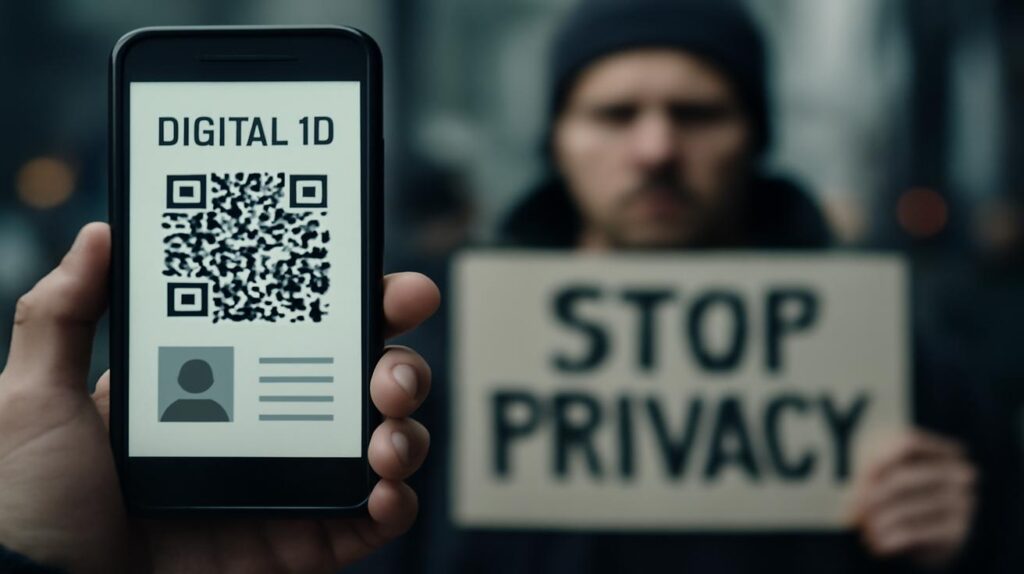
The notice arrived in a thin, unremarkable envelope—no bold red stamp, no dramatic headline—just a plain government letter that looked like it could have been about taxes or parking violations. But when Lena tore it open at her kitchen table, coffee cooling beside her, the words seemed to hum off the page: “All citizens are required to obtain their National Digital Identity Card by March 1st of next year.” The letter went on, calm and bureaucratic, explaining how this would streamline services, “enhance security,” and “modernize citizen-state interactions.” It sounded efficient. It also sounded final.
Outside, the city was waking up. Delivery trucks clattered along the street. Someone in the building across the way opened their blinds, sunlight striking off their phone screen as they scrolled. Everything looked ordinary, but in that moment, Lena had the strange feeling that something invisible had shifted, like a new lens snapping into place over the country.
When Convenience Knocks at the Door
The government’s announcement came wrapped in the language of progress. The new digital IDs, they promised, would replace a messy drawer full of plastic cards, paper documents, and half-remembered passwords. One card—or even just an app on your phone—would confirm who you are in seconds. Need to renew a passport? Tap. Access healthcare? Scan. Open a bank account, file taxes, vote, sign up for school, collect social benefits—all fused into a single, glittering thread of data.
In televised statements, officials spoke with the confident warmth of tech keynote presenters. The digital ID would be “secure,” “encrypted,” “future-ready.” There were glossy mockups of sleek cards and clean white screens with friendly icons. Animation showed a citizen breezing through airport security in seconds, checking into a clinic with a wave of their phone, registering a business from their living room couch.
“We are entering an age,” one minister said, hands folded in front of a blue backdrop, “where identity can be both simple and secure. No more lost documents. No more fraud. No more long lines. This is about giving people back their time.”
And on the surface, it wasn’t hard to believe. Long lines at cramped government offices are a shared national annoyance. Most people already live half their lives online; what’s one more app? Many shrugged and thought: if this makes things easier, why not?
But as the news rippled out, privacy advocates felt something else entirely—a chill along the spine.
The Quiet Architecture of Watching
In a small, cluttered office above a bike shop, the team at a local digital rights organization gathered around a secondhand projector. The wall flickered with slides: flow charts, diagrams, policies from other countries. There was no sleek animation here, no polished soundtrack. Just a different story about the same digital ID.
“This isn’t just an ID,” said Arun, the group’s legal researcher, dark circles under his eyes from a week of late-night reading. “It’s an integration point. It’s the backbone that links everything else together.”
On the wall, a simple diagram: in the center, a single box labeled “Digital ID.” Radiating out from it, lines connecting to health records, tax files, education databases, banking systems, transport passes, voting registries, even social media logins. A quiet web where every strand led back to the same identity anchor.
“Once everything converges here,” he continued, “whoever controls this system doesn’t just know who you are. They can map where you’ve been, what you’ve bought, which protests you went to, which medicine you take, what you posted last year at 2 a.m. The ID becomes the key to the archive of your life.”
The word “surveillance” gets thrown around so often it can start to sound abstract, like a storm forecast that never quite arrives. But in the glow of the projector, it took on a more tactile quality. Surveillance wasn’t just cameras on poles or drones overhead. It was databases slowly knitting themselves together behind the scenes, like a tapestry woven from every ordinary moment you barely remember.
To illustrate, one of the volunteers had put together a simple comparison.
| Aspect | Traditional ID | Mandatory Digital ID |
|---|---|---|
| Primary Use | Verify identity in limited contexts | Universal key for online & offline services |
| Data Collected | Name, photo, address, date of birth | Biometrics, location trails, service usage, behavior patterns |
| Traceability | Limited; many actions remain offline | High; most actions can be logged & linked to one ID |
| Opt-Out Options | Possible to live with minimal documents | Mandatory; refusal risks exclusion from services |
| Abuse Potential | Fragmented; requires multiple systems | Centralized; one system to track, profile, control |
On paper, the table was dry. In reality, it translated into something intimate: whether you can move through the world without leaving a trace.
The Fragile Line Between Tool and Weapon
That afternoon, in a coffee shop humming with low conversation and the hiss of milk steamers, a young software engineer named Max scrolled through the government’s technical proposal on his laptop. He knew how systems were built—how data moved, how it could be protected, and how, if someone was determined enough, it could be pierced.
“In theory,” he said, half to himself, half to the friend across the table, “you can design a digital ID that respects privacy. Strong encryption, minimal data retention, tight access controls. You don’t need to log every action. You can decentralize what’s stored. Technically, it’s not impossible.”
He paused, eyes lingering on a vague phrase in the draft law: “Data may be shared with relevant authorities for security and administrative purposes.” No definition of “relevant.” No limits on “security.”
“But the problem,” he went on, “isn’t just the system. It’s power. A tool that can see everything is a tool that someone will eventually use to do exactly that. Maybe not now. Maybe not this government. But data doesn’t forget, and laws have a habit of stretching.”
He thought of stories from other countries—systems built to fight fraud or streamline welfare later used to track dissent, target journalists, or quietly blacklist activists. A database that began as benign infrastructure slowly reinterpreted as a map of “risk” or “threat.”
“Technology,” he said softly, closing the laptop, “is always built in the present. But it lives in the future. And we’re handing the future a surveillance machine, pre-assembled, with the key left in the ignition.”
The Promise of Safety, the Price of Trust
As debate grew louder, government officials leaned hard on one word: security. Online fraud was rising. Identity theft cost millions every year. Criminal networks exploited gaps between outdated databases. Without a unified system, they said, criminals and terrorists could slip through.
On evening talk shows, serious men in suits spoke of “national resilience” and “modern threats.” They talked about people whose identities had been stolen, bank accounts emptied, lives tangled in bureaucratic knots. A digital ID, they argued, was a shield. A way to make sure you were really you.
It made a kind of sense. Everyone knows someone who’s had a card skimmed, a password leaked, a strange charge on their account. In a world where so much of life happens behind screens, identity can feel like it’s made of smoke.
But privacy advocates heard a different echo in the security narrative. They heard a familiar trade: safety in exchange for visibility. Protection in exchange for exposure. “If you let us see everything,” the logic went, “we can keep you safe from anything.”
In a town-hall meeting streamed online, a woman in the back raised her hand and asked a simple question: “Who, exactly, will be able to see my data?” There was a pause. A carefully worded response about “authorized personnel” and “strict protocols.” She frowned. “And who authorizes the authorized?”
The room was quiet. Somewhere, a chair creaked. The moderator moved on.
When Opting Out Isn’t an Option
What made this digital ID different from the dozens of apps and services people already handed their data to every day was simple: there would be no real choice.
The rollout plan was clear. Within a year, the digital ID would become the primary key to access essential services. Healthcare. Public education. Social benefits. Tax filings. Government housing. Eventually, there were murmurs, even public transportation and voting might be bound to it. The law used the word “mandatory” as if it were a bureaucratic detail, not a moral threshold.
For people already entangled with the state—students, employees, business owners—the pressure would be immense. For those on the margins, the consequences would be dire. Migrant workers. The homeless. People without stable internet or smartphones. Older citizens wary of technology. People hiding from abusive partners who use any trace to find them. For them, the digital ID wasn’t a sleek badge of modernity. It was a gate.
“If you can’t live without it,” said a community organizer during a neighborhood meeting in a dimly lit cultural center, “then it’s not just an ID. It’s a leash. Maybe a soft one at first, almost invisible. But it’s attached to something, and that something can pull.”
A man in the crowd raised his hand. “But don’t we already live in databases? Tax IDs, healthcare cards, bank accounts, phones that track us? How is this different?”
She nodded. “We do. But right now, the systems are fragmented. Messy. Inconvenient, yes, but also a kind of safety. There’s friction in linking it all together. This,” she said, tapping the printout of the proposed law, “removes that friction. It’s not just another database. It’s the skeleton key that turns every lock at once.”
The Slow Creep of Function Creep
If you want to see how a system could evolve, you don’t look at the first year. You look at the tenth.
At first, the digital ID might simply replace old-fashioned cards. A smoother entrance into the familiar maze of bureaucracy. But power rarely stands still. A new technology sparks new possibilities. Someone proposes using the ID to track attendance at public schools more precisely. Another suggests linking it to a credit scoring system. Then to public transit passes, to parking permits, to library cards, to job applications.
Little by little, the ID seeps into the cracks of daily life, filling them with data. Each new link seems logical, helpful, efficient. Nothing is dramatic. There is no single moment where the country “turns” into a surveillance state. Instead, there is an accumulation of convenience, one small integration at a time.
Decades from now, a teenager might grow up never having known what it was like to walk through a city anonymously, to buy a book with cash, to visit a clinic without that visit attaching itself permanently to a profile. Their world will be tidy, personalized, secure—and utterly transparent to those who own the machinery of identification.
“We talk about a surveillance nightmare like it’s a sudden thing,” said Arun, the legal researcher, during a late-night podcast interview. “Like one day you wake up and there are cameras everywhere and guards at every corner. But the real nightmare is quieter. It’s waking up to realize that everything you’ve done for years has already been recorded, sorted, scored, and used to decide who you’re allowed to be.”
Lines in the Digital Sand
The backlash didn’t look like a single uprising. It looked like thousands of small acts of resistance and questioning.
Lawyers pored over the draft legislation, red pens marking margins: Where are the deletion rights? Can citizens see who accessed their data? Are there independent audits? Strong penalties for abuse? Sunset clauses? Technical oversight by neutral experts, not just government agencies?
Technologists proposed privacy-preserving alternatives: systems where verification didn’t require centralized logging of every transaction, where the ID could confirm, “Yes, this person is over 18,” without revealing their birthdate, or “Yes, they pay taxes,” without exposing their entire financial history.
Activists knocked on doors and spoke in community centers, translating abstract concepts into kitchen-table language. Not “metadata” and “centralization,” but “who can see your medical records,” “who knows where you were last week,” “who decides if you’re ‘suspicious.’”
Some people, like Lena at her kitchen table, simply sat with the letter in their hands, feeling a low, unsettled hum in their chest. They weren’t radical. They weren’t even particularly tech-savvy. But something about the word “mandatory” linked with “digital identity” nagged at them like a splinter.
In the end, the question circling the country wasn’t about software architecture or encryption protocols. It was older, almost ancient: How much of yourself do you give to the state in exchange for being part of it? And once given, can you ever get it back?
For now, the letter sits on the corner of Lena’s table, weighed down by a salt shaker so it doesn’t curl. She looks at it every morning over coffee, the way you might glance at a new neighbor’s window, curtains still closed, wondering what kind of noise they’ll bring into your life.
The deadline is months away. The sun still rises. Delivery trucks still clatter past. Phones still glow in apartment windows. But somewhere, deep in server rooms humming below ground and in laws written in careful, neutral language, the shape of tomorrow’s identity is being carved.
Whether it becomes a key to a more open, humane society or the first link in a chain of invisible control will depend not on the technology itself, but on how fiercely people insist that their humanity is more than a line of code in a national database.
FAQ
Is a mandatory digital ID always bad?
Not necessarily. A digital ID can make services more accessible and reduce some forms of fraud. The risk comes from how it’s designed, what data it collects, who can access that data, and whether people truly have a choice. Without strong legal and technical safeguards, it can easily become a tool for pervasive surveillance.
What makes this different from the IDs and accounts I already have?
Most current IDs and accounts are separate and limited to specific uses—your bank card doesn’t automatically expose your health records, for example. A mandatory digital ID becomes a universal key that can link many different databases together, making it far easier to track and profile your entire life.
Can digital IDs be built to protect privacy?
Yes. Techniques like minimal data collection, decentralization, strong encryption, limited logging, and independent oversight can greatly reduce risks. The problem is that many proposals don’t prioritize these protections and instead leave broad loopholes for data sharing and monitoring.
What are the main dangers privacy advocates worry about?
They worry about mass surveillance, political profiling, discrimination, function creep (new uses added over time), data breaches, and the gradual loss of anonymity in everyday life. Once a central ID system exists, it’s very tempting for authorities or future governments to expand its use beyond the original promises.
What can ordinary citizens do if they’re concerned?
They can ask clear questions of their representatives, support digital rights organizations, push for strict privacy laws and transparent oversight, and demand options that minimize data collection. Public pressure can influence how such systems are designed—or whether they’re adopted in their current form at all.