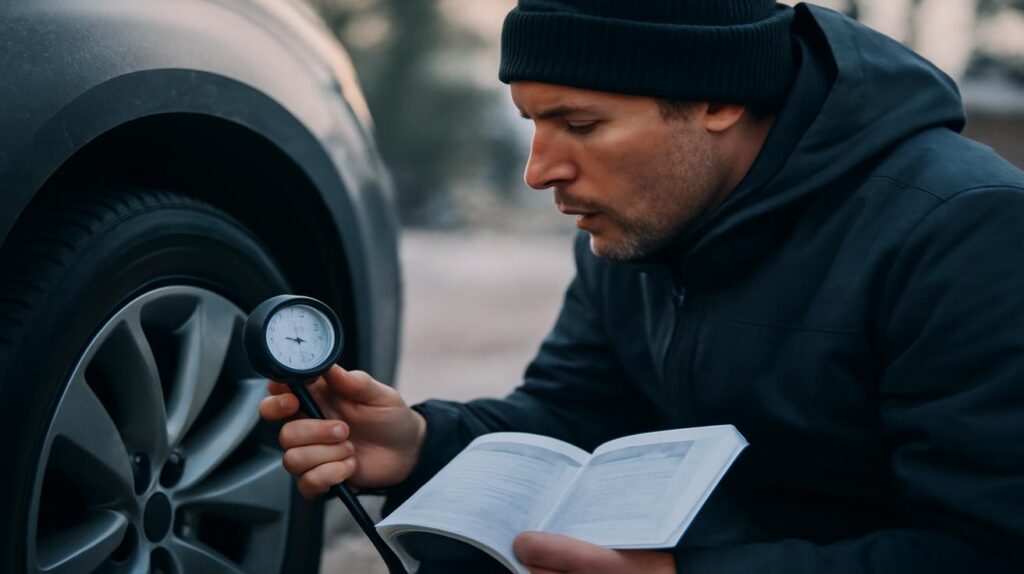
The first cold morning always arrives quietly. You open the front door and the air feels different—thinner, sharper, edged with a crystalline bite that slips through your jacket. Breath turns to ghostly clouds. Somewhere down the street, a car starter whirs, coughs, catches. And as you brush a crust of frost off your windshield with the side of your sleeve, one little amber icon flickers to life on your dashboard: the tire-pressure warning light. Most people sigh, ignore it, and drive away. But that tiny light is trying to talk to you about something that matters far more than most drivers realize—your safety, and the fuel your car is quietly burning.
The Winter Rule Your Car Tries to Whisper, But You Don’t Hear
Ask a seasoned mechanic about winter, and they’ll usually talk about batteries, oil, maybe coolant. But if you linger in their bay long enough, you’ll notice something more subtle: the stack of tires in the corner and the air gauge on the bench that never seems to get put away.
“Everyone remembers to warm up their car,” a veteran tire tech might tell you, rubbing his hands together under the hiss of the shop’s air compressor, “but almost nobody remembers to ‘warm up’ their tire pressure for winter.”
Here’s the rule car experts quietly repeat all winter long, the simple one almost nobody talks about:
For every 10°F (about 5–6°C) drop in temperature, your tire pressure can fall by about 1 PSI. When winter hits, you should check and adjust your tire pressure at least once a month—ideally when the tires are cold—to match the manufacturer’s recommended PSI.
It sounds almost too simple. But that forgotten one-PSI-per-10-degrees rule is what makes your tire-pressure light flare up every time a cold front blows in. And when you ignore it for weeks or months, your tires quietly sag, your fuel bill slowly climbs, and your ability to stop on an icy road shrinks right when you need it most.
The Science Hidden in the Frost: Why Cold Air Steals Your PSI
On a clear, cold morning, your tires look the same as they did in October. Black rubber rings, some road dust, maybe a bit of salt spray clinging to the sidewalls. But inside, in that dark, pressurized space, the air has changed.
Tire pressure isn’t magic; it’s just physics. The air in your tires expands when it’s warm and contracts when it’s cold. That means a tire properly inflated on a mild 70°F (21°C) afternoon can be several PSI under-inflated when the temperature dives to 30°F (-1°C) overnight. To your eye, the tire might not look obviously flat—but your car’s safety systems can feel it.
Most modern vehicles have a TPMS (Tire Pressure Monitoring System) that chirps at you with a warning light when pressure drops about 25% below the recommended level. But here’s the catch: by the time that light comes on, you’re already in the danger zone. Tire experts like to say the TPMS is a “last resort,” not a daily guide. It’s like a smoke detector—essential, but not something you want going off as part of your routine.
Imagine this: your car label (that little sticker on the driver’s door frame) says you should run 35 PSI in your tires. As the temperature slides down across autumn, each cold week quietly shaves off 1 or 2 PSI. A few months later, you’ve dipped into the high 20s—but your TPMS might not scream at you until you’re hovering around 26 PSI or even lower. All that time, you’ve been driving on half-deflated sneakers while thinking everything is fine.
The Feel of a Soft Tire, and Why You Might Miss It
Under-inflated tires can feel a bit “squishy” in tight turns, a vague sort of rolling softness that most drivers chalk up to the road or the weather. The steering can seem slightly lazier, the car more inclined to lean, especially during quick lane changes. But winter roads are already busy with sensory noise—wind, slush, studs, salt, ruts. The nuanced feedback of low pressure gets lost in that chorus.
So you drive on, day after cold day, guided by habit more than by feel. Each trip, the contact patch of your tires—the patch of rubber actually touching the road—grows a little wider and a little less precise. That might sound like more grip, but it isn’t. It’s more drag, more heat, more wear, and less control when you need it most.
Safety in a Snowstorm: How a Few PSI Changes Everything
Picture an icy intersection at dusk. It’s one of those winter evenings where the sky has surrendered to a dim gray and the plows have done their duty, leaving damp, slick patches in their wake. You’re heading toward a red light at a comfortable speed, radio humming softly. Then someone in front of you brakes a little harder than you expected.
In that moment, everything comes down to four hand-sized patches of rubber and the way they grip the frozen world beneath you. Proper tire pressure doesn’t just keep the tires round; it helps them keep their intended shape, allowing the tread pattern to bite correctly into snow, slush, or damp pavement.
What Experts See in the Shop (That You Don’t Feel in the Car)
Ask any winter driving instructor or tire engineer, and they’ll tell you:
- Under-inflated tires increase braking distance. On a slippery surface, that can be the difference between stopping at the crosswalk and sliding into the intersection.
- They reduce steering precision. A low tire sidewall flexes more, delaying your car’s response when you turn the wheel.
- They make hydroplaning and slush-planing more likely. A properly inflated tire cuts through water and slush more efficiently; a soft tire rides up on top far more easily.
What’s striking is how small the numbers are compared to how big the consequences can be. Just being 5–7 PSI under the recommended level—a range many winter drivers unknowingly live in—can mean several extra car lengths in braking distance on slick roads.
A tire engineer once described it this way: “You spend hundreds or thousands of dollars on tires and safety systems, then lose a chunk of that benefit over a couple of missing PSI. It’s like buying great hiking boots and then leaving the laces untied.”
The Quiet Drain on Your Wallet: Winter Pressure and Fuel Use
There’s another part of this story that’s easy to miss, especially when the world outside your windshield looks like a snow-globe shaken by an impatient child: fuel. Winter already makes your car work harder. Engines take longer to reach efficient operating temperatures. Winter gasoline blends can reduce mileage. Idling to warm up the cabin wastes energy.
Now add under-inflated tires to that pile.
When your tire is soft, more of it drags against the road. It’s like trying to roll a half-flat wheelbarrow tire through wet grass—you push harder, fight more resistance. Your engine feels that resistance too. It has to work a little extra every second you’re moving, sipping more fuel as it goes.
According to multiple industry and safety organizations, even a few PSI below the recommended level can trim your fuel economy by 2–3%. Let them drop further—10 PSI or more under spec—and you could be losing 5% or more of your mileage without realizing it. Over an entire winter, that quiet loss stacks up like snow along a curb.
And then there’s tread life. Under-inflated tires flex more, heat up more, and wear faster. On cold, abrasive winter roads, that extra wear can shave thousands of miles off the life of your tires. The money you spent on those winter or all-season tires starts evaporating, simply because the air inside them is a little low and the temperature outside is a lot lower.
A Snapshot of What a Few PSI Really Means
| Tire Pressure vs. Recommended | What You Might Notice | Hidden Effects |
|---|---|---|
| 0–3 PSI low | Feels mostly normal | Slight fuel loss, mild extra wear |
| 4–7 PSI low | Softer ride, vague steering | Noticeably worse mileage and traction |
| 8–10+ PSI low | Risky handling, TPMS light likely on | Long stopping distances, high wear, higher blowout risk |
The Simple Routine Car Experts Swear By
Standing in a warm garage, with the smell of rubber and cold metal in the air, most car experts will boil their advice down to a short, almost ritualistic checklist. It isn’t complicated. It doesn’t require fancy tools. And it might be the easiest winter safety habit you’re not doing yet.
1. Start With the Sticker, Not the Sidewall
Walk to your car and open the driver’s door. On the door frame, or sometimes on the door itself, you’ll see a small label. On it, in dense but clear print, is the PSI your car manufacturer recommends for the front and rear tires. That number—not the one molded into the tire’s rubber sidewall—is your target.
The sidewall number is the tire’s maximum pressure, not what your car actually wants for daily driving. Car designers choose PSI for a balance of grip, comfort, efficiency, and safety. In winter, that balance becomes even more important.
2. Check Pressure When Tires Are “Cold”
“Cold” in tire language doesn’t mean icy or frozen—it means “not driven on for at least three hours, and not checked immediately after a long trip.” Driving heats your tires, and warm air expands, giving you a misleadingly higher reading.
So pick a quiet time: maybe first thing in the morning before you leave for work, or at the start of your weekend errands. A simple digital gauge—often no larger than a key fob—will give you a quick reading. Press it firmly onto the valve stem, listen for the brief hiss, and read the number glowing back at you.
3. Remember the Winter Drop Rule
This is the part most drivers forget: that 1 PSI per 10°F drop. If your tires were perfect back in October when you last checked them at 65°F (18°C), and now it’s 25°F (-4°C), that’s roughly 4 PSI gone simply to colder air. It’s not a slow leak, not a nail, not sabotage by the universe—it’s just physics doing its quiet, relentless work.
Car experts use this rule as a mental nudge: every meaningful step down in temperature deserves a pressure check. In practical terms, that means:
- Check pressure at least once a month in winter.
- Re-check after a significant cold snap or arctic front.
- Adjust back up to the sticker PSI each time.
It’s a rhythm, like changing smoke detector batteries with the time change or swapping wiper blades before a rainy season. Soon, it stops feeling like a chore and starts feeling like part of how you welcome winter.
4. Don’t Forget the Spare (If You Have One)
There’s a quiet kind of misery that comes from realizing your spare tire is flat on the side of a snowy highway. If your vehicle has a full-size or compact spare, it’s usually hiding in the trunk well or mounted under the rear of trucks and SUVs. Those tires lose PSI to cold too, and they often go longer without attention.
Once or twice each winter, add the spare to your pressure-check ritual. It may feel unnecessary—until the day you’re very glad you did it.
Stories in the Snow: How One Check Changes a Winter Drive
Imagine two drivers on the same icy morning. One shrugs off the glowing amber tire light, half-convinced it’s a finicky sensor. The other pulls into a quiet gas station, breath puffing little clouds in front of their face, and rolls a simple gauge onto each valve stem.
The readings come back: 27, 28, 26, 27. The door sticker says 35 PSI. It’s not dramatic—no tires sagging like a balloon two days after a party—but it’s enough. Four quarters in a parking meter. Four flicks of the air pump handle. Four soft hisses as cold air flows into colder rubber.
Ten minutes later, that second driver pulls back onto the road with tires at the right pressure. They’ll probably never know the full difference those extra PSI made—not in the freeway lane change that felt perfectly normal, not in the steady feel of the wheel over a patch of slush, not in the comfortable inch of extra stopping room they had when the car in front of them braked a little harder than expected.
They might notice a few extra miles from each tank of fuel, a bit less money evaporating into the winter air. They might stretch another season out of their tires. And in the quiet math of risk and prevention, they’ve nudged the odds just a little more in their favor.
All from a rule so simple you can sum it up in a sentence: When the temperature drops, your tire pressure drops with it—about 1 PSI per 10°F—so in winter, check and top up your tires at least once a month to the pressure on your door sticker.
It doesn’t have the heroic ring of chains on a mountain pass or a tank plowed through deep snow. It’s smaller than that, humbler. But winter safety, like winter itself, is built out of small, repeated things: the way we brake, the way we steer, and the way we quietly keep the air where it belongs—inside our tires, doing the hard work beneath us.
FAQ: Winter Tire Pressure, Safety, and Fuel Use
How often should I check my tire pressure in winter?
Car experts recommend checking at least once a month in winter, and after any major temperature drop. If a cold snap hits or your tire-pressure light comes on, check as soon as you can while the tires are cold.
Should I overinflate my tires slightly for winter driving?
No. You should aim for the pressure recommended on the vehicle’s door-sticker label. Overinflating can reduce traction, make the ride harsher, and cause uneven tire wear. The safest balance of grip and stability comes from the manufacturer’s recommended PSI.
Why does my tire-pressure light come on only in the morning?
Does tire pressure really affect fuel economy that much?
Yes. Even a few PSI under the recommended level can reduce fuel economy by 2–3%, and more significant under-inflation can cost 5% or more. Across an entire winter, that adds up to noticeable extra fuel use and expense.
Is it normal to lose tire pressure every winter even without a leak?
Absolutely. Losing pressure as temperatures drop is normal. The air contracts in the cold, which reduces PSI. That’s why the 1 PSI per 10°F rule matters: it reflects a natural seasonal change, not necessarily a problem with the tire itself.
Do winter tires need different pressure than all-season tires?
Generally, no. You should still follow the vehicle manufacturer’s recommended pressure on the door sticker, regardless of whether you’re using winter tires or all-seasons, unless the tire manufacturer or a professional specifically advises otherwise for a specialized setup.
Can I rely only on the TPMS light to manage my tire pressure?
You shouldn’t. TPMS is designed as a warning system when pressure becomes significantly low, not as a regular maintenance tool. By the time the light comes on, you’re usually already below the ideal safety and efficiency range. A quick manual check once a month is still important, especially in winter.