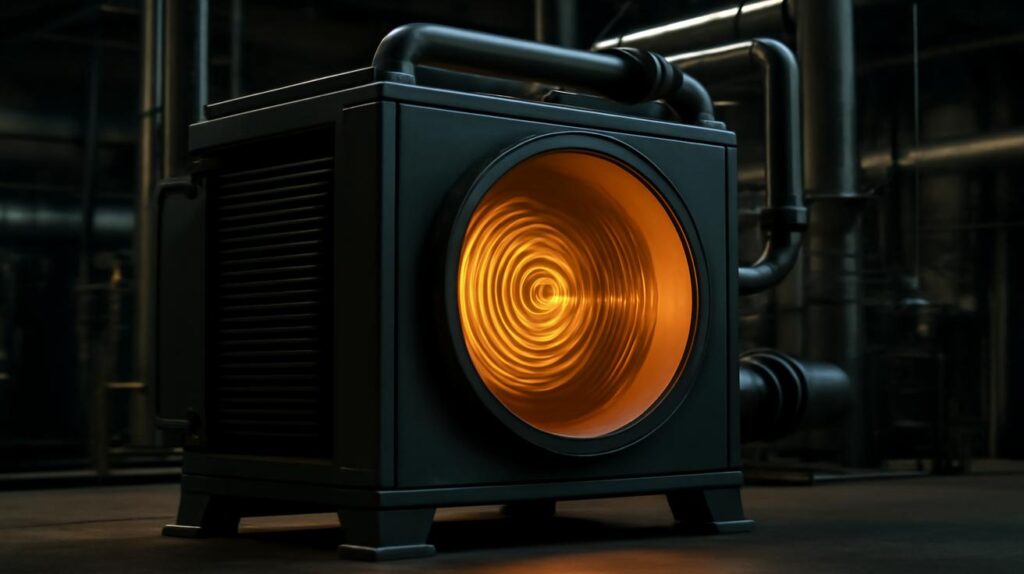
The first time you hear it, you don’t think “heat pump.” You think music. A low, steady hum, like a distant horn, threads through a quiet lab on the outskirts of Beijing. There are no spinning fans, no pistons, no clattering compressors. Just a slender metal tube, some carefully arranged components, and sound — invisible waves bouncing, compressing, expanding the air within. Yet from that sound, heat begins to bloom.
Listening to the Hidden Heat
Industry leaks energy the way old houses leak winter air. In steel mills, chemical plants, refineries, and glass factories, vast streams of hot exhaust roll out of chimneys and vents, carrying with them a staggering amount of wasted power. Engineers have a phrase for it: low-grade waste heat. It’s not hot enough to run a traditional power plant efficiently, and it’s not cool enough to be ignored. It just drifts away, lifting into the sky as shimmering haze.
China has a lot of that haze. According to researchers there, nearly 27% of the energy used in Chinese industry ends up as this mostly untapped waste heat. It warms factory roofs and city skies, but not homes, not water tanks, not district heating pipes. For a country obsessed with efficiency and emissions reduction, that 27% looks less like an unfortunate side effect and more like a monumental opportunity.
In recent years, Chinese engineers and scientists have been hunting for ways to convert this scattered warmth into something useful. They’ve tried advanced heat exchangers, upgraded boilers, smarter factory management. But then a different idea began to take shape, one that didn’t begin with spinning shafts and rotating blades — it began with sound.
The Heat Pump That Doesn’t Spin
Almost every conventional heat pump we know — the kind that warms apartment blocks or keeps supermarket freezers cold — relies on moving parts: compressors squeezing refrigerants, motors spinning fans, pumps pushing fluids. They work well, but they wear down. Bearings fail, seals crack, lubricants degrade. In the grime and heat of a steel plant, that maintenance bill can climb fast.
Now imagine a heat pump with no moving mechanical parts at all. No spinning rotors, no reciprocating pistons. Instead, imagine a narrow tube, inside which sound waves slosh back and forth, pushing air or gas in ripples so rapid your ears might catch only a humming tone. Within that regular, rippling dance, something magic — or at least deeply physical — happens: heat starts to move.
That’s the essence of China’s new “non-spinning” heat pump, a device that uses acoustics — literally, sound energy — to transfer heat from a lower temperature source to a higher temperature outlet. In the language of physics, it’s a thermoacoustic heat pump or thermoacoustic engine. In the language of a plant manager, it’s a way to turn that lukewarm exhaust stream from “waste” into “resource.”
The core idea is refreshingly simple, even if the engineering is not. Inside the device, powerful sound waves compress and expand the working gas again and again, thousands of times per second. When the gas compresses, it warms up slightly; when it expands, it cools down. Carefully placed structures inside the tube — often stacks of thin plates or porous materials — encourage heat to flow in a preferred direction during these cycles. Over time, that tiny directional nudge adds up, shuttling heat from one end of the device to the other, against the natural gradient.
In other words: sound does the pushing; heat follows.
The Strange Physics of a Singing Tube
If it sounds counterintuitive, it helps to slow down and picture what’s happening at a smaller scale. Inside the tube, imagine a parcel of gas — say nitrogen or helium — being jostled by a loud, standing sound wave. This parcel is pushed into a region where the pressure is high; it gets squeezed, its molecules crowd closer together, and its temperature jumps up. A moment later, the wave pulls it into a low-pressure region, it expands, and cools.
Against the walls of the tube sits a carefully designed “stack”: thin plates with tiny gaps in between, or a porous material with narrow passages. When the gas is hotter than the plates, heat slips from the gas to the solid; when the gas is cooler, it draws heat back. By tuning the length of the tube, the frequency of the sound, and the geometry of the stack, engineers can bias this exchange: more heat moves in one direction than the other. After thousands and millions of cycles, that bias adds up to a net heat transfer, just as a ratchet can turn random vibrations into a one-way motion.
To your ears, this might be a gentle tone or even a low-frequency vibration you barely notice. To the gas inside, it’s an ordered storm, a steady rhythm that reshapes where heat lives along the tube.
From Factory Roofs to Useful Warmth
The Chinese research teams behind this “non-spinning” heat pump have a specific dragon to chase: that 27% of industrial energy currently drifting away as low-temperature exhaust. On paper, thermoacoustic heat pumps are almost suspiciously well-suited to the job.
They can operate with gases like air, nitrogen, or helium, avoiding the climate-damaging refrigerants used in many traditional systems. They have no oil to leak, no bearings to seize, no rotating seals to replace. In harsh, dusty industrial environments where conventional mechanical systems struggle, a sealed thermoacoustic device offers the reassuring simplicity of minimal moving parts.
Picture a steel mill: roaring furnaces, streams of molten metal, and, high overhead, ducts carrying hot flue gas away. Usually, that gas might roar straight into the sky after a cursory pass through a heat exchanger. With the new system, some of that hot stream is diverted through or alongside a thermoacoustic device. The sound field inside the device siphons heat from this “waste” gas and pumps it into a pressurized loop of working fluid, which then delivers usable heat for preheating combustion air, running absorption chillers, or feeding district heating systems in nearby neighborhoods.
The same story plays out in different colors across other sectors. Chemical plants vent warm vapors. Paper mills release humid, mid-temperature exhaust. Glass factories radiate through hulking furnaces. Taken individually, each waste stream might look messy and modest. Bundled together with clever heat pumps, they start to look like an invisible power plant humming inside the country’s industrial backbone.
A Quiet Machine in a Loud World
The irony is hard to miss: heavy industry is thunderously loud, but this new heat pump works best when its own sound is contained and controlled. The hummed note inside its metal body may be intense — sometimes corresponding to sound pressure levels far beyond what’s comfortable to humans — but thick walls and smart acoustic design keep most of that energy inside.
From the outside, a thermoacoustic heat pump might appear unremarkable: a cylinder or a cluster of pipes, some insulation, a few electronic controllers. No spinning fan blades to flash in the sun, no rhythmic tapping of pistons. It simply sits in the tangle of a plant’s piping network, quietly bending the flow of heat in ways that used to require loud, complex machinery.
Inside research institutions in China, prototypes are already being tested under realistic conditions. Engineers adjust frequencies, swap materials in the stacks, monitor temperature gradients along the tubes. There’s a certain musical vocabulary to their work: tuning, resonance, harmonics. The aim isn’t a pleasing melody; it’s a more efficient climb up the temperature ladder.
Why 27% Matters
That figure — 27% of industrial energy lost as waste heat — can sound strangely abstract. It helps to translate it into a more tactile image. Imagine every fourth shovel of coal, every fourth cubic meter of natural gas, every fourth spin of a turbine consumed in China’s industrial sector simply fading away as stray warmth. That’s what this number represents.
Now imagine sweeping a portion of that warmth back into circulation. Less fuel burned for the same output. Lower emissions without sacrificing production. District heating supplied without new power plants. In a country still heavily reliant on fossil fuels but aggressively pursuing carbon peak and neutrality goals, such gains are not just an engineering triumph; they’re a climate strategy.
The promise of the non-spinning, sound-driven heat pump is not that it single-handedly solves the problem of wasted heat, but that it offers a new tool specifically sharpened for the messy middle ground: temperatures too low for efficient electricity generation, too high to be ignored. It bridges the gap between “we can’t use that” and “we can’t afford to waste it.”
Critically, the technology slots into existing infrastructure rather than demanding a complete redesign. A retrofitted pipe here, a new loop there, a compact thermoacoustic module installed on a flue line. In an industrial landscape where downtime is ruinously expensive, that matters. Efficiency gains must be evolutionary as much as revolutionary — and this is a technology that promises quiet evolution.
A Table of Industrial Transformation
To understand how this might play out in the real world, consider a few example applications:
| Industrial Sector | Typical Waste Heat | Potential Use via Non-Spinning Heat Pump |
|---|---|---|
| Steel Production | Exhaust gases at moderate temperatures from furnaces and hot stoves | Preheating combustion air, providing hot water for plant facilities, feeding local district heating |
| Chemical Plants | Warm process streams, vented vapors, condenser outflows | Upgrading waste heat to drive other reactions, generate process hot water, or assist low-temperature steam generation |
| Paper & Pulp | Humid, low-to-medium temperature drying exhaust | Supplying heat for pulp drying, building heating, or integration with absorption chillers for cooling needs |
| Glass Manufacturing | Furnace flue gas and radiant heat loss | Recovering heat to preheat raw materials or combustion air, stabilizing overall plant energy use |
| Cement Plants | Kiln exhaust, clinker cooling air | Delivering usable heat for auxiliary processes, or exporting heat to nearby residential and commercial buildings |
Each of these boxes is a little story of energy changing shape: sound carving order out of chaos, heat pulled back from the brink of uselessness to do one more round of work.
Designing for Durability, Not Drama
Part of what makes this technology quietly appealing is what it lacks. No complex gearboxes. No lubrication systems that invite contamination. No strong dependence on exotic, high-global-warming-potential refrigerants that regulators are steadily phasing out worldwide.
Instead, the heart of the machine is often just a combination of carefully chosen metals, ceramics, and sometimes composite materials, arranged with millimeter precision. Once sealed, the working gas circulates within a closed loop, never leaving, never needing a refill unless something goes wrong. The components that do wear out — sensors, control electronics, perhaps small auxiliary pumps or blowers — are familiar and relatively easy to replace.
For maintenance crews in sprawling industrial parks, this simplicity is its own form of luxury. It means fewer emergency shutdowns, fewer unexpected vibrations signaling impending mechanical failure, fewer nights spent hunting for spare parts for specialized compressors. It also means that the overall lifecycle emissions of the technology can be lower, not only because it reuses heat, but because it avoids some of the pitfalls of traditional cooling and heating systems.
There are challenges, of course. Achieving high efficiency requires painstaking tuning: the frequency of the sound wave, the geometry of the resonator tube, the exact placement and thickness of the stacks. The system must interface cleanly with the messy, fluctuating temperatures of real factory exhaust, which rarely behave as nicely as textbook diagrams. And there is the basic fact that sound, while elegant as a concept, still needs an initial driver — usually an electrical source or some coupling to existing mechanical vibrations.
But once running, the reward is a system whose elegance is measured not in spectacle but in steadiness: a humming backbone of thermal management, designed to endure.
From Lab Curiosity to Industrial Workhorse
Thermoacoustic devices have danced through physics labs for decades as curiosities and experimental platforms. Stirling-like engines that sing themselves into motion. Demo rigs that turn heat from a candle into sound, and back into a temperature gradient. What’s happening in China now is more pragmatic: the leap from demonstration to deployment.
That leap is rarely glamorous. It’s filled with late-night troubleshooting, arguments over pipe diameters, trade-offs between cost and ideal materials. Scaling up means learning where theory bends under the weight of reality: where corrosion sneaks in, where temperature swings are harsher than expected, where plant operators need interfaces that are simple and robust, not academically elegant.
Yet this is exactly the kind of work that transforms a clever idea into infrastructure. When a technology steps out of the lab and into the dust and heat of factories, it stops being just an invention and starts becoming part of a country’s energy story.
The Sound of a Different Future
Stand at the edge of an industrial district in northern China on a winter night and you can feel the paradox in your bones. Cold air bites your face. Chimneys exhale warmth into the dark. Somewhere, in nearby homes, heaters work hard to keep families comfortable. In the gap between those chimneys and those homes lies the entire problem of wasted energy.
Now imagine that same skyline a decade from now. The chimneys still vent — industrial processes are stubborn, and some heat will always find a way out. But within the maze of pipes and ducts below, silent heat pumps guided by sound waves are at work. They sip from the exhaust, push that heat up in temperature, and send it across invisible networks to warm buildings, power processes, or even drive new cooling systems.
Nothing about that vision requires fantasy. It rests on physics as old as sound itself, combined with an industrial ambition that China has been honing for decades. The non-spinning heat pump doesn’t look like a revolution. It looks like a quiet correction — a way of listening more carefully to where energy goes, and insisting that some of it come back.
In a world trying to wring more value out of every joule while keeping emissions in check, such corrections add up. Twenty-seven percent of wasted industrial energy is a staggering number. But numbers, like sound, can be shaped. In a metal tube in a Chinese lab, that shaping is already underway, one steady, humming note at a time.
Frequently Asked Questions
What is a “non-spinning” heat pump?
A non-spinning heat pump is a heat pump that has no rotating mechanical components such as compressors, fans, or turbines. Instead, it uses sound waves inside a sealed structure to move heat from a colder source to a hotter sink. This approach can reduce mechanical wear, maintenance, and reliance on complex moving parts.
How does turning sound into heat actually work?
Inside the device, powerful sound waves repeatedly compress and expand a working gas. When the gas is compressed, it heats up; when it expands, it cools down. Carefully arranged internal structures (stacks or regenerators) direct the flow of heat during these cycles, resulting in a net transfer of heat from one end of the device to the other. The sound acts as the driving force for this thermal pump.
Why is this technology important for industry?
Industrial processes in China and worldwide lose a large share of their energy — in China’s case, around 27% — as low- to medium-temperature waste heat. Conventional technologies often struggle to use this dispersed, modest-temperature warmth efficiently. Thermoacoustic, non-spinning heat pumps are specifically designed to upgrade that waste heat into more useful forms, improving overall energy efficiency and reducing fuel consumption and emissions.
Is this more environmentally friendly than traditional heat pumps?
Potentially, yes. Non-spinning heat pumps can use inert gases like air, nitrogen, or helium rather than conventional refrigerants with high global warming potential. They also have fewer mechanical parts, which can mean less maintenance, fewer leaks, and longer lifetimes. Combined with their ability to recover waste heat, this can significantly cut environmental impact over the system’s life.
Will this technology be used only in China?
While China is currently a major driver in developing and demonstrating these systems, the underlying physics is universal. As the technology matures, it is likely to attract interest from industrial sectors in other countries facing similar challenges: large-scale waste heat, pressure to decarbonize, and the need for robust, low-maintenance solutions.
Can these heat pumps be used in homes or small buildings?
In principle, yes, but the current focus is on large industrial applications where waste heat is abundant and concentrated. Over time, as costs drop and designs are refined, smaller-scale versions or derived technologies could find their way into commercial buildings or district heating systems, but that will depend on economic and design choices.
What are the main challenges to widespread adoption?
Key challenges include achieving high efficiency at industrial scale, integrating with existing plant infrastructure, ensuring long-term durability in harsh environments, and driving down manufacturing costs. There is also the human side: plant operators and companies need to trust and understand the technology enough to invest in it. These are substantial hurdles, but they are the same kinds of challenges most transformative industrial technologies face on their way from lab to everyday use.