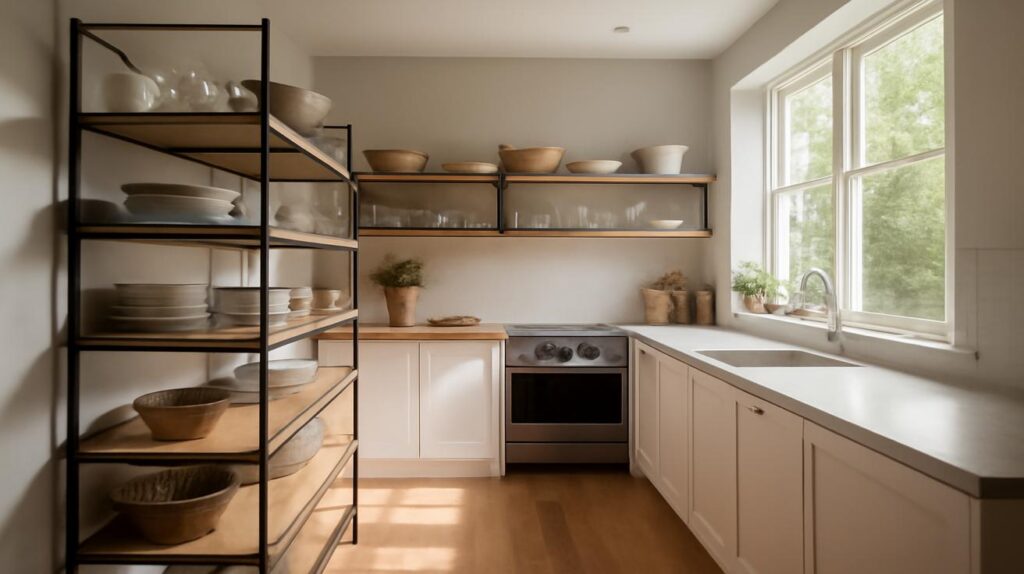
The first thing you notice is the silence. Not the clatter of a cabinet door, not the half-stuck hinge that squeals in protest every time you reach for a plate. Just light—spilling, sliding, pooling across open shelves and smooth, bare walls where boxy cupboards used to loom. The air feels bigger somehow. You can see your bowls at a glance, your favorite mug smiling from its spot like it’s been waiting for you. The kitchen, once a maze of closed doors and hidden chaos, suddenly feels like a room that’s breathing.
Goodbye, Boxes on the Wall
For decades, the kitchen cabinet has been the unquestioned king of storage. Tall, heavy, sealed away from sight and, admittedly, from dust. Rows of them, like obedient soldiers, lining the walls in uniform colors: white, grey, beige. They came as standard, like outlets and light switches—expected, unquestioned, something you just “get” with a kitchen.
But something’s been quietly shifting. As homes shrink, budgets tighten, and people rethink what actually makes a space feel good to live in, the classic upper cabinet is starting to lose its crown. Its replacement isn’t some futuristic gadget or exotic material. It’s simpler. Cheaper. Kinder to small spaces and stubborn humidity.
Think open shelving, metal rails with hooks, wall-mounted racks, freestanding pantries, pegboards, and slim, hardworking base units instead of overhead boxes. Think fewer doors, thinner lines, more visibility. A kitchen that stores like a workshop and lives like a studio.
This new trend isn’t just about looks—it’s about warping less, molding less, costing less, and making your kitchen a place you actually want to be in, not just pass through while slamming cabinet doors.
Why Traditional Cabinets Are Quietly Failing Us
Let’s be honest: most of us grew up with cabinets that weren’t exactly aging gracefully. Over time, they’ve become a quiet list of frustrations:
- Doors sagging slightly off-kilter.
- Swollen edges where moisture found a way in.
- Dark corners where things go to be forgotten and expire in peace.
- Mould creeping in under the sink or at the back of rarely opened cupboards.
The materials are often the culprit. Many standard cabinets are built from particleboard or MDF wrapped in thin laminates or veneers. In humid kitchens—or in homes where steam and ventilation aren’t perfectly managed—those boards are like sponges. They puff, warp, peel, and sometimes harbor mould you don’t see until it’s gone too far.
And then there’s cost. A full run of custom or even semi-custom wall cabinets can swallow a shocking portion of a renovation budget. You can end up spending thousands just to hide things you barely use, while still complaining you don’t have enough space.
All of this is why more people are asking a once-unthinkable question: what if we just… didn’t?
The Uncabineted Kitchen: A Different Kind of Storage
The anti-cabinet movement isn’t about having no storage. It’s about changing how storage exists in your kitchen. Instead of hollow wooden boxes bolted to every inch of wall space, the new trend leans on:
- Open shelving: Slender wood planks, metal shelves, or glass, mounted with minimal brackets or hidden supports.
- Wall rails and hooks: Metal rails with S-hooks holding pots, pans, utensils, and even cutting boards.
- Pegboards: Inspired by workshops, with adjustable pegs and shelves for endlessly flexible layouts.
- Freestanding storage: Pantry cabinets, vintage cupboards, open carts, and sideboards instead of built-ins.
- Smarter base units: Deep drawers and pull-outs that handle the heavy lifting of dishes and cookware.
This patchwork of pieces isn’t random; when it’s done well, it feels intentional, airy, and a little bit like a café kitchen crossed with a studio. And it’s gaining momentum for very practical reasons.
The Appeal: Cheaper, Tougher, Drier, Lighter
Underneath the aesthetics—because yes, these kitchens are undeniably photogenic—are four solid drivers of this trend: cost, durability, moisture resistance, and how the space feels to live in.
1. It’s Usually Cheaper (Sometimes Shockingly So)
Upper cabinets are one of the biggest line items in a kitchen budget. Between materials, hardware, and installation, those neat rows of boxes don’t come cheap. Replacing them with a mix of shelves, rails, and a few well-chosen standalone pieces can dramatically lower costs.
Consider a rough comparison:
| Storage Option | Typical Cost Range* | Notes |
|---|---|---|
| Full run of upper cabinets (3–4m) | High hundreds to several thousand | Includes doors, hinges, handles, fitting |
| Open shelving (same length) | Low hundreds | Fewer materials, quicker install |
| Wall rails, hooks, pegboards | Tens to low hundreds | Highly modular, easy to DIY |
| Freestanding pantry or cabinet | Variable; often cheaper than built-ins | Can be bought secondhand or flat-pack |
*Actual costs vary by region and supplier, but the direction of difference is consistent: fewer cabinets usually means lower overall spend.
When you remove the obligation to line every wall with custom boxes, suddenly your budget can breathe. You might splurge on a better countertop, invest in quality appliances, or simply spend less overall and still end up with a kitchen that feels more intentional.
2. Less Warping, Less Mould, Less Hidden Damage
The real genius of open, cabinet-free walls isn’t just how they look—it’s how they behave in a real, messy, humid kitchen.
Traditional cabinets create little climates of their own: enclosed spaces where steam sneaks in and struggles to escape, where minor leaks go unnoticed, where dampness settles into chipboard edges. By comparison, open storage does something quietly brilliant: it lets the air move.
With shelves instead of boxes, there are fewer corners where moisture can build up unseen. Wall rails and pegboards don’t trap humidity at all. You see the wall behind everything; if a patch of mould tries to bloom, you spot it early. If the paint is bubbling, if a pipe is weeping, if condensation is gathering—nothing is hidden. Problems don’t get decades to grow in the dark.
And those materials? Metal rails, sealed hardwood shelves, glass, solid brackets—they don’t puff up at the first hint of steam. In climates where summers feel like you’re living in the inside of a kettle, skipping closed cabinets can mean skipping years of frustration and repair.
3. A Kitchen That Actually Feels Bigger
Cabinets do something sneaky to a room: they visually lower the ceiling. When upper units march over your head, they bring the whole room down with them. For small kitchens especially, that heaviness can make the space feel cramped and airless.
Take those boxes away and suddenly your eye travels from the countertop right up to the ceiling with nothing blocking the vertical line except, maybe, a slim shelf or two. The walls reappear. The kitchen feels taller, wider, more open—even if you haven’t changed the footprint by a single centimeter.
There’s also the question of light. Upper cabinets create shadows, especially in corners. Open setups let natural light hit more surfaces. Even under artificial lighting, everything reads brighter, less cave-like. It’s not your imagination: when you can see more of the walls and the ceiling, your mind relaxes. The room feels generous, even if it’s technically tiny.
The Everyday Magic of Seeing Everything
There’s something deeply human about being able to see your tools. Walk into a ceramicist’s studio, a woodshop, or a painter’s space, and you rarely find everything hidden in drawers. The tools hang, stand, lean, and line the walls. Visibility is part of the craft.
The new kitchen storage movement borrows this idea. It treats cooking less like a chore and more like a practice—one where your tools are part of the atmosphere, not tucked away out of sight.
Open Shelves: Not Just for Magazines
Open shelves have been all over social media, but in real life, their charm goes beyond photos. There’s practical pleasure in reaching out and grabbing the bowl you want without opening anything, without rummaging. Your everyday plates and glasses can live front and center. The things you love—stoneware mugs, a jar of wooden spoons, a stack of linen napkins—become part of the room’s texture.
You also become more honest with your belongings. When everything is visible, you naturally edit down to what you actually use and love. Those chipped mugs you’ve been saving “just in case”? They suddenly feel less worth displaying. The weird gadget you bought five years ago on a whim? It either finds a real place in your cooking or it quietly leaves your life.
That slow, natural editing makes your kitchen feel calmer. Instead of a graveyard of forgotten objects hiding behind doors, you’re curating a working, living collection of tools and ingredients.
Rails, Hooks, and the Joy of Reach
Then there’s the rail: a simple metal rod, a handful of hooks, and suddenly your kitchen works differently. Your best pan hangs where steam can dry it properly. The ladle you reach for every night is at arm’s length. Even cutting boards can hang, catching the light like little wooden shields.
This system has the same energy as a well-organized workshop. Everything has a place, and that place is visible. You’re not kneeling to reach into a dark lower cabinet, not knocking over three pans to grab the one at the bottom. You cook more fluidly, more instinctively. And your walls become a kind of living storyboard of your cooking life.
How to Make the No-Cabinet Trend Work in Your Real Kitchen
All of this sounds dreamy, but it has to meet the reality test: dust, grease, kids, pets, and weeknight exhaustion. The good news is, the cabinet-free or cabinet-light kitchen isn’t an all-or-nothing leap. You can adapt it to your lifestyle and your tolerance for wiping shelves.
Keep Closed Storage Where It Matters
Most successful “goodbye cabinet” kitchens don’t throw out every door. They simply shift where closed storage goes. Heavy, less-used items and visually messy things—bulk ingredients in bright packaging, spare appliances, cleaning supplies—often live in:
- Base cabinets with deep drawers.
- One dedicated tall pantry unit.
- A freestanding cabinet or sideboard in an adjacent room.
This way you still have hidden storage for the not-so-pretty items while freeing your walls to stay light, open, and mould-resistant.
Put the Everyday Things on Display
The things that earn a place on open shelves or rails should be what you reach for daily: plates, bowls, glasses, mugs, your favorite pot or pan, oils, and spices. Because they’re in constant rotation, they don’t get the chance to gather a thick film of dust. Any light dust that does appear is wiped away every time you wash and replace the item.
Think of open storage as “prime real estate” reserved for your kitchen’s hardest workers, not for every object you own.
Choose Materials That Don’t Mind Life Happening
To truly escape warping and mould, your storage choices matter as much as the layout. Look for:
- Solid wood shelves that are properly sealed or oiled, rather than raw or flimsy chipboard.
- Metal rails and brackets that can deal with steam without flinching.
- Glass or ceramic containers for food storage on open shelves, keeping ingredients safe and moisture at bay.
- Good wall paint that’s scrubbable and designed for kitchens or bathrooms, resisting humidity and mould.
These materials don’t just last longer; they also age more gracefully. A little patina on a wooden shelf often looks intentional. Peeling laminate on a cabinet door never does.
Where This Trend Is Going Next
Spend time in new cafés, small urban apartments, or thoughtfully renovated old homes, and you’ll start to notice the pattern: fewer overhead cabinets, more mixed storage solutions, more visible tools, more walls that can breathe.
This isn’t just a visual trend driven by photographs; it’s a practical adaptation to the way we live now:
- More people renting and needing flexible, movable storage.
- Smaller footprints demanding airy, multi-use spaces.
- Increased awareness of mould, humidity, and indoor air quality.
- A desire to surround ourselves with fewer, better things—objects we actually touch and use.
The cabinet, as a concept, isn’t disappearing. But the unquestioned habit of lining every vertical surface with them is. In its place, we’re getting something more thoughtful: a kitchen that feels lighter, costs less, and lets both air and light move more freely.
So if your current cabinets are swelling at the corners, if you’ve scrubbed out one too many mouldy undersink boxes, or if you just feel like your kitchen is a bit of a storage bunker, this might be your permission slip. You don’t have to replace like-for-like. You can choose shelves instead of boxes, rails instead of doors, a single handsome pantry instead of a wall of cabinetry.
You can choose a kitchen that doesn’t warp, doesn’t secretly grow mould in the dark, and doesn’t demand a small fortune just to exist. You can choose a kitchen that shows its workings—and maybe, quietly, shows more of who you are.
FAQ: The New Kitchen Without Traditional Cabinets
Won’t everything on open shelves get dusty or greasy?
A little, yes—but far less than many people fear. Items you use daily (plates, glasses, mugs, bowls, pans) are constantly being washed and rotated, so dust doesn’t really have time to build up. To minimize grease, make sure your extractor fan works well and avoid placing open shelves right above the most intense cooking zone if you can. A quick wipe of the shelf during regular cleaning usually keeps things under control.
Is this trend practical for families with kids?
It can be, if you plan it thoughtfully. Keep breakables and rarely used items higher up, and use lower shelves and drawers for kid-safe plates, cups, and snacks. Many families find that open storage actually helps children become more independent—everything they’re allowed to use is visible and reachable. Just avoid overcrowding shelves and make sure they’re securely installed.
What about small kitchens that need maximum storage?
Paradoxically, removing some upper cabinets can make a small kitchen feel significantly larger and easier to work in. The key is balance: use deep drawers and well-organized base cabinets, perhaps one tall pantry, and then add a few well-placed shelves or rails rather than covering every wall. Vertical pegboards, magnetic knife strips, and corner shelves can also squeeze a lot of storage into a small footprint without overwhelming the space.
Will this style go out of fashion quickly?
Open and mixed storage has already lasted through several trend cycles because it’s rooted in function as much as aesthetics. Workshops, restaurant kitchens, and studio spaces have used visible storage for decades. Even if the ultra-styled open-shelf look fades from social media, a practical combination of shelves, rails, and fewer cabinets is likely to remain sensible, especially in smaller or more casual homes.
Can I try this without a full renovation?
Absolutely. You can remove just one or two upper cabinets and replace them with a couple of sturdy shelves or a rail to test how it feels. You could also add a pegboard, hang a rail for everyday utensils, or invest in a freestanding pantry or cart to reduce your reliance on existing cabinets. Starting small lets you experiment with the uncabineted life without committing to a full overhaul.